

There are a lot of books about nuclear apocalypses, ranging from the very “grounded” to the fairly fantastic. But none of them, to my knowledge, are as strange as Philip K. Dick’s Dr. Bloodmoney, or How We Got Along After the Bomb (1965).
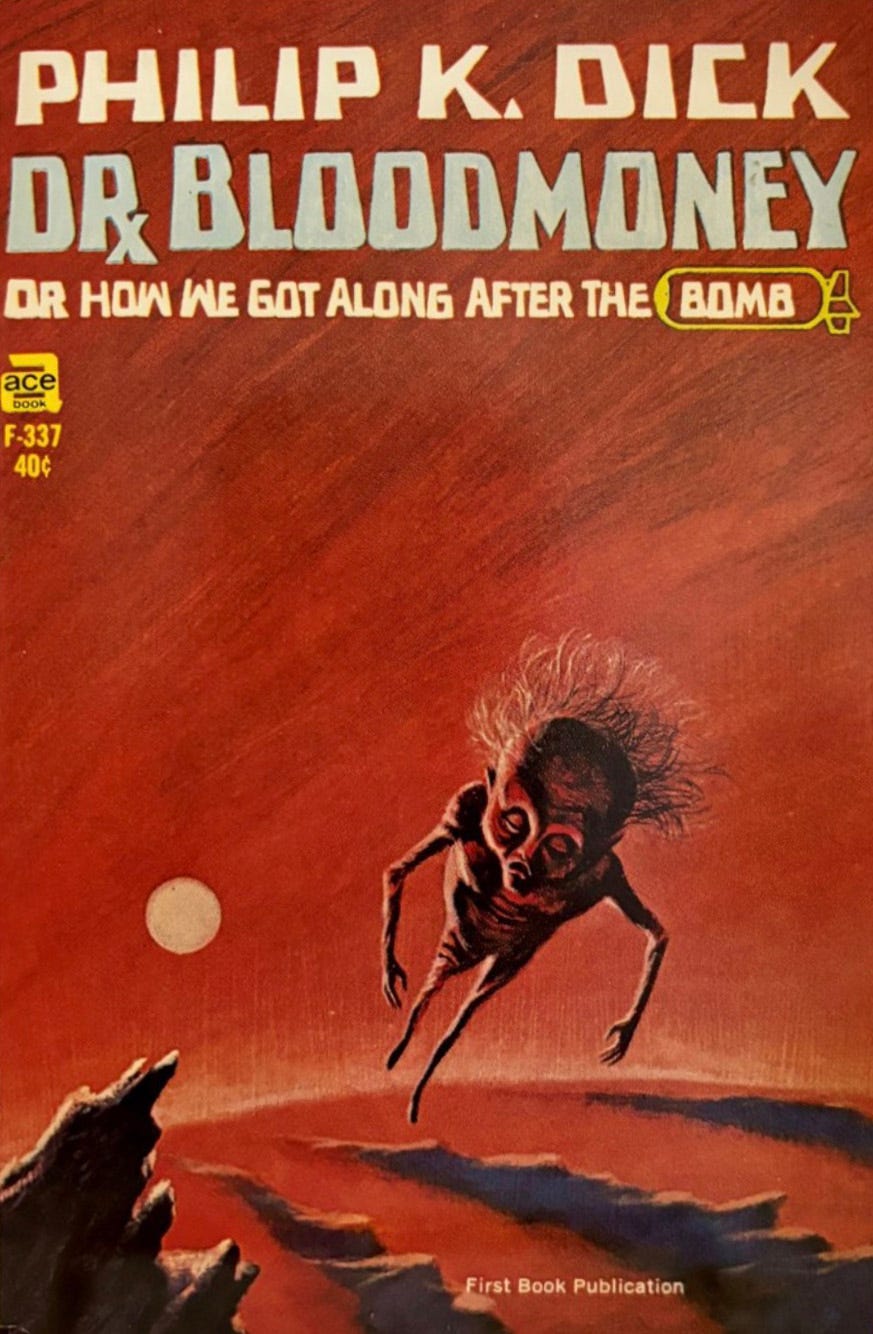
Dick, or PKD as he is known to his fans, was a prolific author of strange science fiction. Many of his novels and stories were made into major Hollywood properties — Do Androids Dream of Electric Sheep? (1968) became Blade Runner (1982), “We Can Remember It For You Wholesale” became Total Recall (1990), and Minority Report (2002), A Scanner Darkly (2006), and The Man in the High Castle (2015) are all based on Dick’s writings. All of these adaptations involved some fairly significant deviations from the source material, because the source material was never all that Hollywood-ready: narrative flow and accessibility were clearly not Dick’s priorities. Dick’s real strengths were creative concepts and, above all, strange vibes — dark, unsettling, paranoid themes, perhaps a reflection of Dick’s own well-documented struggles with mental illness and drug use (particularly amphetamines and, later, LSD).
Whatever the cause, Dick’s Dr. Bloodmoney is a strange, fascinating take on nuclear apocalypse, unlike any others that I have ever read. He wrote the book quickly, along with four other books, in an amphetamine haze in 1963. The working titles were Earth's Diurnal Course and A Terran Odyssey — neither particularly good or descriptive — but his editor suggested they change it to the title it ultimately had in a bid to capitalize on the interest in Stanley Kubrick’s Dr. Strangelove, or: How I Learned to Stop Worrying and Love the Bomb (1964).
The story is centered in the San Francisco Bay Area (where Dick grew up and lived), in two different time periods, which the narrative sometimes jumps between. The first is 1972, before the apocalypse; the second is in 1988, after it.
The 1981 of the book (which was, again, written in 1963) is one in which scientific progress has continued at a decent pace, but has come with consequences. The main one of which occurred a several years before (in 1972), and involved a nuclear test explosion that went wrong. The details are kept somewhat hazy, but the gist of it is made clear: after the test of “high-altitude bombs,” the “enormous masses of radioactive clouds had not drifted off but had been attracted by the Earth's gravitational field, and had returned to the atmosphere,” causing “terrible fallout.” The consequences of this are never quite explained but it is invoked as something that caused enough suffering that several characters refer to themselves as all having been part of “the Spirit of ‘72.”
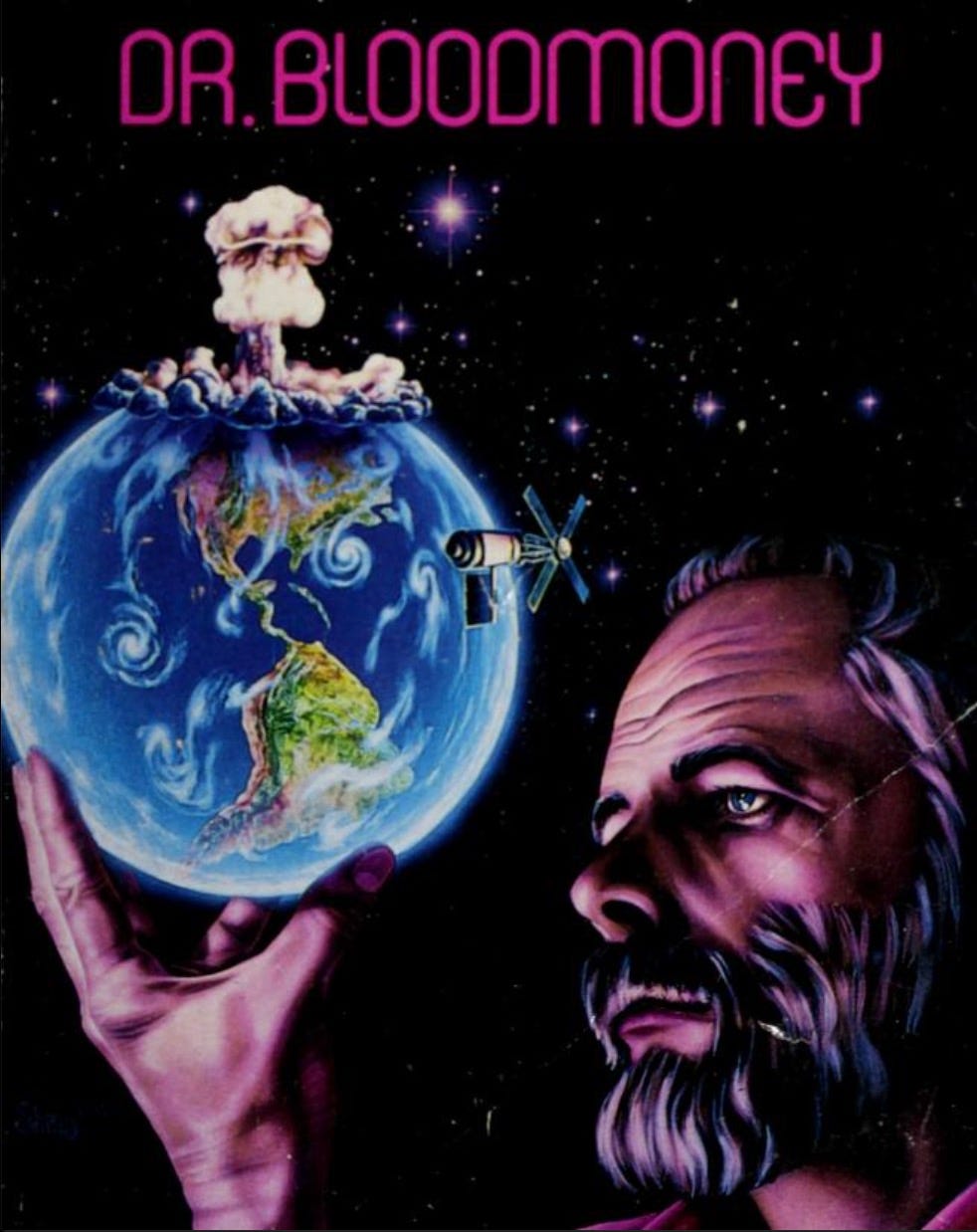
The book contains several characters, many of which are quite interestingly developed, but there are two in particular that stand out as exceptional. These are Hoppy Harrington, and Dr. Bruno Bluthgeld.
Hoppy is a phocomelus; the context is (again) not explained in detail, but it is strongly implied that he was a thalidomide baby. He appears to be a teenager, with a prominent head and torso but “flipper-like” hands and feet. He has a rather sophisticated wheelchair that allows him to both move around and manipulate objects rather deftly, and in the beginning of the book we are shown that he is capable of being an excellent television and radio repairman despite his handicap.
Hoppy is also psychic, capable of telekinesis, clairvoyance, and other apparent powers. He attempts to keep these largely hidden in the pre-apocalyptic period, as he fears how he will be treated, but upon drinking alcohol he enters into a clairvoyant stupor. He and those who listen to him apparently understand the bleak world that Hoppy describes in this stupor as the afterlife, but he is really describing the post-apocalypse. Hoppy’s powers, which manifest even more prominently in the post-apocalypse, are a major part of the evolving story.
Dr. Bruno Bluthgeld (the titular “Dr. Bloodmoney”) is a nuclear physicist from Budapest who is employed by the University of California and the weapons laboratory at Livermore. He is almost universally loathed, and held responsible for the nuclear accident of 1972. Early in the narrative (pre-apocalypse), he goes to see Dr. Stockstill, a psychiatrist, under the pseudonym of “Jack Tree.” Their initial interaction is fascinating and worth reading in its entirety:
To his new patient, Doctor Stockstill said, “Cup of coffee? Or tea or Coke?” He read the little card which Miss Purcell had placed on his desk. “Mr. Tree,” he said aloud. “Any relation to the famous English literary family? Iris Tree, Max Beerbohm...”
In a heavily-accented voice Mr. Tree said, “That is not actually my name, you know.” He sounded irritable and impatient. “It occurred to me as I talked to your girl.”
Doctor Stockstill glanced questioningly at his patient.
“I am world-famous,” Mr. Tree said. “I’m surprised you don’t recognize me; you must be a recluse or worse.” He ran a hand shakily through his long black hair. “There are thousands, even millions of people in the world, who hate me and would like to destroy me. So naturally I have to take steps; I have to give you a made-up name.” He cleared his throat and smoked rapidly at his cigarette; he held the cigarette European style, the burning end within, almost touching his palm.
Oh my god, Doctor Stockstill thought. This man, I do recognize him. This is Bruno Bluthgeld, the physicist. And he is right; a lot of people both here and in the East would like to get their hands on him because of his miscalculation back in 1972. Because of the terrible fall-out from the high-altitude blast which wasn’t supposed to hurt anyone; Bluthgeld’s figures proved it in advance.
“Do you want me to know who you are?” Doctor Stockstill asked. “Or shall we accept you simply as ‘Mr. Tree’? It’s up to you; either way is satisfactory to me.”
“Let’s simply get on,” Mr. Tree grated.
“All right.” Doctor Stockstill made himself comfortable, scratched with his pen against the paper on his clipboard. “Go ahead.”
“Does an inability to board an ordinary bus — you know, with perhaps a dozen persons unfamiliar to you — signify anything?” Mr. Tree watched him intently.
“It might,” Stockstill said.
“I feel they’re staring at me.”
“For any particular reason?”
“Because,” Mr. Tree said, “of the disfiguration of my face.”
Without an overt motion, Doctor Stockstill managed to glance up and scrutinize his patient. He saw this middle-aged man, heavy-set, with black hair, the stubble of a beard dark against his unusually white skin. He saw circles of fatigue and tension beneath the man’s eyes, and the expression in the eyes, the despair. The physicist had bad skin and he needed a haircut, and his entire face was marred by the worry within him... but there was no “disfiguration.” Except for the strain visible there, it was an ordinary face; it would not have attracted notice in a group.
“Do you see the blotches?” Mr. Tree said hoarsely. He pointed at his cheeks, his jaw. “The ugly marks that set me apart from everybody?”
“No,” Stockstill said, taking a chance and speaking directly.
“There’re there,” Mr. Tree said. “They’re on the inside of the skin, of course. But people notice them anyhow and stare. I can’t ride on a bus or go into a restaurant or a theater; I can’t go to the San Francisco opera or the ballet or the symphony orchestra or even a nightclub to watch one of those folk singers; if I do succeed in getting inside I have to leave almost at once because of the staring. And the remarks.”
Bluthgeld eventually leaves in a huff, while Stockstill is convinced that the man is paranoid and probably schizophrenic. The nuclear war breaks out that same day, and Bluthgeld barely notices it, so lost he is within his own delusions and confusions. Bluthgeld is, to a degree, aware that he is ill, but his knowledge of this does not make it any easier for him to distinguish fantasy from reality.
Stockstill serves as our vehicle into the popular understanding of Bluthgeld:
It would be so easy, Stockstill realized, to find pathology here. So easy — and so tempting. A man this hated... I share their opinion, he said to himself, the they that Bluthgeld — or rather Tree — talks about. After all, I’m part of society, too, part of the civilization menaced by the grandiose, extravagant miscalculations of this man. It could have been — could someday be — my children blighted because this man had the arrogance to assume that he could not err.
But there was more to it than that. At the time, Stockstill had felt a twisted quality about the man; he had watched him being interviewed on TV, listened to him speak, read his fantastic anti-communist speeches — and come to the tentative conclusion that Bluthgeld had a profound hatred for people, deep and pervasive enough to make him want, on some unconscious level, to err, to make him want to jeopardize the lives of millions.
Bluthgeld continues in hiding after the apocalypse, but he is discovered. Post-apocalypse, he believes he has the ability to cause nuclear apocalypses with just his mind — which may in fact be true.
In 1979, Dick wrote an introduction to Dr. Bloodmoney, which did not appear in print until 1985. In it, he discussed many of the characters as he re-examined the book years later. On Bluthgeld, he said simply:
So I do have to confess to an overly simple view of Dr. Bluthgeld: I hate him and I hate everything he stands for. He is the alien and the enemy. I cannot fathom his mind; I cannot understand his hates. It is not the Russians I fear; it is the Dr. Bluthgeld's, the Dr. Bloodmoney's in our own society that terrify me. I am sure that to the extent that they know me, or would know me, they hate me back and would do exactly to me what I would do to them.
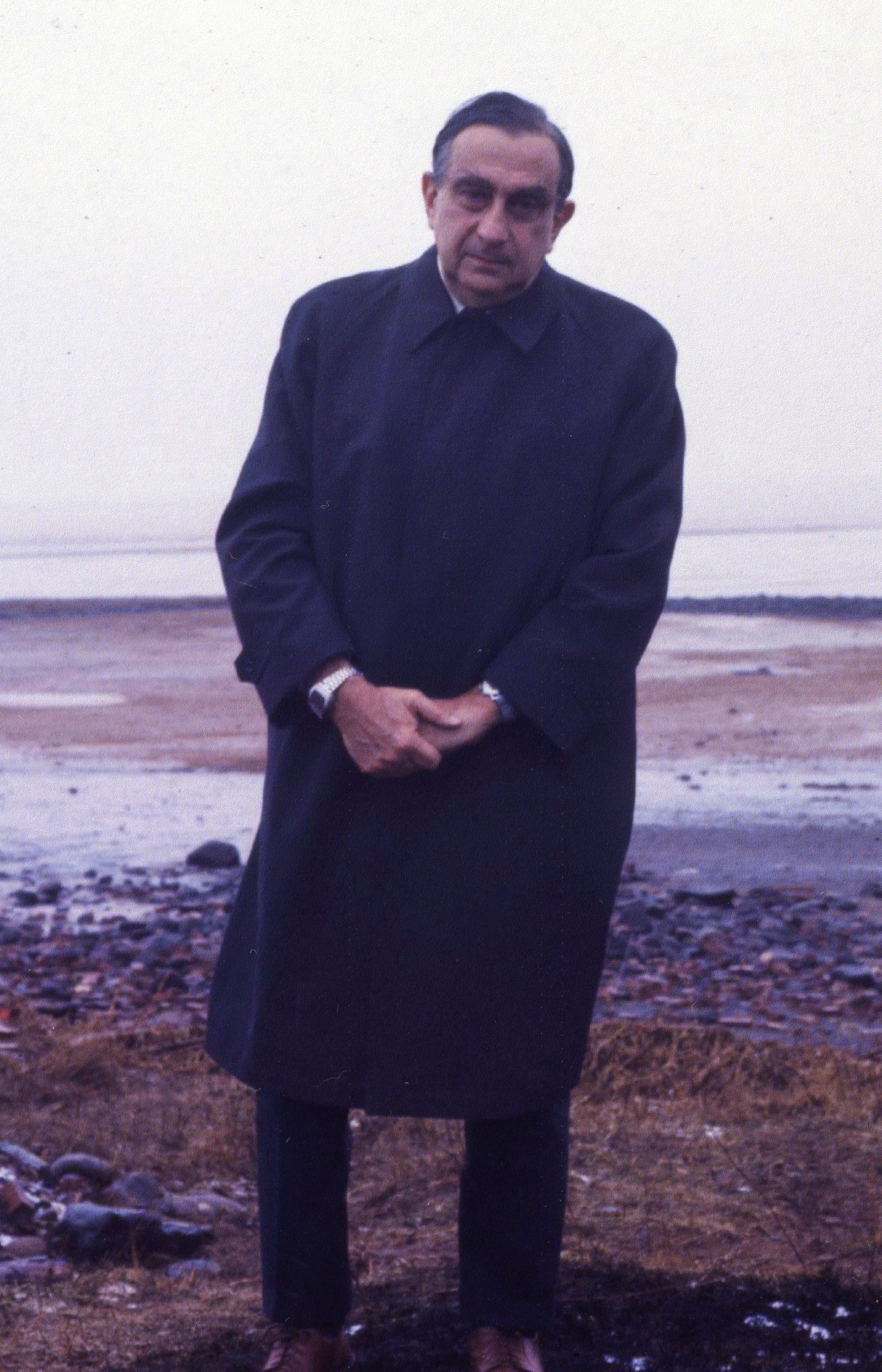
It is an interesting and strong reaction. Bluthgeld is, I think quite overtly, a riff of Edward Teller, the virulently anti-Communist, Hungarian nuclear physicist who worked at Berkeley and Livermore, who was famously the “father of the hydrogen bomb,” and who was a reviled (and famous) character in American political culture at the time Dick wrote his book. While one could identify other potential influences in the character, the references to Teller seem quite direct.
The title of the book as it was published of course invites comparisons to Dr. Strangelove. The stories could not be more different. Dr. Strangelove is a parody; Dr. Bloodmoney is definitely not. Dr. Strangelove is about how nuclear war starts; Dr. Bloodmoney does not concern itself with that at all. Dr. Strangelove is primarily about generals and presidents and other “high-level” politics; Dr. Bloodmoney is mostly about, well, not exactly “regular” people, but something more of that level. Dr. Strangelove is, for all of its parody, played “straight” in terms of its plausibility; Dr. Bloodmoney relies on psychic powers for its story.
The character of Dr. Strangelove, played by Peter Sellers, may be meant “insane” in a sense, but it is a “rational insanity”: Dr. Strangelove’s madness is the madness of following certain types of reasoning to irrational ends. He is not “mentally ill” in a clinical, pathological sense. (The one character from Dr. Strangelove, the film, who was arguably mentally ill in that sense was General Jack Ripper, who believed that the Communists were attempting to infiltrate his “precious bodily fluids.”)
Dr. Bluthgeld isn’t “crazy,” he’s mentally ill. He suffers from clinical delusions both grand and small. (That he happens to be correct that in Dick’s universe, he may have psychic capabilities to manifest his delusions, is immaterial to our comparative point, here.) Ultimately, Dick’s identification of Bluthgeld’s mindset with a profound misanthropy means that his character is doing something very different than Kubrick was doing with Dr. Strangelove, and it makes Dick’s argument quite a different one than Kubrick’s.
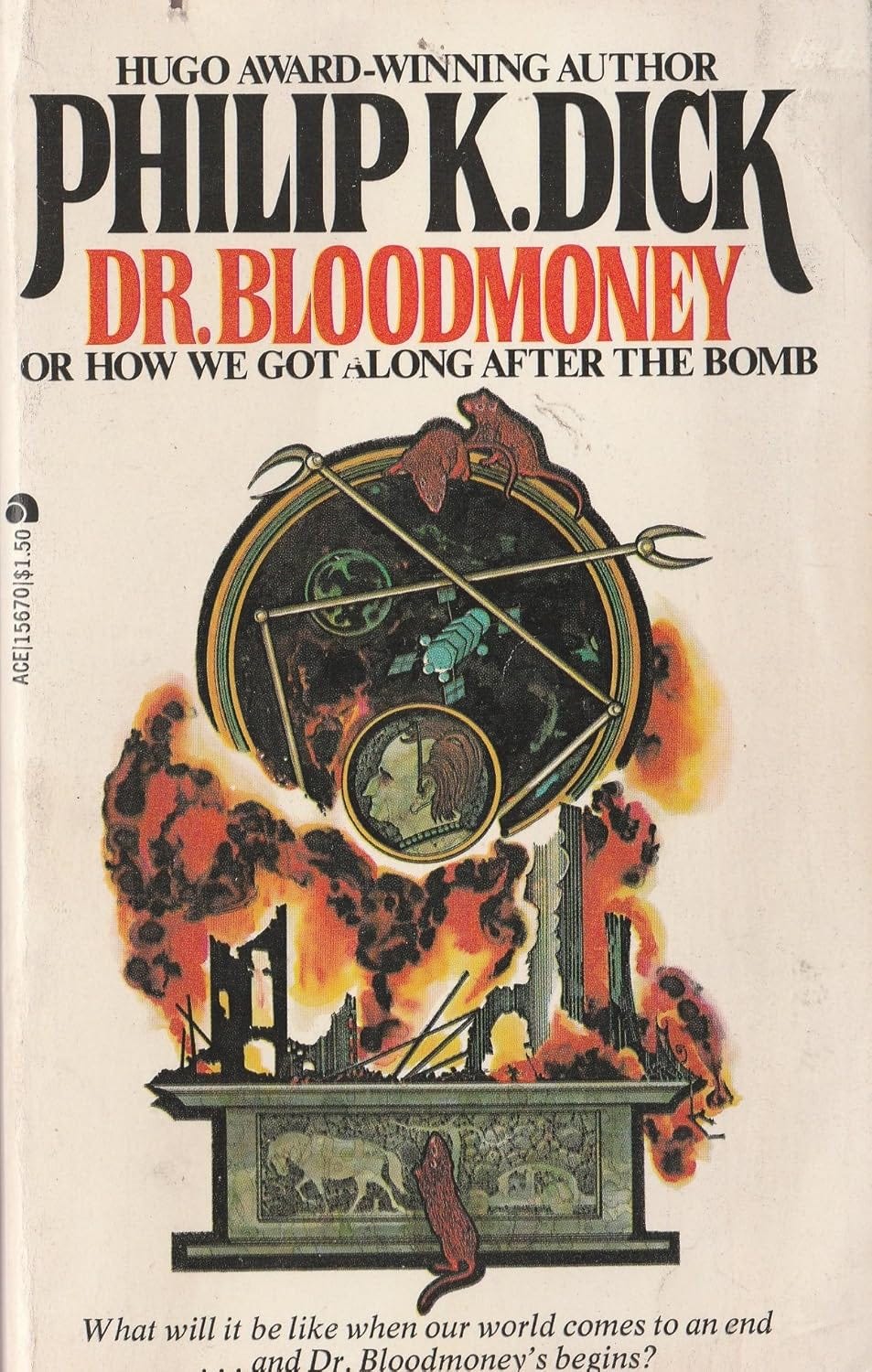
Dr. Strangelove ends with the nukes going off, and the elites rambling about fanciful post-apocalyptic fantasies. The nukes going off happens almost immediately in Dr. Bloodmoney, which is why it is the truly post-apocalyptic of the two. Dick addressed the “survival” aspect of the book in his later introduction:
In my opinion, this is an extremely hopeful novel. It does not posit the end of human civilization as a result of the next war. People are still around and they are still coping. Those who survive, anyhow, are fairly lucky in their new lives. What is interesting is the subtle change in the relative power status of the survivors. Take Hoppy Harrington, who has no arms or legs. Before the bomb hits, Hoppy is marginal in terms of power. He is fortunate if he can get any kind of job at all. But in the postwar world this is not the case. Hoppy is elevated by stealthy increments until, at last, he is a menace to a man not even on the planet’s surface [an astronaut circling the Earth]; Hoppy has become a demigod, and a complex one at that. He is not really evil but that his power is evil.
Which is what makes it all the more unfortunately that the title means that this book will forever have to be compared in some way to Dr. Strangelove, because it is really quite a different kind of story.
I have tried to call to mind what other books or stories it reminded me of. The closest I could come is Stephen King’s The Stand (1978), which is similarly post-apocalyptic, and deals with dark forces and supernatural powers. The Stand is quite different in many respects, to be sure, but in using the post-apocalypse not only as a vehicle for making commentary on the nature of contemporary society (which all post-apocalyptic stories do), but as a way to imbue what starts as a fairly “grounded” novel about a pandemic with supernatural themes, it has more in common with Dr. Bloodmoney than the latter does with, say, Fail-Safe or Red Alert or even The Day After.
Dr. Bloodmoney is not one of Dick’s best-known novels, and it is not a classic of either the post-apocalyptic genre or the nuclear war genres, by any means. But what is interesting to me about Dr. Bloodmoney is that even though it makes no real pretensions about modeling the world as it really is or could be — what with a psychic phocomelus, a psychic conjoined twin (I’m not going to get into that), and other fantastical elements — and is not narrowly focused on any particular “issue,” it still manages to be a commentary on the nuclear age. Not on its specifics, but a comment on what Dick seems to have felt was its darker id, a deep paranoia and misanthropy that lurked beneath its rational surface.
I remember reading this book in French translation (in a binge of lesserknown PKD novels, of which “(A. Lincoln,) Simulacrum” is imho the next one to get a Hollywood treatment, if ever there was need for one, as many of its themes got pilfered in recent scifi tv/movies like Black Mirror, built around bringing back “the dead” through AI, built on memorabilia and/or memories), and remember quite liking it, despite its rather loose, rambling structure, or perhaps even *because* of it.
Part is mostly because PKD always got excellent French translators, due to the French recognising his genius at mixing weird scifi with common people, and common psychological & psychoanalytical science. It is a stark difference in literary ambition from the common US scifi schlock reaching us in Europe, that still often built on heroic and hollywoodian colonist xenophobic monsterfighting tropes.
I have always been convinced PKD’s dystopian postapocalyptic novels/stories (there have been several) lent themselves to longrunning prestige tv more than to movies, because of their often loose structure (even wellknown movies like Total Recall and Blade Runner impose a narrative structure and a Hollywoodian “Save the Cat” beat structure totally missing in PKD’s novels/stories).
Mainly because PKD had the drug- or mental illness-induced tendency to seemingly randomly shift focus or perspective, lose the main thread for sidekicks, and have an infinity of little stories-within-stories, and a hint of a larger-than-shown “world beyond the story”.
I still vividly remember the character of the astronaut stuck in his space station, playing his vast vinyl (?) collection as some godly DJ, as all other media lost hope and broadcasting ability, losing his astronaut wife in his space station to cancer (or dying himself? memory is getting hazy) and I can more easily see this, and Hoppy’s rise-to-power, and many other “vignettes” become part of a prestige series developing the many, deeply flawed, humans (not heroes) PKD loved to write.
Despite its “Nuclear Powers create Superpowers” subplot, it eschews the black & white morality of Stephen King’s (repeatedly adapted, yet always annoyingly railroady) The Stand.
PKD’s post-apocalysm is ultimately thoroughly *humanist* like McCormack’s The Road, PD James’ (The) Children of Men, Naughty Dog Studio’s The Last of Us or (more optimistic) Emily St John Mandel’s Station Eleven, and their adaptations.
Problems aren’t solved by extraordinary human “heroes” (as in power fantasies like Mad Max), but by ordinary, flawed, suffering, wellmeaning yet barely “heroic” humans being human.
The threats don’t come from monsters, but from fellow humans who lost faith in the power of simply being human.
In this sense, Bluthgeld/Bloodmoney truly is the “monster” just as Victor Frankenstein is the one true monster (not Hoppy).
I share PKD’s loathing for the kind of public intellectual/scientist who *might* trigger a WW3 or 2nd Chernobyll (or Bhopal, or Exxon Valdez) by isolating themselves from resposibility (“I only did the calculations!”) and read a lot of Wernher Von Braun in his rationalisations (the analogy *I* made when reading Dr Bloodmoney and suspecting a Project Paperclip name change).
PKD grants his “monster” Bluthgeld (literally “paid for blood”) an albeit confused conscience (humanity!) gnawing at his sanity.
But it’s funny how PKD always loved ultra-Dickensian names, telling part of its metaphorical meaning through wordplay and allusion.
Psychiatrist Stockstill references the German & Dutch words for “unmoving”, PKD’s self-injected author surrogate in Valis & other stories, has always been Horselover (latin: Philo-Hippos) Fat (Dick is German/Dutch for “fat”).
Mr Tree as chosen sobriquet, becomes an alias to Mr Baum. Bluthgeld literally sees himself, a flawed Nuclear Scientist, as the origin/father of Nuclear War: Mr Bomb.
That mysterious cover image at the top? That's the psychic fetus-in-fetu after it gets loose. I haven't read the book for fifty years, but that image has stayed with me.