
Bomb shadows of the future
Ray Bradbury's "There Will Come Soft Rains" (1950)

The famous “human shadows” at Hiroshima are so famous that various mythical versions of them now populate the Internet. The realities are grim enough, if not much to look at — a smudge whose human form requires considerable reconstruction.
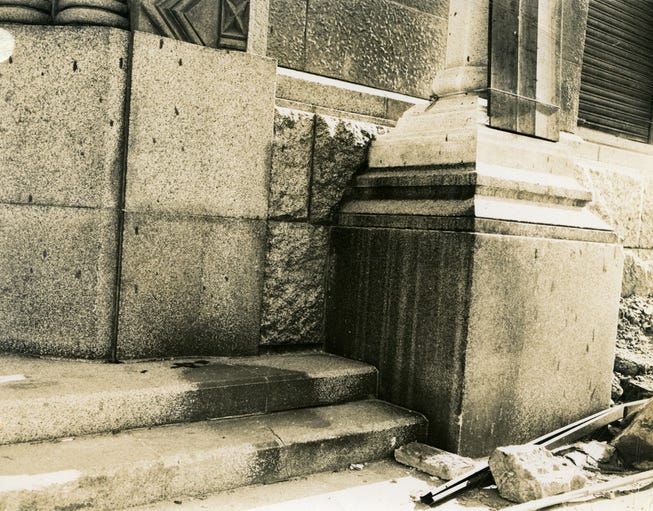
The “shadow” on the steps of the Sumitomo Bank, not far from ground zero, above is the most famous one. The above photograph was taken by US military forces in the city in November 1945. The initial identification of the shadow as being caused by a human being was made by an earlier survey of the bombed city.
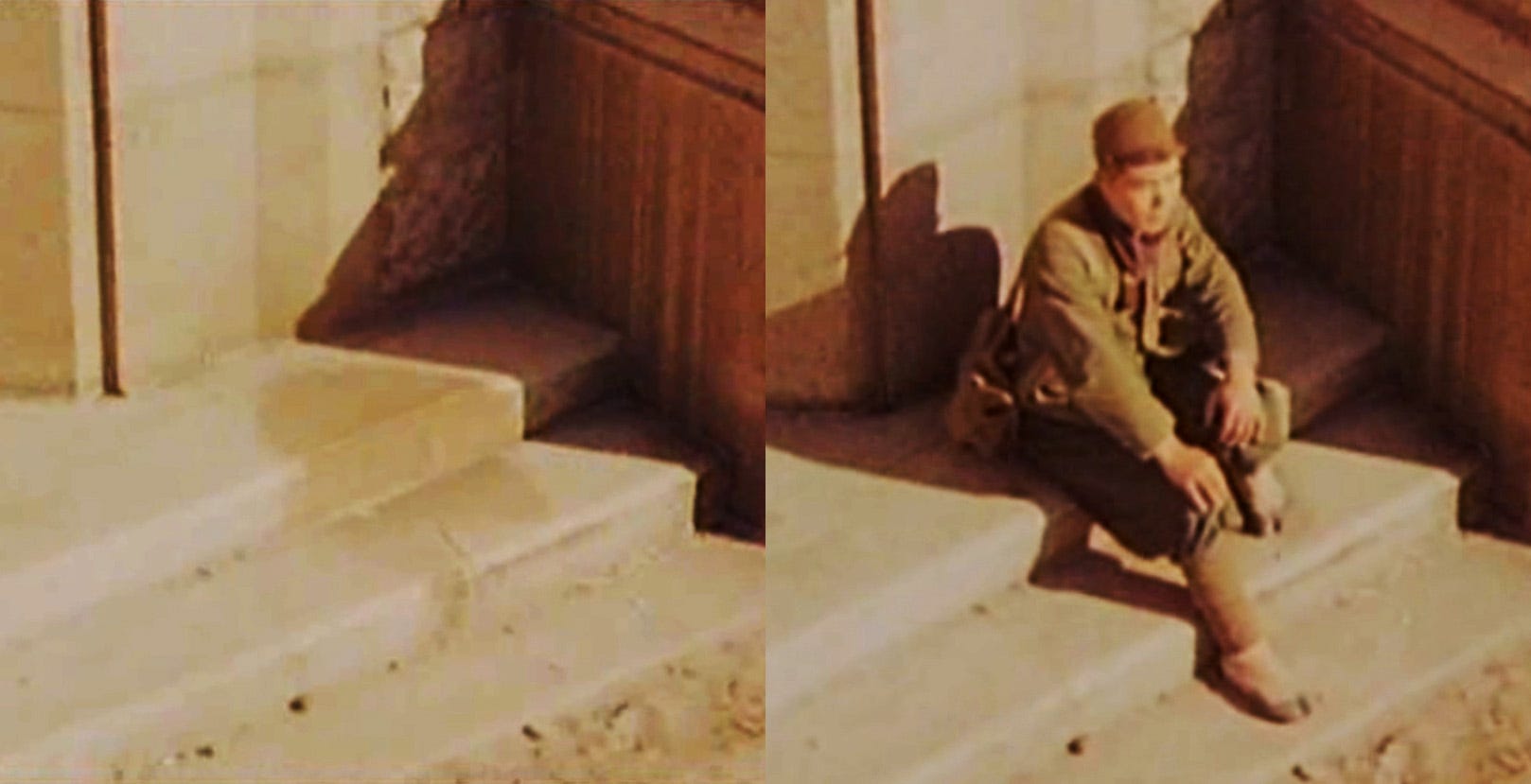
The “shadow” in the above, as with other “flash shadows” in the city, were caused by the intense-but-brief thermal pulse from the atomic bomb. Depending on the exact surface on which it acted, the physical behavior of the “shadow” varied. In the above, crystals in the surface of the polished stone steps expanded, changing their appearance. And any dirt would have been burned off. Except, of course, where that thermal pulse was blocked — in this case, by the body of a sitting man.
(The man, contrary to popular misconception, was not “vaporized” by the heat. In this case, his death probably was quite quick — he would have been intensely burned, and then the blast wave may have scattered him into oblivion. But vaporization — being heated to the point of changing into a gas — requires more heat than was delivered by the bomb onto the ground. The actual identity of the person on the steps is unknown and probably will never be known.)
The image of the atomic bomb searing the memories of its victims onto the surfaces is a potent one. In a short story he wrote for Collier’s in 1950, “There Will Come Soft Rains,” the science fiction author Ray Bradbury uses it for horrific effect. In the story, we see the remains of a house after a nuclear war set in the far future, and see how the automatic house persists despite its owners being quite gone:
The garden sprinklers pelted the windowpanes, running down the charred west side where the house had been burned evenly free of its white paint. The entire west face of the house was black, save for five places. Here the silhouette in paint of a man mowing a lawn. Here, as in a photograph, a woman bent to pick flowers. Still farther over, their images burned on wood in one titanic instant, a small boy, hands flung into the air; higher up, the image of a thrown ball, and opposite him a girl, hand raised to catch a ball which never came down.
The five spots of paint — the man, the woman, the children, the ball — remained. The rest was a think charcoaled layer.
Well, that is disturbing enough. But I am glad (although not surprised) that he correctly identifies that the shadow is the inverse of the thermal effect: that is, the shadow is what was preserved (the paint images of the people) and not what was burned (the rest of the house). The shadow is not the burned part; the shadow is the unburned part, which is only visible because the area around it has been burned.
The story has some additionally disturbing elements, such as what happened to the family’s dog after the nuclear war, and the ways in which our automated robots might just outlast us all.
The kicker for the present-day reader is when Bradbury’s far future was set: “Today is August 4, 2026, the city of Allendale, California.” Bradbury’s future is our present, and will quickly be our past. We’re doing somewhat better than Bradbury guessed, although one wonders how frustrated someone like him would be at the fact that so many very basic problems from his time, problems that do not require any high technology or scientific research to address, still remain on the table.