

What is the role of organized religion after a nuclear war? The question conjures up visions from science fiction, like the technology-worshipping monks in Walter M. Miller, Jr.’s, A Canticle for Leibowitz (1959). But it was also the subject of several curious pamphlets produced by the US Federal Civil Defense Administration (FCDA) in the 1950s.
The first, from October 1951, was titled “The Clergy in Civil Defense” (AG-25-1) and prepared under the supervision of a Religious Advisory Committee of the FCDA.1 Its use of the term “clergy” is, it clarifies, meant to be pan-religious — “the clergy of all faiths” — although the committee was composed of four Christians (of different sects) and one rabbi.
The role of the clergy (thus defined) is divided into two phases: “pre-attack” and “post-attack.” Pre-attack is perhaps the most interesting: they are charged with the task of reinforcing a particular ideological stance:
(a) Maintenance of firm resolution and composure of the people through preaching and worship.
(b) Through pastoral care of families and individuals, creation of a sense of responsibility and spiritual security among the people to meet the possible exigencies of attack on a scale never experienced before in the United States.
(c) Maintenance of courage and spiritual well-being of children through regular programs of religious education (especially in respect to parent groups and teachers).
(d) Encouragement of the enlistment of volunteers for the civil defense services.
(e) Acting as chaplains to the various civil defense services such as warden, rescue, and fire fighting, during training and in actual operation.
(f) Planning, organizing, and preparing services of the clergy and other religious activities in time of attack or other emergency.
(g) Planning and arranging the part of the clergy and members of religious organizations in mutual aid and mobile support programs.
(h) Planning for religious ministry in evacuation reception areas.
(i) Planning with chaplains of adjacent military installations for cooperation and mutual assistance in case of attack.
The first four in this list strike me as quite different from the rest. It is one thing to conclude that pre-attack (or pre-disaster) preparation means thinking about the organizational responses to the attack (or disaster). But the first three are about creating some kind of spiritual or psychological sentiment in their congregations, which seems to go well outside the normal role for the federal government to recommend. An encroachment of “turf,” one might say. And the fourth, actively encouraging participation in the Civil Defense program, assumes that said program is in fact in alignment with the beliefs of these different organizations — something, perhaps, that they could take for granted in 1951, but, as we will see, becomes a trickier assumption as the decade continued.
In the post-attack phase, the role of the clergy shifts to being of “great help in sustaining and restoring the morale of the community.” This is pretty much what you would expect: they are to administer religious rites for “for the seriously injured, dying, and dead,” to conduct burial services (“including possible mass burials”), comfort the survivors, lead ministry and worship “where appropriate,” attend to the religious needs of civil defense workers, and participate in “mutual aid” activities as is possible and appropriate. All of which strikes me as quite practical by comparison to the pre-attack directives.
In 1954, when “The Clergy in Civil Defense” was issued, Civil Defense programs were not yet especially controversial. There are a variety of reasons one could point to for this — the thermonuclear age had not yet arrived, the threat of atomic war against the continental United States still felt somewhat remote to most Americans, and Americans could by and large simply ignore Civil Defense if they thought it was not for them. The amount being expended on it was never large, and it largely did not intrude into American lives one way or the other with the exception of some mild indoctrination for children like “Duck and Cover” drills.
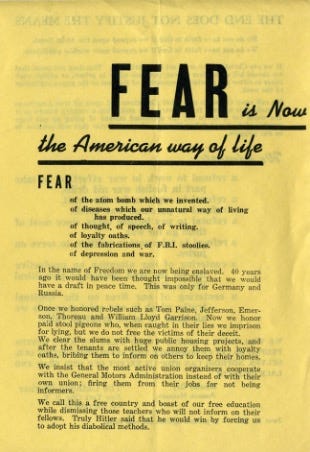
Starting in 1954, however, this situation changed significantly. The Castle Bravo nuclear test accident made it quite evident that the thermonuclear age was at hand and it meant that the destructive capacity for nuclear war had increased dramatically. Both the US and the Soviets began speaking publicly, in much more dramatic terms than before, about what nuclear war would mean. And the FCDA and local Civil Defense authorities began a series of national drills, known as “Operation Alert,” in which they mandated that everyday citizens participate in mock Civil Defense exercises.
The latter point is probably the most important, from the perspective of public opinion about Civil Defense. When your city shuts down for a few hours so that you can pretend you have been obliterated, it forces one to take stock of the situation. Political scientists would say that it increases the salience of the risk: it goes from something abstract to something tangible.
And while most people went along with the exercises, one finds the emergence of a small but significant group of people who began objecting to them on both practical and moral grounds. When the 1955 “Operation Alert” exercises came around, Dorothy Day and the Catholic Workers of America refused to participate, instead handing out pamphlets:
We will not obey this order to pretend, to evacuate, to hide. In view of the certain knowledge the administration of this country has that there is no defense in atomic warfare, we know this drill to be a military act in a cold war to instill fear, to prepare the collective mind for war. We refuse to cooperate.
Over two dozen people were arrested for their non-participation in the drill. While the anti-Civil Defense arguments would broaden over the years — by 1960, over a thousand people would be arrested in NYC for protesting the drill — the fact that this initial argument against Civil Defense was rooted in a religious pacifism, and a specifically Catholic organization, is what strikes me as being interesting in this context. The 1951 pamphlet and its authors assumed, perhaps correctly for its moment, that Civil Defense was religiously uncontroversial. Three years later, however, serious religious objections to Civil Defense had emerged, and consensus could not be taken for granted.
Which is interesting context to consider for the revised version of pamphlet AG-25-1 that was released in October 1956, now re-titled as “The Church and Civil Defense” (AG-25-1 Revised).2 Gone, apparently, is the council of religious advisors — in fact, no author is listed whatsoever. Instead, it appears that the FCDA Administrator since 1953, former Nebraska Governor Val Peterson, created a Religious Affairs Office which consolidated the functions of the previous council and made them a more integrated part of the FCDA. Heading this office, since 1954, was one Dr. Fred W. Kern, a Lutheran reverend — and Peterson’s brother-in-law — who ran the office for the next seven and a half years.3
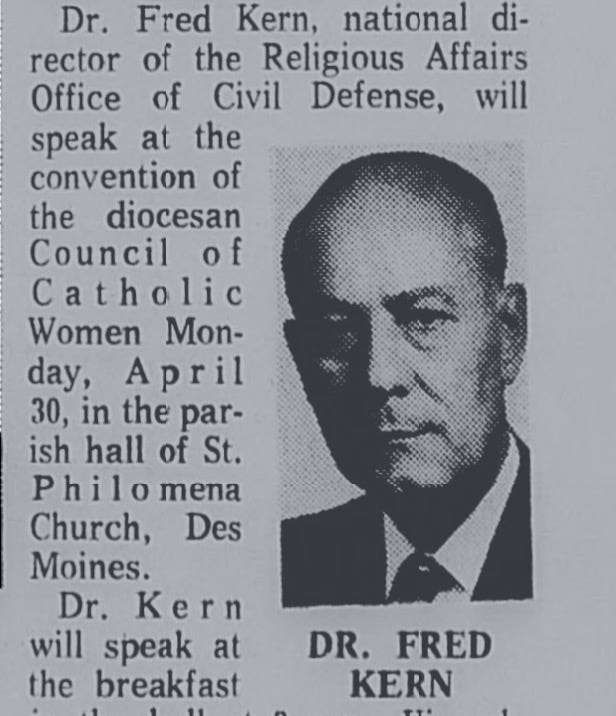
What was Kern’s agenda? Kern gave a talk at a Civil Defense conference in 1956 describing in vivid his approach to the job, and the world:4
When I came with civil defense, no one knew exactly what I should do and I didn't either. I think there was in the minds of some people the idea that the church is such a big institution and has so many millions of people that somehow we ought to get them behind us — we ought to get the church to support civil defense . Now, how are we going to do that? We know very well that everyone in any public office knows that you are not going to go to the church and tell them the government wants them to do so and so, the government says that this is what you ought to do If you ever tried that approach, you know from very clear experience that the opposite may have happened, because the church in this country is free, and that is one of our cherished freedoms. We don't have the government interfere in any way with what we do in our religious life, so long as it isn't contrary to the interests of our government or our citizenship.
I had to do some studying on this business of civil defense because I knew very little about it. I started reading books on civil defense and on communism. Naturally when we think about the question, “Why do we have civil defense," we conclude, "Well, we have to protect ourselves, we have to be ready to live, to preserve our life, we have to be ready to do something for the preservation of our country, our properties. "And, of course, you have to ask yourself, Against whom? "Well,” you say, "only one source, and that is communism.
This is quite an interesting jump — that the role of the church in civil defense is rooted in a deep anti-Communist sentiment. This is clearly what animated Kern, beyond the more prosaic functions that religious organizations could serve after a major disaster. Kern’s talk frames the entire issue in theological–ideological terms:
It has been my contention that we have civil defense because of an ideological friction and conflict in the world. […] The cause of all the friction and conflict and the struggles between East and West and democracy and communism rest with the idea or the concept that we have concerning the true nature of a human being. What is man? It’s a moral issue, because it is a moral judgment applied to the nature of human life and human beings. And there’s only one institution in the whole world and certainly in our country that is dedicated to this problem of the moral judgment of life, to the nature of man, to his origin, the value of his life and his destiny. And that is the church. […]
In the Soviet Union there is no God. It is strange how philosophy can even presume to be logical and rational without the acknowledgment of a Creator. The Russians believe there is nothing spiritual in the world, there is no God, no spirit; there is nothing spiritual about a man — he is material.
And so on, and so on. “Civil defense,” he concluded, “should include spiritual civil defense.“ Because even after a nuclear war, Communism would still exist, even if “every living Communist” was killed. Because Communism was an idea, and as such, “you can’t kill it with a bullet. The only way to meet it is on its own grounds, and that is basically an ideological basis, ideological counteroffensive.”
It seems likely to me that Kern’s expansive mandate was a reaction to exactly the kind of skepticism of Civil Defense that had been developing in the intervening years. Whereas “The Clergy in Civil Defense” could take for granted that Civil Defense was essentially seen as a positive activity, Kern is trying to sell it as an essentially holy war.
The pamphlet, “The Church in Civil Defense,” is not nearly as fiery as Kern’s own speeches, but one sees his beliefs in it:
The very existence of Western civilization is endangered. Our present state of culture, developed over centuries, is threatened with extinction. Not only democratic government, the highest form of political order yet evolved, which offers the greatest degree of individual and group freedom while guarding the rights of all, but religion itself, is challenged by a godless, totalitarian tyranny. The church cannot do its work effectively in a state which stifles it If civilization is to continue to make progress and if democratic government is to exist, then the church must be free to continue its mission.
Communism is a substitute religion. At its deepest level the conflict between Soviet communism and the free world is a religious conflict. We are not dealing with an inconsequential perversion of philosophy and religion. Communism tries to interest mankind in religious terms in spite of its avowed godlessness. It has its substitute god and utilizes all the facets of religious motivation The Party tries to usurp the place of the church and to give the writings of Marx and Lenin the status of sacred scriptures. The kingdom of God is promised in the classless and stateless, that is, governmentless society . […] The old Marxian charge that religion is an opiate used to oppress people can be dispelled only by an alert and positive church, a church motivated by its tenets of love of God and love of man, and therefore, a church actively interested in any program of human welfare. Civil defense is a program of human welfare devoted to saving and sustaining human life.
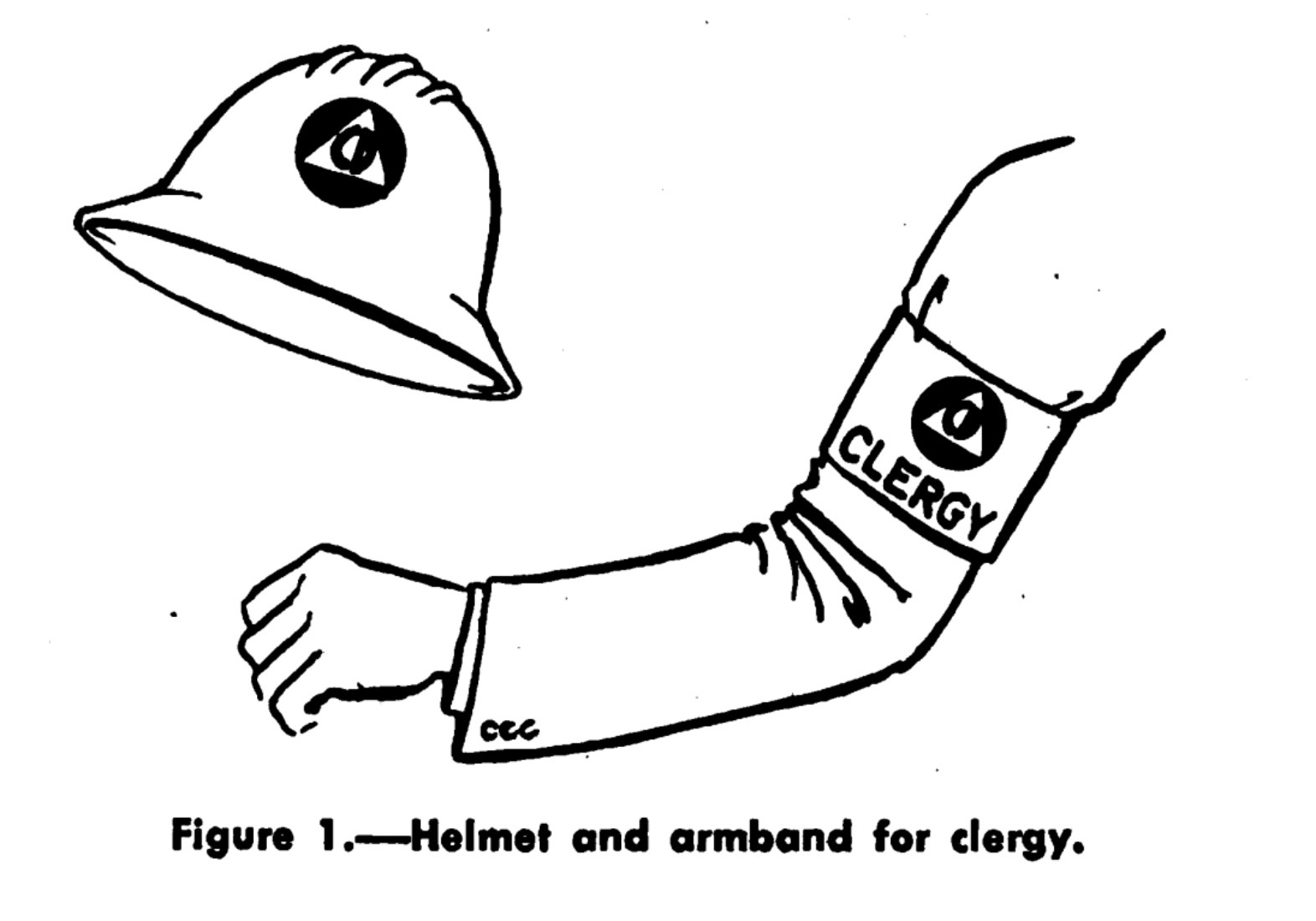
Other than the introductory notes, the actual recommendations are not all that different from the 1951 pamphlet. The only notable difference that jumped out to me was that each clergyman involved with Civil Defense was entitled to a helmet and special armband that would so identify them in time of disaster:
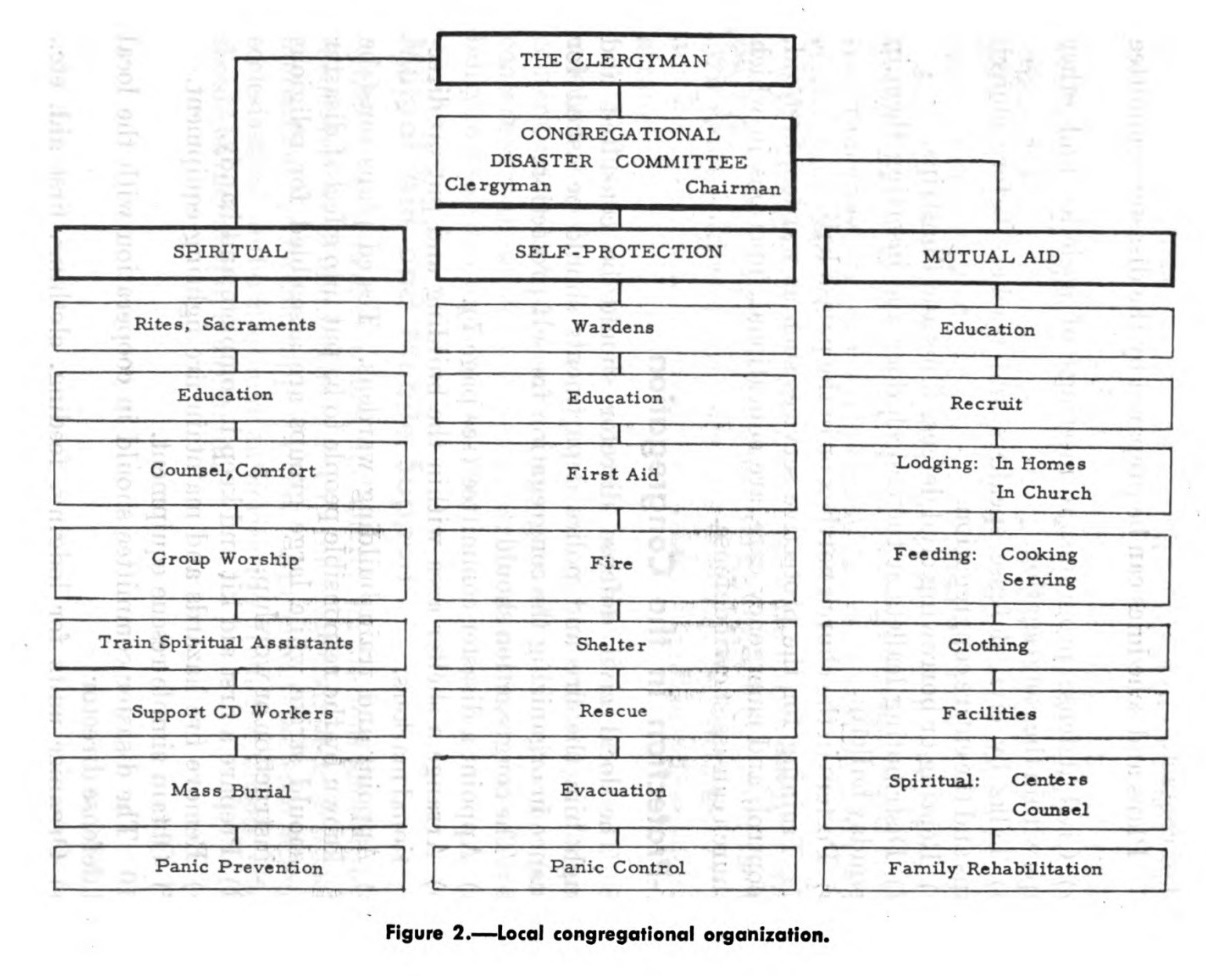
There is also a fascinating organizational chart that divides the work into three functions: the spiritual, self-protection, and mutual aid. I have to admit that having “mass burial” and “panic prevention” being put next to one another raised an eyebrow.
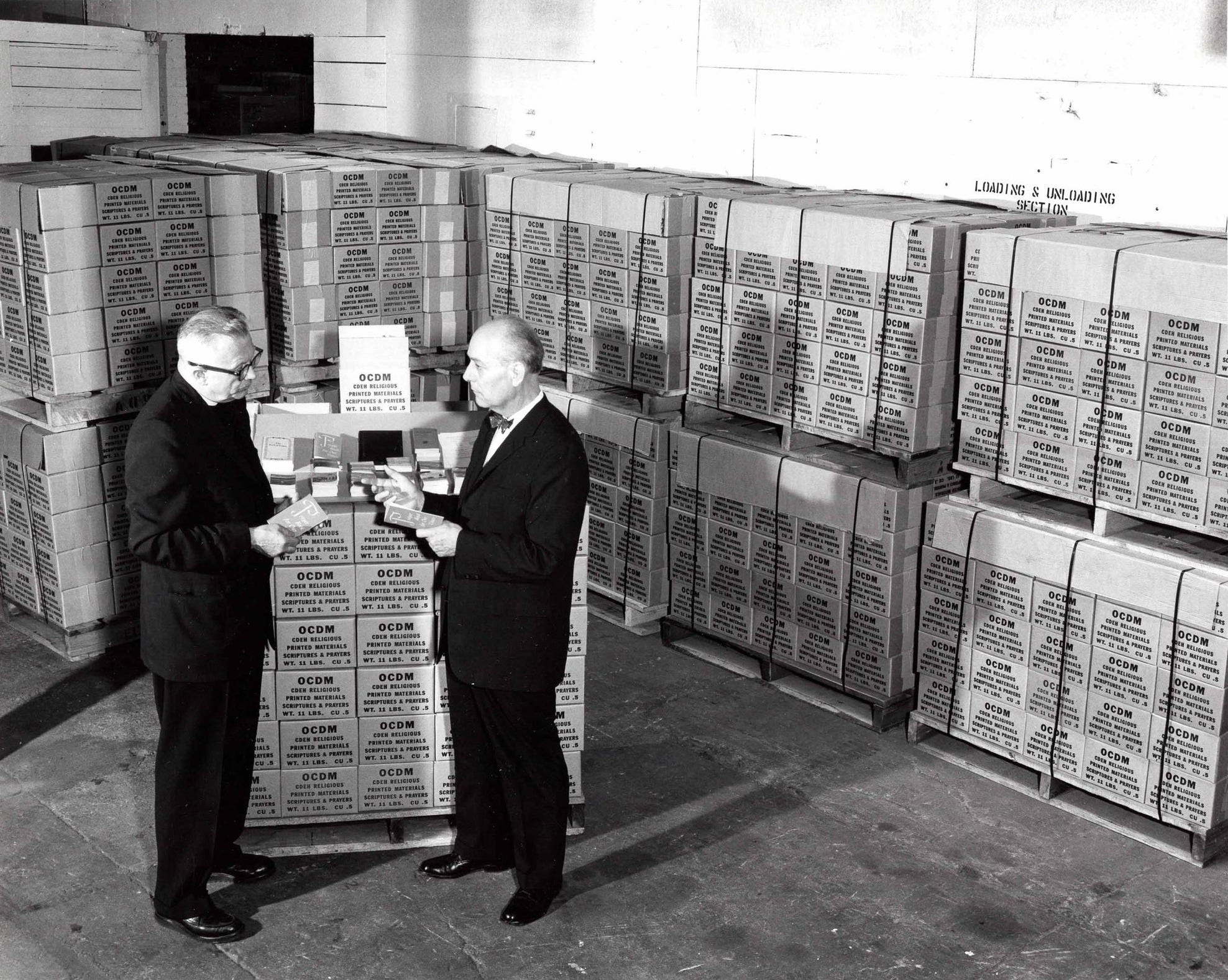
There are a smattering of records of Kern’s work beyond this pamphlet. He was apparently still in the role when the FCDA was consolidated into the Office of Civil and Defense Mobilization in 1958, and stayed in the role until the early 1960s. He gave talks to many religious groups and organizations, and was the one who led the opening “invocation” at official FCDA meetings. His office facilitated the donation of thousands of religious books for post-apocalyptic use, as shown in the photo below.
The official accounts of Kern’s talks to religious groups tend to be pretty positive. A PhD thesis from Matthew Justin Hall at the University of Kentucky on Southern Baptists in the Cold War suggests that the main concerns that at least that group had with Civil Defense were rooted in whether the post-nuclear state would impose too many requirements on religious organizations, weakening separation of Church and State. Kern, in both his pamphlets and talks, urged that this was not the case, that the plans were only to strengthen existing religious activities.5
Aside from the fact that “clergy” and “church” in this time was limited exclusively to Christian and Jewish faiths (with even latter’s inclusion feeling a bit tokenish), I would also just note that like all Civil Defense at this point in time, it is extremely focused on white audiences. Which is not all that interesting in the context of Eisenhower-era Civil Defense, except inasmuch as neglecting African-Americans when targeting religious communities is, well, excluding a potential audience that would possibly have been quite engaged. There is undoubtedly more that could be said on this point.
Ultimately, both of these pamphlets are interesting artifacts from Cold War America, and the shifting ways in which the efforts at Civil Defense were framed in both the Truman and Eisenhower administrations. The push towards an increasingly ideological interpretation of the question of what the role of religious institutions ought to be in preparing for, and recovering from, a nuclear attack, is likely both a reflection of the changing strategic context, as well as possibly a reaction to the growing skepticism towards Civil Defense within the United States. This axis of national security, ideology, and religion is of course quite a potent one in the United States, particularly during certain administrations — Eisenhower, Reagan, Trump — that have sought to explicitly imbue religious sentiment into their ideological pronouncements.
US FCDA, “The Clergy in Civil Defense,” AG-25-1 (October 1951).
UC FCDA, “The Church and Civil Defense,” AG-25-1 Revised (October 1956).
Fred William Kern was married to Val Peterson’s sister Norma, who prior to her marriage to Kern was a nurse in northeast Nebraska, according to an obituary. I have not been able to determine what his doctorate was in or where it was granted.
Fred Kern, “The Church and Civil Defense,” in National Women’s Advisory Committee on Civil Defense, A Report on the Washington Conference 1956 (FCDA, 1956).
Matthew Justin Hall, “Cold Warriors in the Sunbelt: Southern Baptists and the Cold War, 1947-1989,” Ph.D. dissertation (History, University of Kentucky, 2014).
Thank you for this post. Absolutely fascinating. You wondered about The Rev. Mr. Kern. A quick google search turned up this dedication book of First English Evangelical Lutheran Church in Austin, Texas, with a picture of the pastor, The Rev. Fred W. Kern, M.A. Same person or his twin, I believe. The Dr. appellation may not have been an earned doctorate but may have been an honourary degree from his alma mater. https://www.felcaustin.org/wp-content/uploads/FELC-Dedication-Memento-booklet-1939.pdf
A more complete pastoral record, including his education, can be found in the Evangelical Lutheran Church in America's Southwest Archives. His service in "Director of religious affairs office of the US Office of Civil Defense in Battle Creek, Michigan" is included, but undated.
https://swtsynod.pastperfectonline.com/byperson?keyword=Kern%2C%20Fred%20William
As I have written in a long-ago comment on Alex's "Restricted Data" blog, Father Paul Bussard, editor of <i>Catholic Digest</i>, wrote about a combination church and fallout shelter designed by a Minneapolis architectural firm. When the “The Shelter Church” appeared in the March 1962 issue, I was eight years old.
Architects Shifflet, Hutchison & Dickey proposed a dual-use design for a building that could serve as a parish church, bingo hall, etc. during peacetime, but which could become a fallout shelter for many families if (God forbid) the need arose. This fascinated me. I pored over his diagrams. I believe this was the first time I learned that a concrete labyrinth could discourage neutrons, something I would eventually get paid to think about.
I saw other accounts of fallout shelters in magazines of the time, but Father Bussard’s description of ingenuity in the face of World War III was most memorable.
In the course of time, I obtained a PDF of this article. It runs from pages 51 through 56. E-mail me if you wish a copy: h i g g i n s 2 k AT g m a i l DOT c o m.