

One of the tropes of post-apocalyptic fiction set long after the collapse of civilization is that of technological forgetting. The inspiration of western Europe during the “dark ages” after the fall of the Roman Empire is usually fairly obvious, sometimes quite explicit. Whether the idea of the “dark” or “middle” ages as a technological “decline” story is true or not (it’s complicated),1 the trope has been a persistent one in the West, undoubtedly used as a reminder that even the mightiest empires can fall, and that our much-vaunted civilizational achievements might only be one or two generations deep.
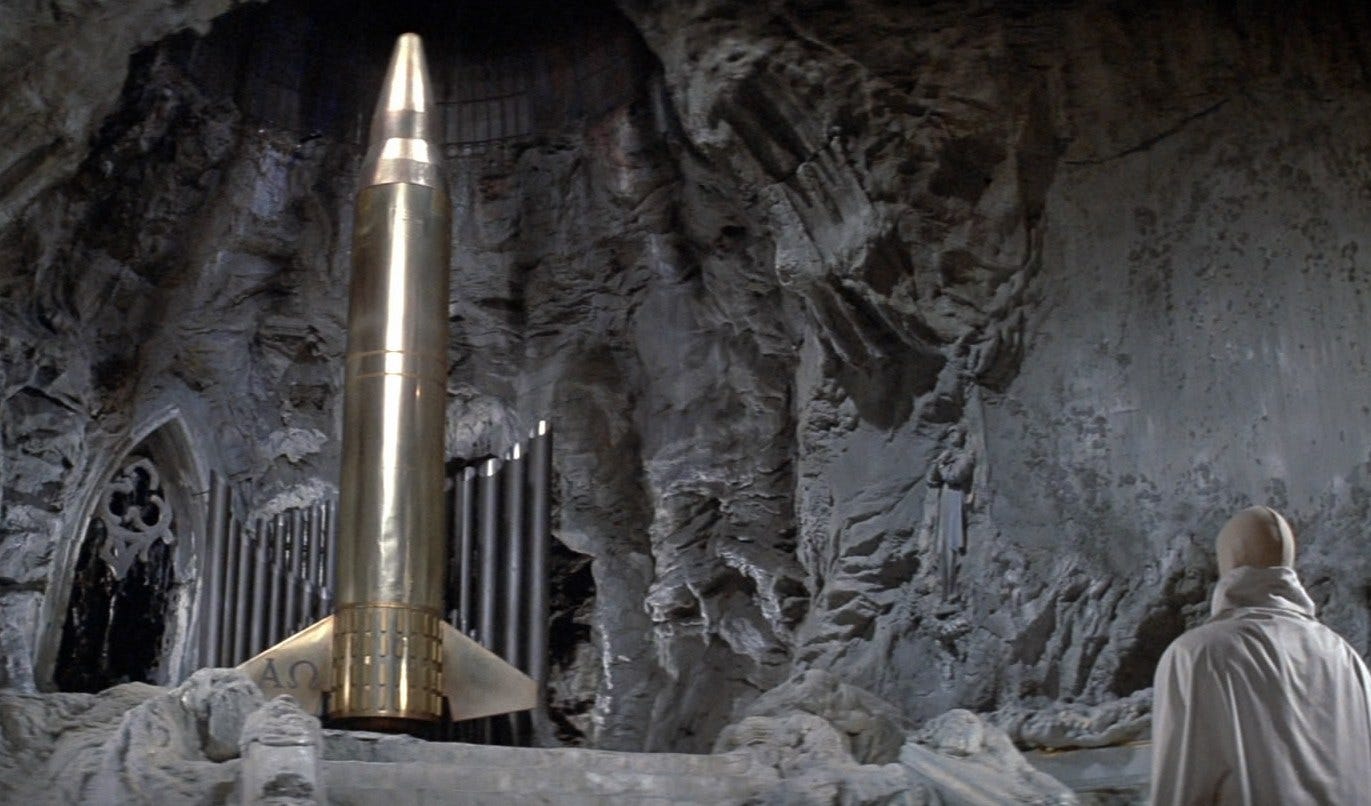
For post-nuclear apocalypses, the trope frequently takes the form of the survivors having only the dimmest or confused memories of what a nuclear weapon actually is. In Beneath the Planet of the Apes (1970), this manifests as a hidden, subterranean religion carried on by mutant human survivors who worship a massive Doomsday bomb emblazoned with the symbols for Alpha and Omega. In Russell Hoban’s Riddley Walker (1980), the memory persists linguistically as the “Bad Time.”
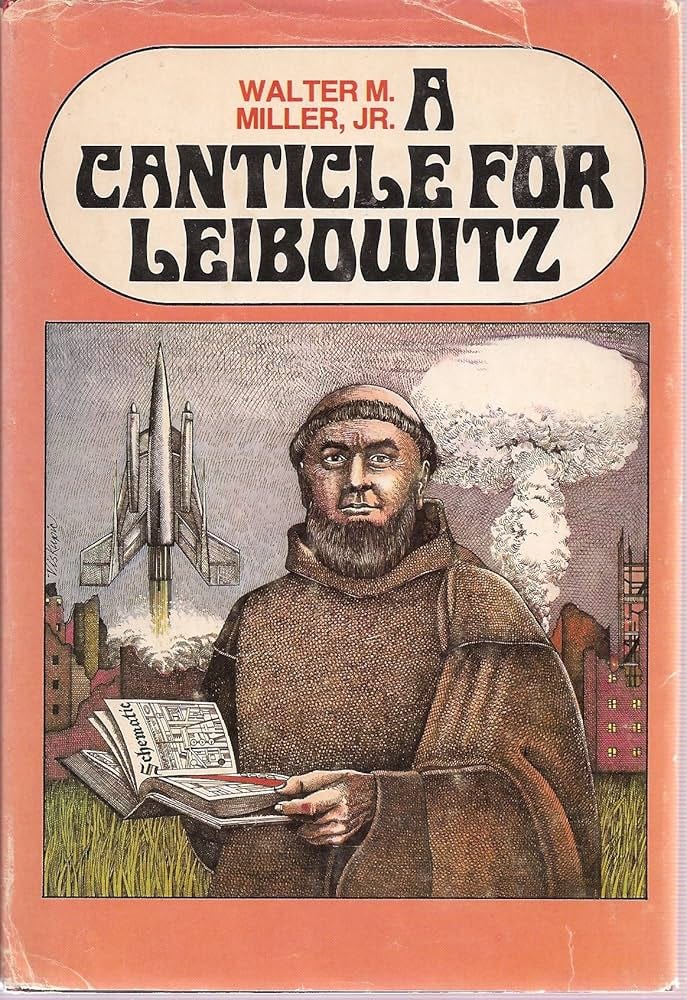
One of the works that engages with this question of forgetting in a sustained way is Walker M. Miller, Jr.’s, A Canticle for Leibowitz (1959). The novel is a compilation of three short stories (written independently but then “fixed up” into a singular story) that looks at three distinct far-future periods after a nuclear war. As with the Roman Empire, some institutions have survived the fall: notably, the Catholic Church, that enduring institution.2 In the novel, the Church once again becomes a repository for old knowledge, which, over the course of many centuries, leads to the reinvention of a technological civilization — and to yet another nuclear war.
This cyclical (and perhaps cynical) message is at some intersection of a statement about human nature and technological inevitabilities: once invented, the bomb cannot be un-invented, and once they have the bomb, humans will inevitably use it again, it is just a matter of time. It would be an interesting variant to imagine the same story but without the Church’s role; is the problem that the knowledge was preserved, or would that rediscovery have been inevitable eventually anyway?
A relevant and provocative argument from the sociology of nuclear technology can be found in Donald MacKenzie and Graham Spinardi’s “Tacit Knowledge, Weapons Design, and the Uninvention of Nuclear Weapons,” published in the American Journal of Sociology in 1995.3 The argument that MacKenzie and Spinardi make is about the nature of knowledge and forgetting, and its possible relevance to nuclear weapons.
The core of the argument revolves around an idea that was by then quite common in the sociology of science and technology known a tacit knowledge. They explain the distinction early on in the article:
Explicit knowledge is information or instructions that can be formulated in words or symbols and, therefore, can be stored, copied, and transferred by impersonal means, such as in written documents or computer files. Tacit knowledge, on the other hand, is knowledge that has not been (and perhaps cannot be) formulated explicitly and, therefore, cannot effectively be stored or transferred entirely by impersonal means. Motor skills supply a set of paradigmatic examples of tacit knowledge in everyday life. Most of us, for example, know perfectly well how to ride a bicycle yet would find it impossible to put into words how we do so. There are (to our knowledge) no textbooks of bicycle riding, and when children are taught to ride, they are not given long lists of written or verbal instructions. Instead, someone demonstrates what to do and encourages them in the inevitably slow and error-ridden process of learning for themselves.
Anything you can communicate by writing down is explicit: the Pythagorean theorem and instructions on how to use it, for example. Or a nuclear weapons blueprint. But not all knowledge is of this form. “Tacit” means wordless — it is knowledge that you feel in your hands, in your body, in your experience. Riding a bicycle, as above, is the paradigmatic example.
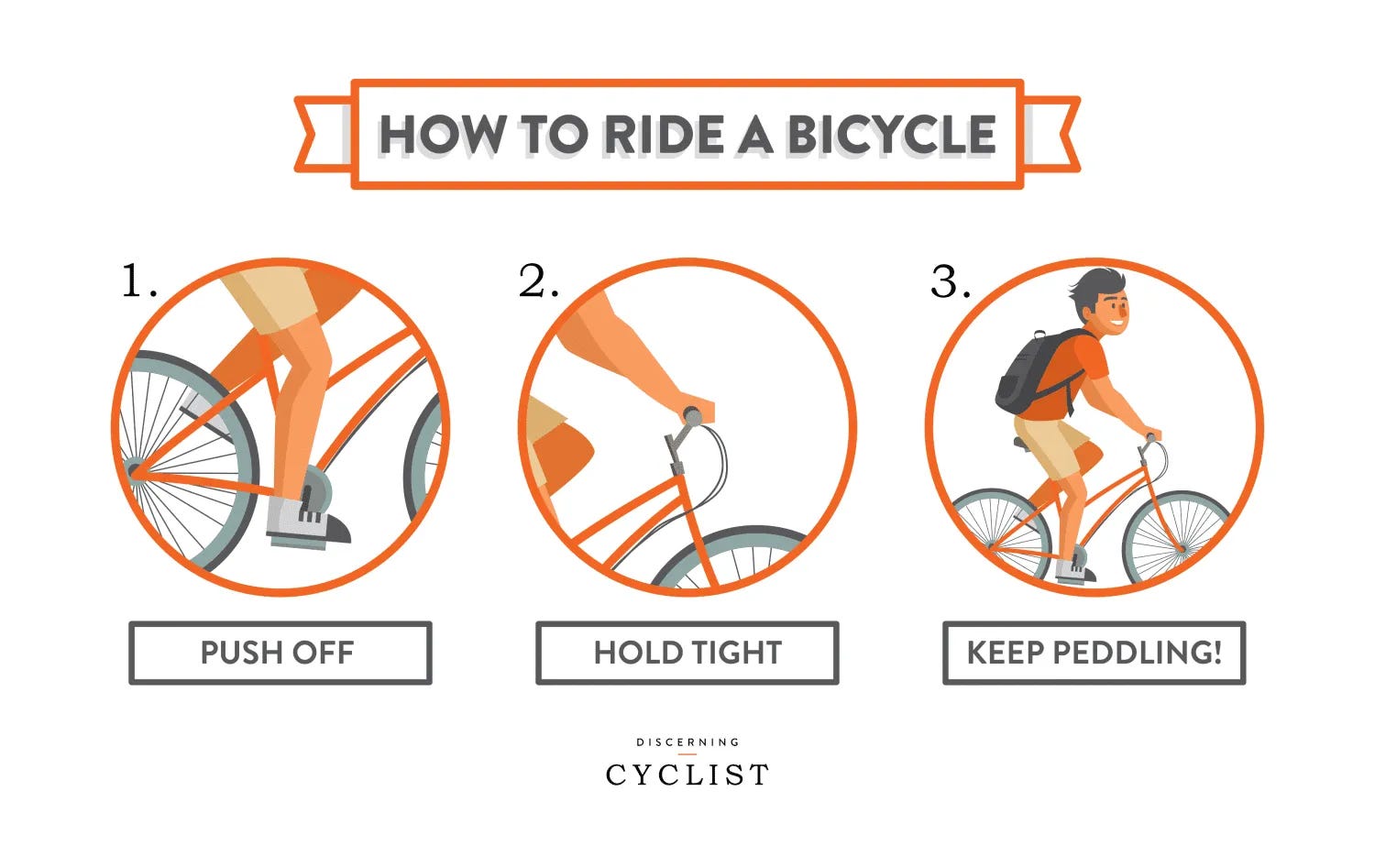
One could write down how to ride a bicycle, but reading that description would not make one capable of doing it. Indeed, the best text about how to ride a bicycle is essentially one that gives instruction as to how to teach oneself how to ride a bicycle:
Acquire a bicycle.
Understand that the goal will be to continually propel it forward while balancing on top of it and turning the pedals with your feet, in a forward “running” motion. Your hands will need to turn the front wheel to change direction. Observing someone else doing this first would help. You will be continually shifting your balance to maintain stability.
Attempt to do this over and over again until your brain figures out how to coordinate your movements and balance in a way that gives you control over the bicycle. You will fail frequently in the beginning. Wear a helmet.
This isn’t really a recipe that you can just follow, it is a program for education, and the actual acquisition of the understanding will come when some nebulous connections “click” in the brain. And like so many things involving tacit knowledge, you can’t really forget it either: if you go 10 years without riding a bicycle, you can still probably do it, you will not need to re-learn anything.
I think the above description gets at both the benefits and difficulties of this term. It does seem to describe certain kinds of knowledge well, although the barriers between it an explicit knowledge are not as iron-clad as they may at first seem. Just because something is tacit does not mean it cannot be learned or taught, it just means that the written word is insufficient for doing it by itself. A lot of what we call experience and know-how is tacit knowledge: the kinds of embodied understandings that one gets over time with close familiarity with any subject that goes well beyond what one can find in a textbook. And this is why, incidentally, “experience” matters so much more than formal knowledge in most contexts: because we recognize there is a difference between “mere book-learning” and “hands-on work.”
Ask anyone who has gotten a post-graduate higher degree and they will tell you that most of the “work” of that experience is essentially an apprenticeship where one “learns by doing.” This doesn’t negate the value of book learning — you need that, too, for a lot of things — but it emphasizes that true mastery isn’t just the book learning, it’s the tacit knowledge, too.
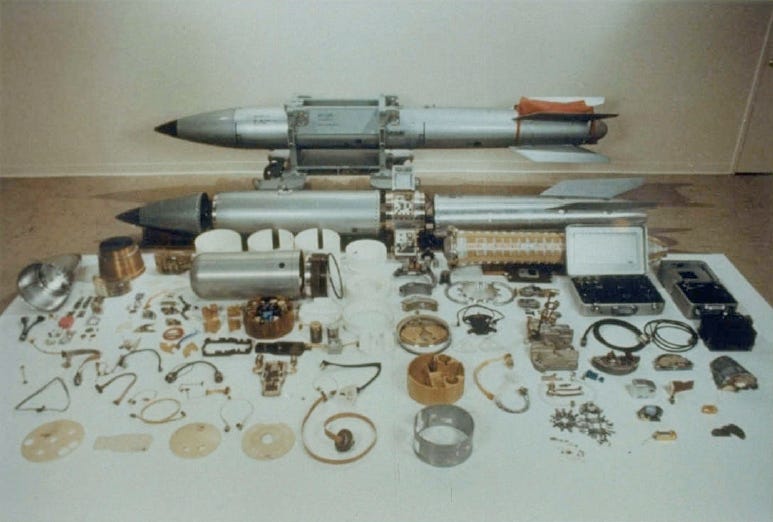
So what is the relevance to nuclear weapons? Nuclear weapons are complex technical artifacts that require even more complex technical artifacts to produce the components that make them work. As a whole, “nuclear weapons” aren’t even just the weapons themselves, but the entire large technical system that is required for them to exist and be sustained. Obviously many of the technical details of these systems can be, and are, written down. But MacKenzie and Spinardi argue that much of their production must also be in the form of tacit knowledge, locked up in the heads and hands of the people who build and maintain them.
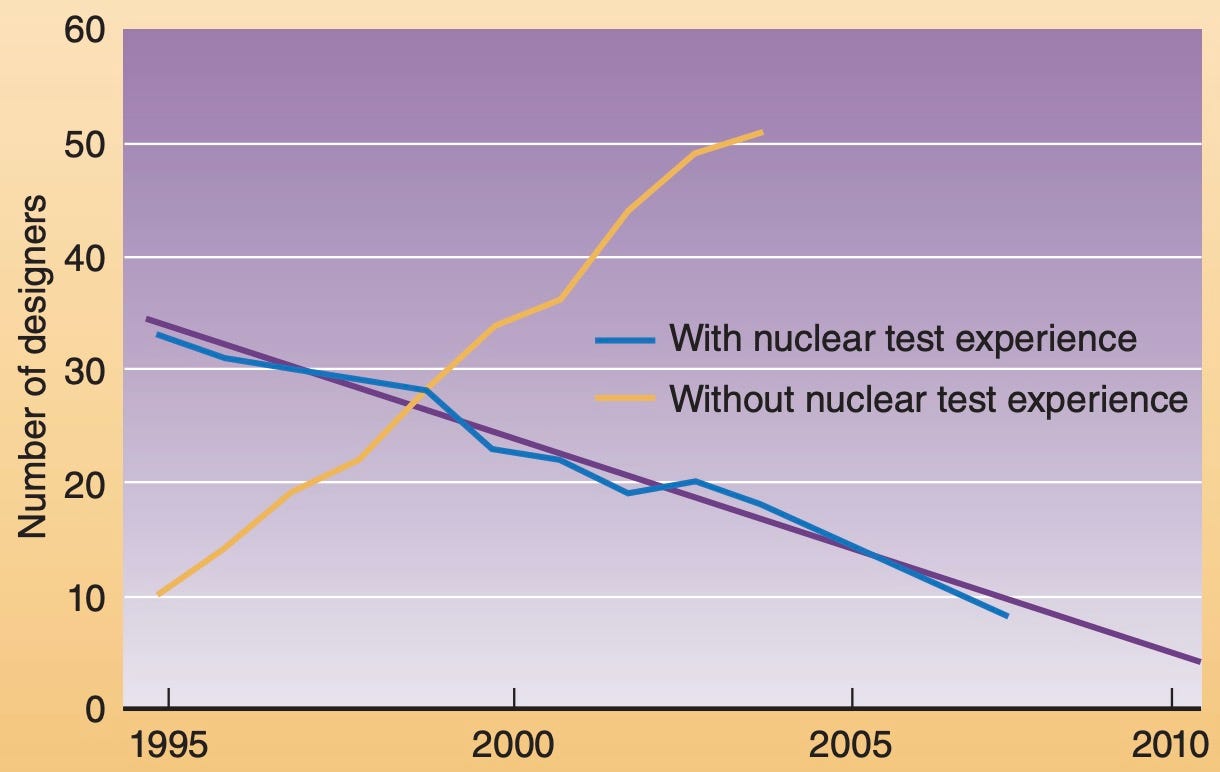
The article, written in that immediate post-Cold War glow, asks the question: what if nuclear weapons are never tested again? What if, after decades of not making them, the tacit knowledge is lost? It is not fanciful, as an idea. Indeed, MacKenzie and Spinardi base their argument itself on interviews with weapons laboratory scientists at the time who voiced exactly this kind of concern, fearing that the future generations of scientists would become increasingly distant from the hard-earned experience needed to even maintain nuclear weapons capabilities, much less imagine innovate in them.
Are there any examples of this happening? The most concrete example of this “forgetting” actually happening is with a mysterious substance known as Fogbank. Fogbank was a classified component used inside certain US thermonuclear weapons. As one weapons worker put it: “The material is classified. Its composition is classified. Its use in the weapon is classified, and the process itself is classified.” It was later indicated that it is an “interstage material,” used in the transferring of energy from the fission primary to the thermonuclear secondary inside a multi-stage nuclear weapon. It is also clear that it is fairly exotic: it is not something used in many other contexts, or produced regularly, and has apparently rather unusual properties.

Whatever it is, the point of bringing up Fogbank is because the US government “forgot” how to produce it. As a Los Alamos publication put it:4
Produced by skilled hands during the 1980s, Fogbank is an essential material in the W76 warhead. During the mid-1990s, Fogbank production ceased and the manufacturing facility was dismantled. As time passed, the precise techniques used to manufacture Fogbank were forgotten.
When it came time to refurbish the W76, Fogbank had to be remanufactured or replaced. In 2000, [the National Nuclear Security Agency] decided to reestablish the manufacture of Fogbank. Officials chose to manufacture Fogbank instead of replacing it with an alternate material because Fogbank had been successfully manufactured and historical records of the production process were available. Moreover, Los Alamos computer simulations at that time were not sophisticated enough to determine conclusively that an alternate material would function as effectively as Fogbank.
Although Fogbank is a difficult material to manufacture, scientists soon discovered that restoring the manufacturing capability would prove an even greater challenge. Scientists faced two major challenges:
• most personnel involved with the original production process were no longer available, and
• a new facility had to be constructed, one that met modern health and safety requirements.
Despite efforts to ensure the new facility was equivalent to the original one, the resultant equipment and processing methods failed to produce equivalent Fogbank. The final product simply did not meet quality requirements.
The full article explains (in ever-elliptical descriptions) that the scientists went back into the archives to look at the historical data on Fogbank’s production, discovering that there were indications of similar problems in the past. They found that maintaining a specific level of “impurity” was partially responsible for the quality of the final product, but that the historical records gave no indication about how that was accomplished.
They ultimately discovered that it was actually their newer processes that were causing the issue: they were doing too good a job of removing impurities that would otherwise have been in the original material. The later scientists ultimately discovered that the earlier scientists who knew how to make Fogbank were not themselves totally aware of what it was that was contributing to its success: “The historical Fogbank production process was unknowingly based on this essential chemical being present in the feed material.” Which is an interesting wrinkle on the question of forgetting: the original “knowers” likely have incomplete knowledge themselves!
So can one un-invent the bomb? MacKenzie and Spinardi say, perhaps: one could deliberately un-invent the bomb, by eliminating them and destroying the records of how to make them, but one could also accidentally un-invent the bomb, by simply not making more of them and maintaining that store of tacit knowledge to adequate levels.
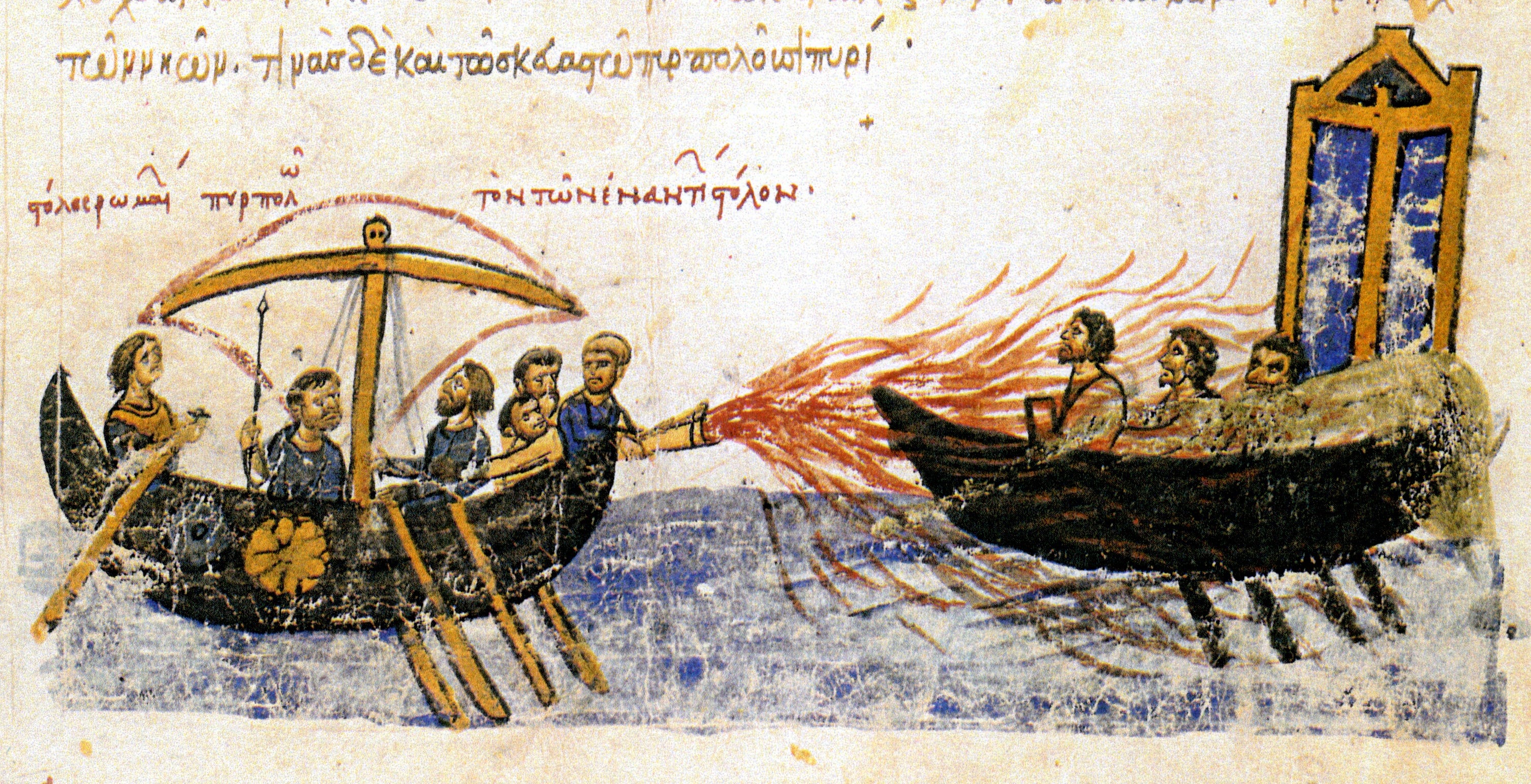
The authors try not to overstate the case, though. They acknowledge that there more-or-less simpler ways to make nuclear weapons than the most advanced varieties that make up the bulk of the warheads currently in the world, that there is considerable overlap in some aspects of weapons knowledge with other fields of knowledge, and would certainly not argue that even an “un-invented” technology could not be re-invented. We may not know exactly what the ancient recipe for Greek Fire was, but that has not stopped people from developing other kinds of incendiary weapons.
Still, the argument an interesting and provocative one, even as it raises some obvious objections. There are ways to reduce dependence on tacit knowledge, for instance: that is exactly what many instruments and machines are invented to do, it is the nature of automation.
As a very simple example, a 3D printer is a machine that reduces the tacit knowledge required to manufacture certain kinds of small components. Instead of learning how to sculpt a small figure out of plastic, I can instead take a data file (explicit knowledge) and command the printer to make me the figure. Even this will have some tacit component — I gather than using 3D printers well requires some hard-earned experience — but now we’ve shifted the tacit component from one domain (sculpting plastic) to another (maintaining the machine), and probably reduced it (becoming a competent sculptor takes years of specialized experience; learning to keep a printer functioning probably does not).
Are we locked into these technologies forever? Even after, as A Canticle for Leibowitz suggests, the technologies may have destroyed the civilization that produces them? It is a grim thought. One hopes not. The idea is what my colleague Benoît Pelopidas calls nuclear eternity, and is implicitly built into many discussions about nuclear weapons, even by those who argue against them, without being interrogated.5
One can imagine ways out of the bind. Despite widespread believe that technology has its own driving momentum, technologies do not exist for their own sake. Their creation and maintenance requires an immense about of work and effort. If you have doubt about that, you don’t have to trust the historians or sociologists, just look at the budget requests for “modernization” of American nuclear weapons: if the US does pledge billions, perhaps trillions, for ongoing maintenance and improvements, then its arsenal will wither away to nothingness. While presented as a problem to be (expensively) solved, it is actually a rather encouraging idea, restoring a much-needed sense of human agency to these conversations. As abstract as they seem, nuclear weapons are still just machines.
If you want to see a medieval historian turn an amusing beet-red color with rage, try using the term “Dark Ages” unironically, and then prepare for a long lecture about how in a few rarified places during the 14th century (the tail-end of the period) it wasn’t actually all that bad. Oh, medievalists, I kid, I kid…
An aside: I had the opportunity last summer to talk with J. Bryan Hehir, a Catholic priest who was involved in the creation of the 1983 pastoral letter of American Catholic bishops against nuclear war. His most amusing anecdote about it was about when the Americans were summoned to Rome to discuss the matter with a representative of the Vatican: none other than Cardinal Joseph Ratzinger, future Pope Benedict XVI. Ratzinger attempted to have the meeting carried out in Latin, to the chagrin of the Americans. Finally, one of them suggested that since the Romans lacked any technical terminology for nuclear weapons, it might be better to proceed in English, which was accepted. After making a bad pun about meeting an authentic member of the nuclear priesthood, I asked Hehir what he thinks he would have done if nuclear war had actually happened in the 1980s, and they had lost communication with the national and international Church. He thought about it a bit and suggested that he would try to seek out other Church representatives, so that they could coordinate some kind of aid activities. He offered up — and this is the relevance here — that the Catholic Church as an institution tries to think in terms of centuries or more, and has a bit of a track record for surviving the fall of civilization.
Donald MacKenzie and Graham Spinardi, “Tacit knowledge, weapons design, and the uninvention of nuclear weapons,” American Journal of Sociology 101, no. 1 (July 1995), 44–99.
“Fogbank: Lost Knowledge Regained,” Nuclear Weapons Journal, no. 2 (2009), 20–21.
Benoît Pelopidas, “The Birth of Nuclear Eternity,” in Sandra Kemp and Jenny Andersson, eds., Futures: Interdisciplinary Perspectives (Oxford University Press, 2021), 484-500.
Interesting, thought-provoking post.
"Riddley Walker" is a book that's stuck with me for decades. Whenever I see a certain kind of site--most recently, the near-ruin of the New York State Pavilion on the site of the 1964 World's Fair--I think of the book's line: “O what we ben! And what we come to!”
I've also read "Canticle for Lebowitz" but for whatever reason it hasn't stuck with me in the same way.
Fascinating insights, reminding me of a piece of media of POST-apocalyptical bent:
Thomas Thwaites’ “Toaster” art project, which demonstrates how much tacit AND explicit technology we take for granted.
https://www.thomasthwaites.com/the-toaster-project/
The linked “I, Pencil” is of equal interest, as it drives home how much of our (industrial) technology is dependent upon implicitly assumed other tech. Just “bringing along a couple of encyclopaedias in your time machine” wont suffice to build a civilisation from scratch. Not to HG Wells’ Eloi (in The Time Machine), not to Jonathan Hickman’s Holy Roman Empire (in Pax Romana).
We *used* to have a literary adventure subgenre, exemplified by Defoe’s Robinson Crusoe, focused on how Man can tame Nature/Adversity through Tech.
We would probably call it “PrepperPunk” today. And while it’s extremely popular as a gaming genre, mixing crafting, survival, resource management, etc… (eg Minecraft), very few “hard” post-apocalyptical novels have been able to (re)imagine how fast/slow we could (re)construct society “from scratch” (nor wether we would even *want* to).