

I had an interesting conversation recently with Ward Wilson about the historicity of the moral revulsion of destroying cities. Ward brought up the destruction of Carthage in 146 BC, a case he has written about before, and how even people in the Ancient world seemed to regard the destruction of an entire city as a moral hazard unlike most of those found in war.
I had not really thought about this before, as even though I wrote a lot about the specific moral hazards that many people (including Henry Stimson and Harry Truman) felt about the destruction of cities during World War II in The Most Awful Responsibility, I had not really considered that moral response in outside of the context of the 20th century.
But the conversation brought to mind something I had taught several years ago in a course for freshman on “The End of the World”: the sections of Genesis, in the Old Testament, about the destruction of Sodom and Gomorrah.
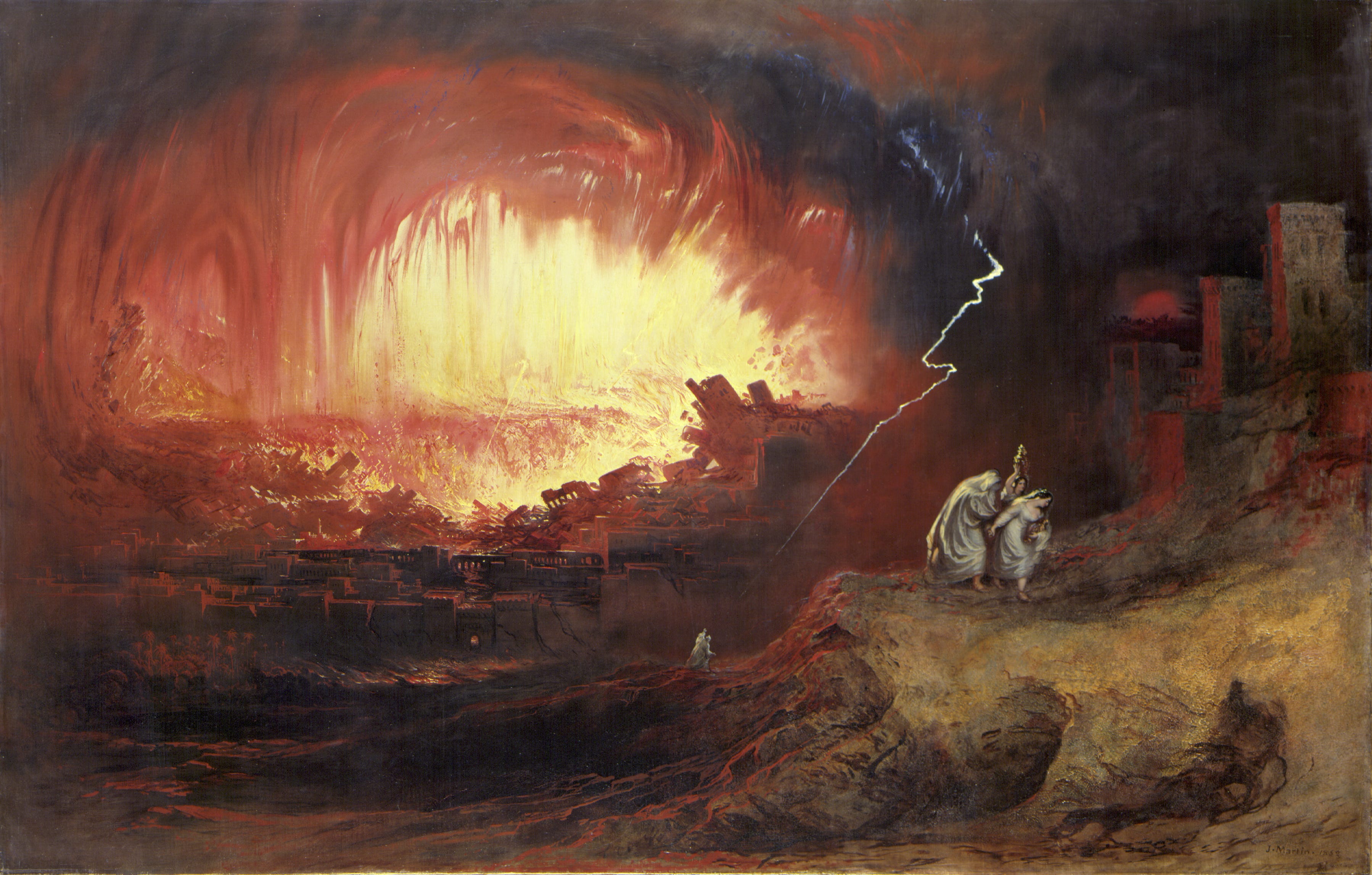

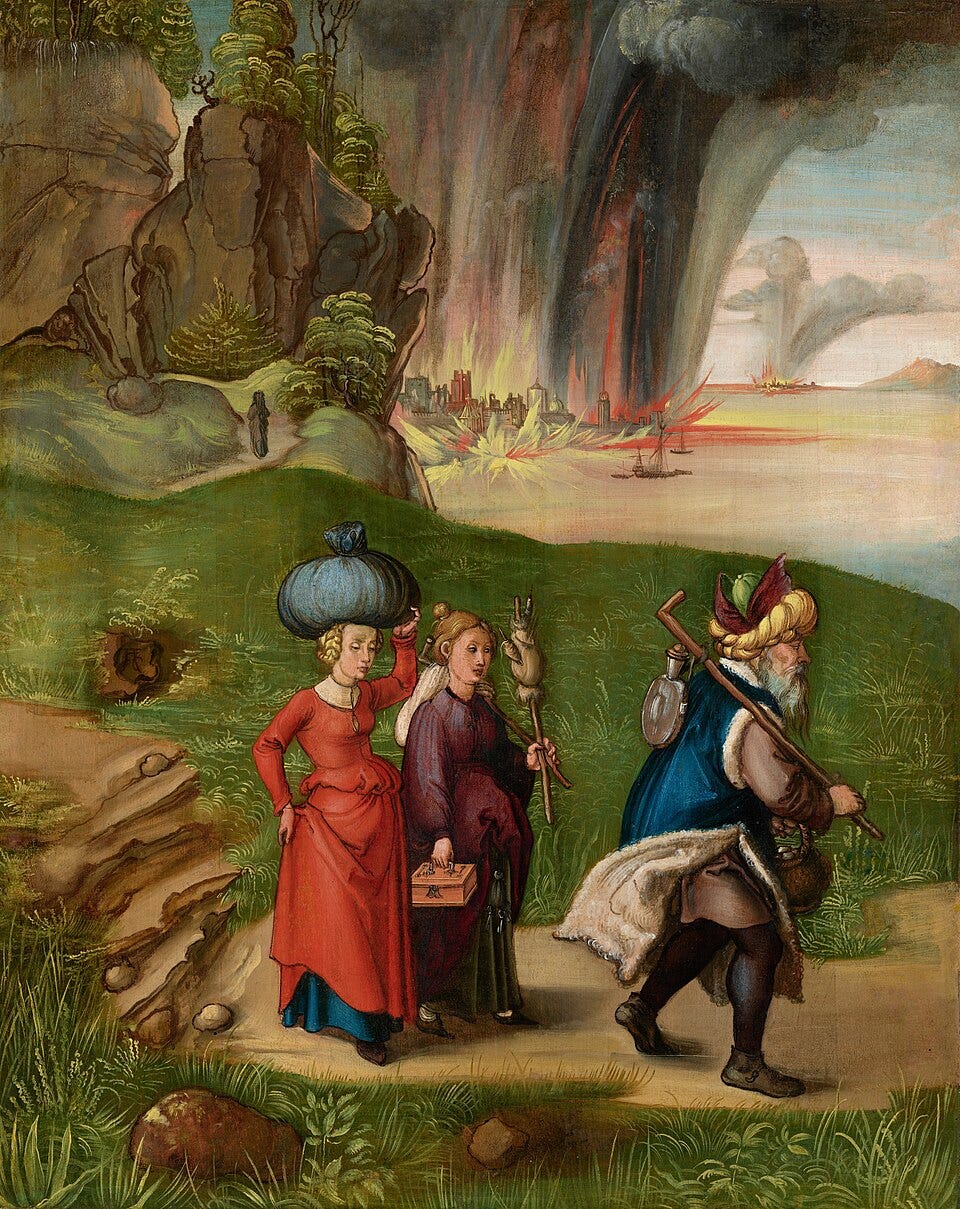
Most people know the general outlines of the story from Genesis 19: Sodom and Gomorrah were sinning, God was unhappy, and so he sent down some angels to check out Sodom. They found Lot, who took them in, and then the men of Sodom showed up and asked if they could have some non-consensual “fun” with the angels. Lot said no, the angels blinded the men, and then told Lot he and his family ought to head of out of town, because God was going to destroy it. Lot, his wife, and his two daughters left with the angels, who told them to not look back. God rained down destruction on Sodom and Gomorrah. Lot’s wife looked back, and was turned into a pillar of salt. Lot and his daughters end up settling in a cave and then they, er, decide that they ought to get pregnant by him, and so they get him drunk and, er, make it happen. The end.
Now, I am not at all, and have never been, a religious person. I am also not a scholar of either the Bible or ancient history. I am reading this text as a person who is very firmly rooted in the 21st-century, with no more deeper understanding of the issues of ancient context, ancient narrative, or translational differences than being able to proclaim my awareness that expertise in such areas clearly exists but I do not have it.
My sense is that most of the time when Sodom and Gomorrah are mentioned in a modern context, the discussion is focused on the why of it: what exactly was the “sin” that was occurring that was so offensive that they warranted total annihilation, and what kind of moral argument is can be derived from that? The text itself appears fairly vague on this point. Were the denizens of Sodom sinful because they attempted homosexuality, or was it because they attempted rape? Is this a story about sexuality, consent, or being bad hosts? And then these theological interpretations are mapped onto various modern political positions in fairly obvious ways. I don’t have a dog in that fight, in the sense that I do not base my views on the morality either homosexuality or rape on any ancient texts, and I generally believe that trying to dictate public policy on the basis of ancient texts is a bad idea no matter how clear or ambiguous they are. Which is just to say, that aspect of the story isn’t what I want to talk about here.
The parts that I find most interesting about the story, and relevant to my conversation with Ward, are not the basic things from the summary above. They are rather the context of the episode, which shows up as a detour from the story of Abraham, the Hebrew patriarch.
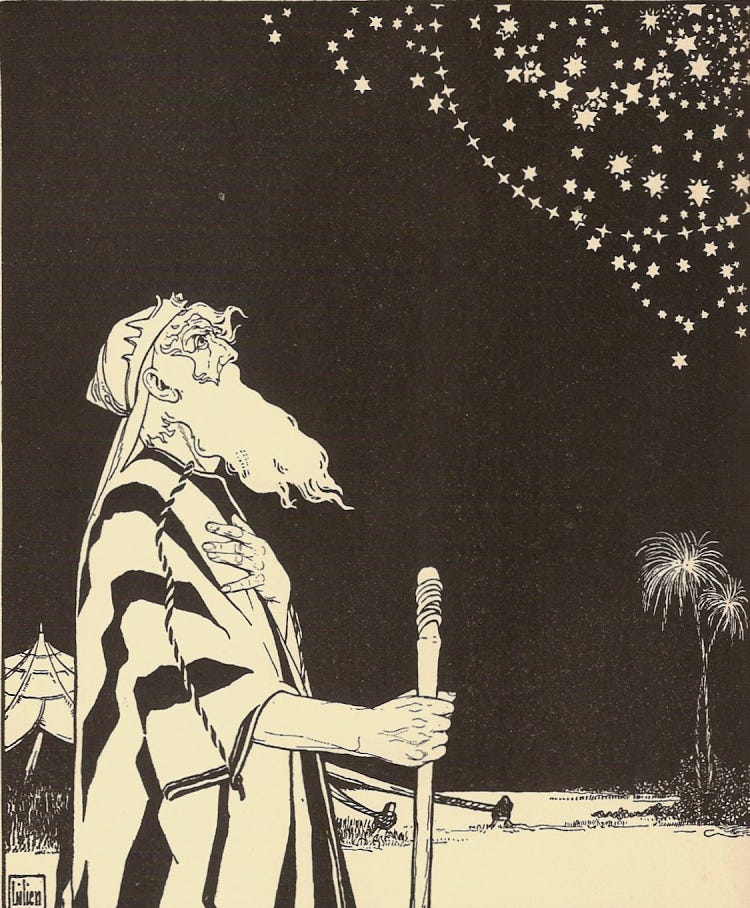

In Genesis 18, Abraham has a conversation with three mysterious men, and, in the not-quite-clear logic of the text, with God. The conversation ends up being about whether Abraham’s wife, Sarah, will bear children. As the men leave Abraham, they look at Sodom. And then we have this (translation is the New International Version):
When the men got up to leave, they looked down toward Sodom, and Abraham walked along with them to see them on their way. Then the Lord said, “Shall I hide from Abraham what I am about to do? Abraham will surely become a great and powerful nation, and all nations on earth will be blessed through him. For I have chosen him, so that he will direct his children and his household after him to keep the way of the Lord by doing what is right and just, so that the Lord will bring about for Abraham what he has promised him.”
Then the Lord said, “The outcry against Sodom and Gomorrah is so great and their sin so grievous that I will go down and see if what they have done is as bad as the outcry that has reached me. If not, I will know.”
Two things I want to highlight here. One is that God’s interest and concern with Sodom and Gomorrah is a response to “outcry” that has somehow reached God, and that God feels the need to send the angels as part of a fact-finding mission. This is not the omniscient, all-knowing, all-present God of the New Testament: this is a God who needs to get some boots on the ground to see if the complaints he’s receiving are valid.
The other is that God’s has this kind of internal dialogue where he’s wondering whether he should tell Abraham about his plans, and concludes, yeah, I should probably give him the head’s up about Sodom, since I think he’s my guy.1 This again adds to this very “human-like God” interaction, but more importantly, is structured about whether he should “hide” what he’s doing from Abraham. That is, it’s not, “should I tell him?” so much as it is “should I not tell him?”
Why would God want to hide his plans from Abraham? Presumably because God is not sure that Abraham is going to like what God is going to do. And, as it turns out, Abraham is pretty upset by the whole thing:
The men turned away and went toward Sodom, but Abraham remained standing before the Lord. Then Abraham approached him and said: “Will you sweep away the righteous with the wicked? What if there are fifty righteous people in the city? Will you really sweep it away and not spare the place for the sake of the fifty righteous people in it? Far be it from you to do such a thing—to kill the righteous with the wicked, treating the righteous and the wicked alike. Far be it from you! Will not the Judge of all the earth do right?”
The Lord said, “If I find fifty righteous people in the city of Sodom, I will spare the whole place for their sake.”
Abraham’s argument with God is fascinating. Will you really kill an entire city because some of its inhabitants are wicked? What about the righteous people within it? This is an ancient argument about discrimination, a core concept in many laws of war: don’t be indiscriminate with your violence, don’t sweep away the righteous and the wicked equally. Abraham pushes this point with an emotional appeal, as well: you’re God, surely you can see that this would be an injustice! Surely you, of all things, would not commit such an atrocity!
And… it works! God says, OK, if there are 50 righteous people in Sodom, I’ll call the whole thing off. (I still find it amusing that this whole thing is still tied to the fact-finding mission.) Now, one could question why God is doing this. Does he really buy the moral argument Abraham is making, or is he trying to just make Abraham happier, or is he trying to prove a broader point about how wicked Sodom is? Who can say? I would just note that one of the major irritations of Old Testament God is doubting him and defying him — Cf., Lot’s wife — so it is really quite gutsy of Abraham to try and claim some kind of moral high ground here.
If the above was the end of the interaction, that would be one thing. But this negotiation goes on and on, in a way that, to me, risks becoming comical:
Then Abraham spoke up again: “Now that I have been so bold as to speak to the Lord, though I am nothing but dust and ashes, what if the number of the righteous is five less than fifty? Will you destroy the whole city for lack of five people?”
“If I find forty-five there,” he said, “I will not destroy it.”
Once again he spoke to him, “What if only forty are found there?”
He said, “For the sake of forty, I will not do it.”
Then he said, “May the Lord not be angry, but let me speak. What if only thirty can be found there?”
He answered, “I will not do it if I find thirty there.”
Abraham said, “Now that I have been so bold as to speak to the Lord, what if only twenty can be found there?”
He said, “For the sake of twenty, I will not destroy it.”
Then he said, “May the Lord not be angry, but let me speak just once more. What if only ten can be found there?”
He answered, “For the sake of ten, I will not destroy it.”
When the Lord had finished speaking with Abraham, he left, and Abraham returned home.
The fact that Abraham haggles God down from sparing the city if 50 righteous people can be found down to 10 is amazing. I also love the detail of Abraham repeatedly being self-deprecating: I know I’m just a guy, a little worm, really, and you’re God, the amazing, but I just want to offer one more little suggestion…
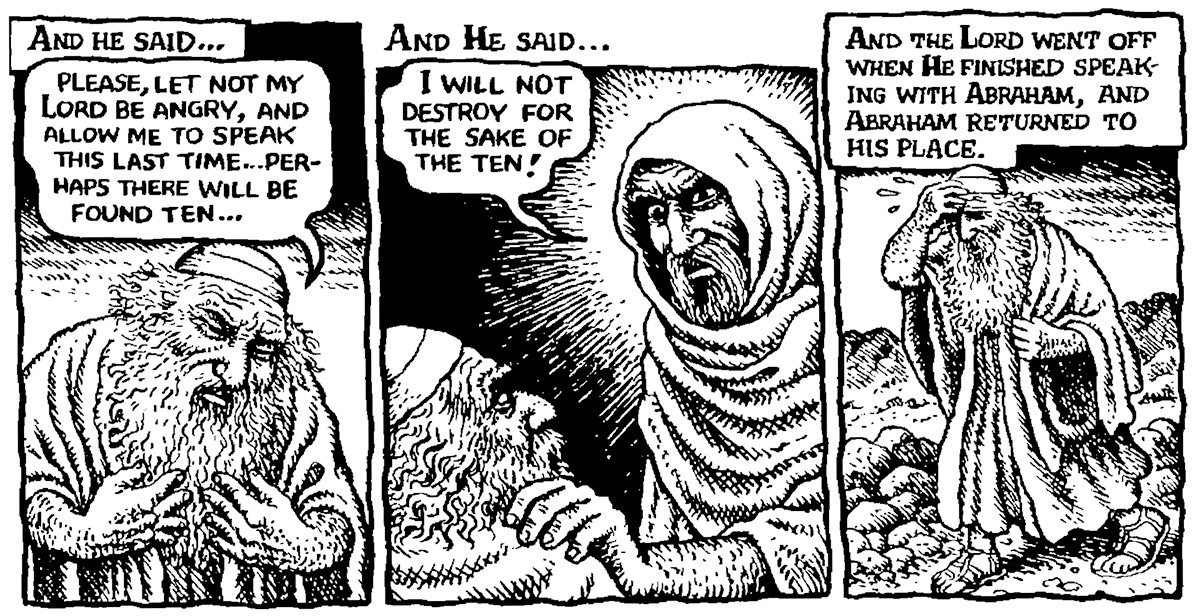
Ten people! The moral reasoning on display here is quite interesting. We don’t know the total population of Sodom, so it is hard to derive what proportion of wicked people to righteous people warrants preservation or destruction, but by the end it surely cannot that high. There is also the explicit appeal to the idea that once you have defined some number of righteous, it is not clear that one can make a differentiation of moral “weight” for lesser numbers. That is the heart of the whole, “if you agree 50 is enough, why not 45?” part, and he gets him all the way down to 10 on that logic.2
Thus ends Genesis 18, and we transition to Genesis 19, which is the story (already recounted) of the angels visiting Sodom, Sodom’s destruction, and Lot and his daughters’ cave “incident.” An interesting aspect of this that I did not recount is the return to Abraham’s point of view near the end (post pillar of salt, pre-Lot and his daughters):
Early the next morning Abraham got up and returned to the place where he had stood before the Lord. He looked down toward Sodom and Gomorrah, toward all the land of the plain, and he saw dense smoke rising from the land, like smoke from a furnace.
So when God destroyed the cities of the plain, he remembered Abraham, and he brought Lot out of the catastrophe that overthrew the cities where Lot had lived.
The last section is the key part, for me: we seem to be being told that the reason that Lot and his family were spared at all is because of Abraham’s moral argument with God. So the argument was not entirely for nothing — Abraham couldn’t spare the cities, but a few lives were saved.3
So that is the ancient text itself, which makes an interesting argument against indiscriminate destruction of cities, one that even God seems to cosign, albeit only up to a point.
The text leaves much to the imagination. What does Abraham think when he gazes onto the destruction from Sodom? What is Lot’s wife thinking as she turns to look? How does Lot feel, to be an almost sole-survivor of a catastrophe, to know that his compatriots, and much of his family, were sentenced to such a harsh punishment? The text itself does not say. But that does not mean, if we are not afraid of sullying the original story, that we cannot think about it.
.jpg)
This is the task that Karel Čapek (1890-1938), the Czech author and playright who is most famous for coining the word robot in his 1920 play R.U.R., took on in his 1923 story, “Pseudo Lot, or Concerning Patriotism.” “Pseudo Lot” takes the text of Genesis 19 (the destruction of Sodom and its aftermath) and reworks it. Parts of the text, added in italics, are verbatim from the source material. But much of it is by Čapek, and instead imagines how Lot would feel about the destruction of his city, and about the opportunity held out for his own survival.4
And they said unto Lot, Hast thou here any besides? son-in-law, and thy sons, and thy daughters, and whatsoever thou hast in the city, bring them out of this place: For we will destroy this place, because the cry of them is waxen great before the face of the Lord; and the Lord hath sent us to destroy it.
Lot was taken aback when he heard this, and he said: “And why must I go from this place?” Whereupon they said to him: “Because the Lord does not wish to destroy the righteous.”
Lot was silent for a long while, but then he said: “I beseech you, sirs, give me leave to speak with my sons-in-law and daughters, that they may make ready for the journey.” They answered him: “Do so.”
And Lot went out, and he ran through the streets of the city and cried out to all the people: “Up, get you out of this place; for the Lord will destroy this city.” But he seemed to them as one that mocked them.
Lot returned home, but he did not lie down, but pondered all night long.
Čapek’s Lot is a deeper, agonized character than the one of Genesis. Lot is torn by the demand: he does not want to lose his town, no matter how wicked its inhabitants are. He cannot reconcile this request, even though he knows they are wicked. The next day, he refuses the command to leave:
And when the morning arose, then the angels hastened Lot, saying: “Arise, take thy wife, and thy two daughters, which are here; lest thou be consumed in the iniquity of the city.”
“I will not go,” said Lot. “Forgive me, but I will not go. I have pondered this all night long. I cannot go, for I too am one of the people of Sodom.”
“You are righteous,” objected the angels, “but they are unrighteous, and the cry of their iniquities has angered the Lord. What are they to you?”
“I don’t know,” said Lot. “I have been thinking about this too, what they are to me. All my life I have complained about my countrymen, and I have judged them so harshly that it grieves me to recall it now: for they will perish. […]
And an angel spoke and said: “The Lord has commanded that the people of Sodom be destroyed.”
“His will be done,” said Lot quietly. “I pondered all night long, and I recalled so many things it made me weep. Have you ever heard how the people of Sodom sing? No, you don’t know them at all, or you wouldn’t have come like this. When the girls walk along the streets they swing their hips and a song hums through their lips and they laugh as they draw water into their pitchers. No water is more clear than that from the wells of Sodom, and no speech in any tongue sounds more beautiful. When a child speaks, I understand him as if he were my own, and when he plays, he plays the games I played when I was very small. And when I cried, my mother comforted me in the speech of Sodom. Lord,” cried Lot, “as if it were yesterday!”
Lot continues in this vein, appealing to the fact that there is good amongst wickedness, and that God’s demand of him is, ultimately, unreasonable and unjust:
“You will be destroyed with them,” said the angel, frowning.
“Perhaps, but first I’ll try to save them from destruction. I don’t know what I’ll do, but until the last moment I’ll think it my duty to help them. How could I possibly go? I am disobeying the Lord, and so He will not hear me. If He had given me three years’ time, or three days, or even three hours! What would three hours matter to Him? If yesterday He had commanded me: Go forth from their midst, for they are unrighteous — I would have said to Him: Be patient with me for just a little while, I’ll have a word with this one and that one; I have judged them instead of going out amongst them. But how can I leave now, when they are to be destroyed? For am I not partly to blame that things have gone so far with them? I don’t want to die, but neither could I bear for them to die. I will stay.”
“You cannot save Sodom.”
“I know I can’t: what could I possibly do? But I will try, although what, I don’t yet know; I only know that I must persist. Because all my life I judged them more harshly than anyone else, because I have borne with them the heaviest burden: their faults. Lord, I don’t know how to tell You what they are to me; I can only show it by staying with them.”
Čapek’s Lot is making a very different kind of appeal than the one undertaken by Abraham: not about saving the righteous, but about the fact that even the wicked deserve mercy, and that one owes something to one’s people, however imperfect they may be.
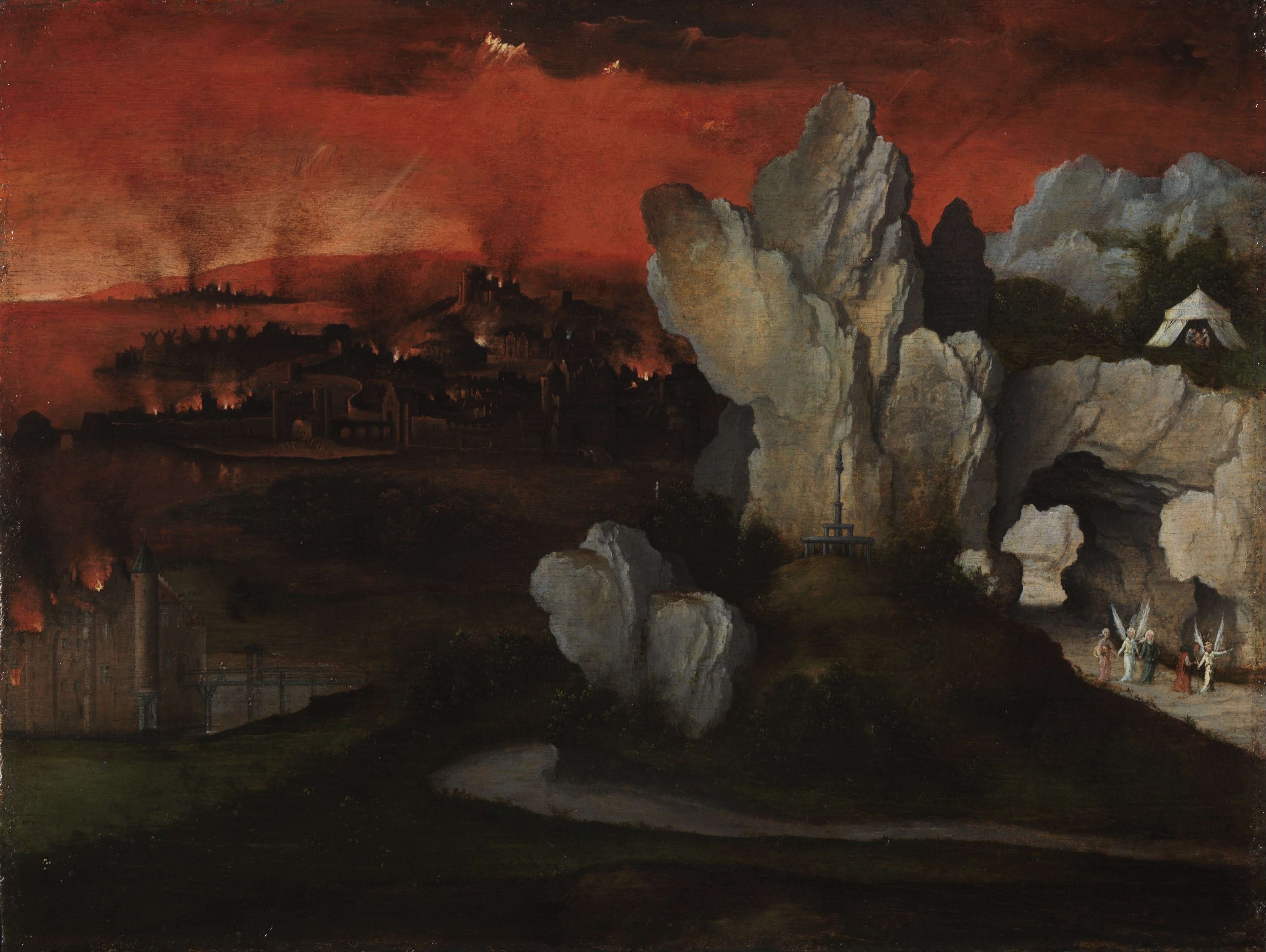

Ultimately, Čapek’s version makes a hard turn away from the source material: Lot refuses to flee.
“Sodom, Sodom, art thou not the most beautiful of cities? [says Lot] And if I were to see only one small window, curtained in striped linen, I would know it and say: this is a window of Sodom. […]
“Oh gates, gates of Sodom, where are they leading me and into what emptiness? Where shall I set my foot? For there is no ground beneath me: and I stand as if I stood not. Go, my daughters, and leave me; I can go no farther.”
And they brought him forth, and set him without the city; and they spake unto him, saying: Escape for thy life; look not behind thee, neither stay thou in all the plain; escape to the mountain, lest thou be consumed."
The sun was risen upon the earth when they said this.
Then the Lord rained upon Sodom and upon Gomorrah brimstone and fire from the Lord out of heaven.
Then Lot looked round and cried out and ran back towards the city.
“What are you doing, accursed one?” the angels called after him.
“I am going to help the people of Sodom,” answered Lot, and he went into the city.
Thus it ends. What does one make of this? It feels radical for Čapek to make a story that is, ultimately, a defense of Sodom, from the perspective of one of its members. Who defends Sodom? Well, in fact, Abraham does: it is not so radical to suggest that there is something unjust in God’s plans.5
For me, the interesting thing about destroying Sodom (and Gomorrah, who basically has no independent story) is not so much the question of the sin or wickedness, but the more fundamental questions about justice that get raised both in the text (Abraham’s haggling) and in works like Čapek’s. When is it just to destroy an entire city, to be indiscriminate with wrath? Even the God of the Old Testament, who no one would ever accuse of being “soft,” appears to have worried about such things, and to be vulnerable to arguments about the moral hazards involved.
This is a tangent, but the fact that the Old Testament God has these internal, “conscious” conversations is fascinating to me. It almost makes me want to comb over all of the texts for evidence of “internal dialogue” voiced by God.
I would remiss if I did not note that I find Julian Jaynes, The Origin of Consciousness in the Breakdown of the Bicameral Mind (1976) a fascinating and bizarre read, and while I do not really buy his overall argument, I do think his reading of the differences between the Old and New Testament, and the way they represent both men and God, really interesting.
The basic gist of Jaynes’ book is that people were not truly “conscious” in a unified way (he believed the two hemispheres of the brain did not mesh completely, essentially — he is actually quite unclear about what he actually is arguing throughout much of the book) until relatively recent in human history, and that the Old Testament was written by pre-conscious people and the New Testament by conscious people, and the relationship to God in the books reflects this (Old Testament God is basically either just another person or a talking, animated object, like a burning bush, whose actual “voice” originates in one of the disconnected hemispheres of the brain; New Testament God is increasingly intangible, rendered abstractly). If you do not know about Jaynes and this sounds ridiculous to you, yes, exactly, it is a wild argument and a strange book. I was amazed that anyone took it seriously at all until I discovered that Jaynes was the chair of the Princeton psychology department. The book is full of fascinating “small” arguments and facts about ancient history and studies of psychology (split-brain, obviously, but also things like research about glossolalia), with many gestures towards a larger argument that he never quite articulates clearly (in my reading of it).
As I said, I don’t actually “buy” Jaynes’ argument about consciousness and history (as much as I can claim to understand it, because, again, it is kept really vague most of the time), but it is still a really fascinating and provocative book.
There is no sign in the text that God required stopping at 10 — one almost wishes Abraham would have pushed further and God would have said, “nope, 10 is my limit.” It implies, perhaps, that Abraham stopped too early. If Abraham had pushed God down only a little further, Sodom probably would have been spared: Lot, his wife, and his daughters make 4, and it is not implied that the rest of Lot’s family who perished were wicked, but rather were incredulous about the coming destruction. Maybe that is one of the lessons here: don’t stop haggling prematurely.
And, one might add, the text makes clear that because of the, uh, “incident” between Lot and his daughters, two whole groups of people (the Moabites and the Ammonites) later existed. So there is, perhaps, an argument about the utility of even small-scale sparing.
Čapek wrote a number of such stories that are riffs off of other, older stories, which were collected as Apocryphal Tales posthumously.
Interestingly, in 1931, Čapek write a similar story which picks up immediately after Abraham’s “haggling” with God over Sodom, in a story called “The Ten Righteous.” It is basically Abraham and Sarah arguing over who might be the best candidates for sparing Sodom, given Abraham’s deal. It’s of a somewhat different character. After Abraham suggests Lot’s daughters are among them, Sarah objects: “Don’t even think about it. That older one, Jescha, is a shameless hussy. Haven’t you noticed the way she waggles her bottom at you? Lot’s wife said to me herself, ‘Jescha gives me so much trouble, I’ll be glad when she’s married.’ The younger one seems more modest. But if you think we should, then count both of them in.” After Sarah suggests another candidate, Abraham objects: “Asriel is a fancypants. I can’t propose some buffoon to the Lord. What if I named Namuel? No, Namuel doesn’t deserve it, either. I don’t know why we should have Namuel, of all people.” Eventually they conclude that they can’t come up with a solid ten they would agree upon as righteous.
One of the reasons for the God of the Old Testament having these sort-of-internal conversations with unclear or under-specified interlocutors and making partial exceptions to his own judgements is that some of these are monotheist redactions of earlier stories which involve councils or parliaments of deities. e.g. the Sumerian version of the flood story where the gods corporately decide to destroy humankind but Enki warns his favourite priest by pretending to talk to the wall.
The whole "old testament" binary opposition between G-d and Jesus, where G-d is vengeful and unloving and Jesus saves, is a particular Christian idea based in the "new" testament, not the Hebrew bible.
Anyway, there is loads of writing about this exchange with Abraham, in the Talmud and a lot of other places. This text is why some Jewish prayers require a quorum of ten adults. This is a particularly awkward number of people to gather. It's too big to just notify your friends - there's a bit of work involved getting everyone there. But it's not an impossible number. It's doable, but requires effort. Which is, of course, why it was chosen. Because it is larger than one family, it creates and maintains community cohesion. I would think it's doing the same thing in the text as it's doing now when friends of a person in mourning are trying to find ten people to turn up at a gravesite.