

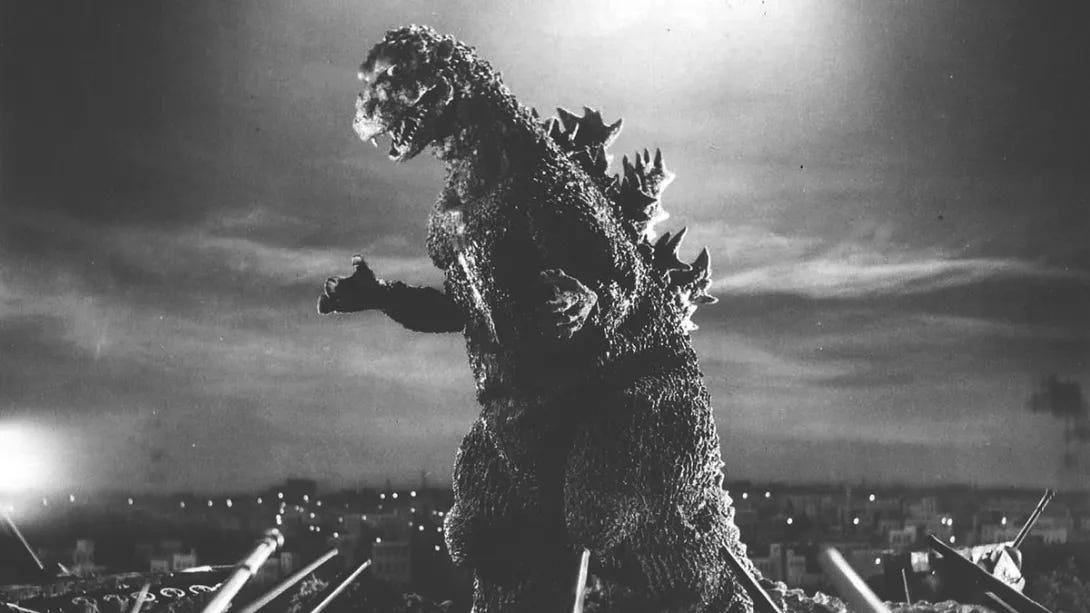
The 1954 film Gojira, known in the United States as Godzilla, King of the Monsters (1956), is famous as the exemplar of the genre of giant radioactive monsters who go on destructive rampages. There had previously been giant monsters (e.g. King Kong, 1939), but Godzilla, as a radioactive monster, captured something specific about his time and context, serving as a fairly obvious metaphor for the menace of nuclear weapons.
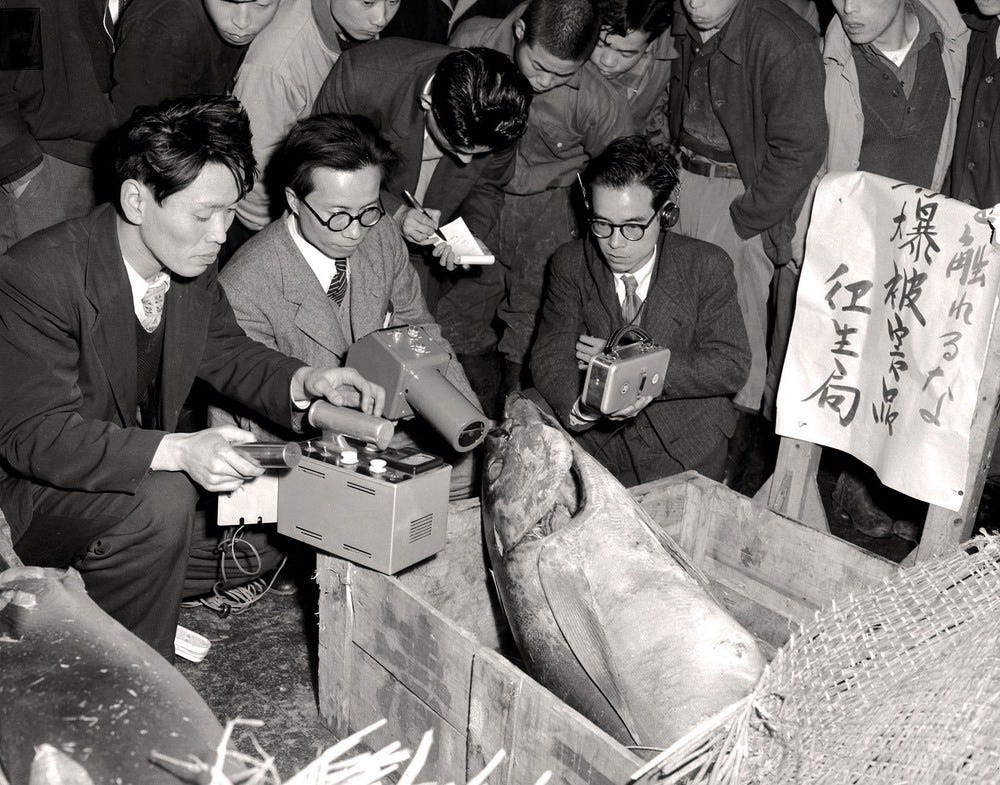
The film was famously inspired by the Castle Bravo accident in March 1954, in which the first test of a deliverable hydrogen bomb at the Bikini atoll by the United States resulted in a radiological catastrophe, with a massive and intense fallout plume that required the evacuation of native Marshallese islands and American observers. A Japanese fishing boat, the Daigo Fukuryū Maru (“Fifth Lucky Dragon”), was also accidentally exposed to its fallout, and after returning to port in Tokyo, its crew began to suffer from the characteristic symptoms of radiation poisoning. One of the crew eventually perished. Prior to this, the tuna catch was released to the Japanese fish markets, leading to a public panic as authorities sought to identify the radioactive tuna. The consequence was a temporary boycott on the eating of tuna, a staple of Japanese food, across the country.
The Bravo accident was an important moment for the Japanese public, who were only two years independent of the American Occupation of Japan, under which discussions about the atomic bombings of Hiroshima and Nagasaki were seriously curtailed, out of fear that they would lead to anti-American or pro-Communist sentiments. Bravo re-opened the issue, centered around (rightly or wrongly) the notion of the Japanese status as atomic victims, a status now doubly implicated. And so Bravo is seen in retrospect as a turning point for the emerging Japanese political movement against nuclear weapons.1
This was, according to those who worked on it, part of the context of deciding to make Gojira, and to make the film and creature a complicated metaphor for nuclear weapons, Japan’s status as a nuclear victim, and even a reminder of Japanese civilian suffering during World War II. I had heard (and taught) this story many times, because it is always interesting in retrospect to see that something that is often dismissed as a rather trivial pop culture phenomena (giant radioactive monsters) be rooted in a much broader political and social movement that can be traced back to a specific event (an American hydrogen bomb test).
But I was recently digging around a bit more in the history of Gojira/Godzilla, and was surprised to discover that Bravo was only half of the equation. The other half was something quite different: another radioactive monster film. What became Gojira was conceived of by its producer, Tomoyuki Tanaka, as a merging of the post-Bravo mindset with a now-forgotten American film that had come out the year before, The Beast from 20,000 Fathoms, which has its own radioactive monster going on a rampage. I was also surprised to learn that the working title for Gojira was even The Giant Monster from 20,000 Leagues Under the Sea.
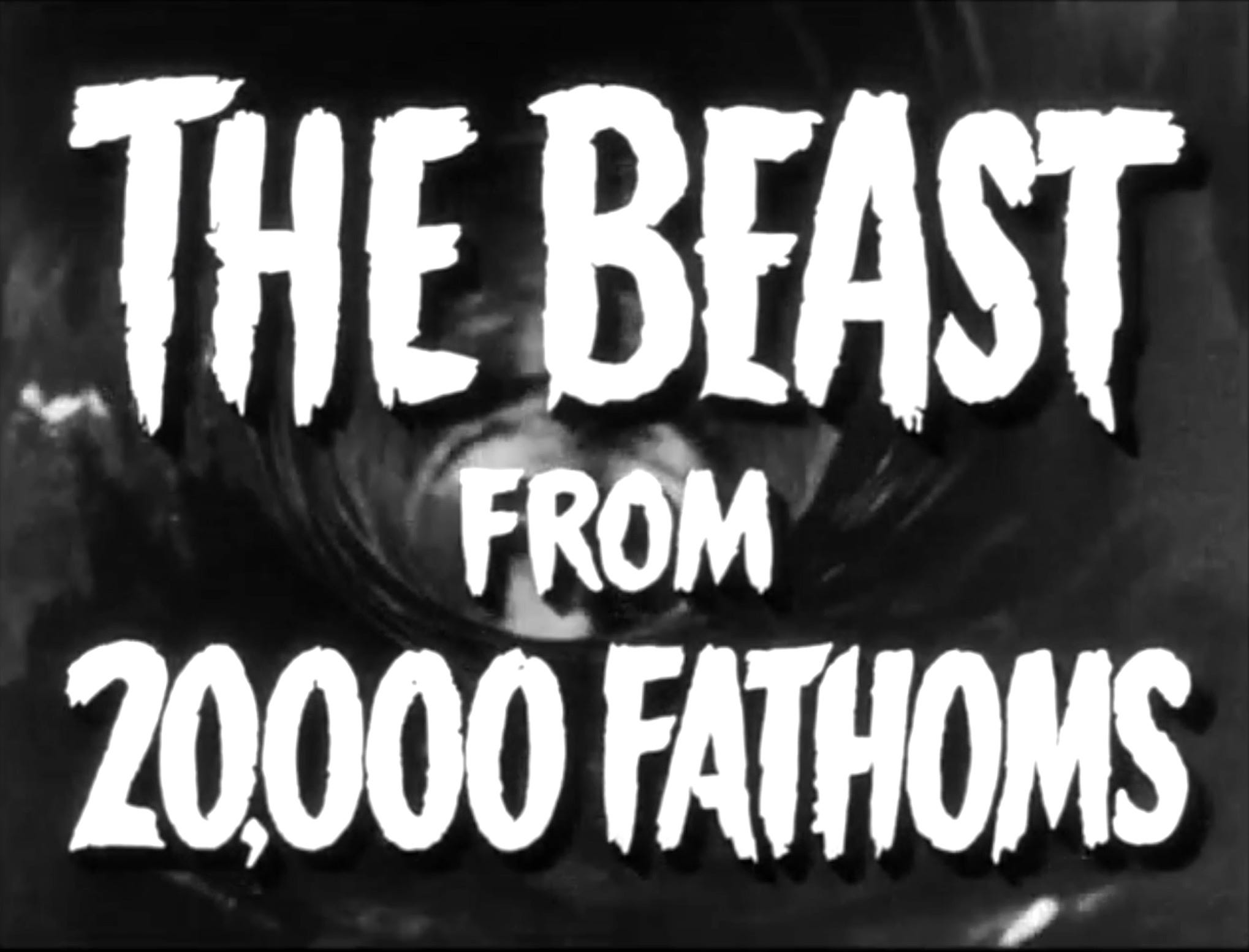
The Beast from 20,000 Fathoms was directed by the Russian–French filmmaker Eugène Lourié, produced independently, and distributed by Warner Brothers. A decent quality scan is available to download or stream for free on Archive.org. Its title comes from a short story of the same name by none other than Ray Bradbury which ran in The Saturday Evening Post in 1951.
Bradbury’s story, later anthologized as “The Fog Horn,” has almost nothing to do with the film as made. It was apparently quite popular, and so the filmmakers decided to buy the rights to it for their already-in-production monster movie, but other than a vague similarities and a single scene (involving a light house), the influence of the story feels rather absent. I had gotten my hopes up that one could trace Godzilla back to Ray Bradbury, but it’s a stretch.
The plot of The Beast from 20,000 Fathoms is as follows (feel free to skip to “THE END” — you’ll see it — if you don’t care about the recap, and just want the analysis). It starts in the arctic (it is later implied to be somewhere near Greenland), where the military and the US Atomic Energy Commission are conducting a nuclear test detonation with the deeply uninspired codename of Operation Experiment. The details of the experiment are unclear, but we see some good stock mushroom cloud footage from the 1940s (one part of the sequence is even cribbed from the Trinity test).2
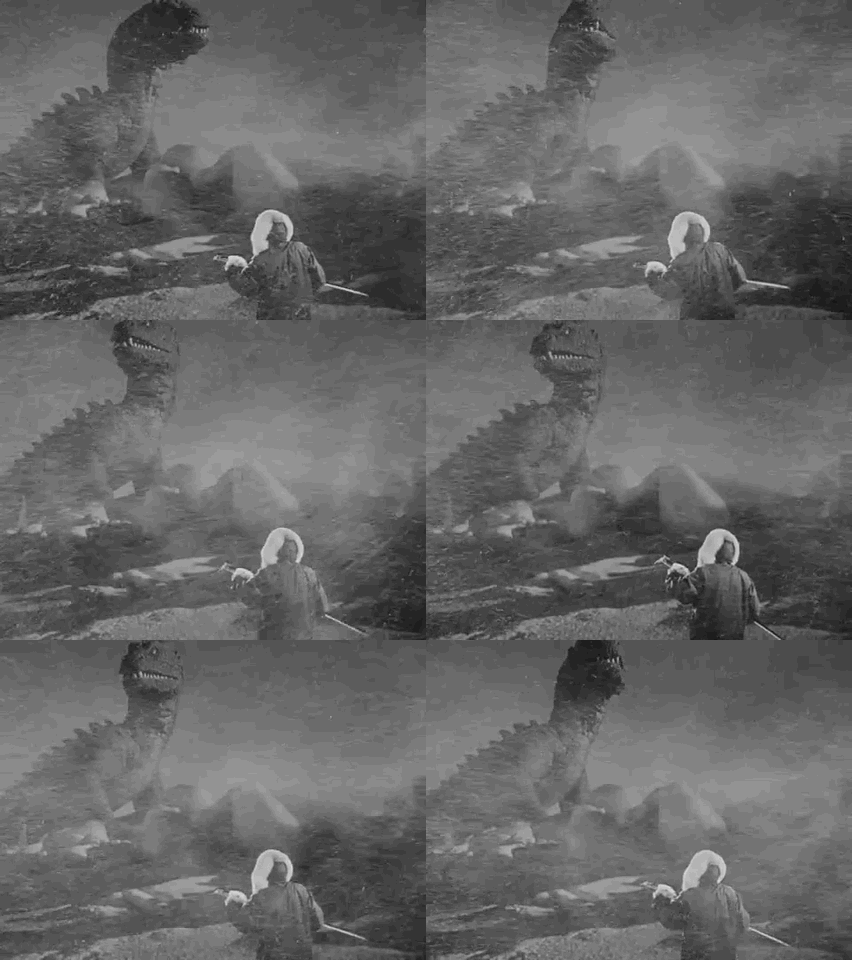
Afterwards, two AEC scientists go outside to take measurements. One of them sees a gigantic lizard creature, and is so shocked that he falls off of a ledge. The ledge only looks like it is 15 feet tall, and he falls onto snow, so it is perhaps a little silly that this results in an apparently fatal condition. While searching for him, his companion, a German-American physicist named Thomas Nesbitt, also catches sight of the creature, before he is himself injured in an avalanche. Nesbitt is found by others and brought back to the base in poor condition, and quickly relocated back to the United States for treatment.
Nesbitt heals physically over time from his traumatic event, but psychologically everyone thinks that he has perhaps lost his mind. Quite a lot of the film is Nesbitt attempting to convince others that he saw a gigantic lizard monster in the arctic, and them more or less politely suggesting that he must be delusional.
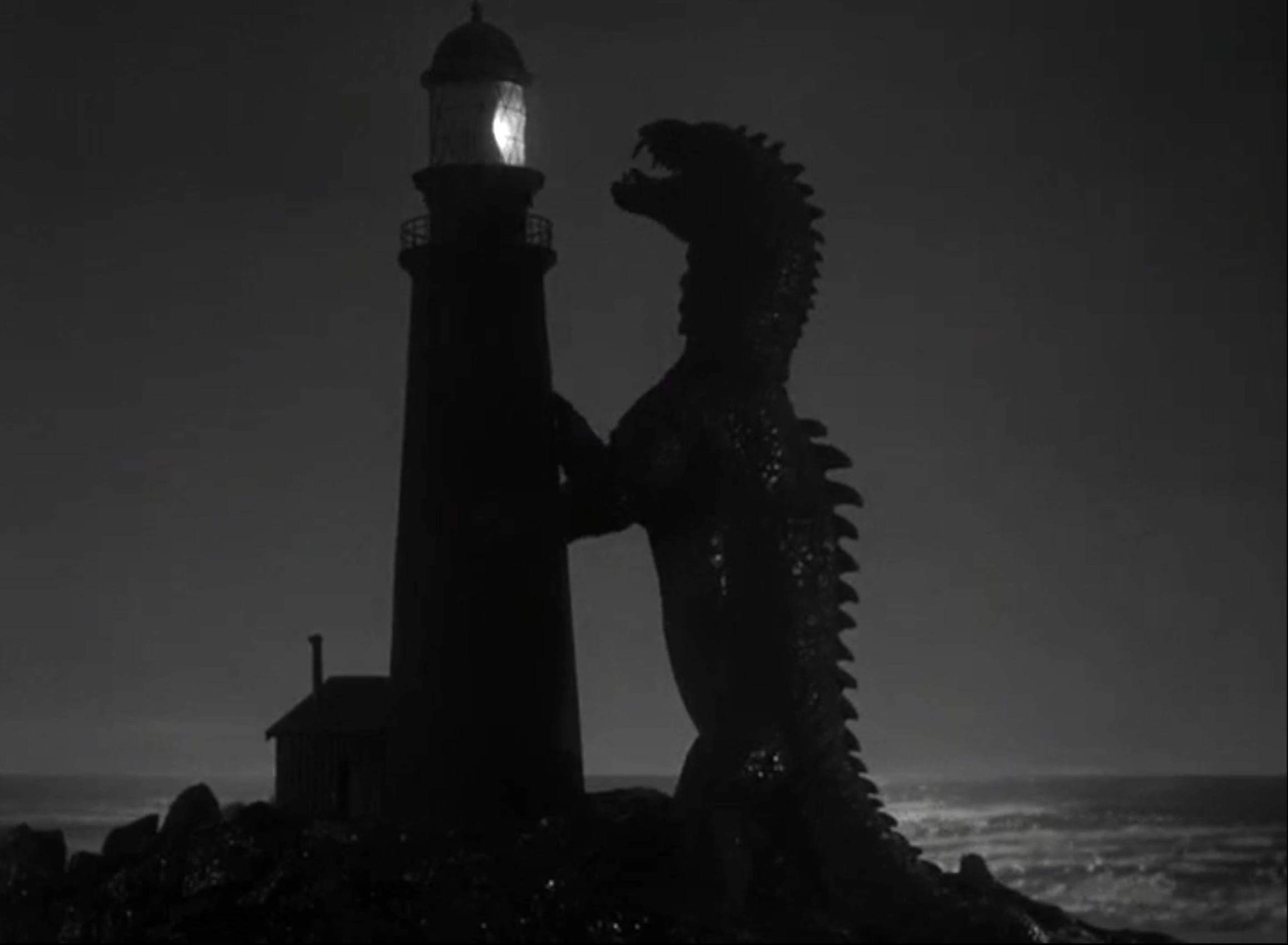
But, of course, we, the audience, know that Nesbitt is not delusional, because we are watching a monster movie. The creature, brought to life by the famed stop-motion pioneer Ray Harryhausen, makes his way south through the water, causing havoc as he goes. He destroys a few boats, and later attacks a lighthouse — the latter being the only real connection to the Ray Bradbury story, which is about a lighthouse that gets attacked by a giant monster. Nesbitt hears of these attacks and connects them with his own story.
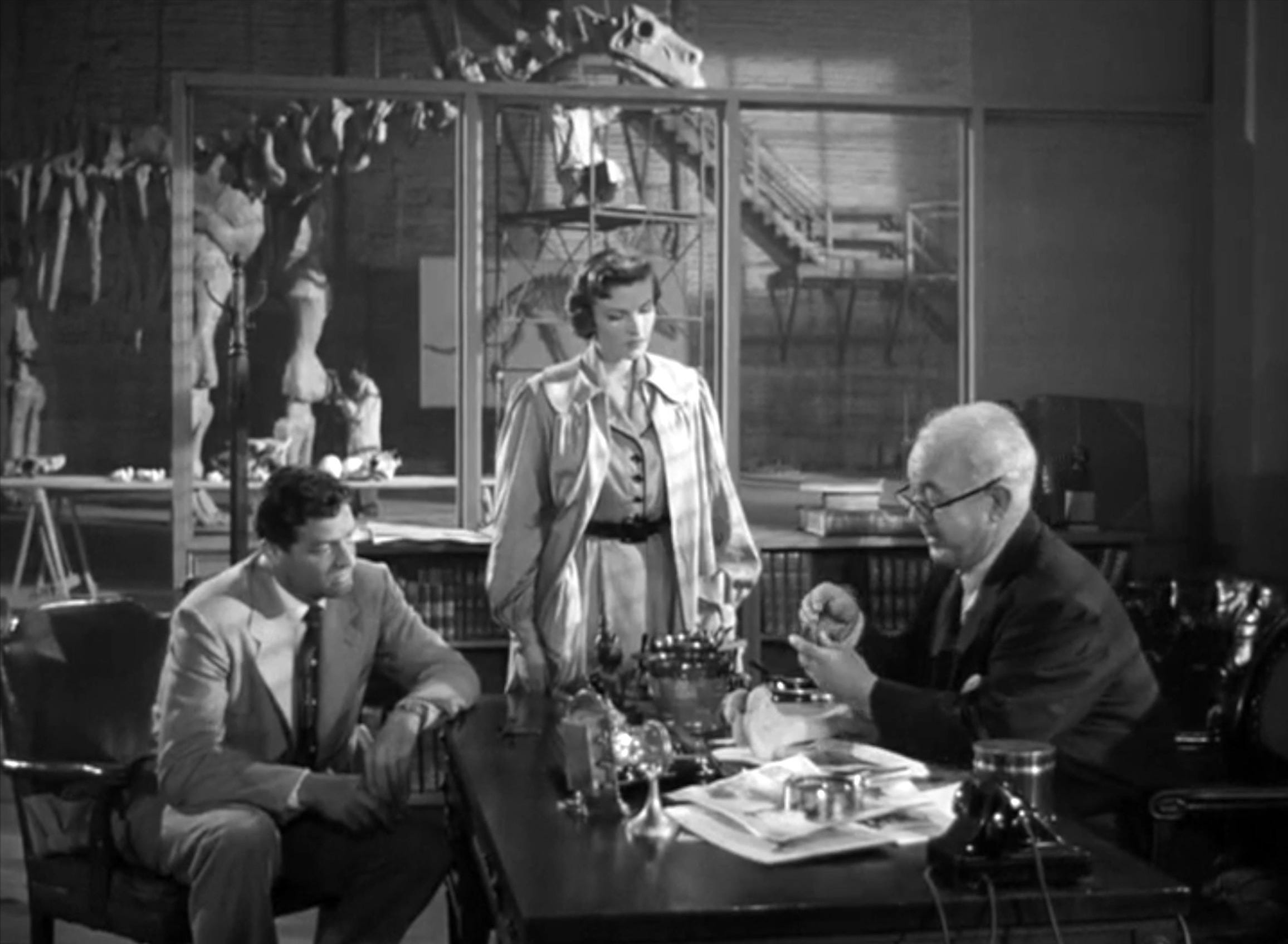
Nesbitt contacts Dr. Thurgood Elson, a world-esteemed paleontologist, to ask about whether the creature could have been some kind of dinosaur that had become frozen in the ice, in a state of suspended animation for millions of years, and was awoken by the nuclear testing. Elson points out the many, obvious flaws in this idea. Elson’s assistant, the comely Lee Hunter, however, is intrigued by Nesbitt. She later meets up with him to show him drawings of different dinosaurs, on the off-chance that he can identify his monster. He concludes it was a Rhedosaurus, a (fictional) dinosaur that looks to me like a wingless dragon.
In order to prove that he didn’t imagine the whole thing, Nesbitt and Hunter work to find survivors of the other attacks. Nesbitt eventually connects with one of the sailors, and convinces them to return with him to New York, where, in the presence of Dr. Elson, he looks over the same dinosaur drawings that Nesbitt had and picks out the Rhedosaurus. Elson is convinced and lobbies the military to take Nesbitt’s claims seriously. While briefing the military, Elson notes that plotting the Rhedosaurus attacks on a map shows a definite southern movement, perhaps towards a deep sea canyon where many Rhedosaurus fossils had been found — perhaps an old breeding grounds.
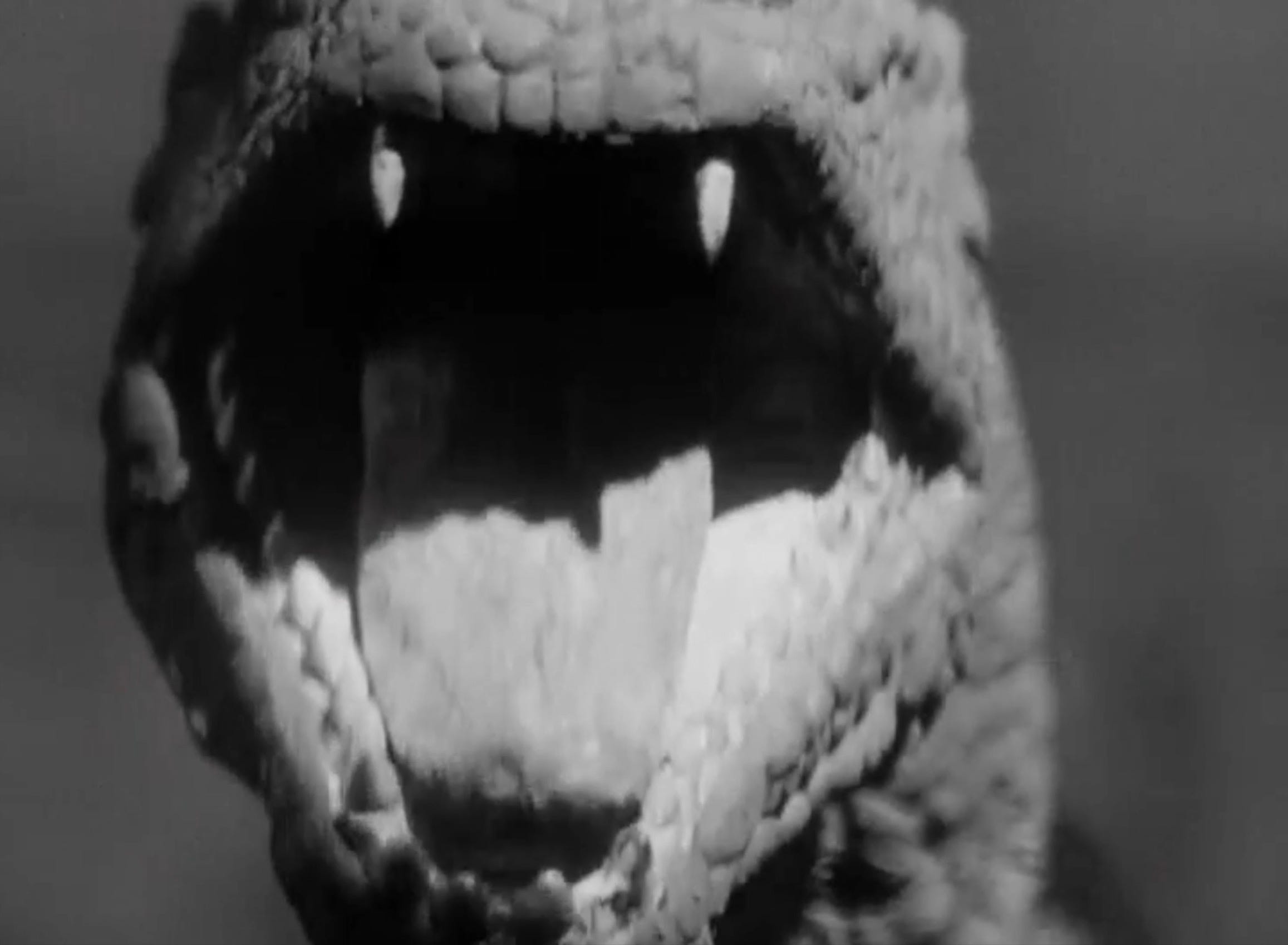
Elson convinces the military to allow him to descend in a diving bell to scout for the Rhedosaurus. After a pointless but extended sequence of a shark fighting an octopus that looks half-real and half-puppet (one wonders if this is recycled footage made for some other film), he finds the lost dinosaur, and is delighted. Of course, it eats him. This is about the 3/4ths of the way through the film — it has taken this long for Nesbitt to be conclusively validated.
The Rhedosaurus soon after surfaces in southern Manhattan and begins wrecking havoc. A police officer shoots it with a pistol and is eaten for his troubles. The Rhedosaurus destroys some cars and crashes through some buildings. Air-raid sirens scream. Crowds flee in a great panic. Somehow the police and military lose sight of the monster. We transition to a newscaster who tells of the lockdown in the city — visualized with news footage of a 1951 Civil Defense exercise in NYC, I would add — and are told that it is “what is already the worst disaster in New York’s history,” with 180 known dead, 1,500 injured, and, god forbid, $300 million dollars in property damage.
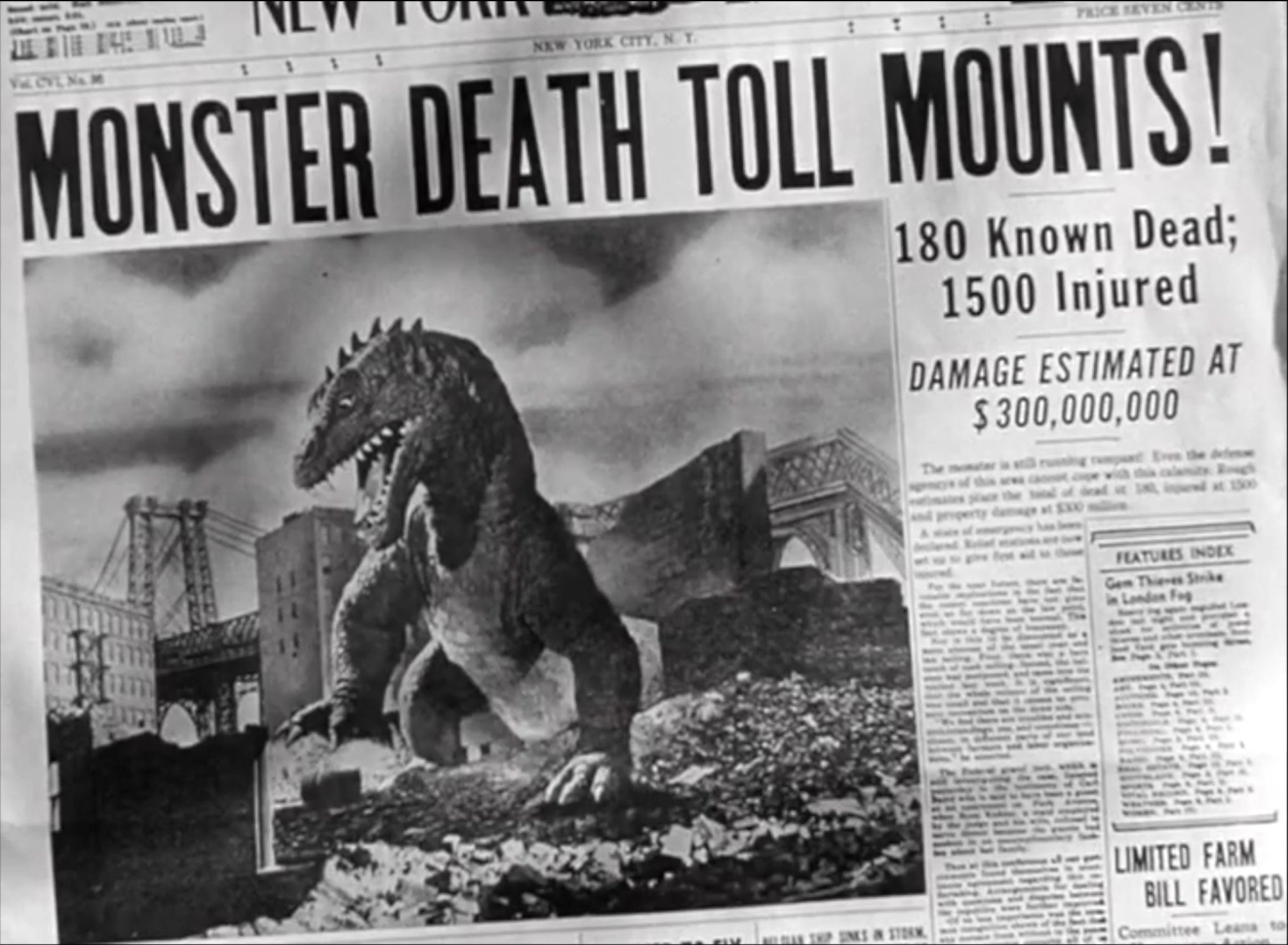
The Army mobilizes. When the creature is next spotted, they attack it with heavy weaponry, including a bazooka that actually injures it. It flees, again, and the soldiers pursue. But the creature’s blood makes them mysteriously sick, and it is theorized that it has some kind of prehistoric disease that has also hitched a ride in hibernation across the millions of years. The fear grows that if they kill the creature in some spectacular way, it will spread its plague along with it. Nesbitt proposes that they use a “radioactive isotope” to destroy the monster and “all that diseased tissue” it carries.
The creature next attacks Coney Island. Nesbitt and the army, including a sharpshooter, pursue. (Hunter, Dr. Elson’s attractive assistant, goes along with Nesbitt on most of this, but doesn’t do much other than serve as a growing love interest. He seems only moderately interested.) While the creature is inside a large wooden rollercoaster, Nesbitt (with the isotope) and the sharpshooter done radioactive protection gear and ascend in one of the coaster’s cars. Nesbitt loads the isotope weapon and the sharpshooter fires it into the wound on the creature. While this happens, the rollercoaster car they used to ascend gets out of their control and, somehow, starts a massive fire. Nesbitt and the sharpshooter precariously descend the burning rollercoaster structure.
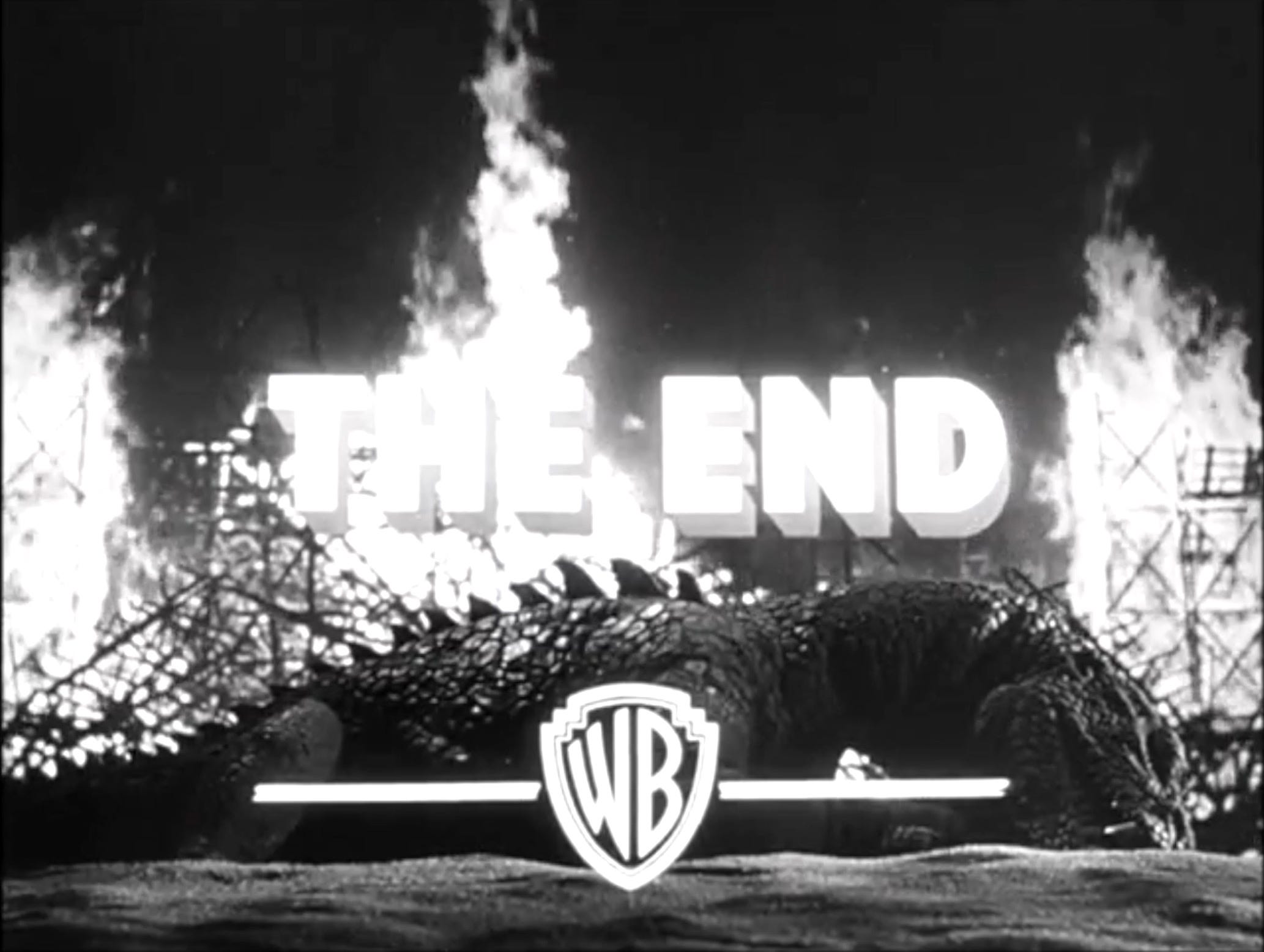
The creature, although wounded by the isotope, escapes the fire and staggers around. Nesbitt gets a hug and a chaste kiss on the cheek from Hunter. The Rhedosaurus emits a Godzilla-like scream, and then dies. The words “THE END” appear over its corpse. That’s all, folks.
The Beast from 20,000 Fathoms is not that great of a film. The stop-motion animation of the creature is really the only thing it has going for it, and it looks pretty good in the slightly-jerky, slightly-uncanny-valley way that all stop-motion creatures from this era looked.3 Almost all of the creature work is in the last 1/4th of the film, however, and the lead-up to that is rather tedious since we, the audience, know that Nesbitt is not insane and that the creature is real, and we are just waiting for the rest of the world to catch up to him.
It is, however, interesting to compare the film with Gojira (meaning specifically the Japanese version from 1954, not the Americanized version, Godzilla, King of the Monsters, from 1956). The Beast from 20,000 Fathoms exists in a very different thematic space as Gojira, and a very different relationship to nuclear technology.
Both Gojira and Rhedosaurus are awoken by nuclear testing. But other than one line spoken by Nesbitt right after the test — “What the cumulative effects of all these atomic explosions and tests will be, only time will tell” — there is no real depiction of nuclear weapons as “a problem” in The Beast from 20,000 Fathoms, and Nesbitt is an active and willing contributor in the test experiment that wakes it up. The US has made its own monster, but nobody ever explicitly frames it that way.
By comparison, in Gojira, the nuclear testing is an external force that the Japanese are being subjected to, and nuclear weapons are explicitly invoked as a harmful, threatening aspect of the modern world. I re-watched Gojira after watching The Beast from 20,000 Fathoms and it was very clear how overt Gojira is about this. There is a conversation on a Tokyo train later in the film (but before the attack on Tokyo) between several people that goes along these lines:
— “It’s terrible, huh? Atomic sea life, radioactive fallout, and now this Godzilla to top it all off!” […]
— “I guess I’ll have to find a shelter soon.”
—“ Find one for me, too!”
— “The shelters again? That stinks…”
Gojira ties the monster, the atomic testing, nuclear fallout, and the need for shelters together, and “the shelters again?” strikes me as a reference to the sheltering that was done during the firebombing campaign in World War II, less than a decade before. Similarly, later in Gojira someone asks: “Isn’t Godzilla a product of the atomic bomb that still haunts many of us Japanese?”
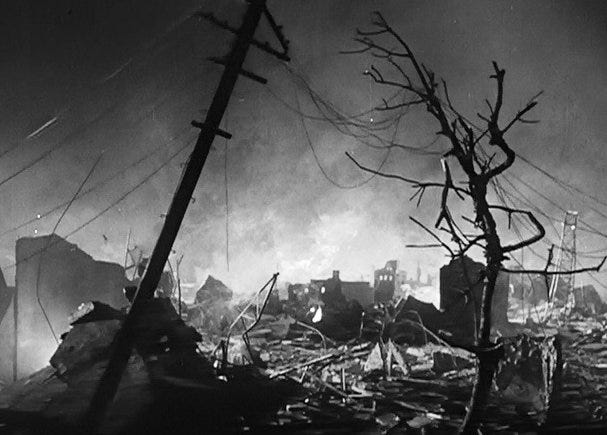
Gojira also has more subtle allusions. The earliest scenes are of a ship undergoing an unexpected (and at the moment, unexplained) catastrophe — something much closer to the Bravo accident than The Beast from 20,000 Fathoms. The attack on the village on Odo Island has scenes from the inside of houses that are collapsing that are strongly evocative of victims’ descriptions at Hiroshima and Nagasaki. When the monster attacks Tokyo, the capital city is set aflame, which to the Japanese at that time must have felt compelled to append the word “again.” Its imagery seems deliberately evocative of these past horrors, in other words, something entirely absent from The Beast from 20,000 Fathoms.
Nesbitt, the scientist in The Beast from 20,000 Fathoms, never renounces his life’s work in any way. He believes that nuclear technology is the future (there is much ado about paleontology being about the past, and nuclear work as being about the future, and this is even turned into flirtatious banter between him and Hunter), and he saves the day thanks to his “isotope.” Yes, the atomic test woke up the Rhedosaurus, but atomic science is also what put it in the ground.
The only “themes” I really detected in The Beast from 20,000 Fathoms were about scientists themselves. In particular, Dr. Elson’s death is the result of his own naivety and scientific fascination, his unwillingness to take seriously the threat that he is trying to study. He encourages the military not to try and kill the beast, because of its value to science, and he believes he understands it, because he is studying it. After it eats him, Hunter tells Nesbitt that he really shouldn’t let it bother him too much: “Nobody is to blame. And everybody is to blame. We all did what we thought was right.” I don’t actually think this was meant to be an indictment of a particular mindset, but it feels like it ought to be considered one — the road to hell, and all that.
The death of Gojira is a very different kind of affair. Without getting into all of the details, a different scientist, working in secret, develops a new scientific weapon known as “the Oxygen Destroyer.” But he doesn’t want to use it, because he believes it will lead to a new arms race, to new destruction, and would be “a new super-weapon to throw upon us all!” He finally agrees to use it, but insists on using it himself, and ends up destroying Gojira, himself, and the secret to his new weapon, all in one go. Which is a very different attitude than Nesbitt exhibits towards his “isotope” (“WHICH ISOTOPE?” I mentally screamed every time someone invoked about “the isotope”) or the killing of the Rhedosaurus.
Gojira is also just a better film overall. The story’s pacing is better and clearly better thought-out. In Gojira, the identity and nature of the creature is not at all clear in the beginning of the film, making the investigations into it a collective understanding for both the characters and the audience. Whereas in The Beast from 20,000 Fathoms, the audience pretty much knows what the creature is from the beginning, but there is a long, protracted sequence in which Nesbitt tries to convince others of this fact.
Nesbitt is also just not a very relatable character, and his “role” in Gojira is split into several different characters (including the always wonderful Takashi Shimura, recognizable even to Americans from his appearances in the films of Akira Kurosawa, including his role as the primary samurai in Seven Samurai, which came out the same year as Gojira) who are given far more emotional depth and thematic complexity than Nesbitt. (And nothing is ever done with the fact that Nesbitt is German, for example. Whose side were you on during zie war, Herr Doktor Nesbitt?)
The one place where The Beast from 20,000 Fathoms outshines Gojira, in my opinion, is the creature special effects. Gojira, the monster, does look like a guy in a rubber suit. It detracts from the seriousness of its endeavor. Rhedosaurus, for all of its clumsiness, looks and acts more like a wild animal. But I noticed that there seemed to be many more action shots of Gojira than there were of Rhedosaurus, and I suspect that’s the advantage of a guy in a rubber suit: it’s probably cheaper, and quicker, than having Ray Harryhausen do your special effects for you, and so you can have more of them.
Putting them side by side, it is clear where Gojira took inspiration from The Beast from 20,000 Fathoms. But it is also just as clear what the creators of Gojira did to turn their film into something much better, by infusing it with the complex cultural associations that the Japanese public had with nuclear weapons, turning a fairly schlocky idea (a monster is awoken by atomic bomb testing and goes on a rampage until put down by scientists) into something that also carries considerable thematic heft.
On the Bravo test’s impact on Japanese politics and culture, see esp. Toshihiro Higuchi, Political Fallout: Nuclear Weapons Testing and the Making of a Global Environmental Crisis (Stanford University Press, 2020).
The test montage appears to be Crossroads Baker, Crossroads Able, and Trinity.
When I was very young, I had vivid dreams about stop-motion giant monsters. One of them was King Kong, which I do not remember ever seeing then, but must have seen on television (or clips of it) at some point, and the other was clearly the Abominable Snow Monster from the 1964 Rankin-Bass Rudolph the Red-Nosed Reindeer Christmas special, which I saw many times as a child on VHS. There is something about the latter that even today I find fascinating and distressing — something about the scale of a giant stop-motion monster (as opposed to “normal sized” stop-motion characters, which never bothered me), and the way it stalks the characters in the film. I suspect there is some unconscious, uncanny-valley related phenomena here relating to the fact that these “big” creatures do not actually move the way very large creatures would actually move — the speed is all wrong, making them much faster than they ought to be.
If you want to learn more about the social impact of the 1954 Godzilla movie and all the not-to-sutble clues that link it to the Bravo test, I wrote a review back when the 2014 movie came out that looks at the links between the two films. https://physicstoday.aip.org/opinion/roaring-again-a-review-of-the-first-and-newest-godzilla-movies
The commander of Operation Experiment was a Major Officer.