

Some months ago, my brain offered me up this intrusive thought some months ago: “What would be the opposite of the Doomsday Clock?”
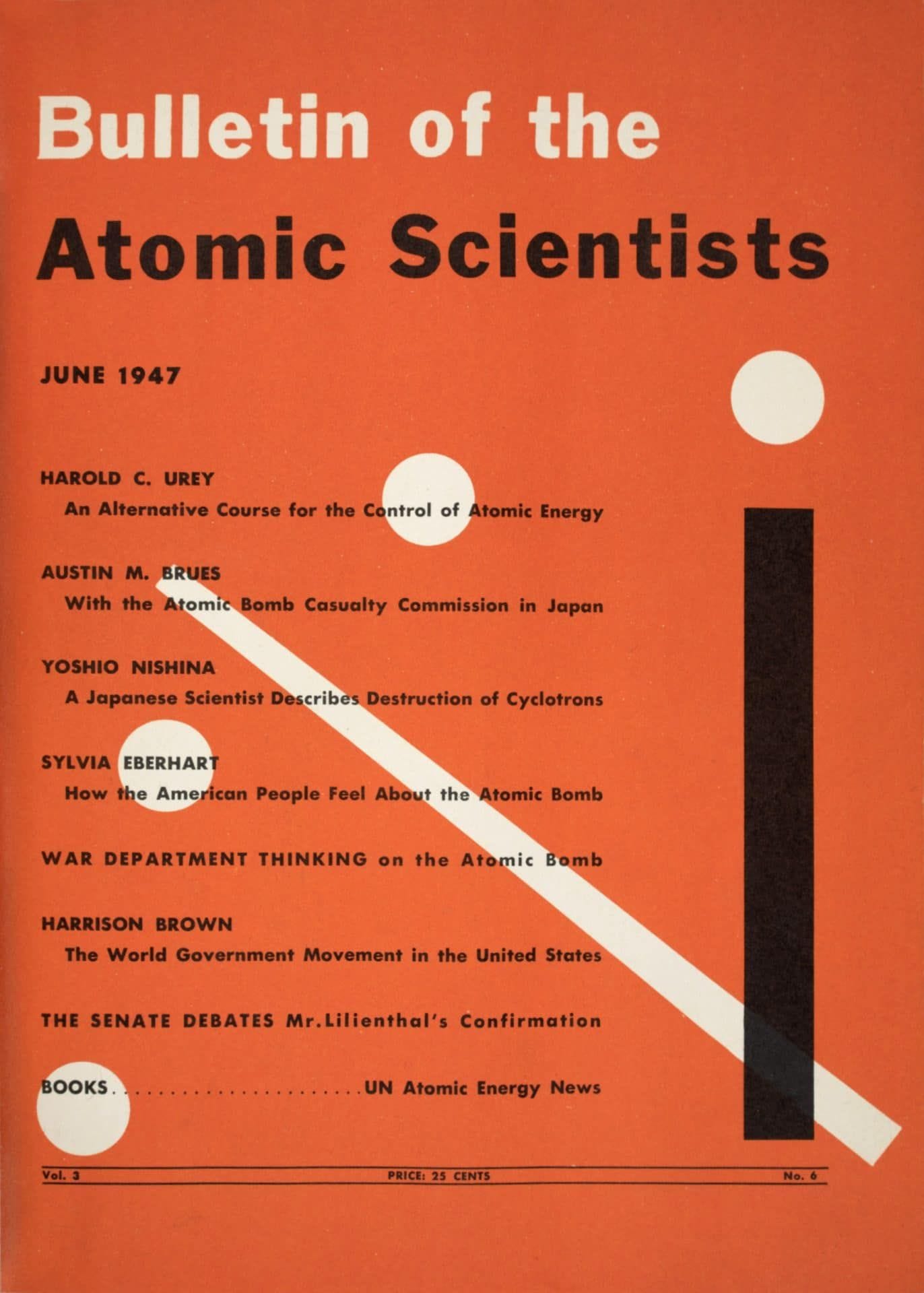
The Doomsday Clock, of course, is the famous design emblem that has been affixed to the masthead of the Bulletin of the Atomic Scientists since 1947. Since 1949, the first time its time was changed, it has served as a way to indicate how close to “midnight” — annihilation — the clock changers believe we might be. It has never made pretensions of being a scientific instrument, it has always acknowledged itself as primarily a way for Bulletin experts (or its editor-in-chief, pre-1973) to signal to a broader world what they thought the global risk trend was. One can think about it how one wants, but it has undeniably been a potent cultural artifact since the 1940s.1
So what would the opposite of the Doomsday Clock be? I don’t know why my brain popped that into my consciousness, but it has been interesting to roll around in my thoughts.
One possibility: if the Doomsday Clock is a measure of how close one is to annihilation, would the opposite be something that measured how close one was to salvation? To utopia? To disarmament? A generally good time? This would be some kind of Anti-Doomsday Clock. Which might be just the same as flipping the meaning of the clock upside-down, and not that interesting.
Another approach would be to focus on the “Clock” side of things. A Doomsday Barometer? Thermometer? Telescope? Seismograph? Microscope? Some of these seem like they would be effectively the same as the Doomsday Clock, just a different visual metaphor. Some of them make little sense metaphorically, or require an imaginative stretch. A Doomsday Microscope, to allow you to see the eschatological implications of the very small things? A Doomsday Telescope, to see annihilation coming from far, far away?
Of course, a Doomsday Graph is all too clear: the hockey-stick curve of global temperature — which looks more like a scythe than a hockey stick every year — is one version of what that could look like. A line that could, in theory, go down. But probably won’t, not in your lifetime.
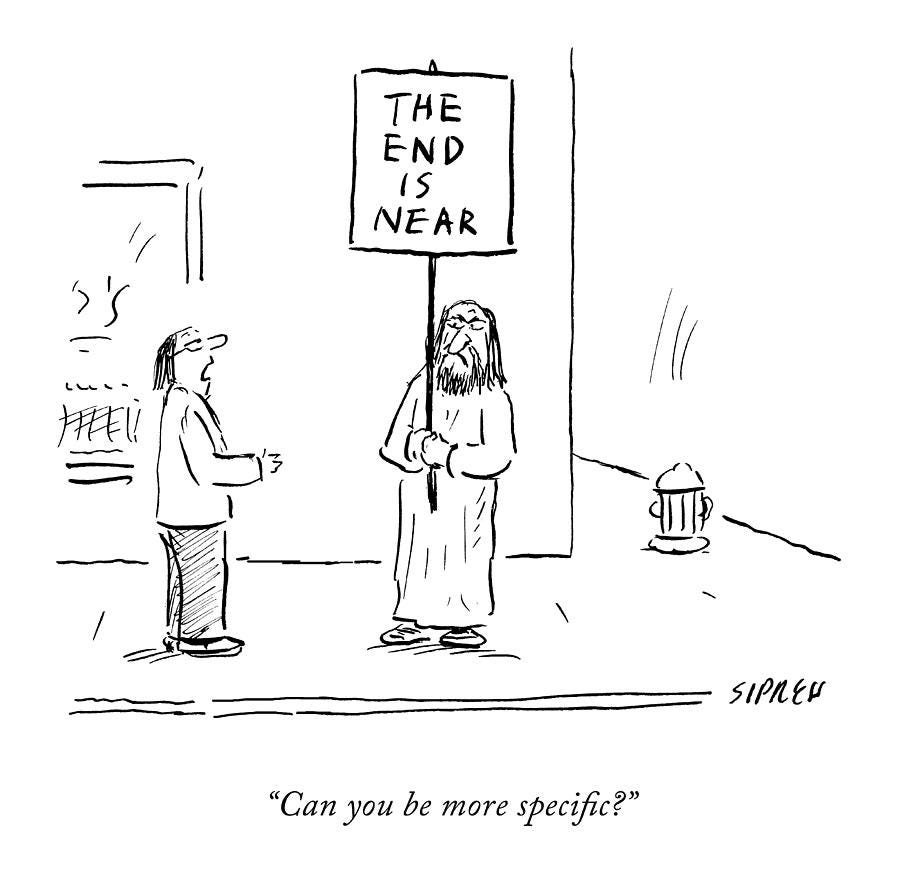
Another place my mind goes is to think about avoiding a sense of measurement and countdown altogether. Perhaps an anti-Clock is really just an anti-Instrument, and the opposite of a Doomsday Clock is simply something that doesn’t try to measure anything, and is just a sign that read: doom. We have such things, of course: The End is Near, the signboard says, in the numerous classic New Yorker cartoons poking fun at sidewalk Jeremiahs. The real sidewalk Jeremiahs usually have a real goal, unlike the cartoon ones: the end is near, you can do nothing about it, so (insert whatever their religion tells you to do here).
A slicker version of the doom sign is the Extinction Symbol, which was was created in 2011 by a London artist who goes by the nom de guerre of ESP. It is simple enough: a stylized hourglass within a circle, along the same simple graphical lines of the peace symbol (which, you may be aware, is composed of the semaphore for N and D overlapped — for nuclear disarmament).

There is a website dedicated to it, that is currently down, but one can view its various iterations on the Wayback Machine. Here is how the oldest version on there, from 2012, describes its meaning:
The symbol above represents extinction. The circle signifies the planet, while the hourglass inside serves as a warning that time is rapidly running out for many species. The world is currently undergoing a mass extinction event, and this symbol is intended to help raise awareness of the urgent need for change in order to address this crisis. Estimates are that somewhere between 30,000 and 140,000 species are becoming extinct every year in what scientists have named the Holocene, or Sixth Mass Extinction. This ongoing process of destruction is being caused by the impact of human activity. Within the next few decades approximately 50% of all species that now exist will have become extinct. Such a catastrophic loss of biodiversity is highly likely to cause widespread ecosystem collapse and consequently render the planet uninhabitable for humans.
The use of an hourglass is what brought the Doomsday Clock to mind: an hourglass is a timekeeping device, of a somewhat different sort than the mechanical clock used in Doomsday Clock imagery. To “reset the clock” for the Doomsday Clock implies some intervention, because time always marches forward, but we are all familiar with setting mechanical clocks to specific times. But hourglasses don’t get reset to earlier times; they are simply restarted once they run out.
Thus I think the hourglass carries with it a much more obvious sense of finality to it. That, and the weight of tradition, is probably why hourglasses are far more heavily represented as symbols of memento mori — “remember death” — in artwork, on gravestones, and anywhere else that people might want to reminded that life is a finite thing.
The Extinction Symbol isn’t a clock, even if it invokes time. It isn’t saying how close we are. The people who made and use it treat it like a warning: they believe there is yet time to change the outcomes. Because it is not just about human extinction, but the extinction that humans cause. All things turn to dust, eventually, but we don’t have to be so directly responsible for it.
I find extinction fascinating. Elizabeth Kolbert wrote a lovely essay on the anatomist Georges Cuvier and his work cementing the concept of “extinction” into the scientific vocabulary for the New Yorker way back in 2013. When I teach about the history of biology, I love to ruminate on the fact that the very concept of extinction is so relatively recent, and was radical. To be able to say, with definition, that there was both a long, lost world of the long-dead (like dinosaurs), and that it was possible, in our modern time, to see such things occurring (as the case of the dodo clearly indicated).
To then extend it to the possibility of human extinction is quite radical yet, and indeed, there are many people who find one way or another to avoid accepting that such a thing is quite literally inevitable, one way or another, at one time or another. It is, essentially, a consequence of the Second Law of Thermodynamics. Don’t get mad at me, I don’t make the rules.
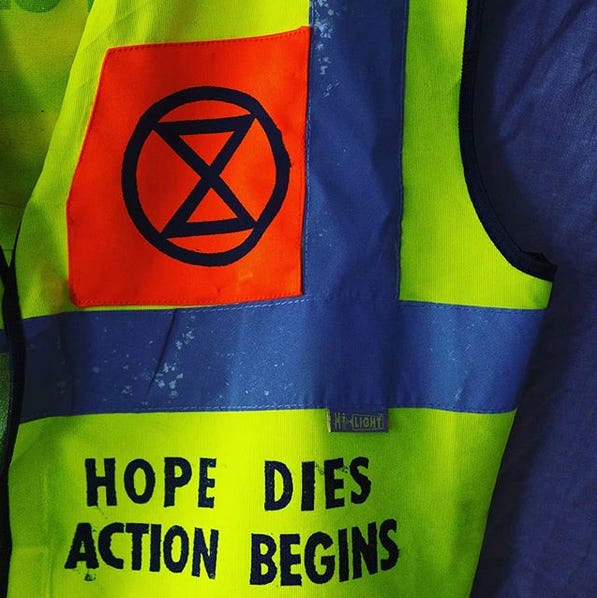
A photograph of an activist’s use of the Extinction Symbol, shown above, includes the text: HOPE DIES, ACTION BEGINS. It is a rather bold idea. Both the Doomsday Clock and the Extinction Symbol are seeking action — but only the latter wants you to first abandon all hope. That may feel contradictory, but I can see the argument, I think: when talking about the climate, in particular, one needs to move beyond denial and bargaining, and into some kind of acceptance, before one can tackle it realistically. (“What if we just stopped pretending?,” Jonathan Franzen asked in 2019, to the revulsion of most people trying to do climate change messaging.)
I’m not sure any of the above are really the opposite of a Doomsday Clock, which might make as little sense as asking what the opposite of a clock is in general. If you have your own ideas, feel free to let me know.
From 1949 until his death in 1973, it was changed on the judgment of the Bulletin’s editor in chief, Eugene Rabinowich. From 1973 until 2008, clock changes were handled by the Bulletin’s Board of Directors. In 2008, a Science and Security Board was created to evaluate the state of the world on an annual basis, and to make clock changing decisions.
Its an interesting question, because I would argue that a Doomsday Clock has properties inherent to it's metaphor. That is to say, a clock ticks.
Sure we can set it to whatever time we want, we can reset the clock. But inherent in the symbol is that the purpose of a clock is to constantly, unrelentingly tick forward, in a single direction. There is an implicit argument here, that the nuclear apocalypse is inevitable, and that if you'll forgive the joke, it is only a matter of 'time'
I almost feel like if we want to engage with what might be a opposite of a nuclear clock, we need to be engaging more with the metaphor, and what implicit arguments said metaphor are making. Something like a pithy political cartoon.
If I had to choose a metaphor for the nuclear fears of the Cold War, I might choose a dartboard. Dead center is the nuclear apocalypse, that doomsday that occurs when all other factors come into alignment. But there were close calls. Perhaps I would label one dart 'The Cuban Missile Crisis', or another one 'Broken Arrow'. We've had a lot of near misses.
But its a more optimistic metaphor than the clock, because a dartboard needs players. If nobody is instigating escalatory incidents, nobody is throwing darts at the board.
The Climate Crisis is a much more depressing scenario to engage with. If I had to come up with a metaphor, I might imagine a man stumbling down a steep hill. It takes a lot of effort and energy to stop his descent, and he will be hurt in doing so, twisting an ankle perhaps. But he is approaching a sheer cliff. If he takes the path of least resistance, he will tumble off. But he needs to climb the hill again to reach safety, which is exhausting, thankless work, which gets harder the further he falls.
Not sure I have any really optimistic thoughts for you today though.
"It has never made pretensions of being a scientific instrument"
Certainly, but they're perfectly happy to have the media and the general public treat and interpret it as though it was a scientific instrument, measuring something tangible and qualifiable... As opposed to what it really is, which is essentially an infinite emoticon based on opinion.