
"Strange even to the men who used them"
"Atomic bombs" before the discovery of fission

The concept of “atomic bombs” — explosive weapons whose energy is derived from “atomic energy” — predated the discovery of nuclear fission by a quarter of a century. The first instance of the idea came from H.G. Wells (1866-1946), that pioneering British author of science fiction behind such other classic tropes as The Time Machine (1895), The Invisible Man (1897), and The War of the Worlds (1898), among so many other works. His novel The World Set Free, published in 1914 on the eve of World War I, tells the story of a future war (1956) fought with “atomic bombs,” made from an exotic element known as Carolinum:
“Ready!” said the steersman.
The gaunt face hardened to grimness, and with both hands the bomb-thrower lifted the big atomic bomb from the box and steadied it against the side. It was a black sphere two feet in diameter. Between its handles was a little celluloid stud, and to this he bent his head until his lips touched it. Then he had to bite in order to let the air in upon the inducive. Sure of its accessibility, he craned his neck over the side of the aeroplane and judged his pace and distance. Then very quickly he bent forward, bit the stud, and hoisted the bomb over the side.
“Round,” he whispered inaudibly.
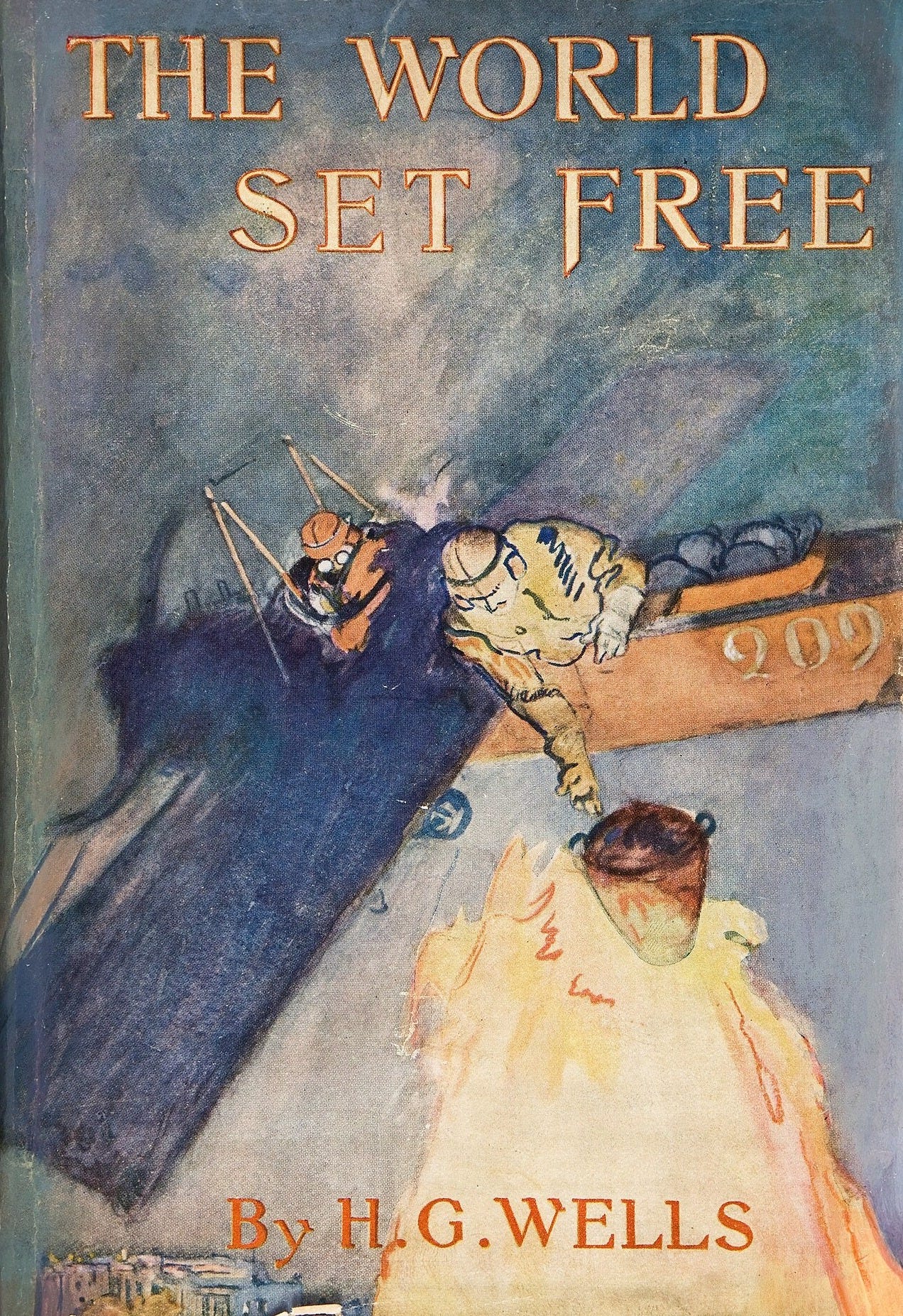
The bomb flashed blinding scarlet in mid-air, and fell, a descending column of blaze eddying spirally in the midst of a whirlwind. Both the aeroplanes were tossed like shuttlecocks, hurled high and sideways and the steersman, with gleaming eyes and set teeth, fought in great banking curves for a balance. The gaunt man clung tight with hand and knees; his nostrils dilated, his teeth biting his lips. He was firmly strapped. . . .
When he could look down again it was like looking down upon the crater of a small volcano. In the open garden before the Imperial castle a shuddering star of evil splendour spurted and poured up smoke and flame towards them like an accusation. They were too high to distinguish people clearly, or mark the bomb’s effect upon the building until suddenly the façade tottered and crumbled before the flare as sugar dissolves in water. The man stared for a moment, showed all his long teeth, and then staggered into the cramped standing position his straps permitted, hoisted out and bit another bomb, and sent it down after its fellow.
Wells’ “atomic bombs” were not like the fission or fusion explosives that would come in the future. It is somewhat difficult to imagine exactly what he had in mind, as the text is not always entirely clear on it.
The section quoted above mentions an explosion with the appearance of “the crater of a small volcano.” He describes the mechanism in a bit more detail shortly thereafter:
Never before in the history of warfare had there been a continuing explosive; indeed, up to the middle of the twentieth century the only explosives known were combustibles whose explosiveness was due entirely to their instantaneousness; and these atomic bombs which science burst upon the world that night were strange even to the men who used them. Those used by the Allies were lumps of pure Carolinum, painted on the outside with unoxidised cydonator inducive enclosed hermetically in a case of membranium. A little celluloid stud between the handles by which the bomb was lifted was arranged so as to be easily torn off and admit air to the inducive, which at once became active and set up radio-activity in the outer layer of the Carolinum sphere. This liberated fresh inducive, and so in a few minutes the whole bomb was a blazing continual explosion. […]
[…]once [Carolinum’s] degenerative process had been induced, continued a furious radiation of energy and nothing could arrest it. Of all Hyslop’s artificial elements, Carolinum was the most heavily stored with energy and the most dangerous to make and handle. To this day it remains the most potent degenerator known. What the earlier twentieth-century chemists called its half period was seventeen days; that is to say, it poured out half of the huge store of energy in its great molecules in the space of seventeen days, the next seventeen days’ emission was a half of that first period’s outpouring, and so on. As with all radio-active substances this Carolinum, though every seventeen days its power is halved, though constantly it diminishes towards the imperceptible, is never entirely exhausted, and to this day the battle-fields and bomb fields of that frantic time in human history are sprinkled with radiant matter, and so centres of inconvenient rays. . . . […]
Once launched, the bomb was absolutely unapproachable and uncontrollable until its forces were nearly exhausted, and from the crater that burst open above it, puffs of heavy incandescent vapour and fragments of viciously punitive rock and mud, saturated with Carolinum, and each a centre of scorching and blistering energy, were flung high and far.
And so on, with his faux-technical terms, describing something that is both radioactive and a “continuing explosive.” To me it invokes a mash-up between a radiological weapon (contaminating with radioactivity), an open and erupting volcano, inextinguishable incendiary warfare, and the Sun.
Wells’ ideas about the atomic bomb and atomic energy are traceable to the writings of Frederick Soddy (1877-1956), the easily-overlooked British chemist who was awarded the Nobel Prize in Chemistry in 1921 for his work on nuclear transmutation with the (much more famous) physicist Ernest Rutherford. Soddy was the first major English-language popularizer of the idea of “atomic energy,” the notion that the newly-discovered phenomena of radioactivity implied that all matter contained huge amounts of latent energy locked into its structure. Whereas radioactive elements tend to leak away their energy steadily, and uncontrollably, Soddy, in popular lectures published as The Interpretation of Radium (1909), imagined a future in which that energy could be released on demand:
This bottle contains about one pound of uranium oxide, and therefore about fourteen ounces of uranium. Its value is about £1. Is it not wonderful to reflect that in this little bottle there lies asleep and waiting to be evolved the energy of about nine hundred tons of coal? The energy in a ton of uranium would be sufficient to light London for a year. The store of energy in uranium would be worth a thousand times as much as the uranium itself, if only it were under our control and could be harnessed to do the world’s work in the same way as the stored energy in coal has been harnessed and controlled. […]
As we have seen, we cannot yet artificially accelerate or influence the rate of disintegration of an element, and therefore the energy in uranium, which requires a thousand million years to be evolved, is practically valueless. On the other hand, to increase the natural rate, and to break down uranium or any other element artificially, is simply transmutation. If we could accomplish the one so we could the other. These two great problems, at once the oldest and the newest in science, are one. Transmutation of the elements carries with it the power to unlock the internal energy of matter, and the unlocking of the internal stores of energy in matter would, strangely enough, be infinitely the most important and valuable consequence of transmutation.
Soddy’s book did not speak of bombs, but its allusions to immense the power contained in the nuclei of atoms were frequent, and many of his examples of such, like the one above regarding the lighting of London, would quickly become standard clichés.1
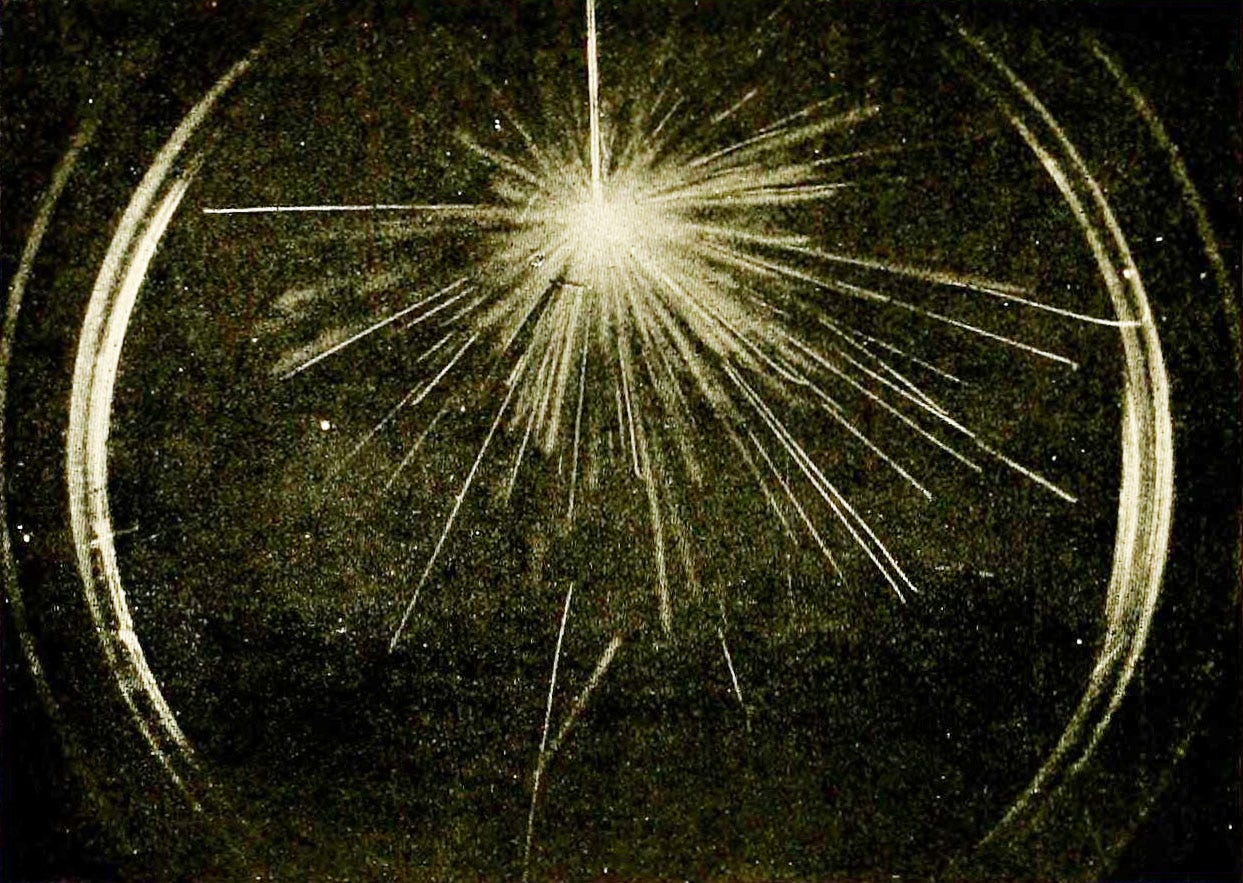
He describes individual radioactive decay reactions as “explosive” in character, and does at one point make an unusual analogy about how much is unknown about the atomic realm at that point, comparing it to an architect being suddenly told that his everyday bricks could “could with effect be employed as an explosive incomparably more powerful in its activities than dynamite,” but he never warns of radioactivity or atomic energy as a fodder for weaponry. The jump from a new, inexhaustible source of energy to a dread weapon seems to have been Wells’ own.2
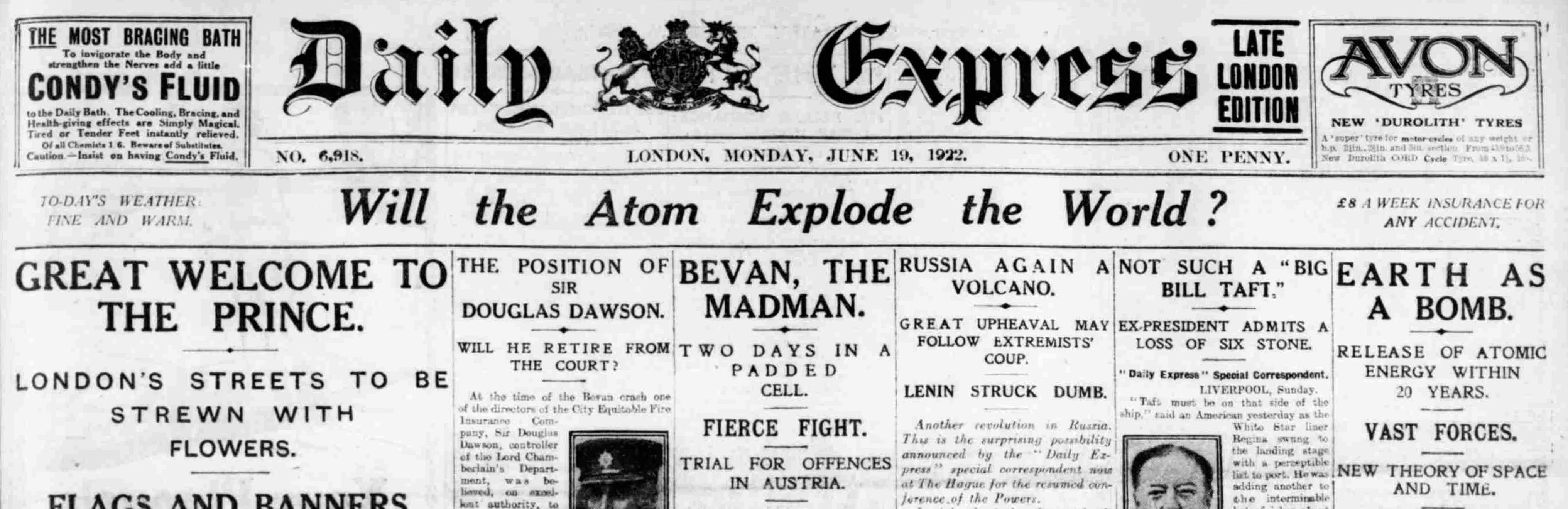
In the summer of 1922, various news syndication agencies ran a story that consisted of essentially one long quote from “one of the eminent English scientists” warning of similarly dire possibilities:
We are on the eve of scientific discoveries of so sensational and so far-reaching a character as to render Einstein’s theory, by comparison, child’s play. I predict that within the next five, ten, or at the outside twenty years, men will be able to say, “I have harnessed the atom.” […] The energy stored in such elements as thorium and uranium is stupendous. […] It only needs the knowledge of how to ignite it — how to cause the atoms to break up when we desire — to make this power immediately available. […]
It is conceivable, too, that such terrific force might eventually be liberated as to blow up the world.
Then consider the possibilities of war. The first nation to discover the secret will be in a position to wipe out all the other nations, literally, in a quarter of an hour. It could send over an aeroplane with a 2,000-pound bomb which would have as devastating an effect as that of a million aeroplanes carrying the 2,000-pound bombs in use today. […]
The question is: Which will that nation be?
This article circulated globally, at times accompanied by dramatic headlines, like “EARTH AS A BOMB.”3 Some of the accounts say it was an “eminent Oxford scientist” who provided the story. But who was the “eminent” scientist? It is quite unclear. That the article ran anonymously suggests that whomever the source was, they didn’t want their name publicly attached to the idea. To my knowledge, no one ever came forward later to claim their prescience as the source after the fact.4
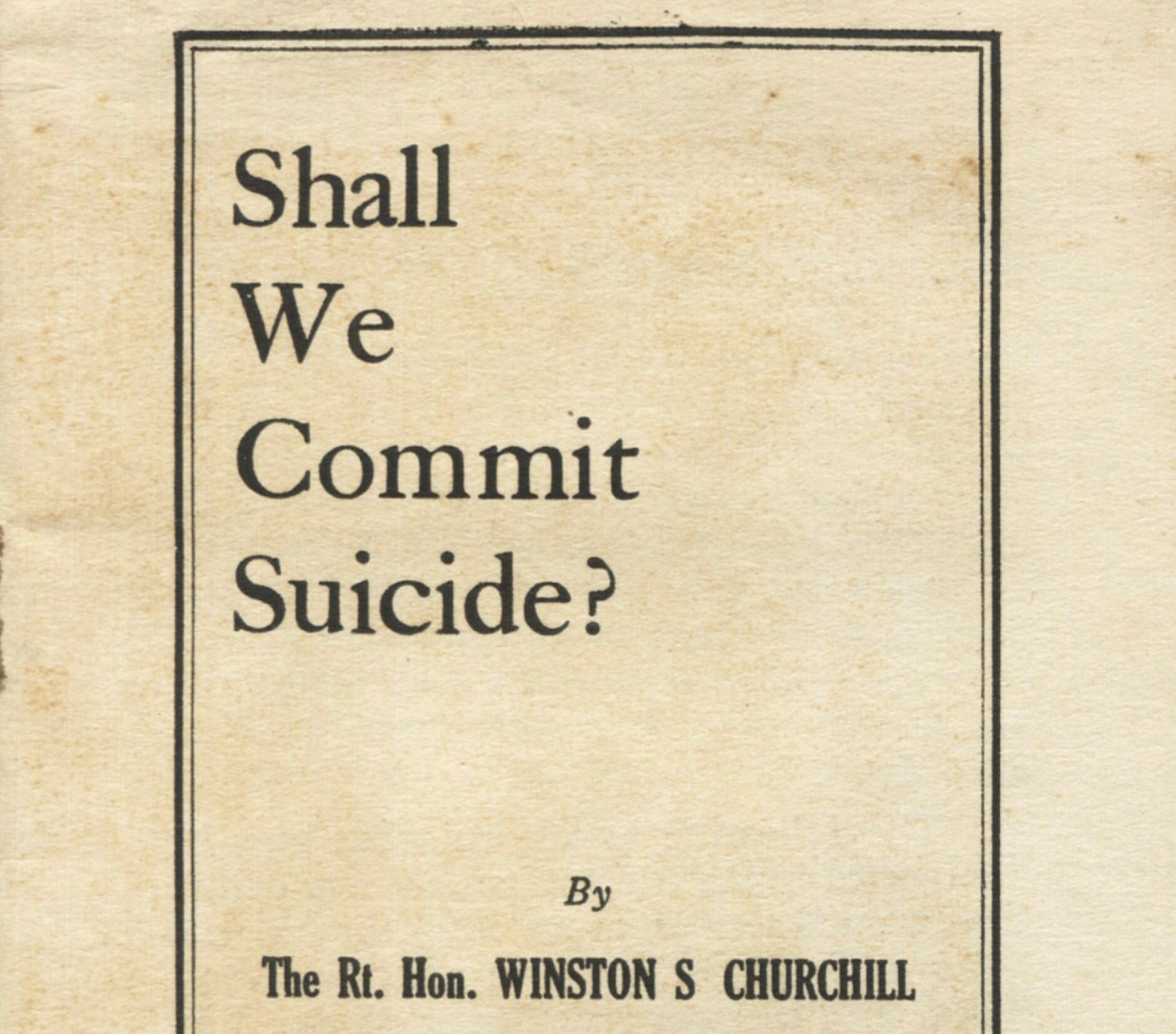
In interwar September 1924, Winston Churchill tried his hand at writing about new technological futures in an article with the odd title, “Shall We All Commit Suicide?” Influenced by both H.G. Wells — Churchill claimed to have read all of Wells’ books since The Time Machine immediately as they came out, and multiple times — and his close scientific friend and advisor Frederick Lindemann (Lord Cherwell, Oxford professor), Churchill laid out a his grim sense of coming conflict and the role that science and technology might play in it:
The story of the human race is War. Except for brief and precarious interludes, there has never been peace in the world; and before history began, murderous strife was universal and unending. But up to the present time the means of destruction at the disposal of man have not kept pace with his ferocity. Reciprocal extermination was impossible in the Stone Age. One cannot do much with a clumsy club. […] It was not until the dawn of the twentieth century of the Christian era that War really began to enter into its kingdom as the potential destroyer of the human race. The organization of mankind into great States and Empires and the rise of nations to full collective consciousness enabled enterprises of slaughter to be planned and executed upon a scale and with a perseverance never before imagined.
Churchill warned that the peace of the Great War was likely a temporary one, as “two mighty branches of the European family will never rest content with their existing situation” — Russia and Germany. And just as surely as war will return, Churchill wrote, the technology of mass destruction will continue to evolve:
“Wars,” said a distinguished American to me some years ago, “are fought with Steel: weapons may change, but Steel remains the core of all modern warfare. France has got the Steel of Europe, and Germany has lost it. Here, at any rate, is an element of permanency.” “Are you sure,” I asked, “that the wars of the future will be fought with Steel?” A few weeks later I talked with a German. “What about Aluminium?” he replied. “Some think,” he said, “that the next war will be fought with Electricity.” And on this a vista opens out of electrical rays which could paralyse the engines of a motor-car, could claw down aeroplanes from the sky, and conceivably be made destructive of human life or human vision. Then there are Explosives. Have we reached the end? Has Science turned its last page on them? May there not be methods of using explosive energy incomparably more intense than anything heretofore discovered? Might not a bomb no bigger than an orange be found to possess a secret power to destroy a whole block of buildings — nay, to concentrate the force of a thousand tons of cordite and blast a township at a stroke? Could not explosives even of the existing type be guided automatically in flying machines by wireless or other rays, without a human pilot, in ceaseless procession upon a hostile city, arsenal, camp, or dockyard?
Churchill further worried that such weapons could allow “a base, degenerate, immoral race” of people to “make an enemy far above them in quality” their slaves on the basis of their possessing and being willing to use novel technological weapons.5
I don’t believe that Churchill’s article had a major public impact on the thinking about “atomic bombs,” but it doesn’t really need to have: it reflects that this discourse about science fiction weaponry had made it to what would very soon be the highest echelons of public policy in at least the United Kingdom (Churchill was on the political “outs” in 1924, but would soon come back), and joined into security debates. Churchill, Franklin Roosevelt, and Adolf Hitler in particular shared a common belief in the value of “wonder weapons” produced by scientific research, a shared “lesson” of the Great War for all of them. It is part of the context of why each of these nations were willing, to differing degrees, entertain the possibilities of fantastical wartime research, including atomic research.
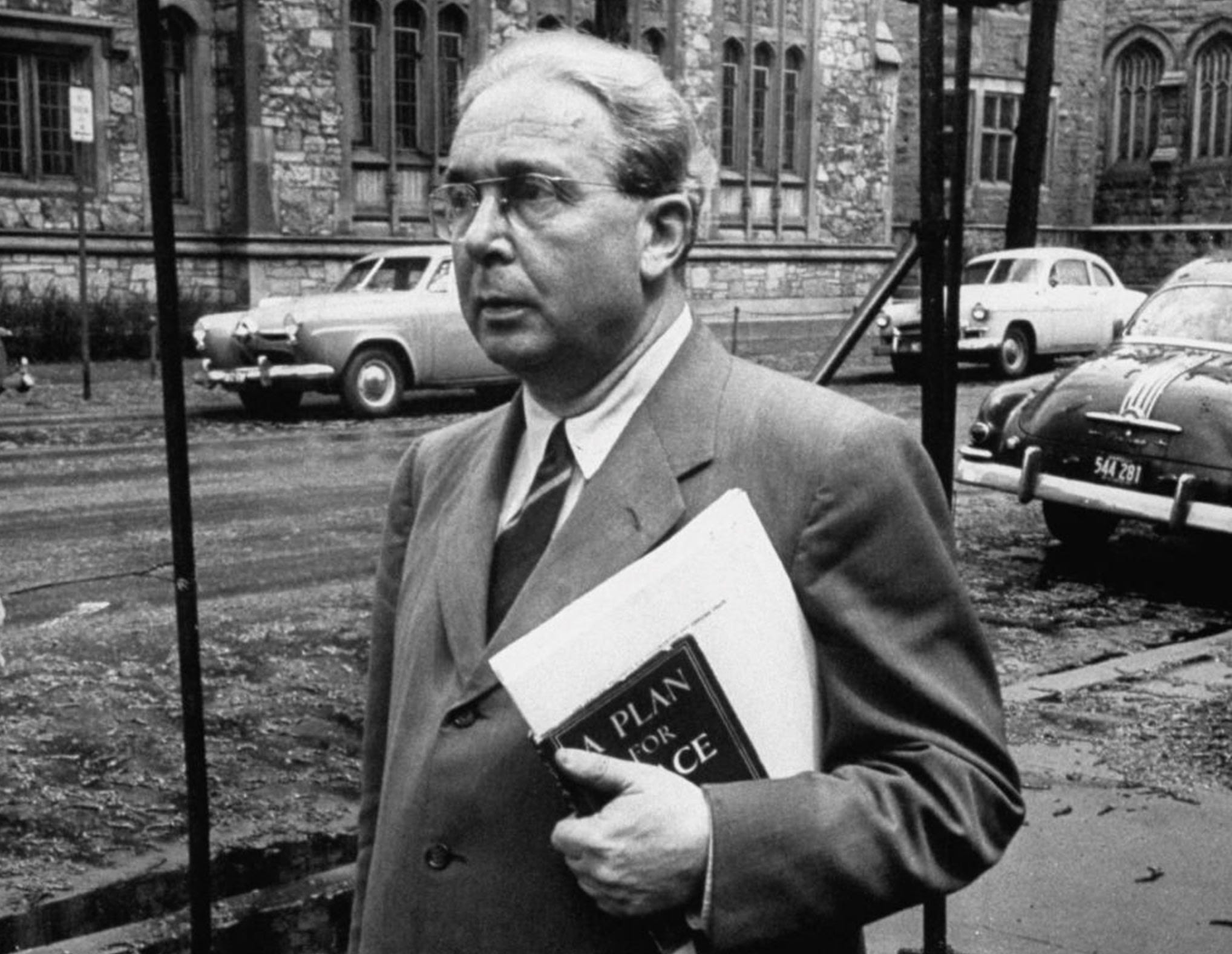
There were other minor references to “atomic bombs” across the 1920s and 1930s, prior to the discovery of nuclear fission. The most important and perhaps famous inspiration was that of the Hungarian physicist Leo Szilard, who famously credited H.G. Wells for his development of the concept of the nuclear chain reaction in 1933, over five years before the discovery of nuclear fission. He later described it this way:6
In 1932, while I was still in Berlin, I read a book by H. G. Wells. It was called The World Set Free. This book was written in 1913, one year before the World War, and in it H.G. Wells describes the discovery of artificial radioactivity and puts it in the year of 1933, the year in which it actually occurred. He then proceeds to describe the liberation of atomic energy on a large scale for industrial purposes, the development of atomic bombs, and a world war which was apparently fought by an alliance of England, France, and perhaps including America, against Germany and Austria, the powers located in the central part of Europe. […] The book made a very great impression on me, but I didn’t regard it as anything but fiction.
I was no longer thinking about [H. G. Well’s book] until I found myself in London about the time of the British Association [meeting] in September 1933. I read in the newspapers a speech by Lord [Ernest] Rutherford. He was quoted as saying that he who talks about the liberation of atomic energy on an industrial scale is talking moonshine. This sort of set me pondering as I was walking the streets of London, and I remember that I stopped for a red light at the intersection of Southampton Row. As I was waiting for the light to change and as the light changed to green and I crossed the street, it suddenly occurred to me that if we could find an element which is split by neutrons and which would emit two neutrons when it absorbed one neutron, such an element, if assembled in sufficiently large a mass, could sustain a nuclear chain reaction. I didn’t see at the moment just how one would go about finding such an element, or what experiments would be needed, but the idea never left me. In certain circumstances it might become possible to set up a nuclear chain reaction, liberate energy on an industrial scale, and construct atomic bombs. The thought that this might in fact be possible became sort of an obsession with me. […]
In the spring of 1934 I had applied for a patent which described the laws governing such a chain reaction. This was the first time, I think, that the concept of critical mass was developed and that a chain reaction was seriously discussed. Knowing what this would mean—and I knew it because I had read H. G. Wells—I did not want this patent to become public.
It isn’t that Wells’ book gave Szilard any strong technical inspiration — Carolinum, it isn’t. Szilard’s neutron-based chain reaction is his own. But Wells did clearly provoke Szilard’s imagination about atomic bombs, and helped frame how he thought they might matter if they were possible. And thus Szilard’s first impulse was towards secrecy, towards believing that such a chain reaction would be vastly important development for humankind. And that impulse set off its own historical chain reaction, leading to Hiroshima, the H-bomb, and beyond.7
Szilard didn’t have a candidate reaction for his concept of the chain reaction, and while he did some research to search for one, he ended up essentially shelving the question for several years. Nuclear fission was discovered by Otto Hahn, Lise Meitner, Fritz Strassman, and Otto Frisch in late 1938, and became global news in early 1939. The moment that Szilard heard about the discovery, he was ready to understand what it might mean:8
[The physicist Eugene] Wigner told me of Hahn’s discovery. Hahn found that uranium breaks into two parts when it absorbs a neutron; this it the process which we call fission. When I heard this I saw immediately that these fragments, being heavier than corresponds to their charge, must emit neutrons, and if enough neutrons are emitted in this fission process, then it should be, of course, possible to sustain a chain reaction. All the things which H. G. Wells predicted appeared suddenly real to me.
This is also one of the clearest examples we have of the complicated relationship between scientific research (radioactivity, transmutation), scientific popularization (Soddy), science fiction (Wells), a feedback loop back into scientific inspiration (Szilard), and broader policy decisions (Churchill).
The pre-fission history of atomic bombs is important, not just for Szilard, but for a vast number of other people, including scientists, statesmen, and the everyday public. It created a context for understanding what “atomic bomb” even meant prior to their invention, and towards thinking about the idea of a vastly powerful science-borne weapon as a possible concrete reality. It is why, in 1945, when the United States announced that it had invented an “atomic bomb,” people understood immediately that this meant a vastly powerful, possibly game-changing weapon, and not, say, a very tiny explosive.
The atomic bomb in Wells’ book may have been “strange even to the men who used them,” but Wells’ book made the concept considerably less strange than it might have otherwise been.
Among many excellent historical works that cover the history of pre-1945 understanding, attitudes, and clichés about radioactivity and “atomic energy,” a few stand-outs are: Spencer Weart, Nuclear Fear: A History of Images (Harvard University Press, 1986); Luis A. Campos, Radium and the Secret of Life (University of Chicago Press, 2015); and P.D. Smith, Doomsday Men: The Real Dr. Strangelove and the Dream of the Superweapon (Allen Lane, 2007).
Wells was slightly and somewhat pre-dated in imagining radioactivity as a weapon: the French satirist Anatole France, in his Penguin Island (1908), described, briefly, an explosive which “emanated from a gas which radium evolves, and it was supposed that electric waves, produced by a special type of oscillator, were propagated through space and thus caused the explosion.” It does not appear that Wells was aware of this, nor influenced by it, and it is not entirely clear what France was describing. Graham Farmelo, Churchill’s Bomb: How the United States Overtook Britain in the First Nuclear Arms Race (Basic Books, 2013), 22.
The origin of the article has been difficult to trace; one reprint credited it to British newspaper The Daily Express. The earliest versions of it I have been able to find date to 19 June 1922, and it seems to have come out in multiple newspapers on the same day, many of which crediting themselves with having conducted the interview “yesterday.” So it is rather unclear! Separately, the topic of a chain reaction blowing up the world is something different (although obviously interconnected), and I will have to write another, different post on that in the near future.
Some possible candidates, just taking the Oxford affiliation for granted, include Frederick Lindemann, Henry Tizard, and even possibly Frederick Soddy. Or someone else entirely, particularly if the Oxford affiliation might not be accurate. The number of British scientists who made expansive claims about atomic energy in the early 1920s was quite large.
As Farmelo also points out, Churchill, while also talking about the dangers of biological and chemical weapons, failed to note that “five years before, he had approved their use against the Bolsheviks and, in a note about the strategy in the war against Mesopotamia, had declared himself ‘strongly in favour of using poisoned gas against uncivilised tribes.’” Farmelo, Churchill’s Bomb, 30.
Spencer Weart and Gertrude Weiss Szilard, eds., Leo Szilard: His Version of the Facts; Selected Recollections and Correspondence (MIT Press, 1978), 16-18.
For more on Szilard’s campaign for self-censorship and secrecy, and his role in the early American US nuclear program, one might do worse than turn to Alex Wellerstein, Restricted Data: The History of Nuclear Secrecy in the United States (University of Chicago Press, 2021), chapter 1.
Weart and Szilard, eds., Leo Szilard: His Version of the Facts, 53.
"This is also one of the clearest examples we have of the complicated relationship between scientific research (radioactivity, transmutation), scientific popularization (Soddy), science fiction (Wells), a feedback loop back into scientific inspiration (Szilard), and broader policy decisions (Churchill)."
Fantastic article and incredibly tidy thesis statement of what would be a wonderful book itself! Thanks for the continued great ideas/topics to elaborate on--I really enjoy the spread of perspectives you bring into your posts. I bring this general topic (My Theories of Persuasion class has a special topic just called "The End Of The World") into a few of my classes and the combination of science, discussion and pop culture (I love looking at music here myself) is so complex, but if we "crack" the mini-eras from 1945 on, there's so much to study! Thanks again!
You say "it's not clear what he was describing", I say "technobabble has a long and illustrious pedigree". :) I have no doubt that even earlier examples might exist. Off to the Bat-R/askistorians!