
Survival is a drag
Simulating shelter tedium in the video game "60 Seconds!"

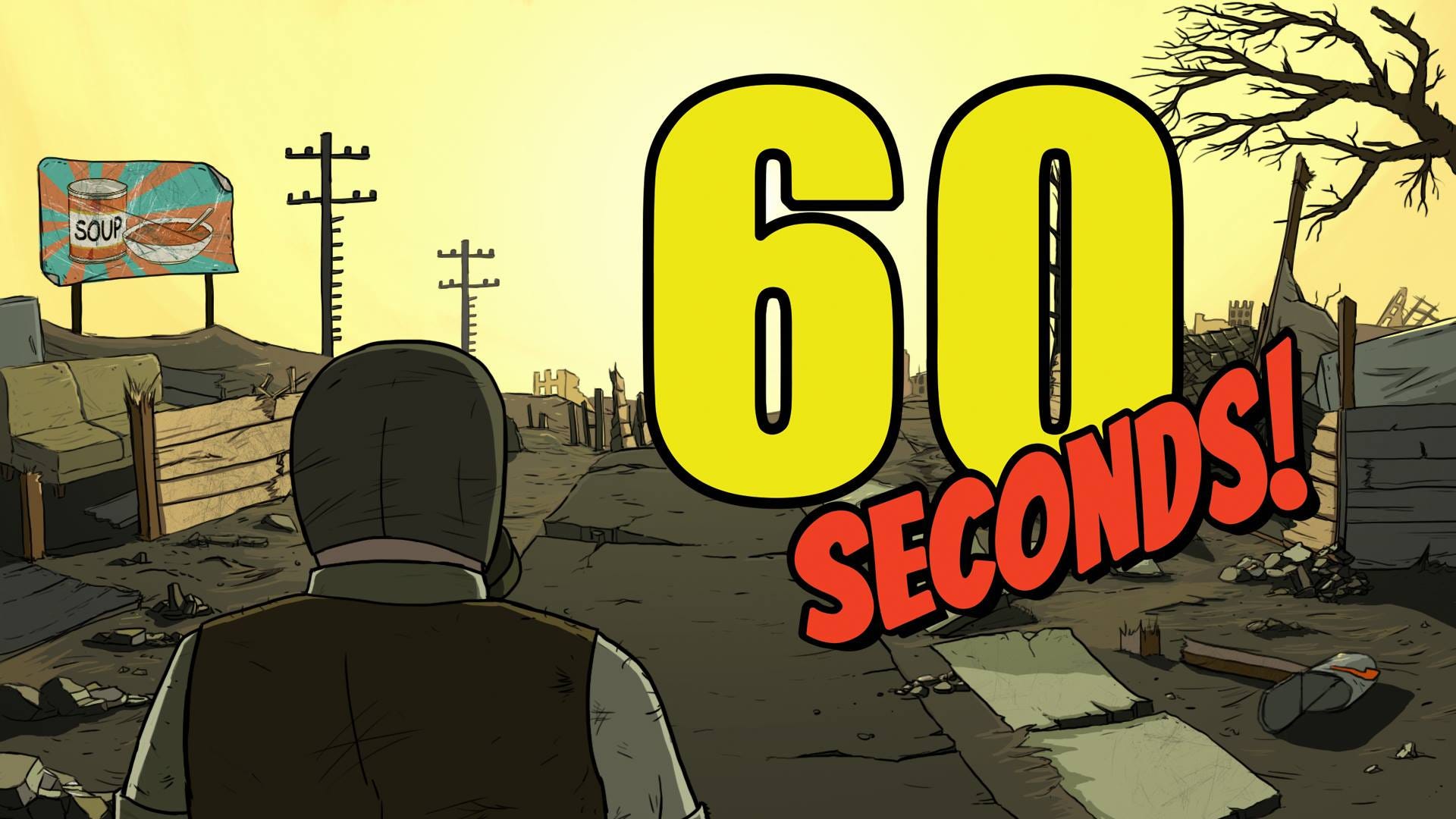
60 Seconds! is a video game about spending some quality family time in a fallout shelter after a nuclear detonation, developed by a Polish video game studio (Robot Gentlemen) and released in 2015 (and a remastered version was released in 2019). Like the Fallout game series, it leans heavily into a 1950s gonzo aesthetic about nuclear war, and is very tongue-in-cheek in its approach to the subject.
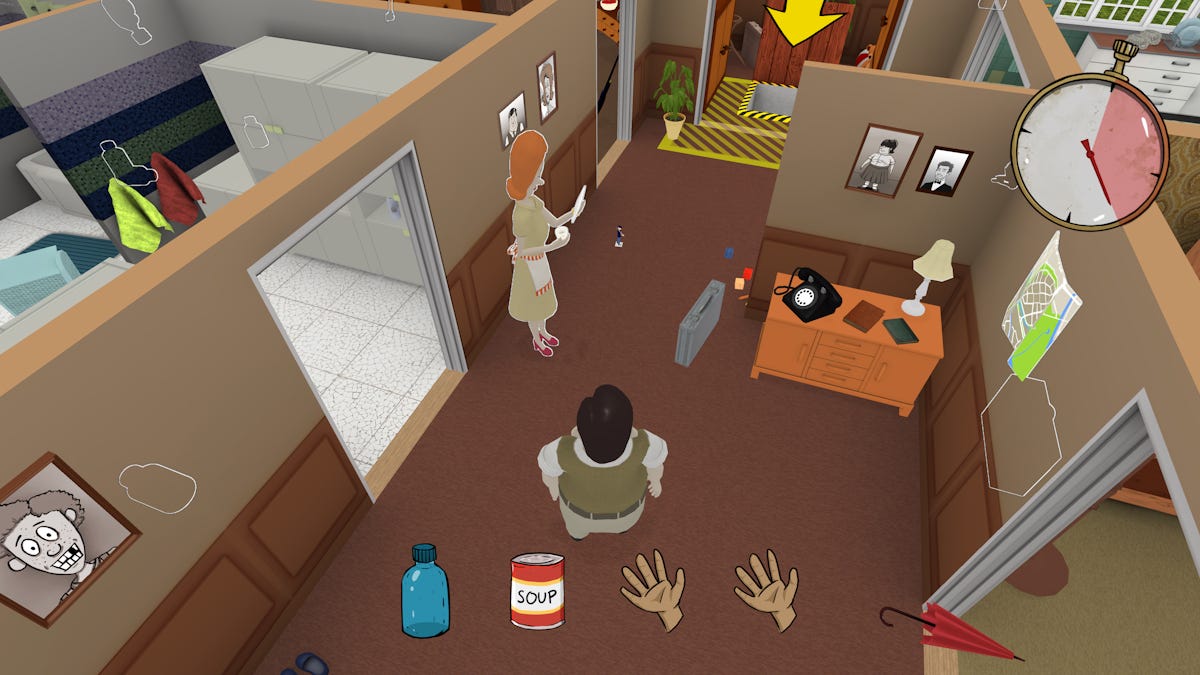
The game has two basic “modes” which can be played concurrently or individually. “Scavenge” is a top-down, 3D game in which you must collect supplies and family members before the bombs go off. One can choose either Ted (the father) or Dolores (the mother) as one’s main character. One may have a few seconds to look around the house before the warning timer starts, which is helpful as the location of objects and people in the house is random on each playthrough. Once the attack warning starts, the player has 60 seconds to grab as much stuff as one can and throw it down the hatch to an underground bunker. If you aren’t near the hatch when the 60 seconds are up, you die, game over.
This is a maddening sequence, as your character is slow and runs into things. Clearly this is deliberate; it is why it is hard. In the house are your three other family members (your spouse, your son Timmy, and your daughter Mary Jane), cans of soup, bottles of water, a radio, a suitcase, a fire axe, a gas mask, a first-aid kit, a rifle, a map, various games and books, and so on. You only have four “slots” to hold things at any one time, and objects (and people) can take up multiple slots (poor Mary Jane requires three slots). So you have to strategically decide which rooms to run to, what items to grab, and be as quickly as possible. The temptation to grab just one more item (and possibly not make it inside the shelter yourself) is high.
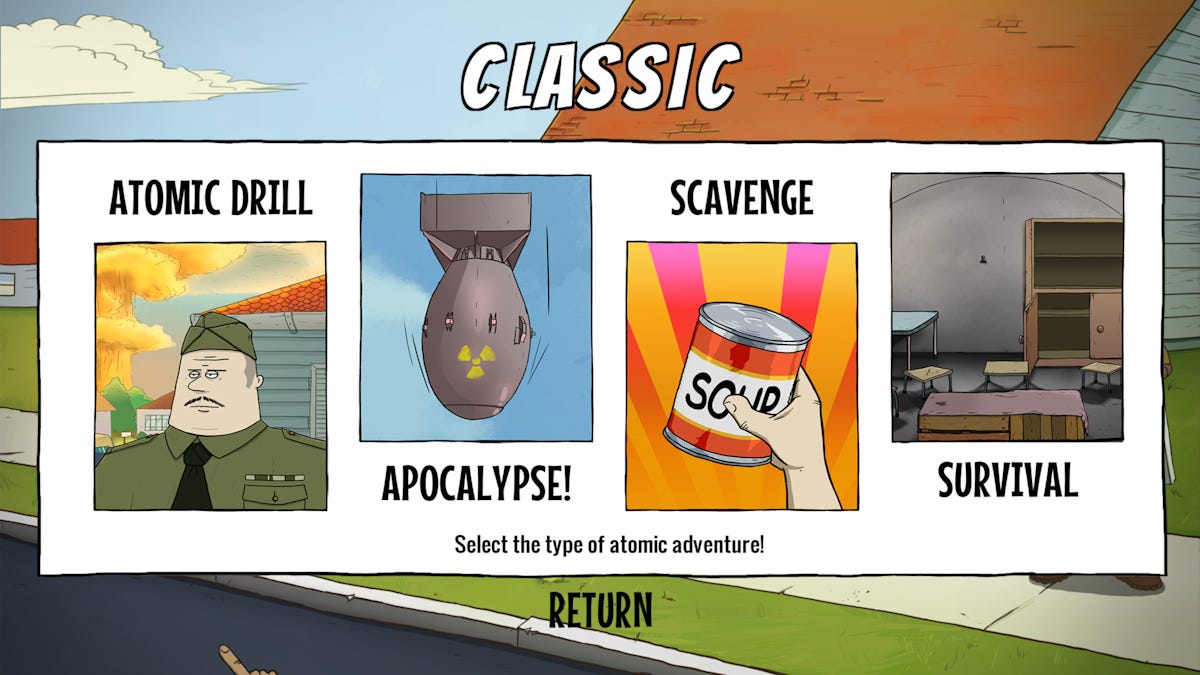
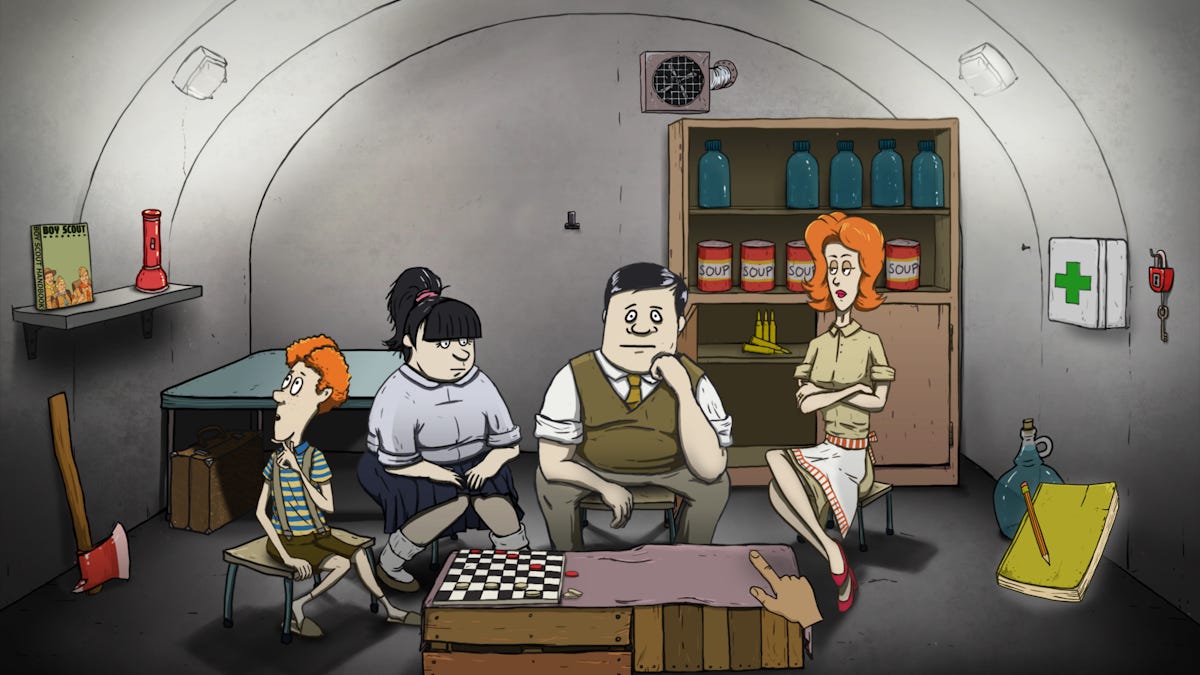
If one is playing the two modes concurrently, after “Scavenge” the game then transitions to “Survival” mode. This takes place inside the fallout shelter, and is a 2D, point-and-click, visual-novel sort of experience. Whatever and whomever one grabbed during “Scavenge” mode is now inside the shelter as well. (If one is playing only “Survival” mode, then it is stocked with some random distribution of items. On the easiest level of difficulty, some additional items might be in the shelter as well, even if you didn’t grab them.)
“Survival” mode has a fairly simple game loop. Every day, one must dole out food and/or water to the survivors. People can go for a few days without food or water (the game tells you if they are very hungry or thirsty). Every day there is usually some “decision” that needs to be taken. The most regular of these is that one can send a survivor out into the world to look for more supplies. One can choose the survivor (or decline to send someone out) and an item for them to take with them (e.g., a gas mask, which helps keep them from getting sick from fallout, or a map, which helps them locate better places to scavenge). Once someone leaves the shelter, you won’t know for a few days how it worked out — they might come back with supplies, or information, or a disease. Or they might just never come back.
Other “decisions” include reacting to specific random events. A person might show up and offer to exchange the contents of their bag (which you cannot inspect) for a can of food. Do you agree to the trade? You hear a phone ringing across the street. Do you send someone out to go answer it? You hear a series of knocks on the door. Do you open it? Timmy seems depressed. Do you talk to him?
You seem to be able to do about one “decision” per day, and then it transitions to the next day. The characters in the shelter have essentially static cartoon appearances, but when they get sick, or go insane, their portrait reflects this. The inside of the shelter also changes to reflect different items you have, the amount of food and water, and whether you’ve picked up an additional friends (like a cat or a dog).
Such is the game. This loop continues until some end state is reached, and there are many end states. The most common is a “bad” ending, where you and everyone in the shelter ends up dead from disease, starvation, or dehydration. Womp womp. There are a multitude of other “bad” endings as well, such as having your shelter being taken over by armed ruffians.
One can also get rescued by the army, which is one of the few unambiguously “good” endings. Less unambiguously “good” are some of the stranger endings, like being sent in a rocket into outer space by a mad scientist who contacted you because of your cat. Or being “saved” by the Soviet Union.
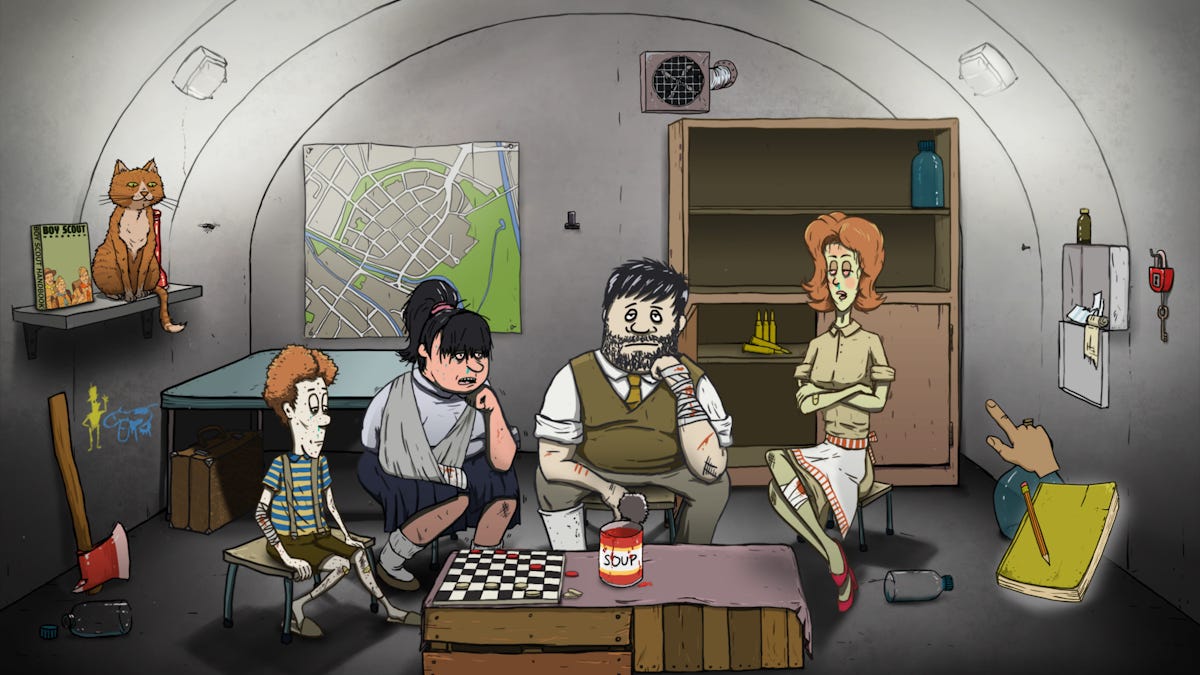
The game makes no pretense at realism. It is possible for Mary Jane to get bitten by a radioactive spider and turn into a purple-skinned mutant. There are doomsday cults, Mad Max-style raiders, cats with cloning devices, and much more. The only “realistic” aspect of the shelter experience is that a) leaving the shelter early has the highest threat of radioactivity, b) it lasts on the order of weeks (and not, say, decades or centuries), and c) it is pretty boring, both for the characters and (in my opinion) for the player.
To be even more realistic, it would be even more boring, and take much longer to play through than the 5 minutes or so each “run” requires. I once contemplated making a VR game/art piece, years ago, that would “truly” simulate a fallout shelter experience, in mind-numbing detail, with time passing at exactly one in-game minute per real-world minute. This would, of course, not be fun to play. It would be a sort of nuclear version of the (in)famous anti-game Desert Bus, which simulates the driving a bus for 8 hours along a desert highway in real-time. The fact that it would not be fun would be, of course, the point: even just one week in a small fallout shelter, with little to pass the time, sounds more like prison than salvation.
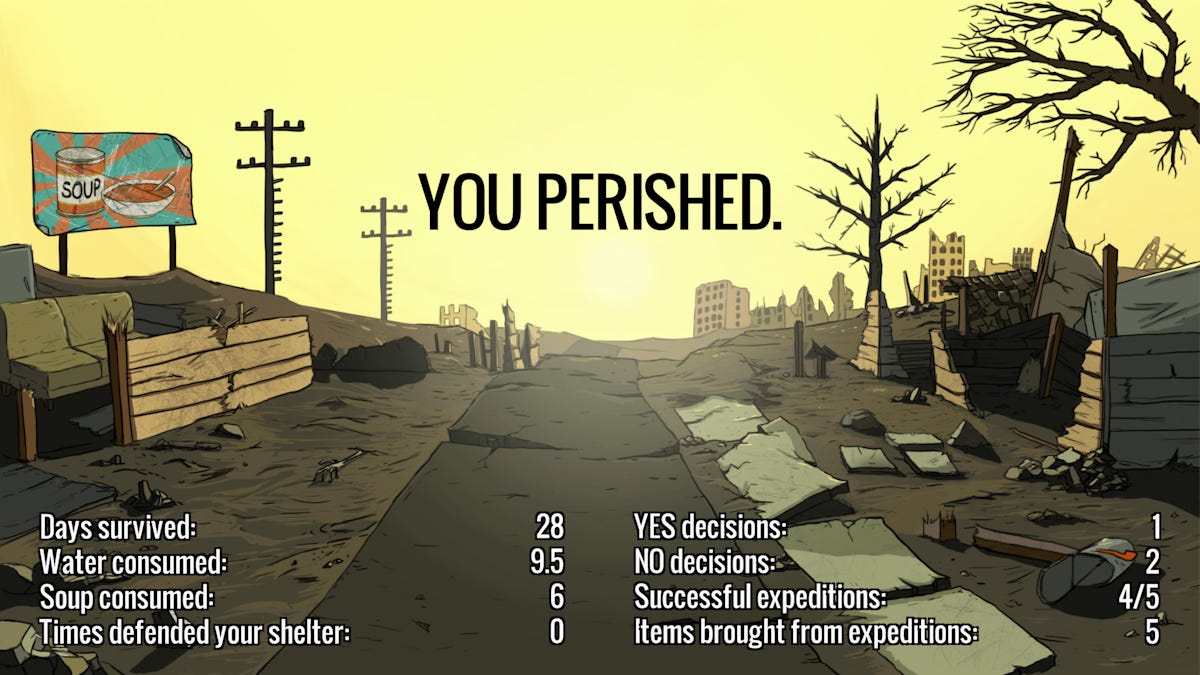
Of course, if the alternative were really death — something a game could never truly make one believe — then one could imagine doing it. But the only person who would find such an experience fun would be someone who got truly high on the idea of their own individual survival, and how superior that made them to everyone else. Such people, of course, probably exist.
The silliness of 60 Seconds! is, of course, meant to make staying in a shelter actually seem like something one might want to do. Even so, it is a game of endurance, and, presumably, optimization of choices. I can see how a certain kind of player (not myself, alas) would enjoy figuring out all of the ways to improve their odds and length of survival, or figuring out how to obtain all of the different endings.
As far as “shelter games” go — of which there are a few — 60 Seconds! is much more realistic than anything that is more in the Fallout genre (e.g., Fallout Shelter, which has some similarities but lots more silliness). That they incorporate mental health (however unrealistically), tedium, and illness into the game already makes it a good antidote to most “lone survivor” fantasy games. I don’t think many people who played 60 Seconds! would come away believing that a post-nuclear war scenario would be very fun, and that’s better than the alternative.
What's the timeline for the release of your game??
living 6 miles out from Manhattan Island in the badlands of the bronx I can see the city rising and the lights at night over the low buildings of the northern boro , I know when it does come I won't know what hit me and I'm very ok with it after visualizing this video game.