
The scarred women of Hiroshima
The complicated political and cultural memory of the "Hiroshima Maidens"

As part of my work as a Senior Fellow of the The Bulletin of the Atomic Scientists, I am writing several articles for them, which I am allowed to republish here on Doomsday Machines. You can read the original article here.
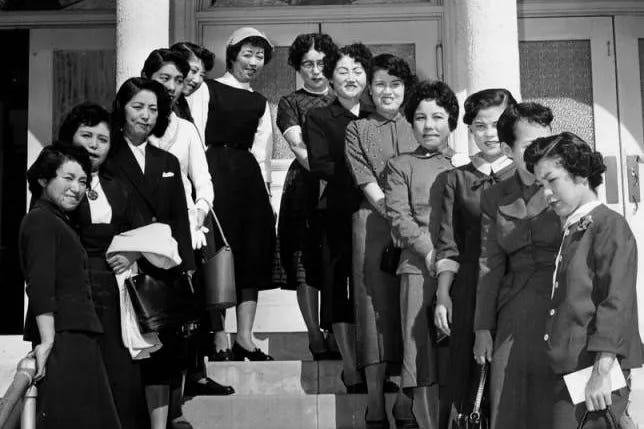
On May 7, 1955, 25 young Japanese women arrived by airplane at Travis Airfield in California. They had flown there from Iwakuni Airbase in Tokyo a few days prior, with a layover in Honolulu. In California, a crowd greeted their arrival by showering them with flowers—and four women who, to the discomfort of many involved, used the opportunity to give a speech about the dangers of the hydrogen bomb.1
All of the women had been schoolchildren in Hiroshima on the morning of August 6, 1945, when the United States detonated an atomic bomb over the city. Many of them had been at work building firebreaks at the time of the bombing, and had all been severely burned by the attack. They were known in the press as the “Hiroshima Maidens,” and they were part of a trip, organized by a Japanese reverend and an American journalist, and with the hesitant blessing of the US State Department, to bring the women to the United States, so their scars might be healed through the power of American plastic surgery. The primary intent was to ease their individual suffering, but the trip was understood by all involved to be more than that: the wounds being healed were not just physical, but political.
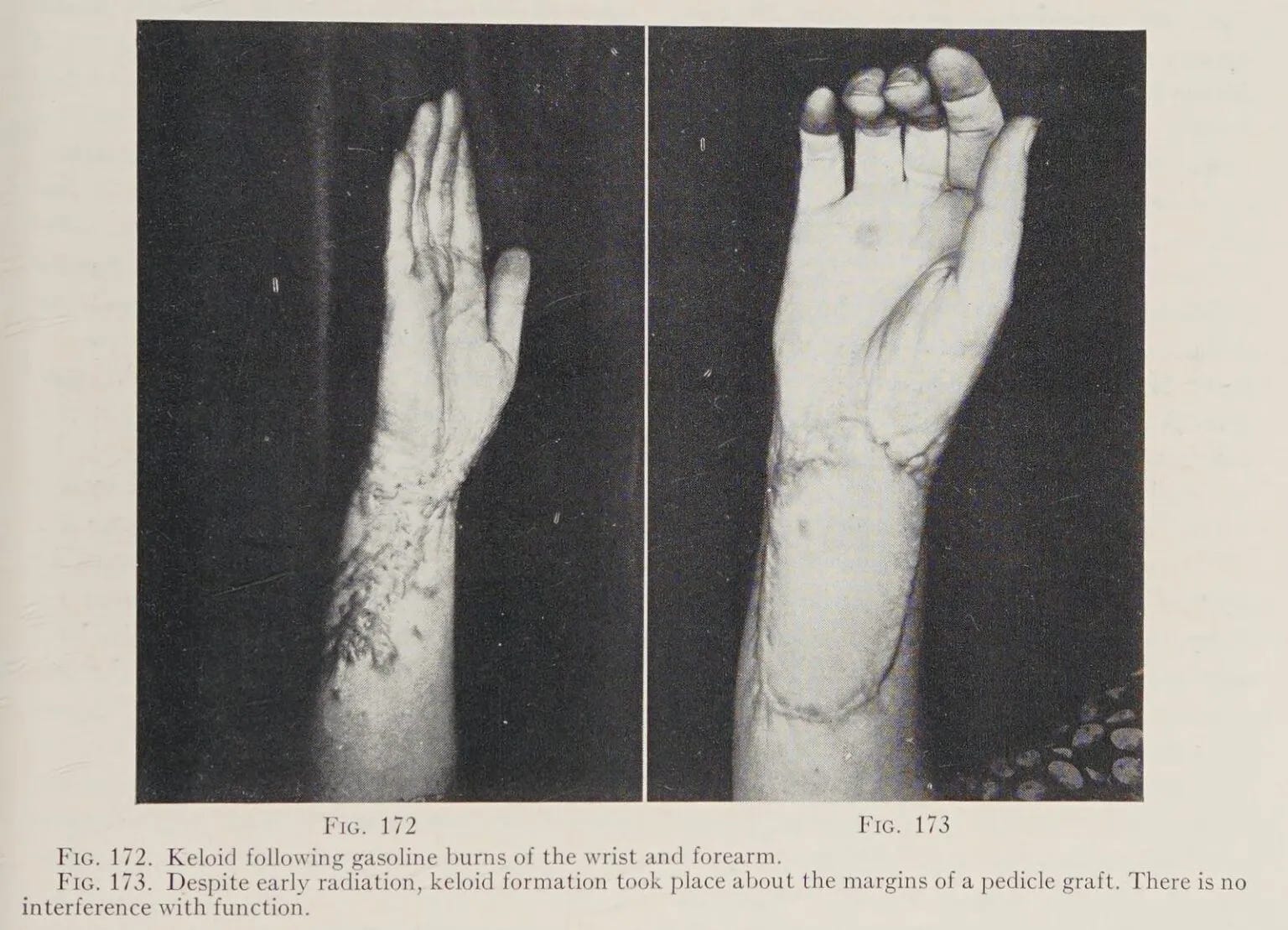
Keloid scars are raised, thick, and irregular slabs of collagen. They can form after any injury, and can appear long after the injury itself. They generally do not hurt, but they can itch. They can also constrain muscle movement, decreasing mobility dramatically, depending on where they have formed. And they are disfiguring. For reasons that are apparently still not well-understood, such scars are more prone to develop in people of Asian, African, and Hispanic descent than in other peoples, and their heighted incidence among survivors of the atomic bombs has suggested that radiation exposure may increase the chances of their forming.
Photographs of the scarred bodies of atomic bomb victims are a common, if still controversial, accompaniment to discussions of the atomic attacks today. But in the immediate years after the end of World War II, they were much rarer. While an October 1945 story in LIFE magazine did feature two photographs of atomic victims, nearly all other popular photographs of Hiroshima and Nagasaki in the 1940s featured only photographs of the ruined buildings, not ruined bodies.
Less popularly, the bodies of victims were visible in official, technical publications on the “medical effects” of the bombs, with photographs of the victims months or even years after the bombings. These photographs were meant to display, cleanly and clinically, the effects of atomic bombs. They were not intended to provoke a sense of guilt, or even empathy, except as relates to how their audience might be interested in “effects data” for planning for the possible use of atomic bombs against themselves in the future.
Information about the survivors was tightly controlled within Japan by the occupation authorities, who feared that widespread discussion of the atomic bomb could lead to anti-American and pro-Communist sentiment.2
John Hersey’s Hiroshima, published as a full-issue of The New Yorker in August 1946, was the first publication to really give international audiences a view of what the atomic bombings were like from the perspective of the bombed. One of the six survivors that Hersey profiled was an American-educated Methodist reverend, Kiyoshi Tanimoto. Tanimoto’s account is gripping, and prominently features his inability to render the help to others that he wished that he could:
After crossing Koi Bridge and Kannon Bridge, having run the whole way, Mr. Tanimoto saw, as he approached the center, that all the houses had been crushed and many were afire. Here the trees were bare and their trunks were charred. He tried at several points to penetrate the ruins, but the flames always stopped him. Under many houses, people screamed for help, but no one helped; in general, survivors that day assisted only their relatives or immediate neighbors, for they could not comprehend or tolerate a wider circle of misery. The wounded limped past the screams, and Mr. Tanimoto ran past them.
Hersey’s account showed Tanimoto trying to help whom he could, but the magnitude of the disaster was overwhelming. Tanimoto himself suffered from a bout of radiation sickness, but recovered.
At the time of Hersey’s book, there was no agreed-upon term to use for those people who were at Hiroshima and Nagasaki at the time of the bombings but who had not died. The term “survivor” was common in English usage, but the Japanese have tended to shy away from their equivalent (seizonshai), apparently finding it to contain a bit of guilt or blame in its focus on those who did not die. Conversely, the term “victim” appears to have been used more commonly in Japanese (higaisha) than in English, perhaps again because of its apparent connotation that the violence done to the Japanese was unjust. It is not clear exactly when the term hibakusha—“explosion-affected person”—became the preferred term; it seems like it was used in Japan by the mid-to-late 1950s, and became well-known in English only in the early 1960s.3
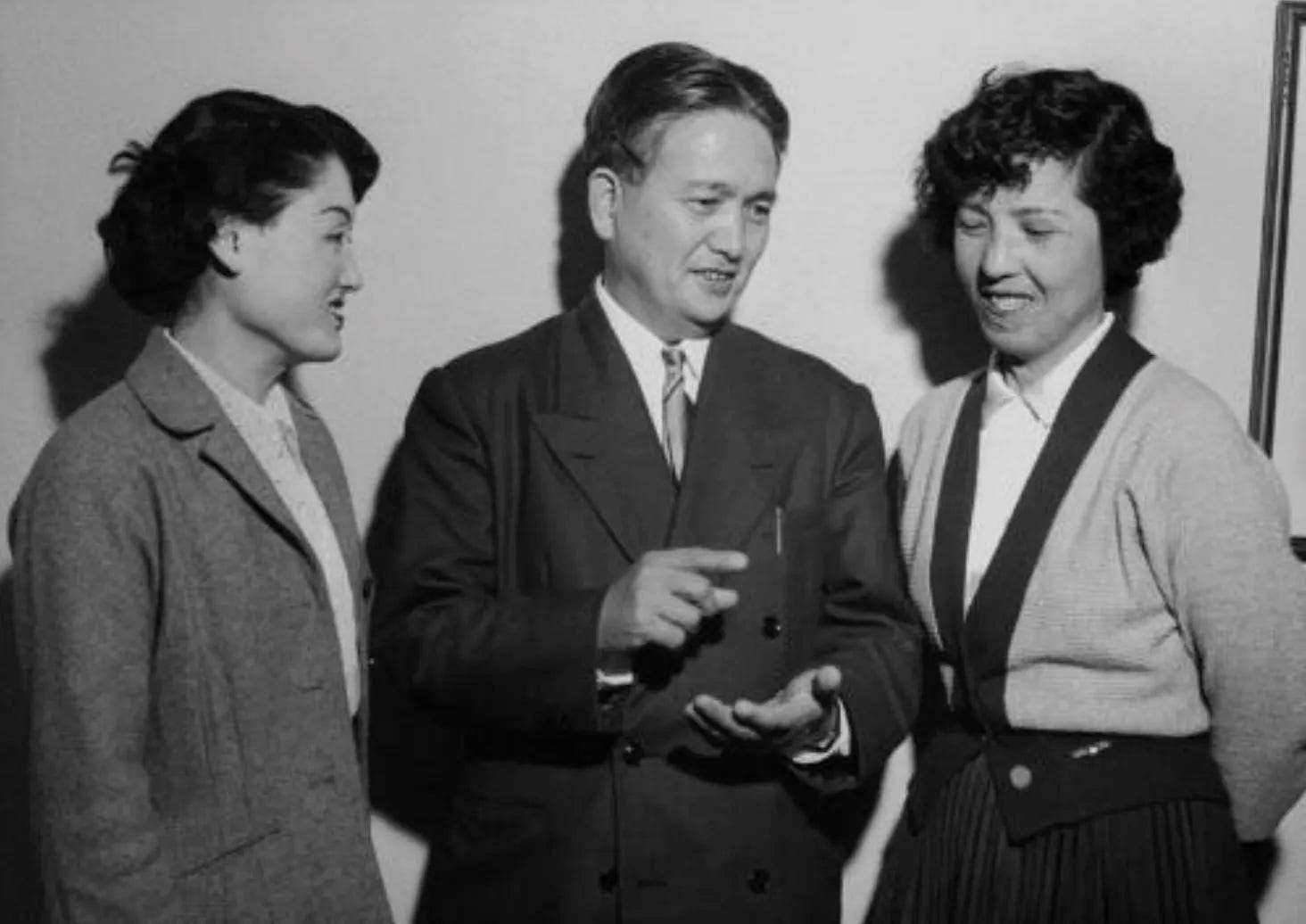
In the months after the bombing, his church destroyed, Tanimoto worked as a street preacher in Hiroshima. His message was both theological and political: Looking for someone to blame for the atomic bombing—whether the Americans who had dropped the bomb, or the Japanese military leaders who had started the war—was futile. Seek salvation through God alone. With parishioners, he began the work of rebuilding the church building, but the work was slow, for there was no money and few resources available. In 1948, he traveled to the United States to meet with an old classmate of his, in an effort to raise funds for a new church. While on the ship to San Francisco, he had an idea: He could dedicate his life to peace, and the rebuilding of his ruined Hiroshima would be the focal point for that. Without consulting anyone back home, he began to give sermons around the United States, taking up a collection for Hiroshima’s rebirth. By the end of 1949, he had visited over 250 American cities, and raised about $10,000 for the church.4
Tanimoto ultimately made a connection with the editor of the Saturday Review, Norman Cousins, who enthusiastically supported his plea, and ran an editorial proposing the creation of a World Peace Center in Hiroshima. Although the article claimed to be in the name of the inhabitants of Hiroshima, no one but Tanimoto was ever consulted. A Hiroshima Peace Center Foundation was set up in New York by Cousins, in order to receive American donations.5
A few years later, as part of his peace center efforts, Tanimoto began a Bible study class for a group of women that he apparently called his “Keloid girls.” He had offered other classes to victims of the bombing; the Keloid girls were special because their deformity and their sex was seen to demand a level of social exclusion that went beyond that of other Hiroshima victims. He would eventually petition the Hiroshima government for funds to give them plastic surgery, but was rejected. He then went to the Atomic Bomb Casualty Commission, the American-run effort to study the medical effects of the atomic bombings, but he was told that this was outside the commission’s scope. The commission was not in the business of “treatment,” and keloids were not unique radiation effects.6
Eventually, Tanimoto received some funding for surgery on the Keloid Girls within Japan, bringing a group of them to Tokyo in the spring of 1952, just after the end of the American occupation. There was also one male victim in the group, Kiyoshi Kikkawa. The Japanese press, to the surprise of Kikkawa, became completely focused on the women, dubbing them the Genbaku Otome: “Atomic Bomb Maidens.” The women were attractive because of their symbolism of peaceful Japanese resilience. Kikkawa quickly felt it was going too far: At one point in their trip, the “maidens” were taken to tour a prison that held Japanese war criminals, and two of the “maidens” chosen as delegates proclaimed that while they had once held grudges against the Japanese militarists, they now saw them as being in the same situation as the survivors.7
The surgeries were at least somewhat successful. Tanimoto had been in touch with Cousins about the “maidens” ideas, and with this pilot project completed—and its publicity value proven in at least the Japanese context—Cousins was ready to push for an American side of it. This would be larger and grander: more “maidens” (no men, this time), and the surgeries would be done in the United States, where plastic surgery was state-of-the-art. Cousins is credited for transforming their name: Having changed from “Keloid Girls” to “Atomic Bomb Maidens,” they were now the “Hiroshima Maidens.”8
For six months, Cousins sought funding for the project from foundations. It would be expensive: the transportation and lodging alone would cost tens of thousands of dollars, and the operations would drive the cost into the hundreds of thousands. He saw little success, apparently because the foundations blanched at the possible negative publicity that might attach to the project.9
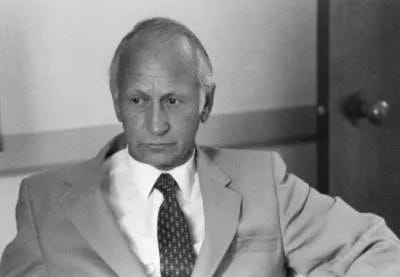
Changing tactics, Cousins then attempted to see if the operations might be performed pro bono. Through his personal physician, he made a connection to Dr. Arthur Barsky, who ran and had founded the plastic surgery departments at Mount Sinai Hospital and Beth Israel Hospital in New York. Barsky had literally written one of the primary reference books for the field, Principles and Practice of Plastic Surgery, in 1950. Barsky had dedicated the book to “the soldier patients of World War II,” on whom Barsky had practiced as a lieutenant colonel. The art of plastic surgery had long been associated with war injuries, and the “Maidens” project would be no exception.10
Barsky agreed to the work, so long as he could be involved in the selection of proper candidates, as keloids were tricky, as his textbook explained. “The possibility of post-operative keloid formation is an ever present one,” and certain parts of the body, and certain races of people, were more prone to them than others. “The cause and treatment of keloids are vexatious problems which have not been solved,” he lamented. But experience had given promise that many could be treated, particularly with high doses of radiation, either directly to existing keloids or after the tissue had been excised.11
Barsky, along with his colleague William Hitzig — Cousin’s physician — would fly to Japan to select the candidate “maidens,” alongside Japanese physicians. The initial plan was to look only at women who were part of Tanimoto’s Bible classes, but it was decided it would be more appropriate to widen the pool to any young woman who had been disfigured by the Hiroshima bombing. Although that would be a very large potential number, fewer than 50 actually showed up for the screening, perhaps because of rumors that the women would be subject to experimentation. Ultimately, 25 were deemed suitable candidates. The Mount Sinai surgeons had agreed to donate their labor, and the hospital agreed to provide bedding for little to no charge.12
After hearing about the project, Gen. John E. Hull, head of the US Far East Command, gave orders that a plane would be provided to bring the “maidens,” Tanimoto, and the surgeons to the United States. The flight landed first in California, where it was met by journalists and a small protest, and then proceeded onward to New York. Before the operations would begin, there was publicity to attend to. Three days after landing New York, Tanimoto, and two of the “maidens” flew back to California to appear on the popular television show This is Your Life, with the goal of making a public appeal and raising perhaps a million dollars.
For Tanimoto, it appears to have been an agonizing experience. He was apparently unaware of the format of the show, in which various “surprise” guests from his past would be shown, and the studio’s approach was disrespectfully sensational. One of the guests was Capt. Robert Lewis, the copilot of the Enola Gay, the B-29 bomber which had dropped the atomic bomb on Hiroshima. Lewis was, by a later account of someone backstage, extremely drunk: Lewis had thought he would be paid for appearance, and when he discovered he would not be, he went on a bar crawl.13
While the host, Ralph Edwards, appeared to find the entire episode jovial, Tanimoto was rigid and uncomfortable-looking for almost all of the show. Lewis slurred and struggled through a stiff speech, but appears to have been genuinely affected. Supposedly, before his segment, he looked into the room where two “Hiroshima maidens” were waiting. “And there are a hundred thousand more who look like that?” he is reported to have asked. During his segment, he recounted what the bombing of Hiroshima had looked like from the air, and recounted that he had written in a log book at the time: “My God, what have we done?”14
The two “maidens” were shown in silhouette only. A public solicitation was made for their cause, with Lewis giving the first check on behalf of the crew of the Enola Gay. The New York Herald Tribune denounced the episode as a “new low in poor taste” and “commercialized sadism,” while the Associated Press judged it “morbid and maudlin.” Former American servicemen jammed the telephone lines afterwards to complain about Lewis’ appearance, believing him to have disgraced the United States for expressing anything that sounded like guilt. Ultimately the episode only attracted $55,000 in donations — a meager sum compared to what had been hoped for.15
Back on the East Coast, Tanimoto and the women spent several weeks resting in a Quaker retreat in Pennsylvania. They were objects of intense scrutiny and paparazzi attention; no activity that the “bomb-scarred” (as the newspapers called them) women did was too mundane to avoid attention from journalists.16
Soon, however, the actual surgeries began. Over the next year, a team of surgeons at Mount Sinai, led by Barsky, performed over 140 operations on the women. When not in surgery, the women lived with host families. The operations were difficult. In some cases, there were dramatic improvements in mobility and appearance. One of the women, Tomako Nakabayashi, age 26, died of a heart attack during her third operation—a point that American newspapers made little of, but led Japanese newspapers to accuse the Americans of treating the women as guinea pigs.17
By the June 1956, 10 of the women were deemed ready to return home. The rest returned in late October 1956. The surgeries involving the women who survived were considered successful, although the reactions of people seeing them for the first time would often be to focus on the scarring that was still visible. But the women appear to have found the physical transformations a great boon, even if, as one later said, “there are lingering wounds in our hearts that have not healed.”18
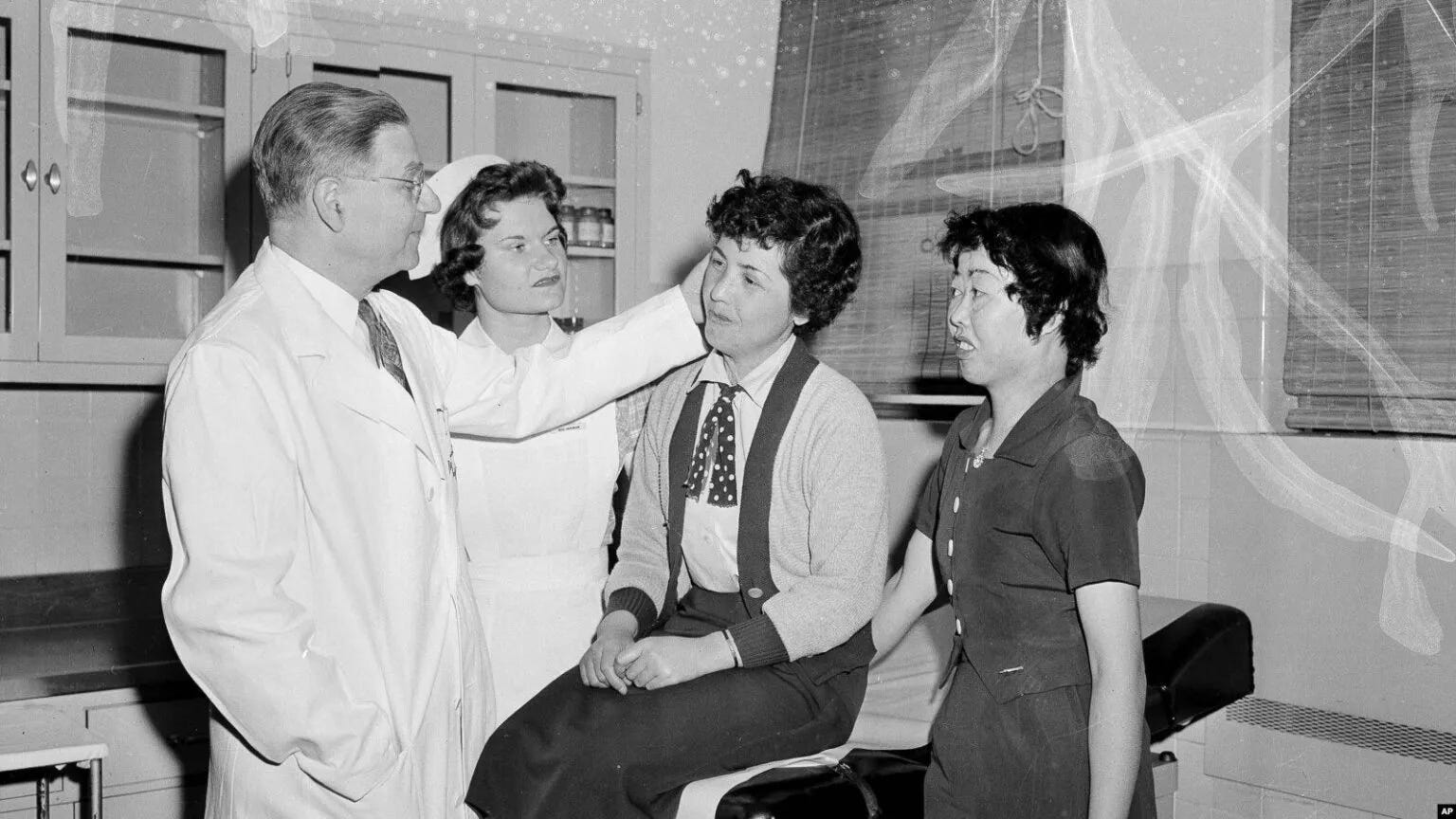
The story of the “Hiroshima Maidens,” which has been told many times over the years, comes in two distinct modes. The “original” mode is optimistic and, perhaps, a bit naïve. It is the version of the story pushed by Tanimoto and Cousins and most of the press who eagerly covered the women once they arrived in the United States in May 1955. This version is one of rebirth: just as Hiroshima, the city, was in the process of rebuilding after the atomic bomb, so could Hiroshima’s inhabitants rebuild their lives, even their very flesh.
City organizers in Hiroshima embraced their own version of the narrative of the city’s rebirth. Starting in the 1940s, and accelerating in the 1950s and 1960s, they emphasized that the destruction at Hiroshima would be not its end, but its new beginning. There was a tactical element to this: They needed to attract resources for development and rebuilding, and leveraging their status and fame was a potent part of this appeal. It was not an approach that denied that the past destruction had occurred, obviously, for this could not be denied. The “rebirth” narrative would be a way to lean into that story and change its trajectory. Among the hibakusha, there were understandably mixed feelings about the approach. The famous “Atomic Bomb Dome”—the ruin of the former industrial exhibition hall near ground zero—ended up being the only preserved “monument” to the destruction, serving a focal point for Hiroshima’s peaceful rebirth activities, but its preservation was contentious.19
There is a more cynical read on the “Hiroshima Maidens” and the rebirth mode of talking about the bombings. For one, this version of the story almost exclusively focuses on Hiroshima, at the expense Nagasaki, even though the case for the use of the second atomic bomb, only three days after the first, has always seemed much weaker than the case for the use of the first.
The focus on “maidens” also creates additional places for critique. There were married and divorced hibakusha who were rejected from Tanimoto’s project, and after the pilot project’s single male hibakusha, the rest were all women. The exact reasons for this have not been articulated by the players involved, but it seems that Cousins and Tanimoto felt the maidens made for more sympathetic figures and gave the project more of an apolitical appearance.20 As Robert Jacobs has put it, the “Hiroshima Maidens” were:
…generally depicted as childlike, innocent and grateful. They were uniformly spoken of as being “almost pathologically shy,” and then “blossoming in the warmth they shared in the homes of American ‘parents.’” […] The use of the term “maiden” reveals the focus on the lack of romantic prospects for the women while reinforcing the image of their innocence and childlike nature. […] The Japanese women were all students when they suffered the atomic attack, thus sparing them of any complicity in the Japanese war effort, and casting them as victims themselves of Japanese military aggression.21
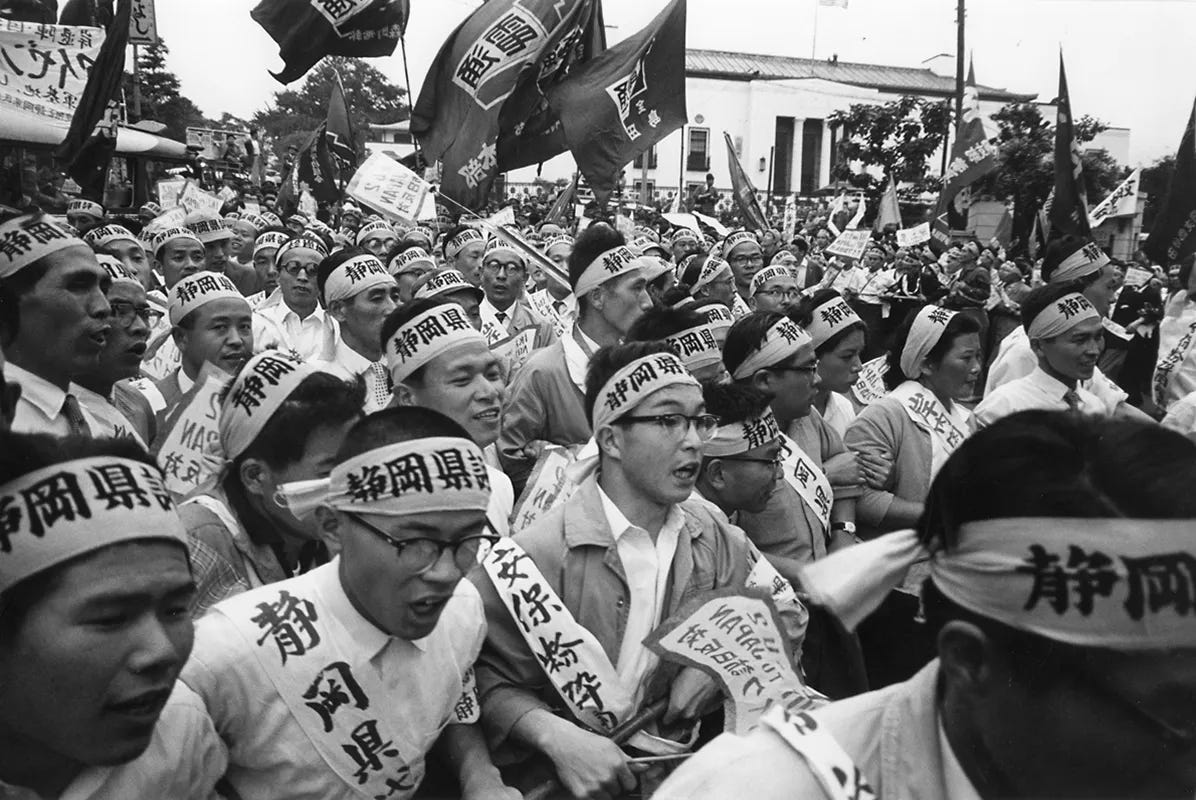
While the “Hiroshima Maidens” project was being planned, the discourse about the atomic bombings in Japan radically shifted. In early March 1954, the United States tested its first deliverable thermonuclear weapon at the Bikini Atoll, in the Marshall Islands. The detonation resulted in a massive plume of radioactive fallout that contaminated thousands of square miles of ocean and islands downwind of the test site and exposed a Japanese fishing boat, the Lucky Dragon No. 5, which had inadvertently strayed close to the test site. After they returned to Tokyo, the crew began showing the symptoms of radiation sickness, but not before their tuna catch was offloaded in Tokyo fish markets. Thus followed a tuna boycott and massive global attention to the issue of nuclear fallout. One of the crew would eventually die. Within Japan, this Bravo test became a major focal point for an emerging anti-nuclear political activism and generally led to an opening up of long-suppressed public discourse about Japan’s status as a “nuclear victim.”22
The “Hiroshima Maidens” project, however, was not part of this political movement. Tanimoto’s politics were far more conservative, more pro-American, and definitely not anti-nuclear. His was a politics of restoration and “moving on,” and, if anything more specific than that, about suppressing the anti-H-bomb sentiment of the Japanese that was being used to fuel protests against American military presence in Japan.23
Cousins had a more left-leaning approach, but his goals were focused on a bland humanitarianism and universalism, with a dash of world governance thrown in. While earnest, this was not particularly threatening to the status quo. As Ron Zwigenberg notes, Cousins “unwittingly promoted the American expansionist agenda with his outreach projects in Japan and elsewhere.”24
Still, this cynical read of the Hiroshima maidens effort feels, well, cynical. There is nary a humanitarian project in the Cold War that does not vacillate between these two readings, the earnest and the cynical. There is always some truth to each of them. All humanitarian aid was, arguably, part of some side of the Cold War project, and anything that came out of the United States could be justifiably considered a promotion of an American expansionist agenda, part of its bid for “soft power,” and part of the explicit attempt to foster public attitudes in the United States and abroad that would serve as to damper more radical calls for change. It is of interest to note that in the case of the “maidens,” the United States was not the only superpower with the idea: Physicians from the Soviet Union had offered to provide reconstructive surgery to the “maidens” in 1952, on the condition that they speak out against American imperialism and nuclear testing.25
Similarly, while it is certainly the case that the “Hiroshima Maidens” were part of an American attempt to assuage feelings of culpability and guilt, they were also actual people, with actual suffering. That it required maudlin public relations efforts to make the project happen, and that the aid was so selectively applied, constitute the most apt critique of the project. And there are certainly worse narratives for a devastated city than Hiroshima’s self-conscious “rebirth” and self-fashioning into a symbol of international peace.
There is also a critique to be made about the politics of memory. The mono-focus on Hiroshima has been at the expense of Nagasaki. This has had practical effects, including differences in care received by survivors. It also changes how we regard and remember the attacks. Modern surveys show that among Europeans, around 85 percent can correctly identify Hiroshima as the first city attacked by atomic weapons. That number drops by 20 percent when asked about the second.26 The exclusive focus on Hiroshima for the “maidens” project is both a product of its circumstances — Tanimoto was in Hiroshima — and a sign as any that for all of its appeals to humanitarianism, it was intended, primarily, as a symbolic gesture.
Above: Excerpts from a film made by the US Air Force on the medical effects of the atomic bomb at Hiroshima, 1946. I have only included the least invasive of the images. Source: NARA.
After their surgeries, few of the “maidens” sought additional attention. In the 1980s, Shigeko Sasamori lent her voice and authority as a hibakusha to a growing anti-nuclear movement. But most appear to have sought privacy after their period having their bodies and identities subjected to extreme focus, both positive and negative.27
The hibakusha, as the psychologist Robert Lifton observed in his in-depth study of them, have a complicated relationship with their status as victims. It is a no-win situation: If their victimhood is remarked upon or treated as special, they fear that any assistance rendered is inauthentic and confirms that they carry a stigma. If, on the other hand, they are ignored, they feel abandoned.28
Barsky, the plastic surgeon, continued his own kind of ministry. In 1969, he organized a clinic in Vietnam to operate on Vietnamese and Cambodian children who had been horribly burned by American munitions. The clinic operated on over a thousand children, including Kim Phuc, the famous “napalm girl.” After American surgeons fled during the fall of Saigon, the hospital was kept running, and still operates to this day.29
Scars are a sort of archive of a body’s experiences. They fade, and they can sometimes be healed. Scars in the mind are harder to see. But the scars of history, as played out in politics and attitudes and cultural creations, can outlive the people who experienced them firsthand. What does it mean to remove scars, or to preserve them? What story do the scars of history tell?
Most of the “Hiroshima Maidens” seem to have truly desired to be apolitical, which in this case seems primarily to mean non-controversial. This desire was, of course, impossible to fulfill. Their bodies were, by virtue of where they had been on the morning of August 6, 1945, inherently political. Plastic surgery could hide some of the scars. But being hibakusha appears to have thrust survivors of the bombings into a political position: One’s existence is some kind of statement about power, and so an object for others to use in making their own kinds of political statements. To gaze upon the body of a hibakusha is a political act—but so, also, is looking away.
David Serlin, Replaceable you: Engineering the body in postwar America (University of Chicago Press, 2004), 78; Rodney Barker, The Hiroshima Maidens: A story of courage, compassion, and survival (Viking, 1985), 86-88.
On the postwar censorship, see Monica Braw, The atomic bomb suppressed: American censorship in occupied Japan (M.E. Sharpe, 1991).
Robert Lifton, Death in life: Survivors of Hiroshima (Random House, 1967), 7. Hersey himself used both “victim” and “survivor” in Hiroshima, with a preference towards “survivor.” After the Fukushima accident, some have preferred to use a homophonic version of hibakusha that means “exposed-person,” widening the meaning beyond the atomic bomb survivors. Ran Zwigenberg, Hiroshima: The origins of global memory culture (Cambridge University Press, 2014), xiv.
John Hersey, Hiroshima (Vintage, 1989), 136-139. The 1989 and later editions of Hiroshima feature an additional chapter (“Aftermath”) that contains discussion of the “Hiroshima Maidens,” among other things.
Hersey, Hiroshima, 136-139.
Hersey, 141, and M. Susan Lindee, Suffering made real: American science and survivors at Hiroshima (University of Chicago Press, 1994), 134.
Hersey, 142; Yuki Miyamoto, “In the light of Hiroshima: Banalizing violence and normalizing experiences of the atomic bombing,” in N.A.J. Taylor and Robert Jacobs, eds., Reimagining Hiroshima and Nagasaki: Nuclear humanities in the post-Cold War (Routledge, 2018), 123-138, on 130-32.
Zwigenberg, 82, fn. 74. Hersey, 142, suggests the early operations were “not altogether successful.”
Barker, 68.
Barker, 69; Serlin, 63-65.
Arthur J. Barsky, Principles and practice of plastic surgery (Williams and Wilkins, 1950), 122-127.
Serlin, 108.
Barker, 94.
Barker, 8-9, 94. Bill Geerhart also has an excellent write-up on the episode, its context, and its reception on his blog CONELRAD Adjacent, “Hiroshima: This is your life” (August 6, 2010).
Geerhart, “Hiroshima: This is your life.”
Serlin, 82, 91.
Serlin, 106.
“To return to Hiroshima: Ten girls to leave here soon after plastic surgery,” New York Times (June 5, 1956), 4; Rodney Barker, Hiroshima maidens: A remarkable survivor story (Endeavour, 2015), “Afterword 2015.” This updated, electronic edition of Barker’s book adds an additional chapter.
Zwigenberg, 210-219.
Miyamoto, 131-133.
Robert Jacobs, “Reconstructing the perpetrator’s soul by reconstructing the victim’s body: The portrayal of the ‘Hiroshima Maidens’ by the mainstream media in the United States,” Intersections: Gender and Sexuality in Asia and the Pacific, no. 24 (June 2010).
Zwigenberg, 77-82; Toshihiro Higuchi, Political fallout: Nuclear weapons testing and the making of a global environmental crisis (Stanford University Press, 2020), 41-60.
Zweigenberg, 85.
Zweigenberg, 84.
Serlin, 99.
Sterre van Burren, Benoît Pelopidas, and Alexander Sorg, “Nuclear memories for the future: Gaps and forgetting in European publics’ understandings of the atomic bombings of Hiroshima and Nagasaki,” Thesis Eleven 189, no. 1 (2025), 3-8.
Barker, “Afterword 2015.”
Lifton, 193-194.
Gloria Emerson, “Where surgeons reconstruct bodies – and lives – in Vietnam,” New York Times (August 31, 1971), 24; “Plastic surgeon’s 40-year legacy lives on,” Viet Name Women’s Union (August 15, 2008).