
The spoils of nuclear war
A surreal-yet-serious study of post-nuclear economics from 1965

One of the things that makes Civil Defense interesting to me, as a historian, is that if one takes it truly seriously — which not all of its advocates do or have done — it involves trying to think very concretely about what would happen during a nuclear war, and what kind of world would exist for those who survived a nuclear war.
These imagined scenarios, particularly when they get very granular in their attacking the problem of nuclear war survival, often feel surreal. Pretty much anything mundane looks absurd and inconsequential when put up against the specter of full-scale nuclear apocalypse. Still, I think there is some value, even to those of us who are not committed one way or the other to do the survivability of some Civil Defense planning, into “grounding” an understanding of what “nuclear apocalypse” means.
In 1963, the Institute for Defense Analyses (IDA), a prominent DC-area think tank, was contracted by the US Office of Civil Defense, Department of the Army, to conduct a detailed study of what would happen to a American single city in the event of a nuclear war. Several reports came out of this work over the course of 1965.
The city chosen was Houston, Texas, and the studies looked at the effects of a singular detonation, centered on the most populous area of the city. A variety of possible explosive yields, ranging from 100 kilotons up to 100 megatons, were looked at for comparative value, and the consequences for a number of sheltering scenarios were compared (e.g., no shelters, versus people having the time to move to dedicated shelters, versus people only being able to shelter nearby). The focus on a “local area approach,” the study authors explained, was “fruitful” in that it allowed for “insights into the effectiveness of shelter programs that would have been lost in the aggregations necessary for any evaluation at the national level.”1
One of the specific studies done as part of this work was on the economic impacts of a nuclear weapon detonating over Houston. The report on this was written up by William C. Truppner, an economist and career bureaucrat with decades of experience in different US government agencies, with an inauspicious title: “Nuclear Blast Effects on a Metropolitan Economy.”2 It specifically was meant to assess “weapon effects on economic resources and considers the post-attack relationships between surviving population and resources.”
How does one study such a thing rigorously? Truppner’s study focused in on three aspects of what is an insuperably large problem: “economic output, property values, and population characteristics including the experienced labor force.”
“Property values” seems like a pretty odd thing to worry about, post-apocalypse. This is the part that seems absurd on the face of it. And perhaps it is a bit absurd. But Truppner is clear that this is an artifact of available data: property values are the kind of mass statistical data that are relatively easy to obtain, and can be thus used as a rough proxy for calculating economic impact. The problems with the data are pretty clear: are assessed values and real values the same (no), what does one do about the fact that certain types of property are exempted from taxation and thus are not in the same datasets (extrapolate between them), and, more fundamentally, the fact that the idea of a “pre-war” property value having any meaningful correlation to a “post-war” property value, as if the “pre-war” and “post-war” market forces would be roughly equivalent. Still, Truppner seems to be arguing, you have to start somewhere.
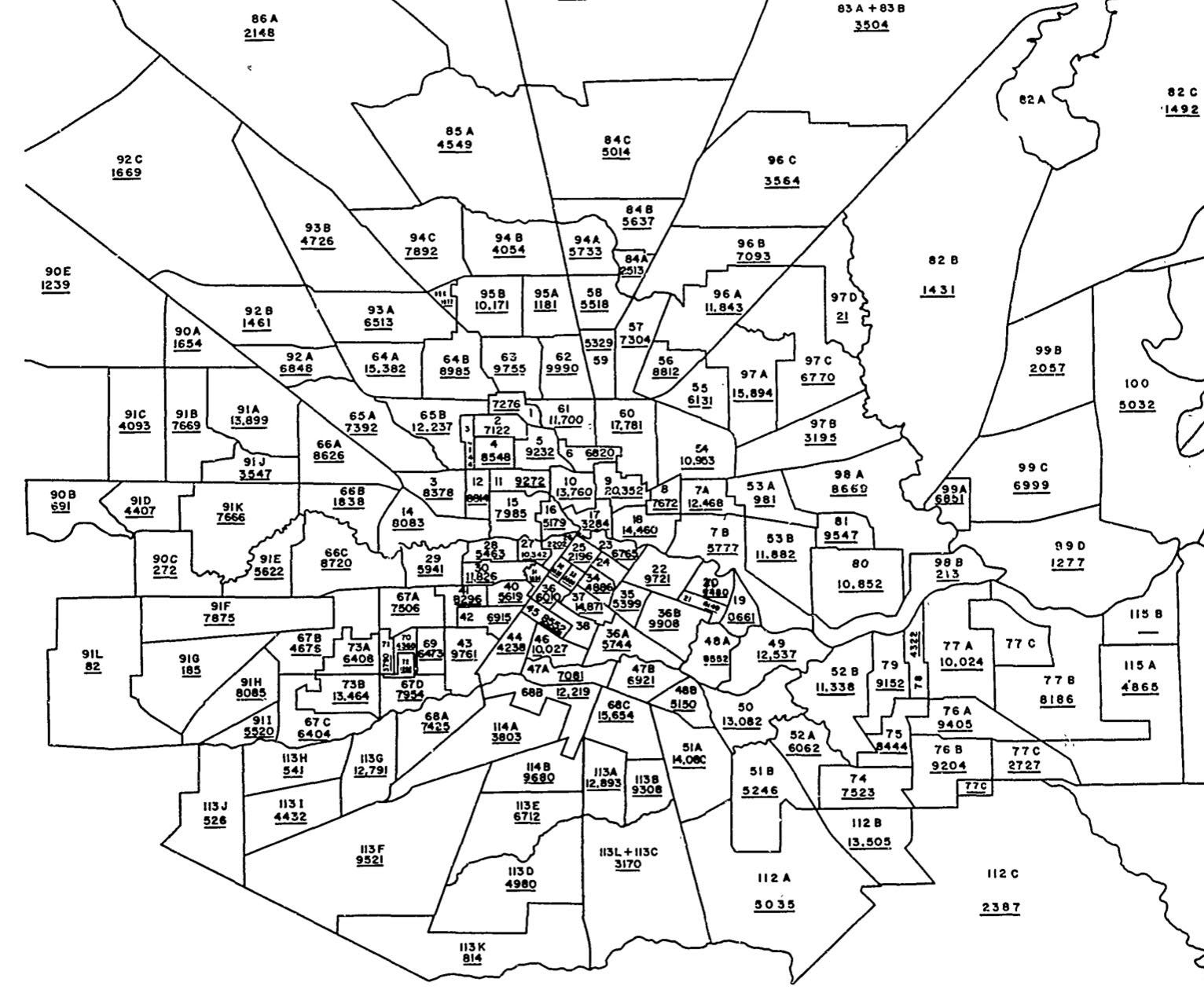
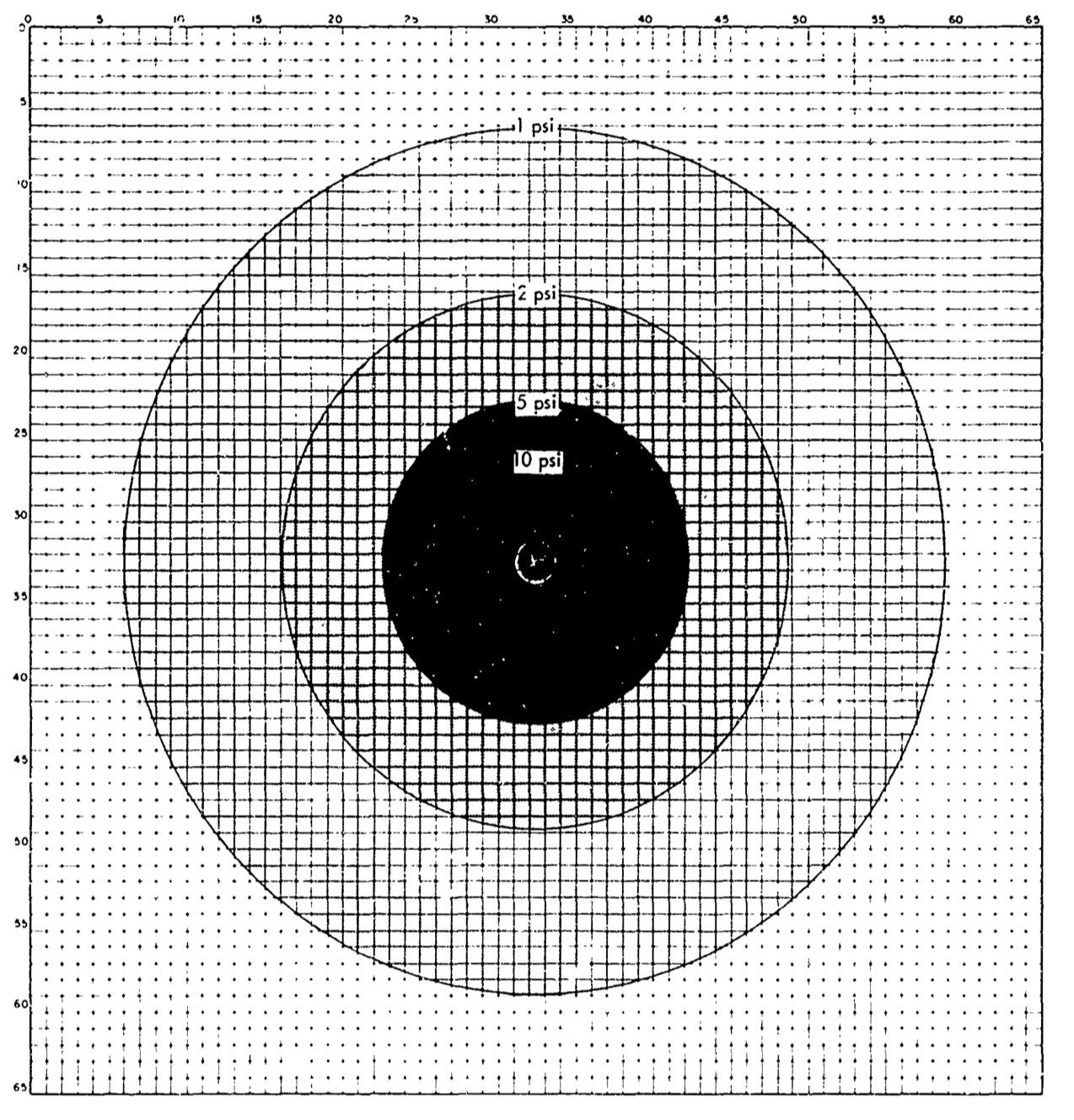
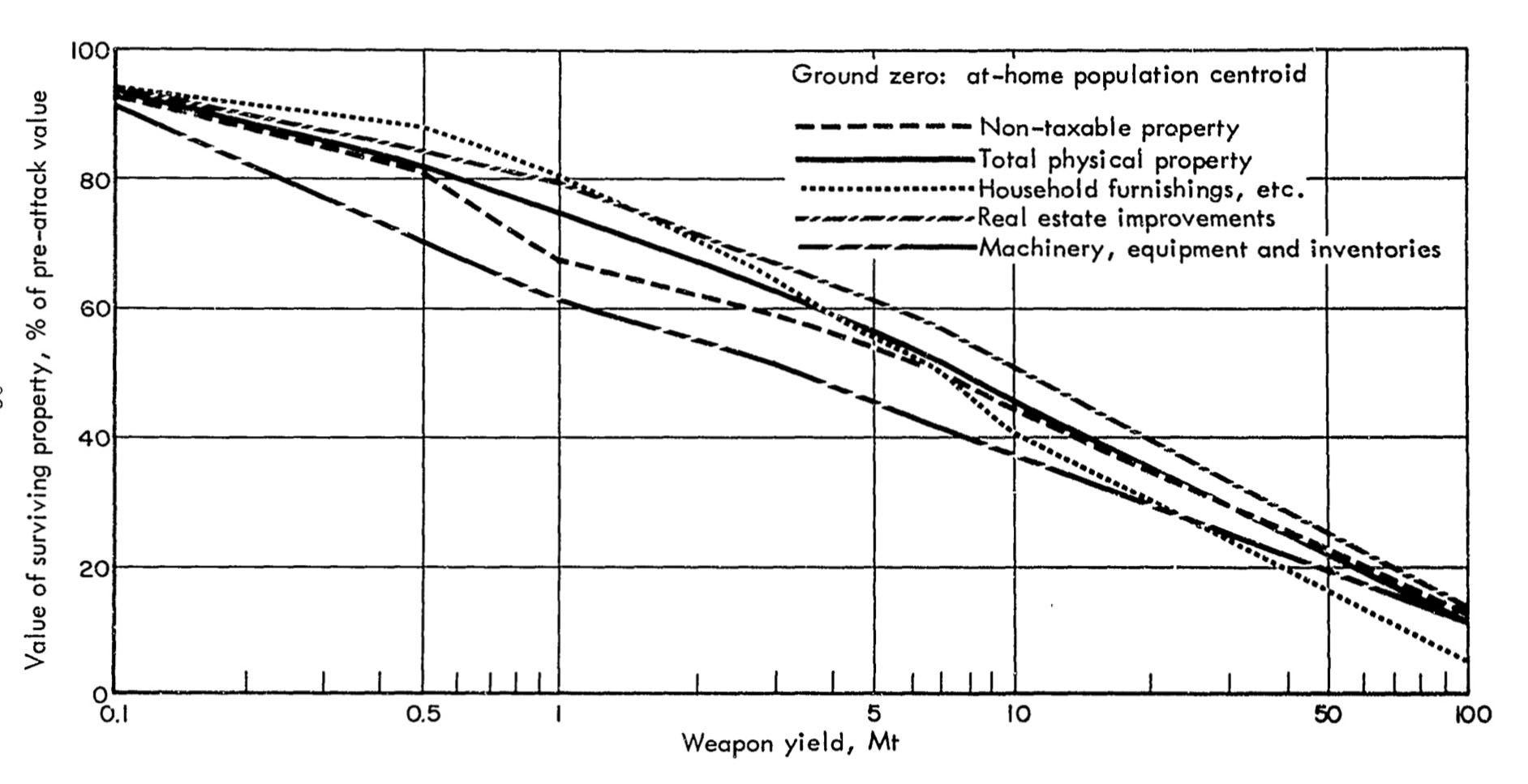
In looking at property values, what the IDA researchers did was essentially superimpose a series of blast rings over the city of Houston and assume that within certain distances of ground zero, for the variation detonations explored, a certain percentage of property was destroyed. Understandably, the larger the bomb, the higher the percentage, although the relationship between destructive potential and weapons yield for nuclear weapons is not linear. At the lowest end (100 kilotons), some 90% of the property in Houston survives; at the highest end (100 megatons), less than 20% does.
Some interesting results come out of this. One is that the total population also declines proportionally with property value in an unsheltered scenario — because people are in those properties that are getting destroyed, obviously. For a 10 megaton scenario, only 10% of the population of Houston would survive such an attack. But if one assumes that people are able to take shelter, this changes: in the 10 megaton case, now 30% of the population would survive.
That is still already somewhat sobering: even in a likely idealistic sheltering situation, you are still going to lose 70% of your city’s population. Is the difference between 70% dead and 90% dead “worth it”? The Civil Defense planner will generally say yes, because from a numerical perspective, at least, there is a significant difference between the total survivors in that situation, and that puts one on a very different “post-war” footing.
But a somewhat surprising results comes out of this. For one, the amount of property destroyed does not change with sheltering plans, only the population. So that means that if the “value” of the city is considered as its property (and not its people!), then the total value per person after nuclear war goes down when more people survive:
These data suggest that if the entire population is given any kind of shelters, even fallout shelters, and the attack is upon the at-home population for upon the shelter posture was designed, they will emerge “poorer” on the average. If the population were at work and therefore unable to reach the shelters allocated for the resident population, there are postures which would have the effect of maintaining or increasing post-attack per capita wealth. But the stronger the shelters available, the poorer the survivors will be.
I hesitate only a little to point to this as evidence that economists are very strange, and perceive the world very strangely. The logic certainly makes sense. But it seems like entirely the wrong way to think about survival: we’d all be richer if fewer of us survive. The fallacy of this is somewhat evident: a lone survivor is hardly “wealthy” in a meaningful sense, even if he may make claim to all the world’s resources, because actual value comes out of societies, systems, pooled resources, etc., to say nothing of the fact that there are many ways to value things other than economically.
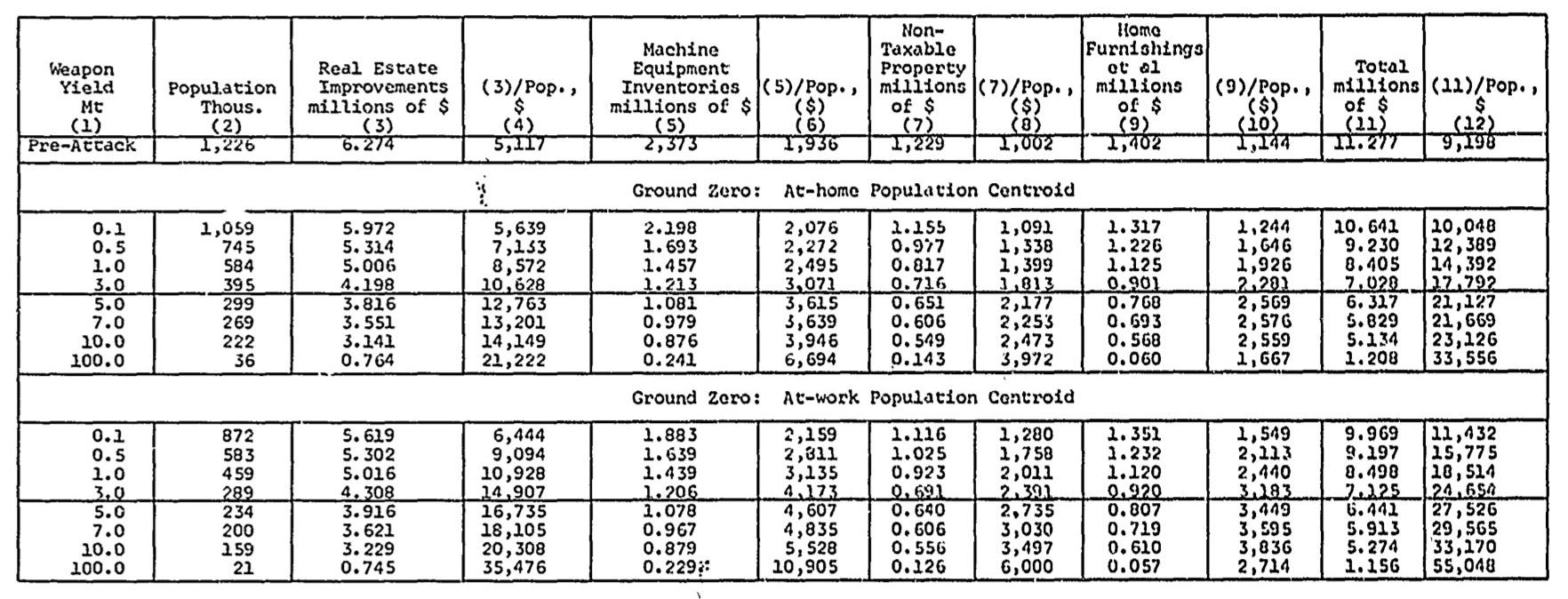
This effect of “richer” and “poorer” survivors is also, understandably, correlated with the amount of damage that is done:
Post-attack physical property values, subjected to the sixteen hypothetical attacks (eight weapons, two targets each), varied from 94 percent of the pre-attack value for a 0.1-Mt weapon to 10 percent for a 100-Mt weapon. The same attacks on the unsheltered population of Houston result in 86 percent and 2 percent rate of survival, respectively. The survivors of larger attacks, in a limited sense, become richer. The higher the yield of a weapon, the greater the per capita “wealth” of the survivors....
I hesitate to call this perverse, both because that is not a very “historical” judgment, nor do I think the logic is wrong. But one does wonder how Truppner felt, writing that last sentence down.
Obviously Truppner was not calling for less people surviving, or for the economic benefits of being attacked by multi-megaton weapons. To the contrary, he sees in this data a new mandate: Civil Defense must do a better job to protect property:
It seems, then, that unsheltered people are more destructible than unsheltered property, but sheltered people are less destructible than unsheltered property. If one purpose of a shelter program is to maintain per capita property values within bounds, protection must be given to property as well as to people…
I need to start creating a list of deeply strange Cold War sentences, because that first one is really one for the hall-of-fame.
Truppner’s report goes deeper than this high-level generalization, looking at the specific industries affected within Houston, both in terms of infrastructure (e.g., what kinds of buildings and factories are destroyed) and workers (focusing on particular professions). For both of these, he that because industries and their workers are not uniformly distributed inside of Houston, there were places where surprisingly disproportionate results occurred, with some industries (and professions) having roughly the same proportion of survivors in “post-war” Houston as “pre-war” Houston, but others being either over- or under-represented. He describes this as a “distortion” of the economic situation, and underlined the consequence of it to highlight them:
Assuming that such a situation would be characteristic of every target city in a nuclear attack, it would appear that important tears in the national industrial fabric are obscured by analyses relying on nationwide aggregation. This finding has obvious implication for judgments based on estimates of post-attack economic output developed from statistics reflecting national totals.
When applied to the workforce, Truppner found that there were serious “distortions” in professions between the “pre-war” and “post-war” in unsheltered scenarios, and that they disappeared if you assumed sheltering was taking place. This part of the study gets into more of that impressive minutiae which also gives it that air of absurdity. Pre-war Houston had 1,603 barbers, which made up 3.57% of the labor force. Post-war (10 megaton detonation) Houston without shelters would only have 105 barbers, now only 3.04% of the labor force — a distortion of 0.53%! But with shelters, you’d have 398 barbers, and they would retain their share of 3.51% of the labor force. Phew.
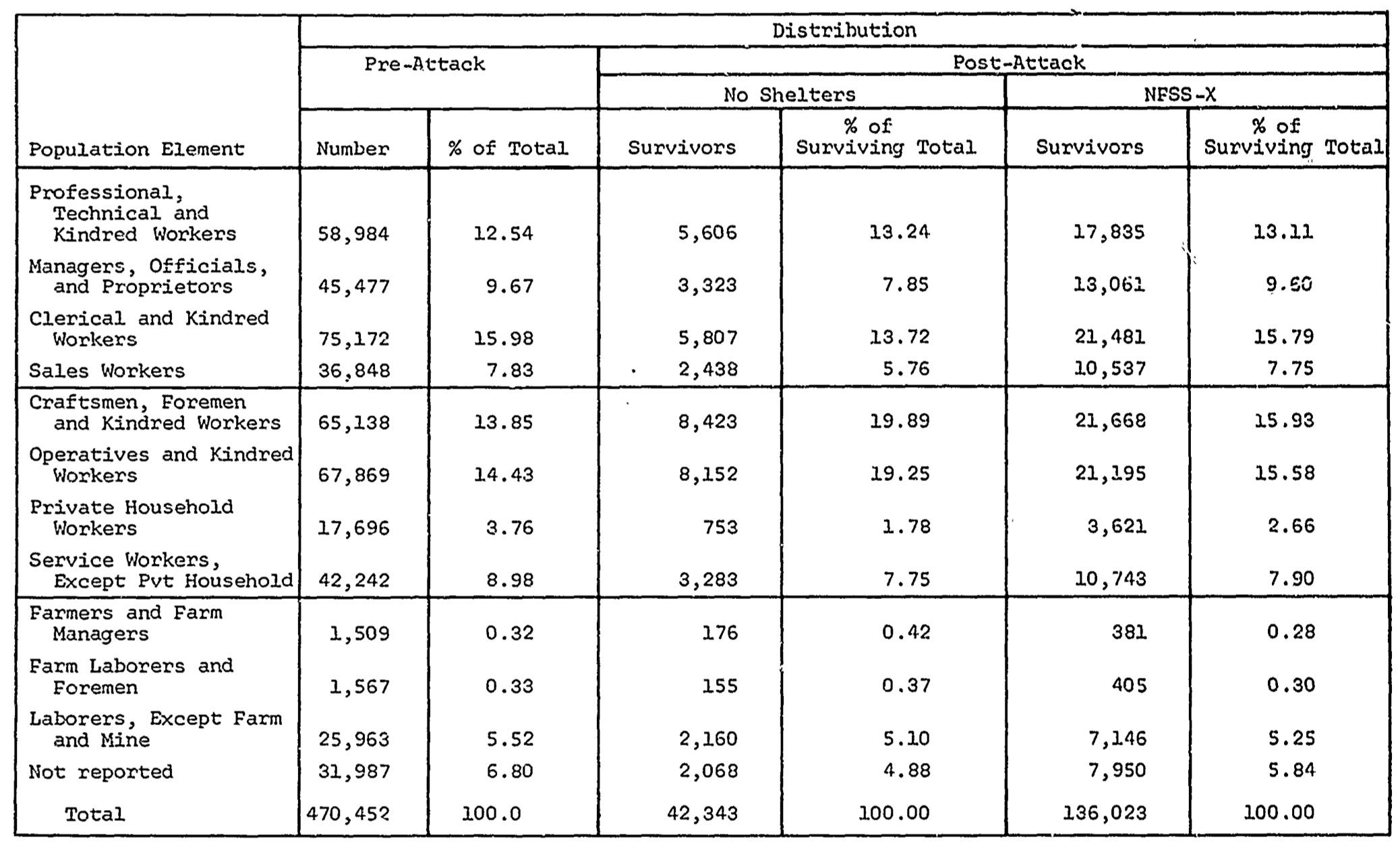
It’s not just barbers — it’s taxi cab drivers, midwives, weavers, welders, asbestos and insulation workers, plumbers, opticians, electricians, stone masons, carpenters, glaziers, real estate brokers, underwriters, stenographers, cashiers, conductors, lawyers, judges, teachers, nurses, physicians, psychologists… you name it, they tried to catalog how many of them were in Houston before the war, and how many would be expected to survive with and without shelters.
I think this is actually quite wonderful. Would it not be amazing if NUKEMAP could do something like this? Does it not render the cost of nuclear war so much more tangible?
That is not how Tuppner sees it, of course. He instead frets that some industries would be over- and under-represented, and how this has “stark implications for the post-attack world,” notably that, for example, the surviving employees in the “food and kindred products, wholesale trade, and retail trade” sectors would outstrip those sectors’ capabilities post-war, and those workers would not have transferable skills. This is where the economist’s world view seems to go off the rails: that people who worked in “retail trade” might need to learn a new profession after a nuclear war is, well, probably not what most people would count as a pressing problem.
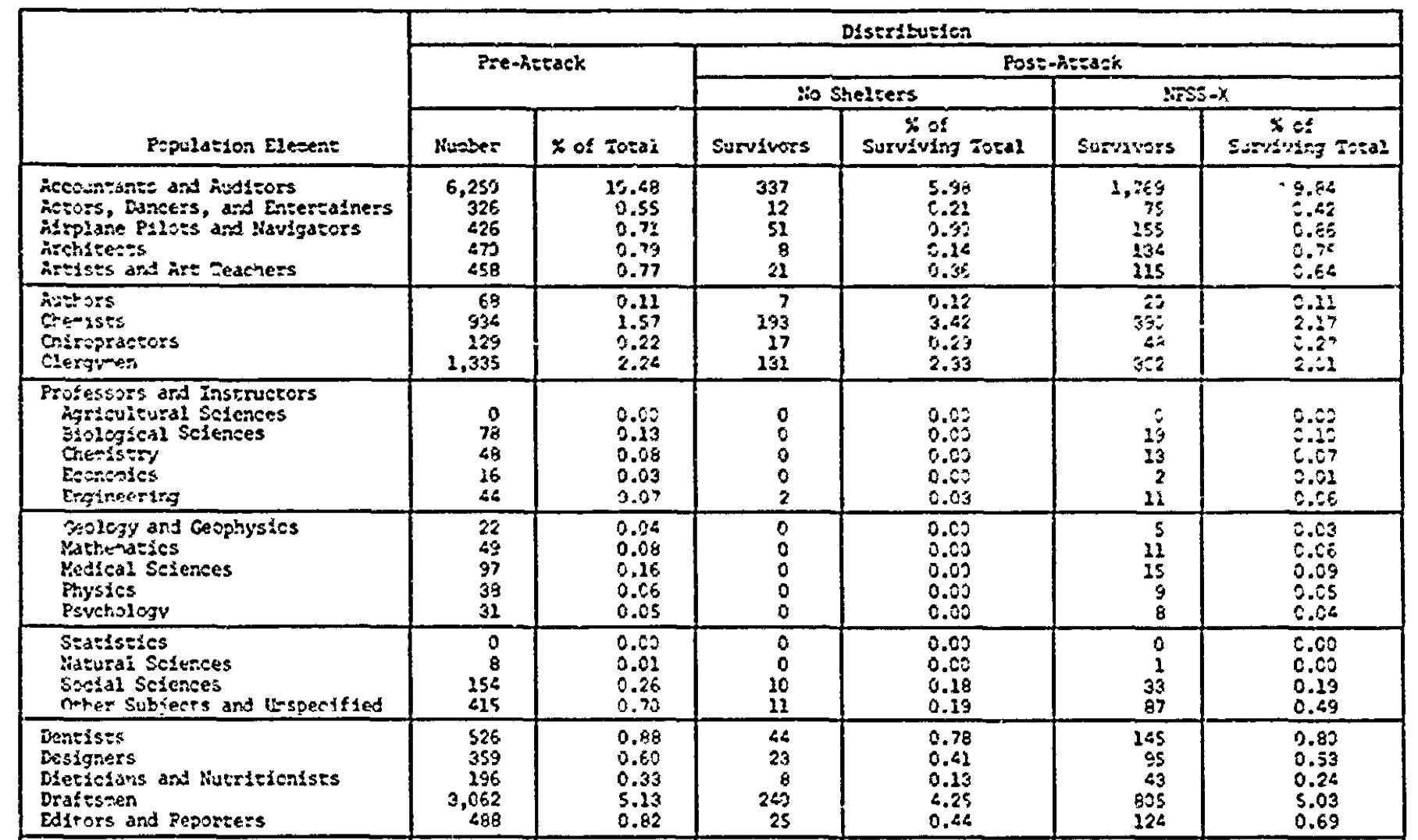
Truppner’s study is fascinating and horrifying in equal measure. There’s definitely value in this kind of “local area” approach to nuclear war: it makes the unimaginable seem tangible, graspable, and individual. Who can resist looking for one’s own profession on such lists? (Pre-war Houston would have had 154 Professors of Social Studies. After a 10 megaton blast, without sheltering only 10 would remain. With sheltering, 33.)
But at the same time, the framing of nuclear war in purely economic terms, and the perhaps perverse conclusions that arise from that, feels like it undercuts the ultimate message about survivability. Contemplating the number of surviving barbers in Houston under different nuclear war scenarios feels so disproportionately strange that it mocks the entire enterprise in a way that no parody possibly could.
Samuel Ewer Eastman, “The Effects of Nuclear Weapons on a Single City: A Pilot Study of Houston, Texas,” Institute for Defense Analyses, Report R-113 (September 1965), ix. This report also describes the overall context of the work, and gives many of its preliminary results.
William C. Truppner, “Nuclear Blast Effects on a Metropolitan Economy,” Institute for Defense Analyses, Study S-209 (September 1965).
These studies are perverse, "historical judgement" and logic(!?) notwithstanding. It's not just economists who think like this. The same cold-blooded calculations have been used for centuries by oppressors when planning to exterminate people to steal their land and resources. The of use of graphs and spreadsheets just makes it all seem more logical.
Classifying the survivors of a holocaust by their occupations may have given Truppner the data he needed to create his report, but it reeks of survivalist capitalism. His assumption is that if enough (capital) property and people (workers) can survive the blast then the local economy will reemerge; and maybe wealthier than before!
Why look for one's profession in Truppner's lists? You really think there will be an immediate need for professors (you) or graphic designers (me) in the aftermath? You and Truppner don't consider that besides the physical losses in some categories there will be exponential increases in others. I did a search of his report and found no data for scavengers and gravediggers; however, there was a listing for "Engravers ... ." LOL
Finally, a modest proposal: workers who do "not have transferable skills" may be useful as a food source.
Truppner is talking about economic value, not subjective value. That is, what is something worth, in exchange. But he also errors by looking at real estate selling price rather than land rental value. Yet he does get it perfectly correct that the value of land - its economic rent, is the best measure of the state of an economy in that time and place. It matters little, economically, about anything else if you are trying to measure its value...economically.
Of course there are other values to be considered. But which ones in this scenario will be considered first? It will be the ones that can get you the most water, food and shelter and a stock of reserves for the future. That, is how all people will be thinking and acting will it not? And that value is measured in RENT. Just as it is today in peacetime.
I concur with you that relying on a professor of economics is a mugs game. They are always and always will be devoted to their 'Lord' feeding them and maintaining their incomes in rent. And this might be why Truppner has 'accidentally' forgotten about the one thing all economists agree on - rent. Because its an embarrassingly selfish activity for all people in times of peace and war equally.
So it is not the "properties" that matter post burst. It is the land rental value. As it always has been in the past, as it will be after the bang and as it always will be, forever.
The term 'wealth' also raises its head and as usual prior to anyone defining what they mean by the term. And then going onto to use the identical term with different meanings within the next few sentences. People think this is not important. But are we trying to decide what is actually happening or not?
When he state "we must protect property" surely he means we must increase its value as soon a possible. This is not greed. It is because that is how people recover the most quickly. Speaking sentimentally about greed will soon seen you shot dead post nuclear attack. This is not nice I agree. It will happen.
Its hard to consider the possibility that whatever happens, RENT IS ALL. Even Mr. Musk is not that bothered about data centres in space. He wants the rent from those operating the centres - his tenants. I reckon. Maybe I'm being too harsh on the man. Many are way too harsh on him already, especially the rent seekers themselves. But do you remember how rail expanded out west in the young United States and those who owned a piece of desert one day next to the stop, where millionaires the next? And look to the chattel slaves in the southern states - were they better off as slaves in the cotton fields or tenants with their freedom? Harsh, yet true. I digress.
It is not "a horrifying" analysis. It is how things happen today during peace time. Te same will happen after a bomb. Only the scale of it changes.
This is an interesting post. Because it talks again about how all people are again trying to cover up their complicity in the kind of activity - that might lead indirectly but with great force, to nuclear war. But will never confess to it for obvious reason in the eyes of society.