
Wasteland Wrap-up #62
Another book podcast, the Castle Bravo accident, "Hamnet", and nuclear technopolitics...

This has been a somewhat wetter and more rainy week than the past ones, but it’s not that cold, so I’ll take that for what it is, especially given the freezing whether back in the Northeast (and so many other places in the United States). Lyndon doesn’t mind getting wet, so long as he is given a good towel-down when we get home — I think he sees it as a bonus.
I did an interview with Andrew Pace for H-Net’s Diplomatic History section of the New Books Network, about The Most Awful Responsibility, which is now online. You can listen to it at the link above, or on Spotify:
I’ve been pulling together materials for a talk that I’m giving next week at the Department of History and Philosophy of Science at the University of Cambridge, for their departmental colloquium series. I had initially thought I would give a talk about the book, but decided after looking at their normal roster that it might not be “history of science”-enough, and so went with another paper I have been meaning to write up for a couple years now and could use the push. It is about the Castle Bravo nuclear test accident of 1954. As always I have spent perhaps too much time on the cover slide, under the perhaps misguided belief that a good cover slide set the tone for the rest of the presentation:
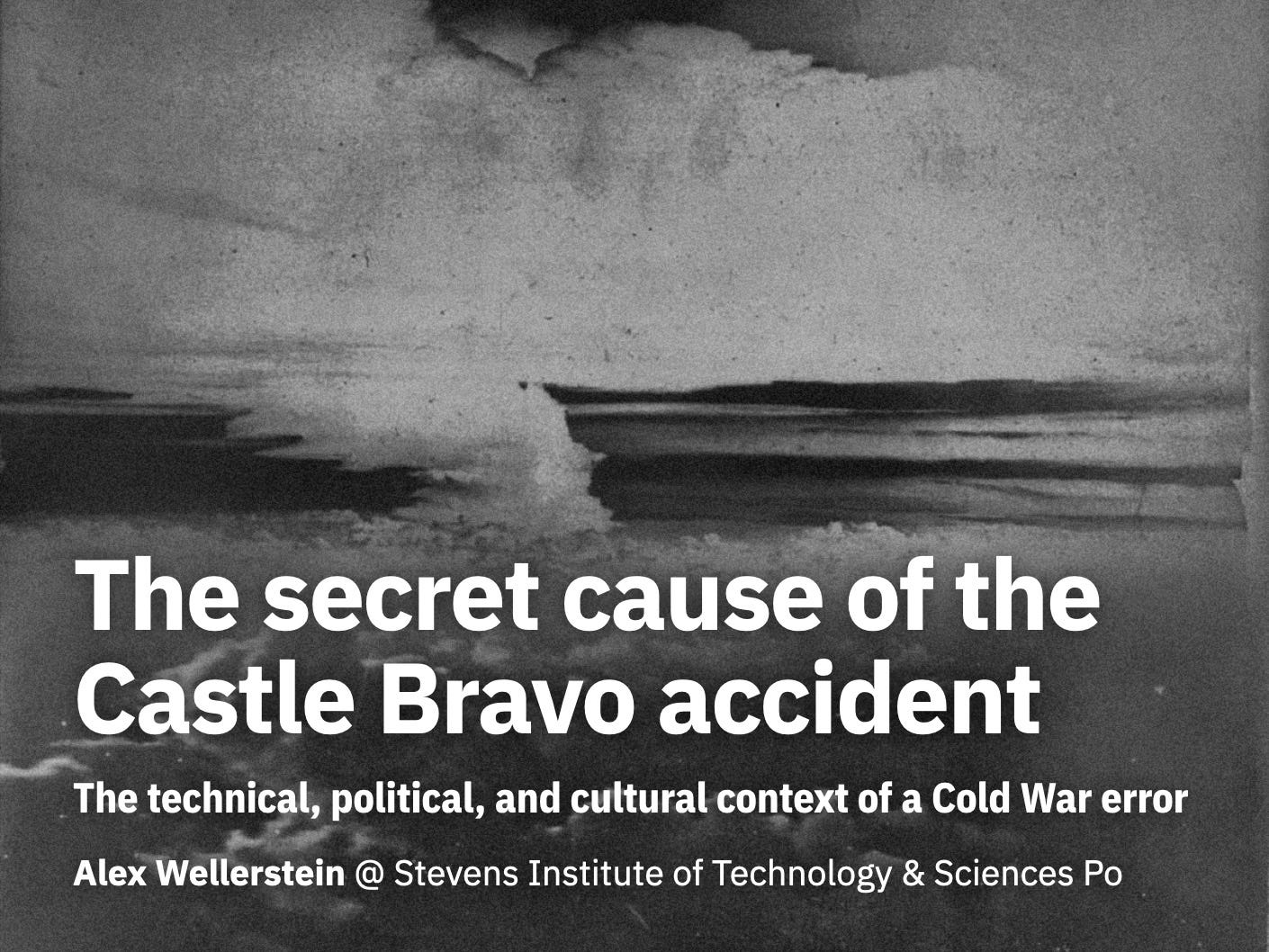
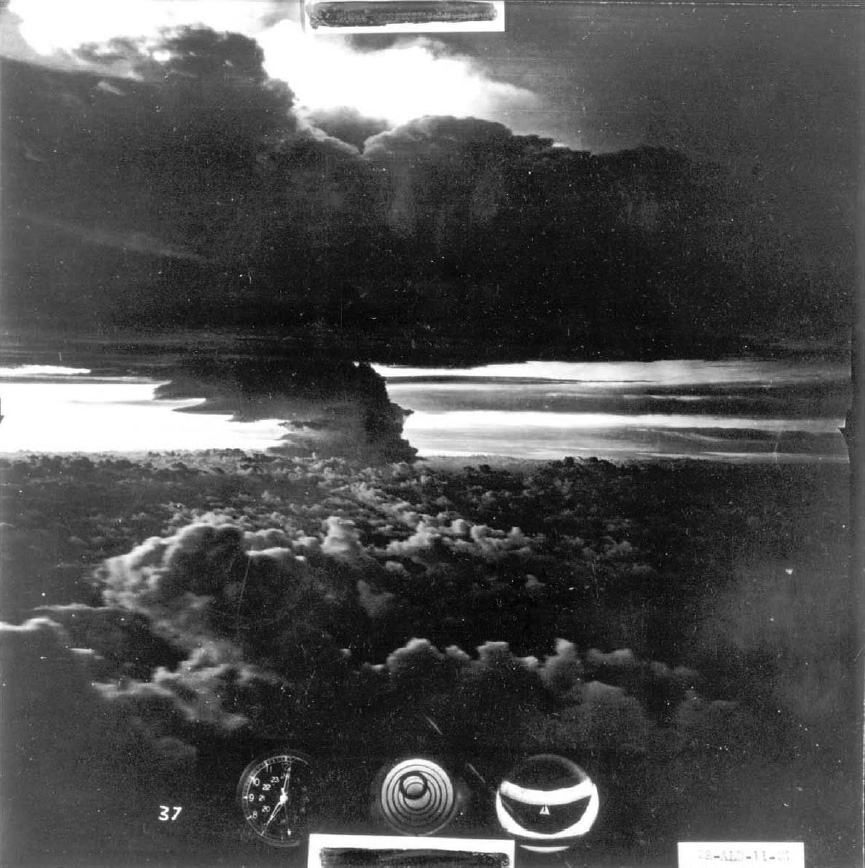
Pretty fun, eh? That is a manipulated (partially inverted and a few other things) photo of the late-stage cloud from the Bravo accident, 30 minutes after detonation — a massive column with a huge, flattened mushroom head above it. Here’s the unedited version of it, for the curious.
The paper is about the fact that the main “causes” of the Castle Bravo accident that have been offered up since 1954 have largely been bunk: it wasn’t an accident because the wind direction changed from the forecast (it didn’t change by an amount that mattered), or because the yield was unexpectedly high (that didn’t help, but it wasn’t why it was an accident).
Rather, the actual “technical” cause of accident was that their planning was done under a very incorrect model of how fallout would work for multi-megaton explosions (“stratospheric trapping”). The basic idea was that since the cloud head was expected to rise well above the level of the tropopause and into the stratosphere, it would get “trapped” up there and not come down anytime soon. Here is how physicist Henry DeWolf Smyth, then a commissioner on the Atomic Energy Commission, explained it to the Congressional Joint Committee on Atomic Energy in a classified session in February 1953:
![Mr. Smyth. There is an effect that counters the increased yield [of the bomb]. The very fact that the explosion is very big makes the cloud rise very high and gets a larger proportion of the stuff up into the high levels of the atmosphere where it tends to stay up longer. So that while the total amount [of fallout] is much greater, the amount coming down in any given time and given place seems to be, if anything, less.](https://substackcdn.com/image/fetch/$s_!H5l5!,f_auto,q_auto:good,fl_progressive:steep/https%3A%2F%2Fsubstack-post-media.s3.amazonaws.com%2Fpublic%2Fimages%2F80d97a6e-7eaa-4c01-9c2c-904663c2243b_1724x706.jpeg "Mr. Smyth. There is an effect that counters the increased yield [of the bomb]. The very fact that the explosion is very big makes the cloud rise very high and gets a larger proportion of the stuff up into the high levels of the atmosphere where it tends to stay up longer. So that while the total amount [of fallout] is much greater, the amount coming down in any given time and given place seems to be, if anything, less.")
This theory turned out to be, well, dramatically wrong, and a vast amount of radioactive fallout came down in the hours after the explosion, over a very wide and long area, contaminating inhabited atolls, the ships of US observers, and the Japanese fishing boat “Lucky Dragon #5.”
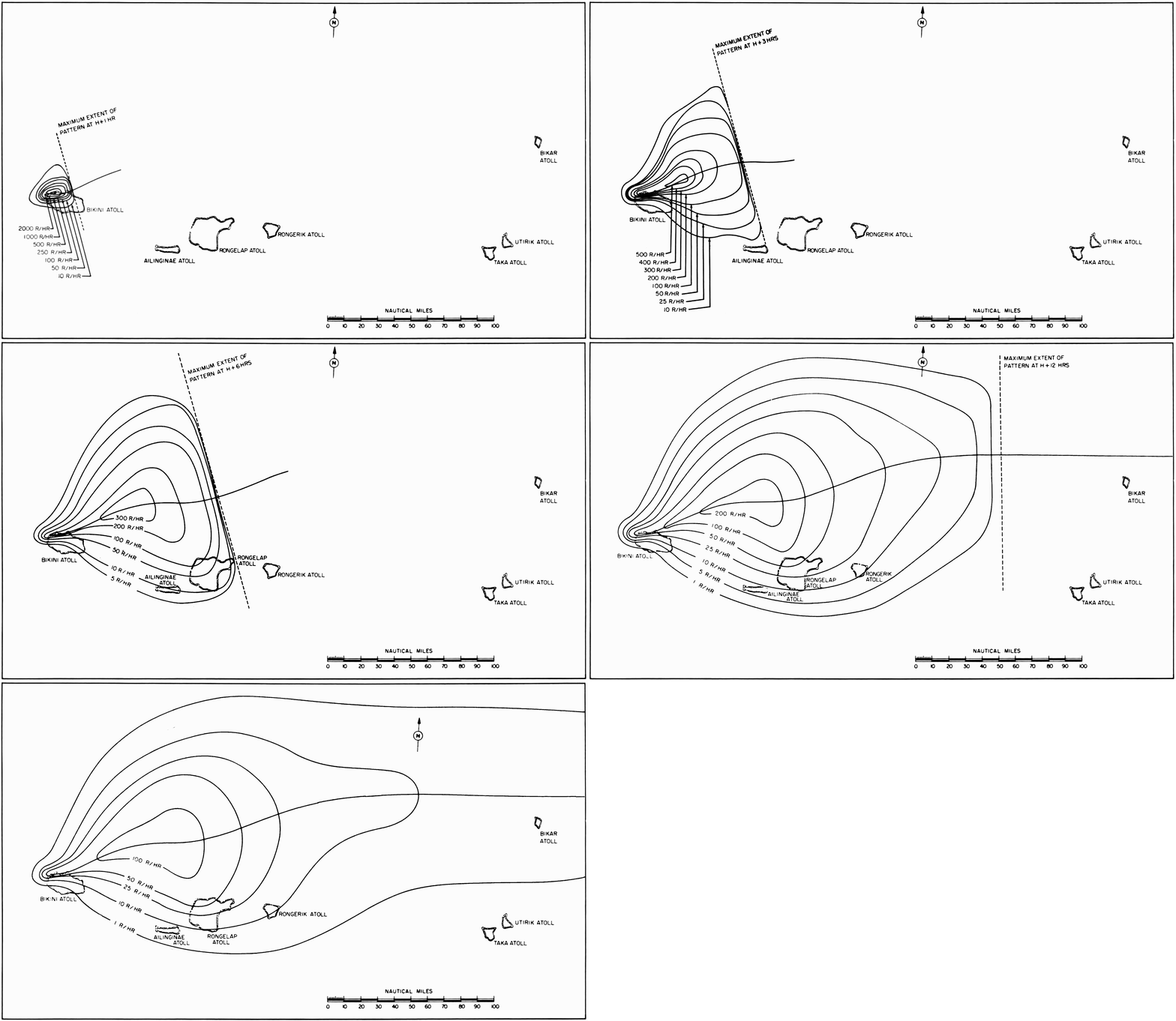
The talk is going to be about all of the above, plus how this wrong model got developed (and why their negligence in fallout monitoring for the 10 megaton Ivy Mike test led them to this wrong model in the first place), and, ultimately, about how the real “cause” of the accident wasn’t so much a bad theory as it was the creation of a certain kind of Cold War epistemic context in which a single bad theory was allowed to impact the health of thousands of people.
It’s a classic history of Cold War science argument, the main twist being that the event in question (the accident) is well-known, but turns out to have been historically poorly understood. I’m hoping to write it up and get it out the door sometime in the next few months, because I’m feeling the need to get a few more scholarly papers in the “pipeline” at the moment (you would think that writing an entire book would give one a reprieve from such pressures, but, alas, no).
I’m looking forward to the trip; I’ve never been to Cambridge (UK), before, and it’s still exciting to think one can just take a train to such exotic locales.
I began teaching at Sciences Po this week, my first time teaching outside of the United States. I’ll put a bit more of that down below, but it has been positive so far, although the little differences in expectations are amusing and somewhat interesting. We also saw Hamnet (2025), which we enjoyed a lot, and I will write about below, as well.
In case you missed it, for Doomsday Machines this week I posted a “self-assessment quiz” that the US Department of Defense’s Defense Civil Preparedness Agency (DCPA) created in 1973, so that you could assess your suitability as the manager of a public fallout shelter in the event of thermonuclear war. It’s a pretty strange document, and I included some other discussions from the overarching report it is from about the imagined life in said public shelters:

I’ve been working on a few new posts for Doomsday Machines; we’ll see which one gets finished by next week…!
Keep reading with a 7-day free trial
Subscribe to Doomsday Machines to keep reading this post and get 7 days of free access to the full post archives.