

We had a week with some rain, but the sun is back out today, and Paris remains lovely. People I know often ask: How is Paris? I mean, what can one say? It is very nice? Certainly compared to many other places, right now… the imagery of Tehran, with its oil-choked skies, horrifies the mind.
My pal Cheryl Rofer has a good post up at Lawyers, Guns, and Money this week which hits at something I have felt, and been saying privately, especially this last week:
This week, I’ve talked to or messaged with a number of reporters. Rob has been doing a crazy number of interviews. That adds to the personal distractions. The wearing-down means I no longer have patience for certain types of foolishness, including the media’s willingness to consider Trump a rational actor. Others are giving up that pretense as well.
I have also been queried by a number of reporters this week (sometimes I get back to them, sometimes I don’t, I am trying to take the attitude of “it is not on me to be the expert on every single aspect of this world,” and I do not claim to be any kind of Iran expert), and I’ve felt a similar weariness.
There is a journalistic assumption that somehow we should be parsing Trump & Co.’s actions and phrases as if they were made with some intent at conveying meaning, truth, or rationality to them. I am convinced, for example, that Trump does not know what “unconditional surrender” means as anything other than a clichéd war-related phrase, and that Hegseth does not know what “give no quarter” actually literally means (much less its legality under American or international law).
I do not think there is any reason whatsoever to trust the Trump & Co. are being truthful in any statement. I do not think there is any reason to think that they have some kind of real plan. I do not think there is any reason to assume they have earned any benefit of the doubt, or that they have either the interests of the United States or the greater world in mind.
My sense is that the American journalists I know are all too aware of all of this, yet feel obligated to go through the motions of pretending. It’s has always been tiresome but it also increasingly feels dangerous and deluded. The media continues to “sane-wash,” to assume good faith and rationality, to phrase bald-faced statements of racism and idiocy as if they are perhaps “controversial.” Can we be done with it, already? When will the time come that we can just say, plainly, that the Emperor has no clothes, and not feel like we are saying something controversial?

Cheryl made another point that was on my mind:
As the stories came out about the White House deliberations, though, the military (presumably) did feel stung enough to leak that it wasn’t them who ignored this Gulf of Hormuz thing. They specifically pointed to the President, but as long as they are carrying on this improv war, they’re culpable too.
They are culpable, as is everyone keeping this show on the road, whether they agree with every aspect of it or not, whether they believe they are holding back some bulwark of even worse ideas. (I will admit that even paying taxes right now feels like collaboration, to a degree. I guess I’m feeling very Henry Thoreau about the whole thing at the moment.)
The whole thing makes me furious. Not “angry,” in the sense of a quick emotional sensation, the kind that everyone is trying to monetize one way or the other (including the endless text fundraising spam from Democratic candidates — like, are you kidding me? Are you for real right now?). I mean really furious. It is all so morally and ethically and civically offensive. On a level that mocks any safe and empty phrases about the desire to “resist,” much less the pathetic letters of disapproval registered by “concerned” politicians.

One of the things I write about in The Most Awful Responsibility is how the Korean War was the real “Cold War turning point” for Truman, the event that really and truly caused him to be a “Cold Warrior.” What I mean by this is that Truman’s view of the world situation, and the Soviet Union, prior to the summer of 1950 was about the tenseness of it, but he essentially thought of it as some kind of misunderstanding. The Soviets he seemed to regard as an essentially petulant teenager of a world power, testing boundaries and acting out, paranoid and problematic, but not really an existential risk to world peace and stability.
Even well after most of his cabinet and advisors had moved to be more anti-Soviet, Truman seemed to think that it was a salvageable situation — that eventually the Soviets would see that the United States was not really going to be all that aggressive towards them or their interests, so long as the Soviets didn’t push things too far. In one of the more bizarre moments, in the spring of 1949, Truman told people (including Oppenheimer) that he believed that by 1951, the world would probably agree to nuclear disarmament — which Oppenheimer plainly thought was nuts. As it happened, the Soviets detonated their first atomic bomb a few months later.
But the invasion of South Korea by the North, which Truman (and those around him) credited to the Soviet Union (rightly or wrongly; we now know it’s a bit more complicated than that), really made him furious. It offended Truman’s sense of moral and civic virtue in a truly deep sense. Why? Because Truman was, in fact, quite personally committed to the idea that the proper response to the horrors of World War II was to create some kind of lasting peace. And here the Soviets were, not 5 years later, starting a new war of choice. One gets this sense that this is really just too much for him. Sure, play games in Berlin and Greece — none of that is great, but it’s a bit of jostling inside the constraints of war. But to embrace war itself, just to do it, just to see if you can get away with it — this disgusted him.
That’s the level of disgust and fury I’m at right now. It’s not that the many other horrific, immoral, disgusting policies pursued by Trump & Co. didn’t deeply offend me. They all did. But the Iran war situation is one that has been war-gamed and discussed and — quite rightly — avoided by multiple presidents, of all parties, for a long time now. Because all of the scenarios about its outcome have consistently suggested that it would be very risky, that the costs would not be worth the benefits, and that there were going to be better options on the table. And yet, here we are, and Trump & Co. didn’t even feel the need to try and actually “sell” it to the American people or American allies.
We’re all going to get stuck holding the bag on this one. Even if one imagines that Trump & Co. will someday get their comeuppance — one can dream — it won’t actually remove the costs that they have imposed on everyone else. And there will be high costs, of different forms. We’re well past pretending otherwise.

I don’t usually write that much about politics on here, both because it is not my métier and because I really don’t want to spend all my time thinking about them — I find thinking about nuclear weapons and nuclear war far less depressing, whatever that says about me. I figure you have plenty of sources of that in your life right now, if that’s what you want to read about. But one can’t escape it.
Well. In other news, I was asked by some reporters whether NUKEMAP had seen increased usage over the last week or so, and indeed it did. Here is just a quick snapshot of my “unique visitors” according to Cloudflare, which is just one (easy to access) way to see the change over time, even if I don’t really trust the exact numbers (web analytics are an impressively large sham, and only are useful in relative terms):
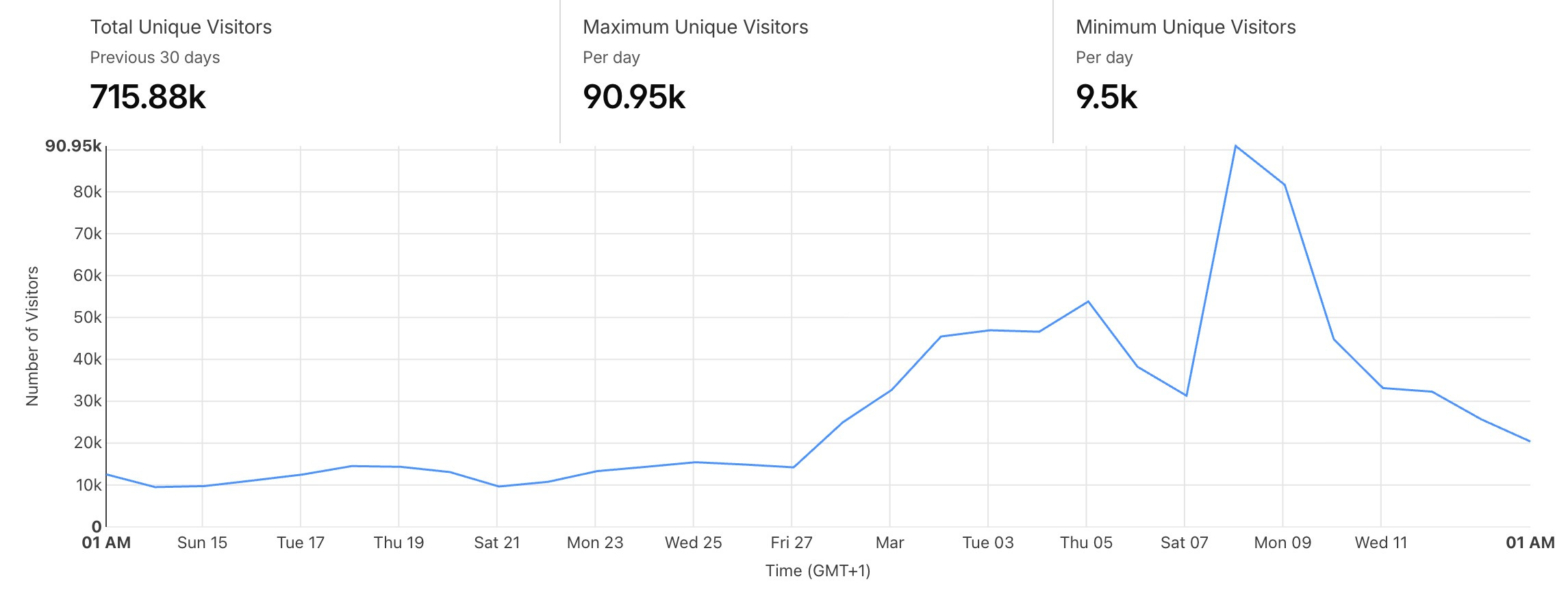
This is still quite low compared to the Russian invasion of Ukraine in 2022, which is probably a good thing for the world, and my servers and their bills. I’m happy to say that the latter are at least much more robustly done since 2022, however.
For Doomsday Machines this week, I wrote about “PLAN A,” a visualization/simulation that I worked on some years ago with researchers at Princeton University:

I will admit that this was a bit of a punt — I had a busy week and did not feel I had the time to do something more substantive, and talking about my own software is very easy for me to do, even if (as in this case) I had to “reconstruct” how things worked because I didn’t really take good notes on it at the time. I have something more substantive planned for next week.