
Wasteland wrap-up #72
A nuclear crisis, the worst of all possible worlds, nuclear mindsets...

Well, the last week was pretty awful, wasn’t it? If NUKEMAP is a useful proxy for “how worried were people that the United States was about to use nuclear weapons?”, the answer is “pretty worried.” Here is a screenshot of activity on the Cloudflare account that handles NUKEMAP’s traffic for last Tuesday/Wednesday, which gives some sense of it:
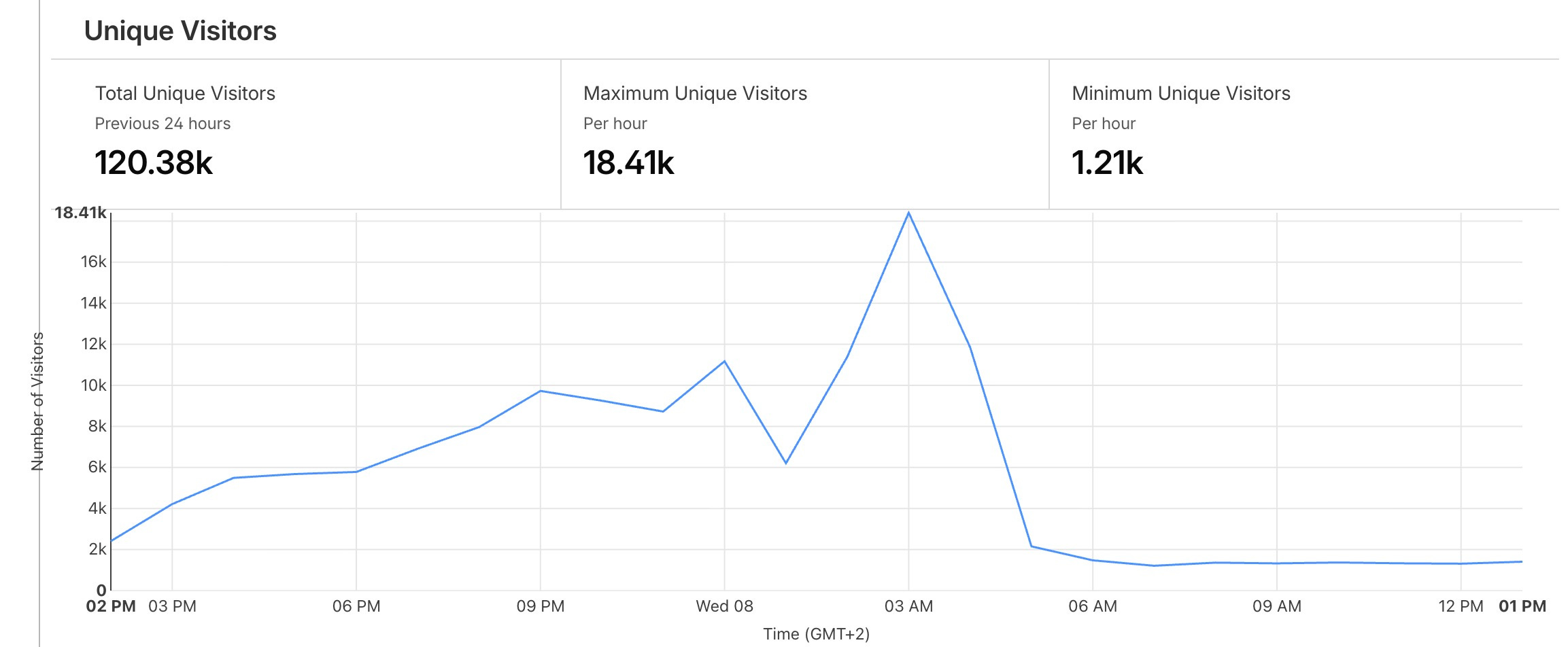
This wasn’t quite Russia–Ukraine 2022 levels of usage, thank goodness, but it’s still a pretty significant spike. It is also interesting to me how quickly it went down to baseline afterwards — a graphical rendition, perhaps, of how people react to nuclear crises in general, where there is a sudden burst of attention and then a return to not worrying much about it at all.
NUKEMAP did pretty well in that period, although there was some performance degradation for the parts of it that require Amazon EC2 and RDS instances to function (casualty calculation and loading some dynamically-modified configuration data). It has given me some ideas as changed to make so that NUKEMAP can still load its basic functionality even if the Amazon assets are knocked out by too much traffic, which I’ll implement when I get the chance.

And how did you do? I found the whole thing very alarming. Not so much because I thought the US was about to use nuclear weapons — although the inability to rule that kind of thing out was troubling — but because I did think that there was a real danger that the US was about to commit a very terrible massacre of civilians. Trump’s language about killing “a whole civilization,” described as “grave” in some headlines where the word “genocidal” should have been used, is unprecedented for a sitting president. It is reprehensible, a war crime, and an impeachable offense by itself: whatever his intent, the language was meant to invoke a genocidal threat.
I was asked about this by a New York Times reporter, and had some rather strong things to say about it. They only quoted one of my least strong statements, which perhaps is for the best:
Alex Wellerstein, a historian who studies nuclear conflicts, said that even if Mr. Trump does not carry out the extent of his threat, the president’s violent rhetoric damages his credibility as a negotiator and his country’s standing in the world.
“You’re talking about a world that largely increasingly sees the United States as unhinged and dangerous, and not a reliable partner,” he said, “where all of the countries that typically align with democracy and freedom are on the other side of the United States.”
The more substantive thing that I said to them was that while one can point to instances of sitting presidents making nuclear threats, the truly (and intentionally) aggressive ones have been done in private, not in the public sphere. And the reason for this is that such threats a) terrify one’s own populace, b) terrify one’s allies, and c) there is a good chance your enemy will call your bluff. All of which were on display in this case.
Was Trump’s rhetoric meant as a nuclear threat? I don’t know. I did also tell the Times reporter that a) if the words had any intentionality behind them at all, they were meant to invoke specter, and b) it didn’t really matter what the intentionality was since any reasonable audience would (and did) consider that to be a plausible interpretation of them.

Intentionality does matter a bit, particularly when we are talking about words perhaps taken out of context, or goaded out of someone. When Truman made comments about the atomic bomb being under “active consideration” at a news conference during the Korean War, that was a case of a news story being manufactured out of nothing. That news story did succeed in terrifying both the US population and its allies (the UK immediately requested an audience with Truman), but it also led to an immediate clarification and rebuttal by the White House. (If you are curious about this incident, I discuss it at some length in The Most Awful Responsibility. Even at the time it was clear that this was a “slow news day” problem.)
In the case of Trump, there is no such excuse. That does not mean that I credit his intentionality all that highly, because I think his grasp on language is pretty poor, but it is hard to imagine a world in which he (or his allies) would interpret such language differently if it was coming from the Iranians.
Well, now that can has been kicked down the road some more. Coincidentally, my post on Doomsday Machines this week was about looking at what US nuclear war plans were in the late 1950s, through the lens of The Power of Decision, an in-house production for the USAF about how its bomber forces would coordinate to destroy Communism from 1958:

I’ve been looking at The Power of Decision for a long time, particularly at “the Big Board” and all that it implies. The restored version by Peter Kuran made finalizing my thoughts on it much easier, as there were a number of very basic things (like “what does the legend on the board say?”) that were unanswerable without better resolution than was previously available to me.
This upcoming week I will be out of town for part of the week, so I’m not sure what I’ll get posted for Doomsday Machines, but I have a few things in a “partially finished” state that I’ll try to turn around before I head on the road. Here’s hoping for that, among other miracles!
Keep reading with a 7-day free trial
Subscribe to Doomsday Machines to keep reading this post and get 7 days of free access to the full post archives.