
Wasteland wrap-up #73
Evaluating nuclear threats, a trip to Perugia, fingers on the button...

It’s been one of those busy weeks. Early in the week I saw an interesting talk from George Perkovich, of the Carnegie Endowment for International Peace, hosted here in Paris at the Institut français des relations internationales. I have known Perkovich’s work for years — among other things, he is the author of India’s Nuclear Bomb (2001), a now-standard text — but I had never met him, and I was pleased to both see him talk and get coffee with him the next day.
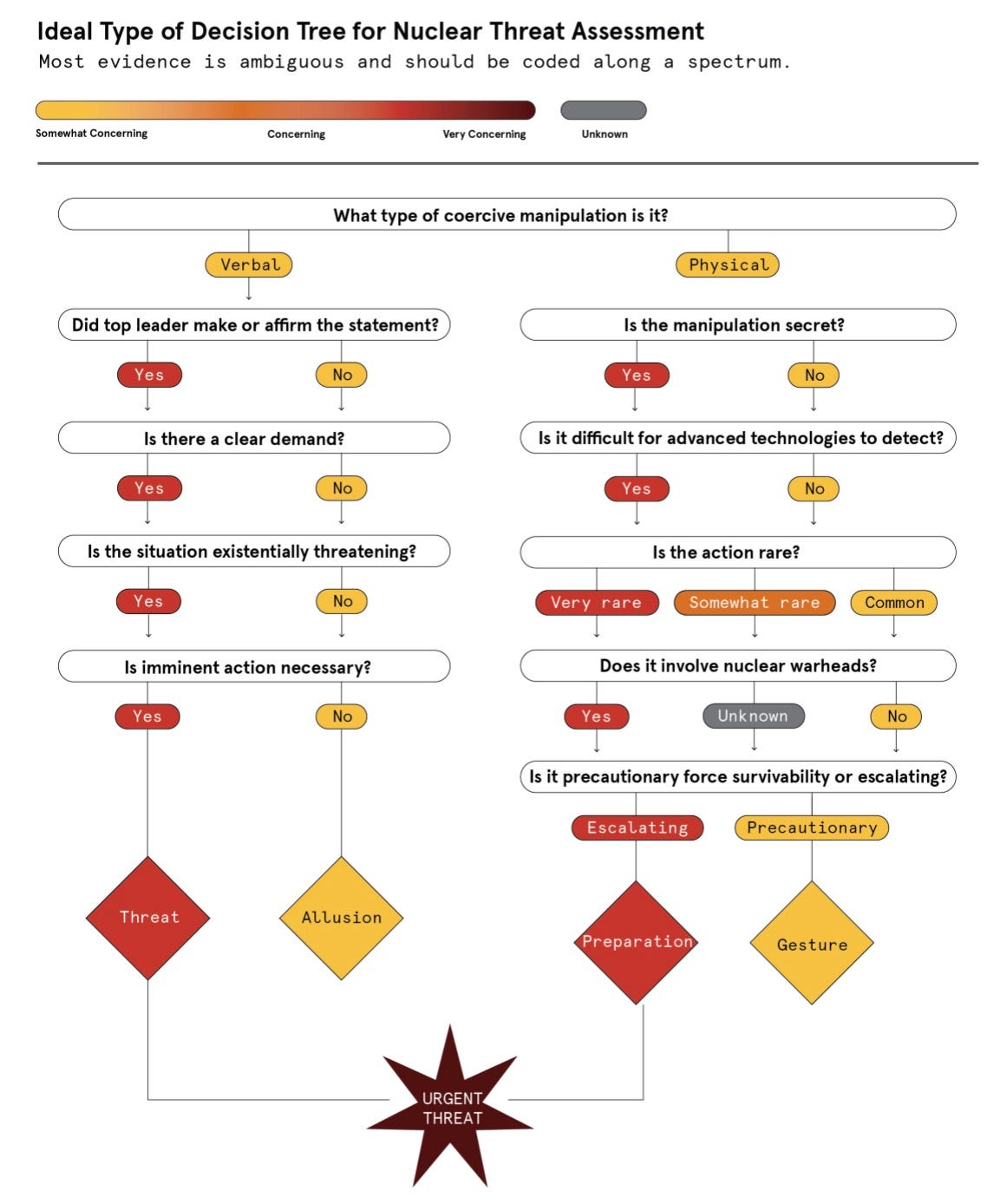
His talk was on a very important question, one made all the more important by the rhetoric of two weeks ago: how do we evaluate various kinds of “nuclear threats” that are made or alleged to have been made? Perkovich prefers to call these kinds of things “nuclear manipulations,” because not all of them are genuine threats (e.g., if one is just “reminding” the world that you have nuclear weapons, that is different from, say, drawing a red line and saying, “if this event does or doesn’t happen, I will use nuclear weapons,” even if the former still can be rather “threatening” if made during a crisis). Perkovich’s paper on this, which you can read online here, is a careful attempt to think about the various factors that would go into evaluating such “manipulations” in real-time, with a very nice “decision tree” for weighing the relative urgency and seriousness of a given “threat.”
I find this kind of thing quite interesting and stimulating. I have an unabashed passion for taxonomic approaches to the world (make it orderly!) and of course my “historical brain” loves to think about examples from the past that could be fodder for complicating such a system. (And I recognize that complicating the system is often deliberately not the intent, nor necessarily helpful, but still, it is my impulse.) So, for example, where most of Perkovich’s criteria are simple yes–no binaries, I am always tempted to create little spectrums and then think about how they would be weighed. For example, “Did top leader make or affirm the statement?” for me instantly splits into a little hierarchy of possible “voices” for a threat, e.g., the “top leader,” a top military leader, someone in the cabinet, someone who is assumed to be a mouthpiece for the leadership even if they aren’t technically in it, and so on down the line. And instead of yes–no–unknown for “did it involve nuclear warheads?,” I want to add something like, “it was kept deliberately ambiguous,” and think about how I would want to chart that between “yes” and “no.”
All of this is a heuristic, of course, a way to practically and roughly think about how to distinguish between different kinds of situations and scenarios. It’s a little model, one aimed at utility rather than representation of the world as it is. I love little models, particularly because I am not that invested in whether they represent “reality” in a deep sense (plenty of models don’t, but are still useful).
Perkovich also mentioned that he has a book coming out from Adelphi Books later this year on Nuclear Threats in the Ukraine War, which I am very keen to see. There are bits and pieces of that story that have been reported on (some of which is in the paper linked above), but there’s quite a bit that is not generally known that I think is rather important to get out there, so I am hoping it will lead to a broader discussion of this issue.
After teaching on Wednesday I got onto a plane and flew to Rome, Italy, and from there took a shuttle bus to Perugia, for the International Journalism Festival. I had been asked to be on a panel about the nuclear imagination (and its limits) with Beatrice Fihn (formerly of ICAN), who I have enjoyed meeting and talking to over the years, and moderated/hosted by Rob Elder (of Outrider), who I have worked with many times (I am on Outrider’s Advisory Board). I find speaking for “only” 15 minutes almost intolerable (even when I lecture for hours I feel like I barely scratch the surface of these things), but I gave a little talk about the creation and limits of various kinds of “nuclear imagination.”
The main thing I wanted to try and get across is the ways in which “imaginations” about nuclear weapons have been created (a sort of complicated and dynamic interaction between the audiences — public and official — and the various “voices,” including experts, journalists, and “cultural” creators like artists and writers and directors), and talk a bit about the dangers of limited imaginations and ones that are based in essentially incorrect ideas. For the (mostly) journalists in the audience, my point was really to get them to see that they have a rather important role in this kind of thing (even if they are not the only “player” in it), and that a lot of things in the “nuclear world” that are taken for granted are in fact quite constructed and debatable.
You can watch the whole panel here if you are interested, but it not required! I felt like it went OK for a short talk, but it’s hard for me to know whether that is true or not, given that I am not really a member of the target audience (journalists) and I’m also not really sure what the “impact” goal of such a talk even is. But I usually wonder the same thing about talks at more academic conferences as well, and suspect most of why these things exist is as a form of networking (“here I am, this is what I’m working on, get in touch if you’re interested” could be the “ultimate” goal of pretty much all academic talks).
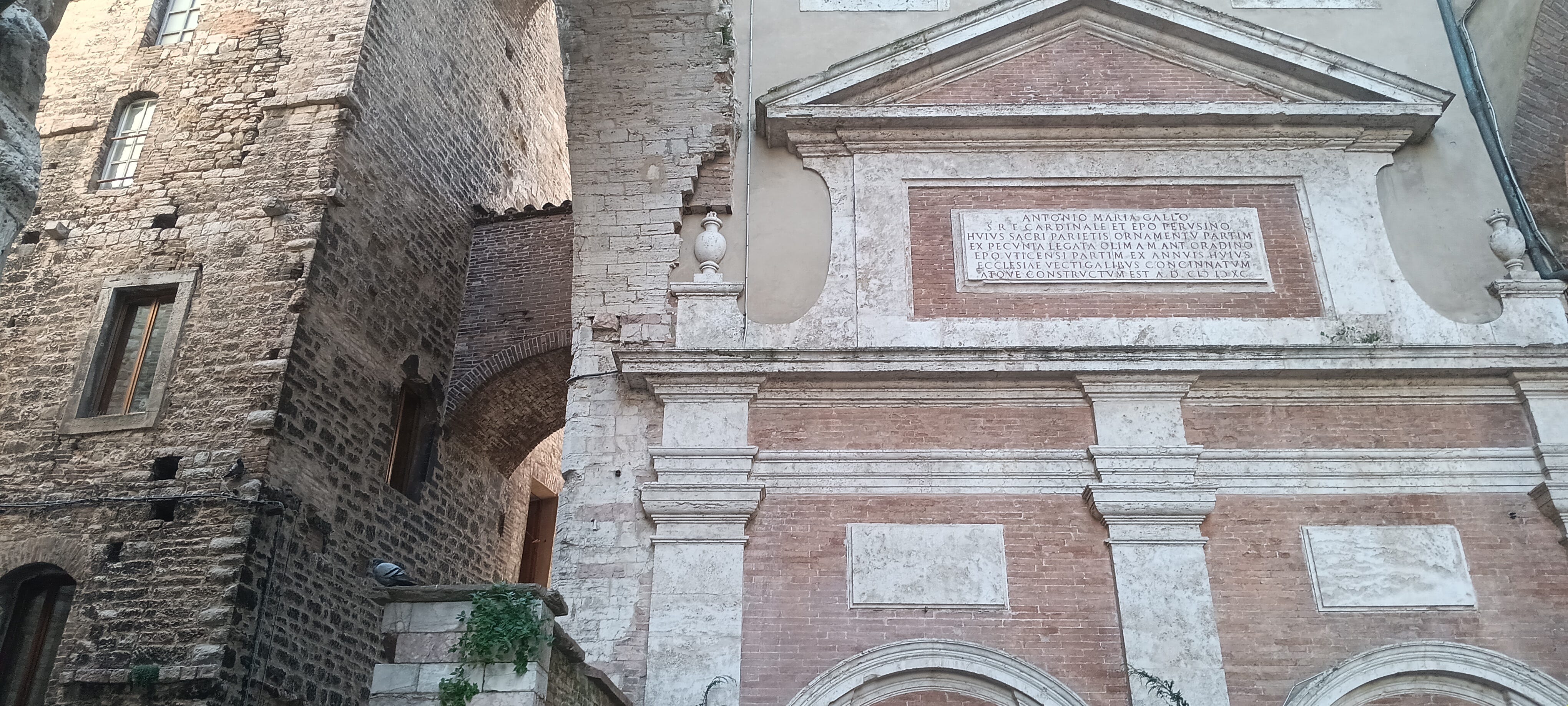
Perugia was interesting. I had never been to Italy before, and I am aware that it is much more than this one city, and that even Perugia must be more than the small piece of it that was hosting the conference. The conference was mostly in various venues (hotels, theaters, etc.) in the “old” part of the city, which was on a craggy hill and seems to have architecture dating from the 14th-17th centuries or so. If you like very old-seeming, somewhat decaying, very atmospheric kinds of spaces, well, they’ve got those by the spadeful. I hope you like getting lost and walking up steep hills, though, because the place is a complete maze and as mentioned built on a fairly impressive hill.
I will admit that Perugia’s charms wore out on me fairly quickly. The first few picturesque streets and cobblestone corridors were quite charming. But then they all started to blend together, and my frustration with the fact that I kept getting lost (Google Maps is just not built for this kind of environment, and it shows) made me long for the Paris’ 19th- and early 20th-century “baroque modernity.” Which was a preference/distinction I didn’t quite know I had, until I was walking around something that felt much more medieval and early modern.
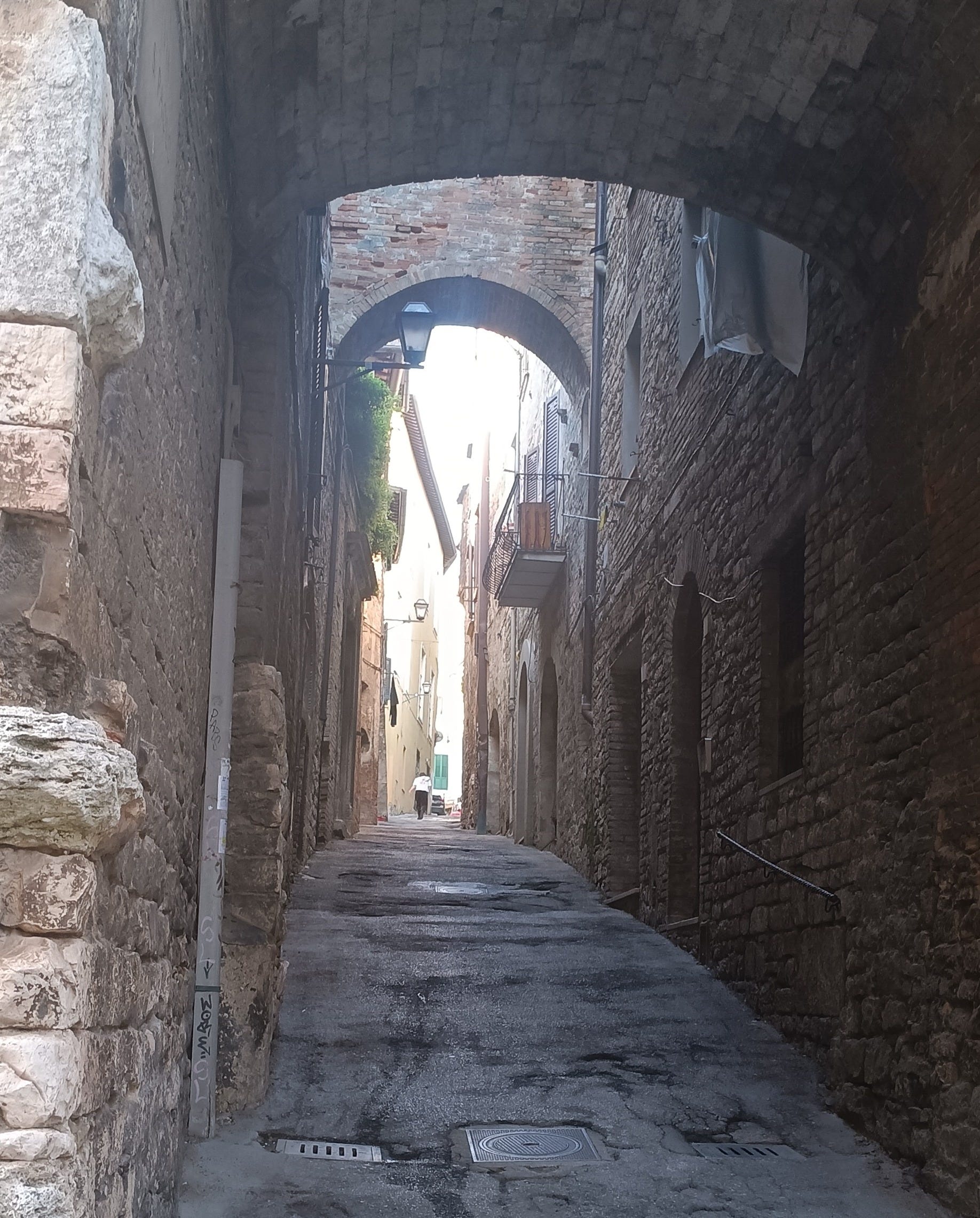
There is also a way in which Perugia felt embalmed, probably because the only local economy near the “old town” was tourism, and the streets I walked in even outside of it were essentially devoid of pedestrians and the kind of pedestrian-dependent or pedestrian-catering spaces that I have started to take for granted. The whole place felt very anti-pedestrian in general, with far too many tiny Italian cars driving disturbingly fast around blind corners.
So while I found Perugia interesting to visit, and I enjoyed meeting some of the people at the conference (and I attended a few other panels, about nuclear weapons and AI weapons), but I was pretty ready to go home by the end of it. At some time in the future I will do a more “traditional” trip to Italy — Rome, Venice, etc. — because I know that I really only got a taste of it here.
While at the conference, I did manage to get a blog post out the door for Doomsday Machines, on the trope of “atomic bombs” prior to the discovery of nuclear fission:

I’ve wanted to write something up on this for awhile, because it’s a favorite of mine to lecture on, and it often surprises people. It is also the answer to a common question that I get, which is about how people conceptualized the meaning of “atomic bomb” in 1945. The answer is that they already had a conceptual framework for it, because the idea predated the actual realization of the weapon by several decades, and it is also one of the clearest cases we have where you can show that cultural products (like the novels of H.G. Wells) had an impact on the later attitudes of both scientists (Leo Szilard) and policymakers (Winston Churchill) when they grappled with an “emerging technology.”
Keep reading with a 7-day free trial
Subscribe to Doomsday Machines to keep reading this post and get 7 days of free access to the full post archives.