
Wasteland Wrap-up #75
A "theory of change," a radioactive monster, some insights into my programming practice, some thoughts on US vs. French education...

I had coffee a few weeks ago with an American academic I have known for a long time who works in the field of nuclear policy who was visiting Paris for a vacation. (As an aside, I have had more coffees with Americans visiting Paris for vacation than I ever did for Americans visiting New York for vacation. I can imagine reasons for that, but it is indeed surprising to me that my social calendar here is typically busier in this category than it was in the USA.)
One of the things he brought up in the conversation was that he was entirely rethinking his “theory of change.” This is a term that I am most familiar with from grant proposals, but can be applied more broadly. What, exactly, is the underlying model one is imagining if one is going to make an argument that one’s life or work can have an impact on the world? That is what a “theory of change” essentially is — if it’s for a specific project, the “theory of change” is your argument about how this project will “matter.”

My colleague’s concern was that as someone who had been working at a policy school for years and years, he had an underlying, assumed theory of change that basically was that if he produced some kind of very smart and useful policy proposal, one could imagine, if it was written up and discussed in the right circles, that it would eventually land itself on someone’s desk in a position of power, and they might actually implement it. One could also imagine, in such places, that one’s students might be trained on a methodology, way of thinking, theory, policy ideas, etc., and that if those students ended up in positions of influence one day, they would be able to implement your ideas, if they were good ones.
This is all very bread and butter for the policy world and the international relations community, I think. But what do you do when nobody rational is running the ship? When the government explicitly eschews expertise, in particular academic expertise? When they are basically “anti-policy,” in the sense that all “policy” is based on whatever online ramblings and whims of an idiot were posted the night before, and everyone just bends over backwards to reaffirm that said idiot is not only always right, but has been more right than anyone who has ever lived?

This is especially the case for arms control, which has just been shredded under the Trump administration. Just absolutely shredded. Decades and decades of work and negotiation, hard work on treaties and agreements that were ultimately always primarily about serving US interests, thrown into the trash by someone who does not understand them in the slightest.
There seem to be two options, here. One is to imagine that, well, this will pass at some point. You continue the work, despite the fact that the day to day won’t be anything more than a hope for the future. Someday, this line of thought says, some reasonably sane people will once against inhabit the halls of power, and then you can go about the old approach again. Of course, you don’t know when that will be, and what the situation will be at that point, and what the priorities will be at that point. If one believes this will happen in, say, two years, that is not so awful. If one does not think that American politics will return to a position of stability for, say, ten years, then that is much less heartening, particularly if you are thinking in terms of one’s own career.

The other option is to pivot to some other “theory of change,” some other approach to one’s work. What does that even look like? Who is the audience, what is the method, what is the goal? Well, that’s the question, isn’t it?
I’ve thought a lot about the “theory of change” embodied in my own work, although other than grant applications where it is a requirement, historians are I think less inherently “obligated” to imagine themselves as enacting some kind of tangible change in the world, at least compared to people in the world of policy. Personally, I don’t have ambitions for direct change, in the sense that I am trying to push for some specific policy outcome via a specific mechanism. But I do like to believe that there are many possibilities for indirect influence and change — that is, to contribute to a broader context of ideas and facts, which might help steer the direction of how people think or talk about things, and could, you never know, play some unexpected role in making things better.
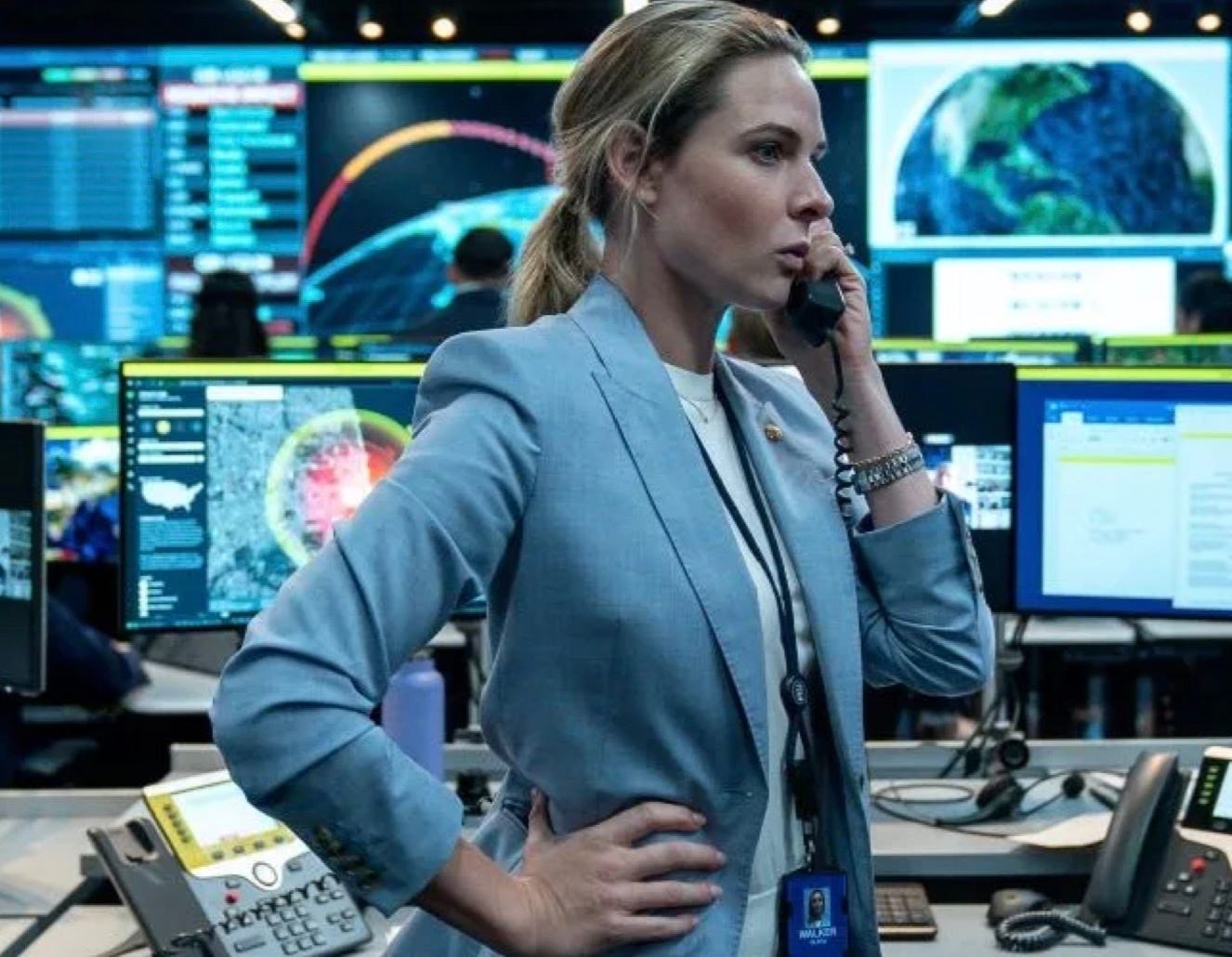
Well, one can hope. I’m not trying to be overly modest, here — I can see the impact of some of my contributions to the discussion of nuclear weapons in the world, sometimes in minor-yet-amusing ways. As a really silly example, I cannot confirm that the nuclear-effect visuals seen on the monitors of A House of Dynamite are based on the Outrider Nuclear Bomb Blast site that I helped work on (and is a “skin” of NUKEMAP), but I think it’s pretty likely that they are. There are many other things of this nature where I see something that is based on something I made, or hear some idea that is basically my own, and think, ah, that’s nice. A small contribution to the discourse.
I have a rather more developed “theory of change” that I use for guiding my public-facing work, that perhaps I will write up on here at some later time, which is based in both my experiences of making things “for the world” as well as my reading of the role of “culture” as a historian. It’s still relatively modest, in the sense that it is hard, I think, to successfully and deliberately make an “impact” on how people think about things, much less how politicians do things. For everything one can point to where “an impact was made,” there are undoubtedly even more things that had no impact, or had very indirect or delayed impacts.
Relatedly, in case you missed it, this week on Doomsday Machines I ended up writing about a film that I stumbled across while looking for something else: The Beast from 20,000 Fathoms (1953), which was explicitly part of the inspiration for the 1954 Japanese film Gojira/Godzilla (with the other part being the Castle Bravo accident and memories of the atomic and fire bombings from World War II).

It is not a great film, by any measure. But I didn’t hate watching it, even though I thought the pacing was quite bad. What it really did for me, ultimately, is serve as an interesting foil for a rewatch of Godzilla. So while this is a post about The Beast from 20,000 Fathoms, it is ultimately a post about what makes Godzilla interesting, which is fully on display when comparing it to this far inferior source material. The one place that I thought The Beast from 20,000 Fathoms did well was in the monster’s special effects, which generally (but not always) look better than the monster in Godzilla, who looks far too much like a man in a rubber suit for me to ever suspend disbelief. It is interesting to wonder what Godzilla would have looked like in 1954 if they had gone with stop motion instead… maybe better? Maybe worse?
The people who created The Beast from 20,000 Fathoms did not really, I suspect, intend to have any big impact on how people thought about nuclear weapons at all. They are really quite ancillary to the plot, ultimately. But they were just enough that they nudged the people who ultimately made Godzilla to think along those lines, and to bring the Japanese nuclear experience to bear on the giant-monster question. And that perhaps did have a cultural impact that resonated, to some degree.
I have a couple things on the possible docket for next week, including another entry in my file of “insane nuclear war plans from the 1950s,” but we will see what grips me…
Keep reading with a 7-day free trial
Subscribe to Doomsday Machines to keep reading this post and get 7 days of free access to the full post archives.