
Wasteland wrap-up #86
A trip to Edinburgh, a British surrealist, nuclear films, the Odyssey, an overlooked Iain Banks novel, a talk on secret laboratories...

The bulk of the last week was spent in Edinburgh, Scotland, for the annual meeting of the History of Science Society (which was co-located with the European Society for the History of Science). I gave a talk (more about that after the fold, below), and was a discussant for a panel on global nuclear history, and otherwise spent time going to some talks and meeting with friends and colleagues. I enjoyed it quite a lot.
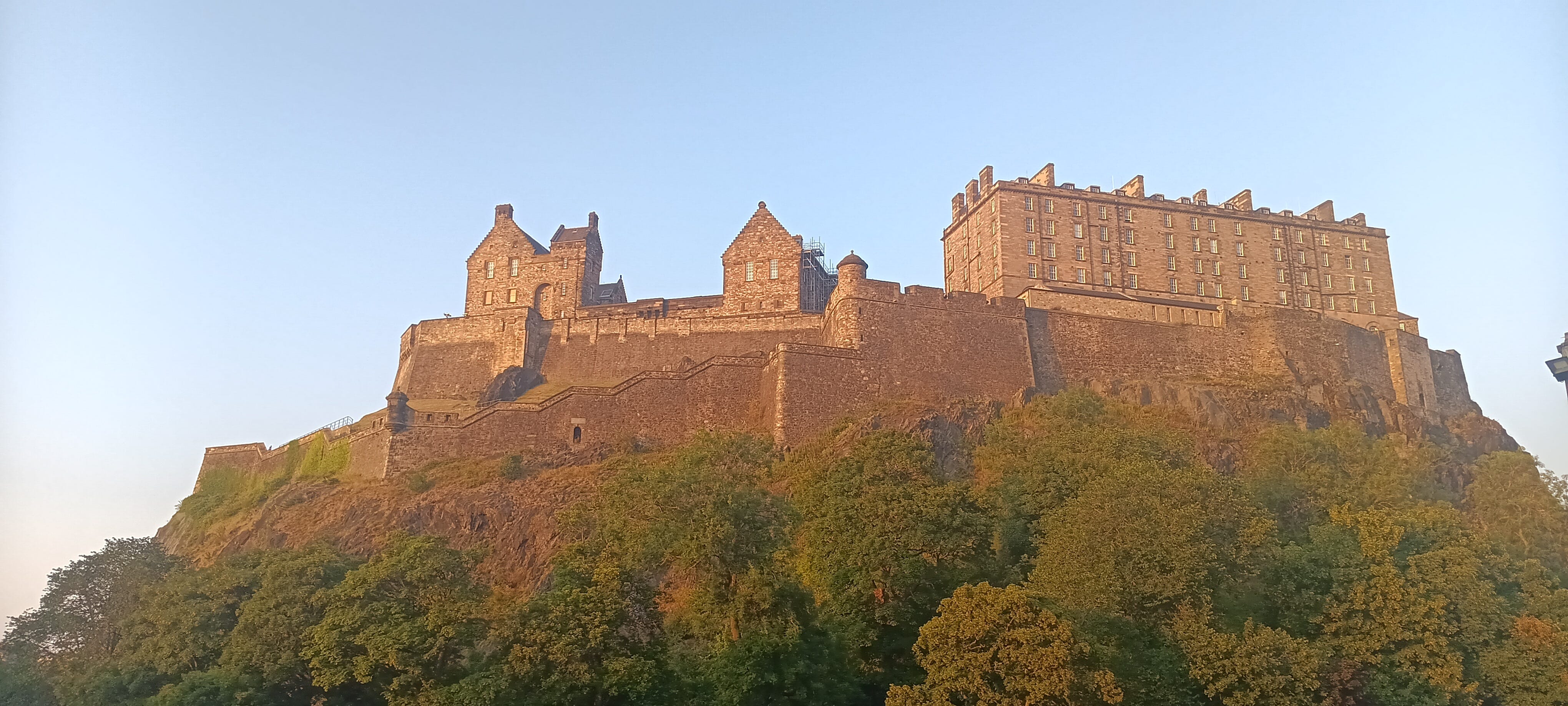
I did not come away with a real sense of what Edinburgh was like as a city, as I was really there just for the conference. I did drink some Scotch and some haggis, as one does. (I have had haggis before. The haggis I had in Edinburgh was not the best haggis I have ever had, but it was fine.) I thought the architecture was all a bit grim and austere for my tastes. I did appreciate that it was a lot less hot than Paris — it was around 60ºF/15.5ºC while it was 90ºF/32ºC in Paris. I was actually cold at times, owing to my lack of having brought appropriate clothing for the weather. Which was a nice break.
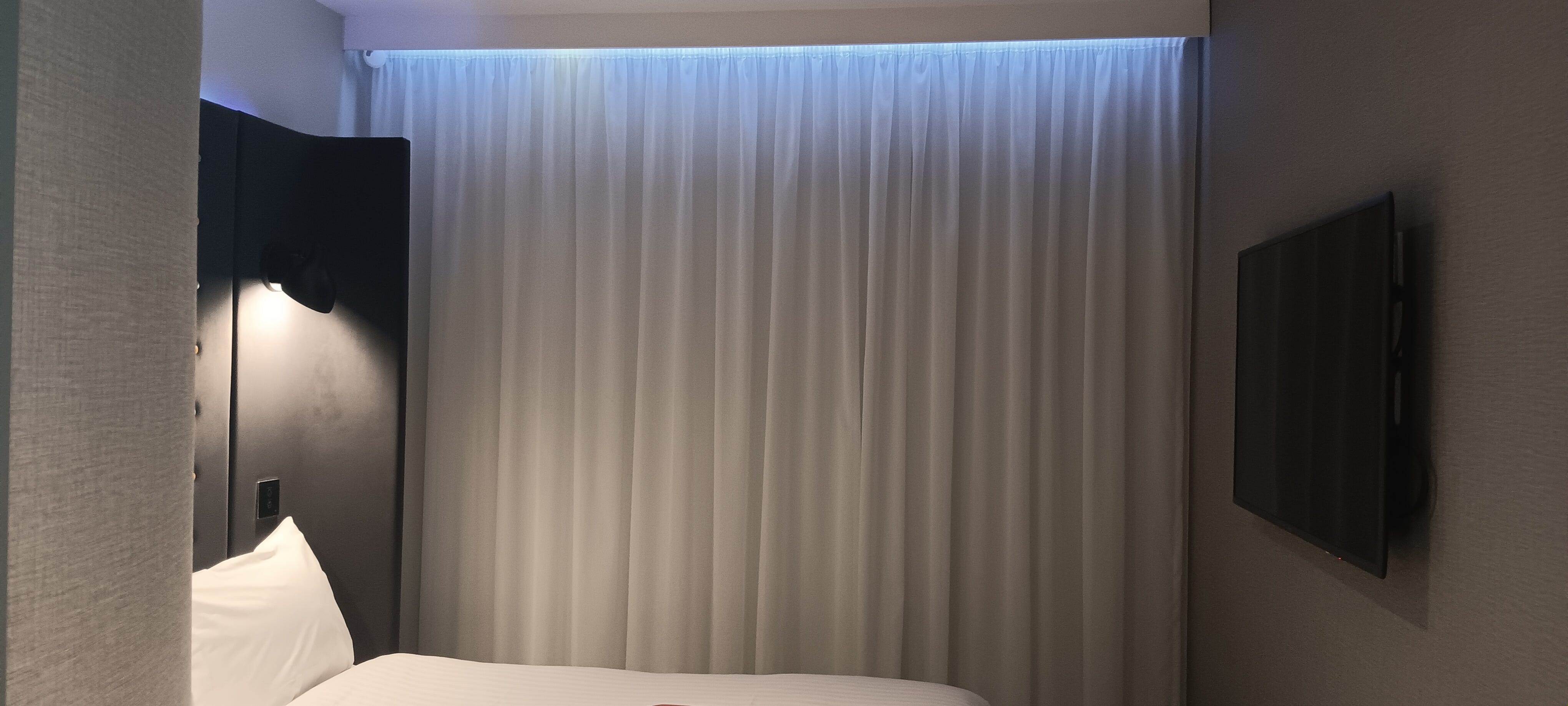
I had the oddest hotel room, as a hotel very close to the hotel. When one entered the room (see below), it looked like it was a small, European-style room with a large window. But… there was no window. It is a fake window. Behind the curtain is a blank wall. The “sunlight” spilling over the top is an LED strip. Super strange. I did not mind it too much — I just used the room to sleep — but there was a strange internal prickling in my mind, which for no very rational reason abhorred the idea of a windowless room/tomb.
I had many people at the conference ask me what I was working on next, which is standard academic-speak (and also a little annoying when one has only recently published a book and moved to another country), but it did give me an opportunity to think a bit more about whatever my “next big project” should be. I have a few ideas. I am in the process of trying to finish up some other “smaller” projects, first, though. But it was useful to think about these things, to think about what the next few books ought to be, over the next 5 years or so.
I did not watch the World Cup, but I kept track of the scores. La France est mort; vive la France. The force de M’bappé was not enough for them to overcome their opponents, alas. While disappointing in a way, I have reverted to my former state of not caring at all about sports very easily. C’est la vie.
I’ve been trying to catch up on various work-related things since I returned. But I did have a chance to go with my wife and some friends to see an exhibit of Leonora Carrington’s (1917-2011) surrealist artwork at the Musée du Luxembourg. I was not aware of Carrington’s work at all prior to going. The exhibit had everything from little scribbles she made as a very young child and teenager, up through her work as an older woman living in Mexico. The museum texts were entirely in French but my reading French is basically at a level where I could understand almost all of it (there was some art-specific terminology that I had to look up) and read it at a reasonable pace, and so that felt like progress.
Carrington’s early work was interesting to see because one could see how a schoolgirl interest in very-British-looking fairytale imagery gradually morphed into surrealism as she became older and more serious about it. Her early surrealist work also seemed to take the form of trying on a variety of different artistic styles. Some of it reminded me variously of Edward Gorey, Marc Chagall, Georgia O’Keefe, and Hieronymus Bosch. Eventually it settled into a sort of style that felt very much of her own, playing with themes taken from various “mythological” and “mystical” sources ranging from the British/Celtic through Zoroastrianism and the Old Testament.
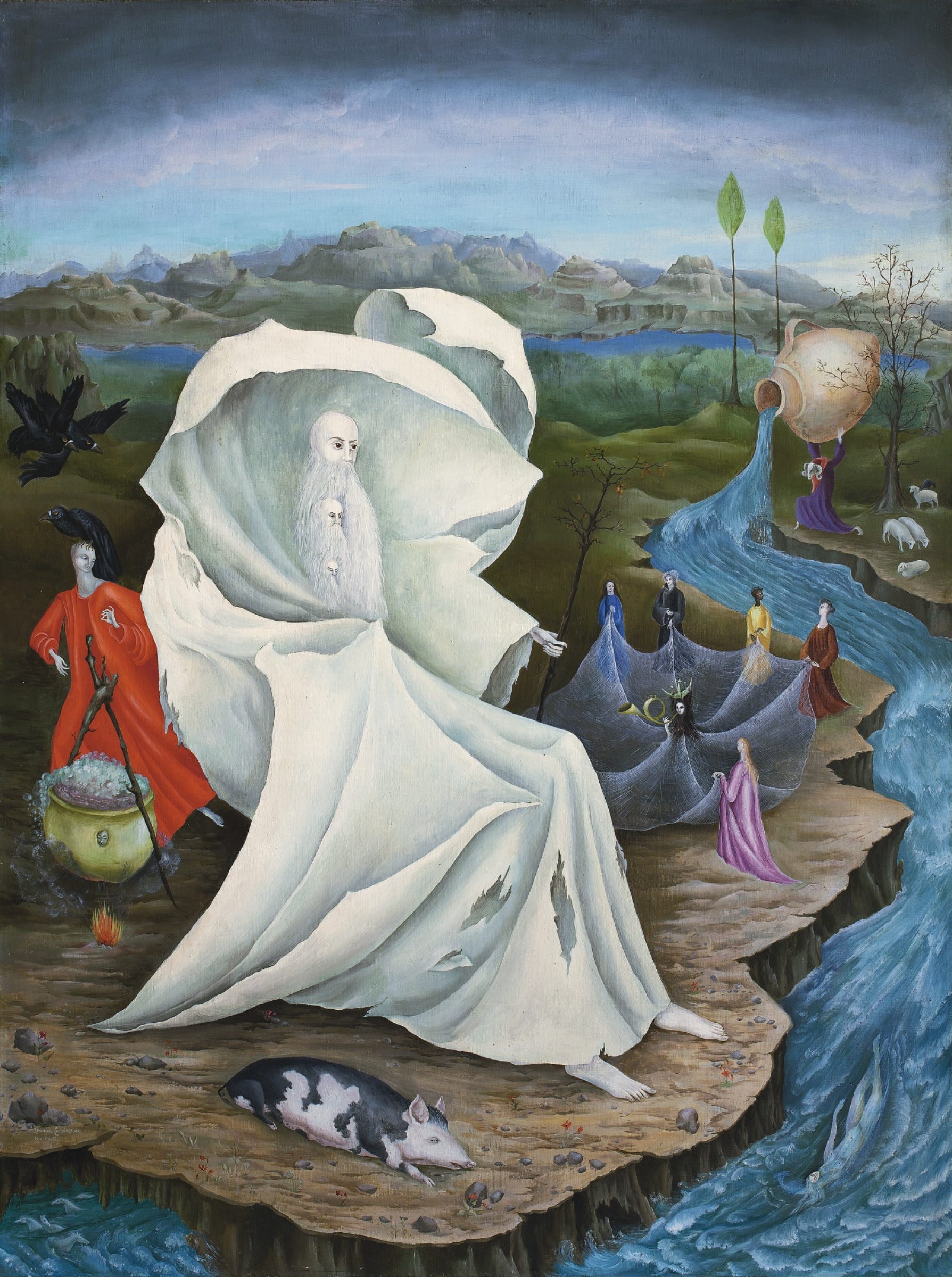
The exhibit also had a lot of details about Carrington’s personal life as well. She was very well-to-do British, fell in with the surrealists, had a notorious affair with Max Ernst, and ended up in Mexico during World War II. It seemed like she had quite a full life. It was an interesting exhibit.
For Doomsday Machines this week, I posted a mirror of my latest article for The Bulletin of the Atomic Scientists, which is a selection of films (with my commentary, and my selection of a short clip from each) that I have arbitrarily designated as “essential to understanding the nuclear age”:

In truth it was not entirely clear to me what the organizing principle was until quite late in the game. My list of 13 was down from around 40 possible candidates that I considered for this list. It was initially labeled as the “best” nuclear films, but I didn’t really want that to be what I was claiming, because there are arguably “better” films by other criteria (and certainly, as I mention in my accompanying text, this is a very Anglocentric selection). I am also aware there is a conspicuous jump between the 1980s and the 2020s, and that the final two inclusions are obviously a form of recency bias (I am not sure I would count them as being “as important” or “as essential” as, say, Dr. Strangelove). But I was pleased that while many of them are well-known and obvious, some of them are more obscure. I will probably be writing about at least one of them (Testament) in some more depth in the near future on here.
What will I be writing about for Doomsday Machines next week? I am not totally sure. I think by rights it should be something that is less cultural, just because I’ve had a few films-related posts in a row. So probably something either related to a document, or something related to research for Oregon Road ‘83. We shall see what grabs me…
Keep reading with a 7-day free trial
Subscribe to Doomsday Machines to keep reading this post and get 7 days of free access to the full post archives.