
Bomber arithmetic
A revealing memo from 1957 about the pitfalls of Air Force nuclear planning methodology

In February 1957, Captain John H. Morse, Jr., a former US Navy aviator and a special advisor for the US Atomic Energy Commission (AEC), wrote a long memo to AEC Commissioner Lewis Strauss about the “arithmetic” of Air Force strategic planning. The context was a debate inside the AEC about the prudence of a “military requirement” that the US Strategic Air Command had set for the development of a 60 megaton bomb. I will write more on the saga of the 60 megaton bomb in the future, and why it was never developed by the United States, as it is an interesting and important story in its own right, but Morse’s letter is worth looking at closely by itself.
SAC had first established the “military requirement” for the weapon in December 1954, and then reasserted that “requirement” twice over the course of 1956. AEC commissioner Thomas Murray wrote a letter to President Eisenhower in July 1956 inquiring whether “the stockpiling of a weapon of this size is in the national interest,” questioning whether it was “necessary or useful for military purposes” and whether its use would “be consistent with the dictates of the moral law with regard to the moderate and discriminating use of force in warfare.”1 Eisenhower bumped the question to the National Security Council, who did not complete their study until August 1957.
In January 1957, Murray gave further testimony to the Congressional Joint Committee on Atomic Energy which criticized the plans for the stockpile, and the 60 megaton bomb proposal. Subsequently, in February 1957, the Deputy Chiefs of Staff met to discuss the 60 megaton bomb question — the Army opposed it, the Air Force and Navy supported it, but again, there is more to this story that I am glossing over. Morse wrote his own analysis of Murray’s position in a letter to Strauss a few days later.
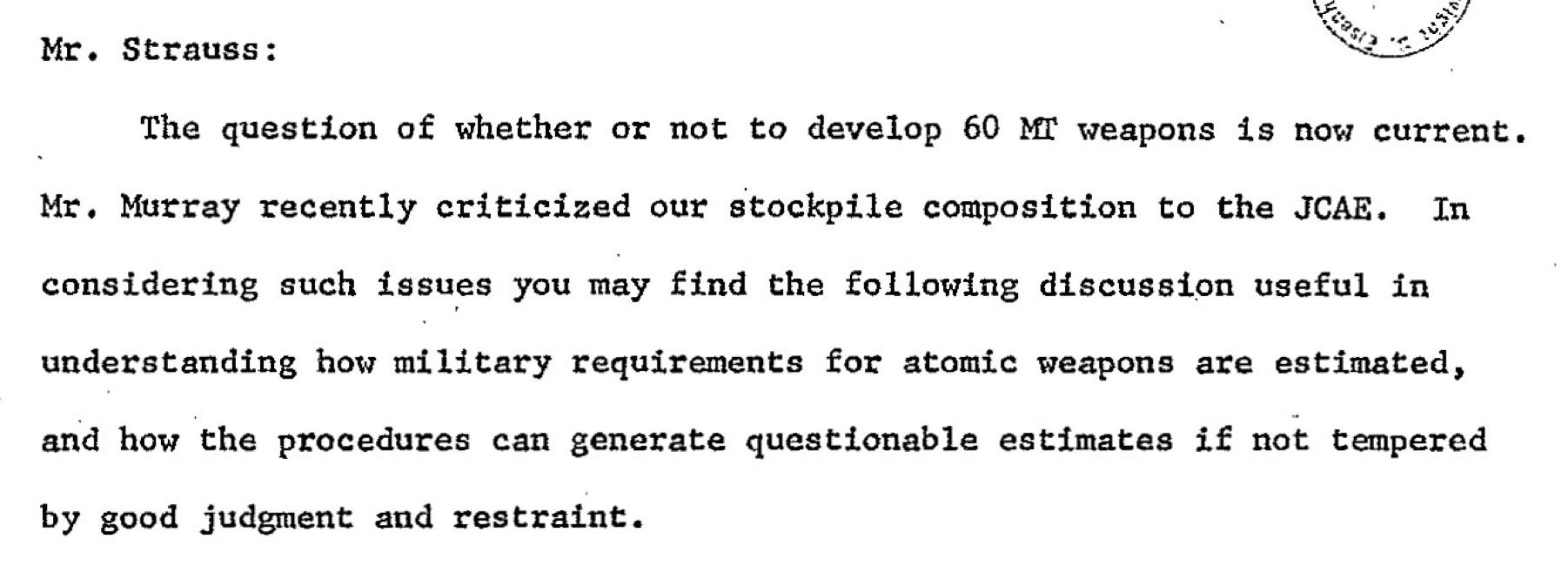
Morse’s own position on the 60 megaton bomb question appears to have been complicated. He did not believe that Murray, “nor any other civilian,” was in a position to “properly or successfully challenge the mathematics or the military factors” which were necessary for making sense of whether a “military requirement” was valid or not.
But he did believe that he had the qualifications necessary to discuss such matters, as he had served for three and a half years as the head of Atomic Planning within General Lauris Norstad’s Air Operations Directorate in European Command. And so Morse’s memo was primarily about why he believes that the methods for the military requirements of nuclear weapons was “still in the ‘stone age’ of development,” and that he felt the AEC commissioners should be aware of this fact.2 His critique starts as an organizational one:
Two major handicaps restrict military atomic planning. First and most important is the inferiority complex still common to most senior officers. They tend to consider atomic weapons to beyond their understanding without extensive study for which they have neither interest nor time.
Atomic planning is therefore delegated to junior officers who have completed various “effects” courses. They frequently lack the maturity and judgment normally provided by guidance from their seniors. When these junior planners confront their seniors with effects terminology and apparent complex calculations, the senior officers are unable to exert normal guidance. Instead, they are prone to endorse the computations without close questioning and without understanding procedures or implications, and often in spite of personal misgivings. I have seen this reaction time and again in the European Theater.
So what we have here, in Morse’s description, is nuclear planning being done by fairly inexperienced officers who are then deferred to by senior officers because of a lack of confidence on the latter’s part in contesting technical analysis.
The second issue is one of national policy in general:
Another major handicap lies in our National Policy which establishes no specific war objectives from which the military can deduce any limitation on the destruction to be inflicted on the enemy. Consequently, no limitations are planned.
This is quite damning and a fascinating observation: if the war objectives do not provide any requirements for limitation of damage, then the planning will not contemplate such limitations.
Morse then continued, analyzing the difference between how the Army and the Air Force saw these issues. The Army, he argued, were focused on how to defeat “men” — tactical issues in battle. As men are “mobile and unpredictable,” they had a much harder time justifying any military requirements for the stockpile. (The Army might have opposed the 60 Mt bomb, but at that same time they were pushing for over 150,000 tactical nuclear weapons to be built for their own use.)
The Air planner, however, thought in terms of “facilities,” and had a very simple “arithmetic” for calculating their requirements, which Morse explained:
The “arithmetic” of the Air planner is important. He first studies each target in the dim light of four important guesses: his bombing error, his desired probability of success in achieving a selected degree of damage to selected elements of the target. (Single rather than multi-weapon attack on each target is the rule in order to conserve delivery forces.) As an example, the planner may estimate a 3000 foot CEP (explained below), and require a 50% probability of achieving 50% damage to concrete structures. After these selections of guesses the answer comes by “arithmetic”. The answer is highly sensitive to all initial selections.
All of the emphasis in the above is in the original, and meant to indicate what “variables” could be tweaked, with the exception of the last sentence, which is just emphasized.
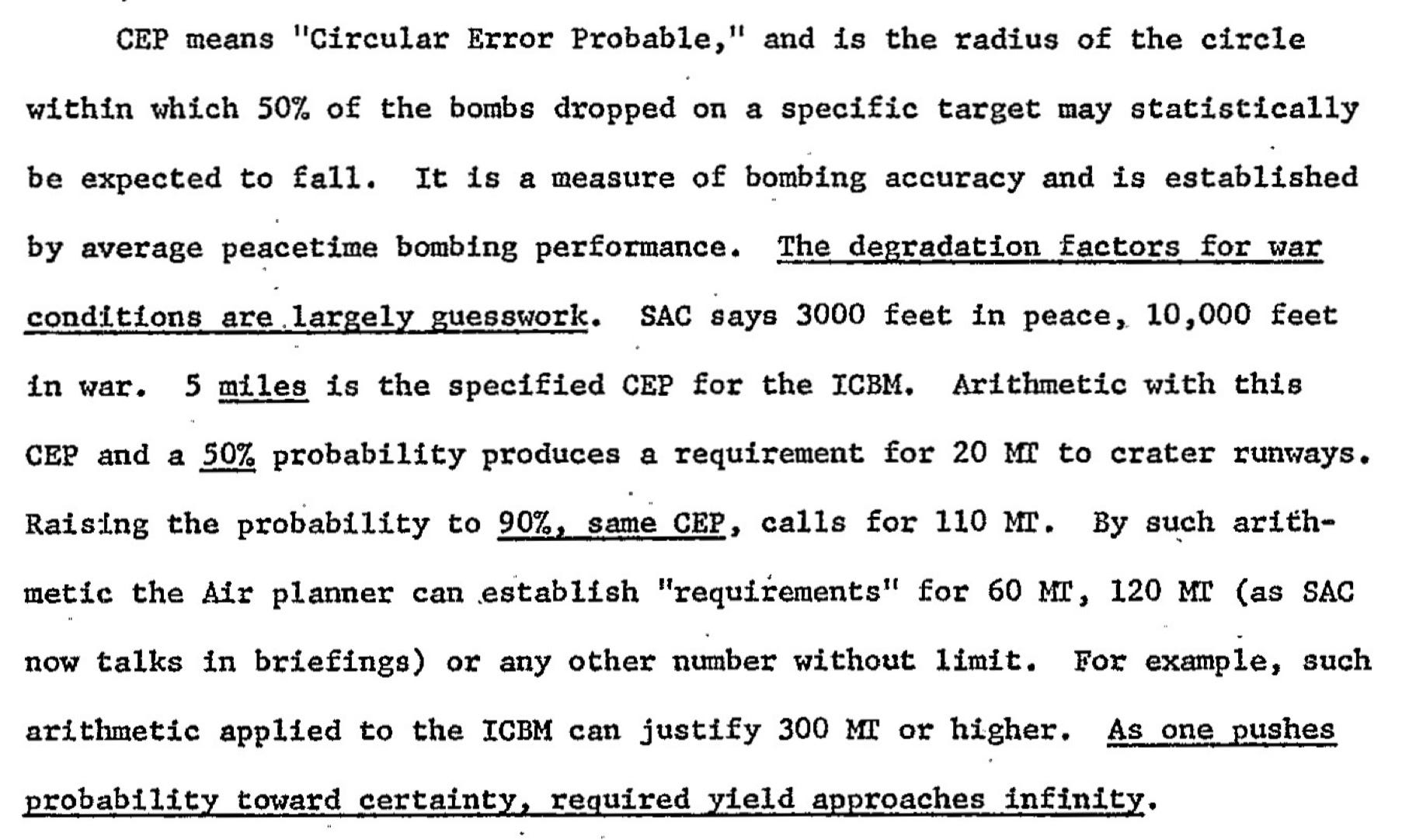
Morse explains CEP (which in the original he first calls “DEP” in an apparent typo), a common measure of projectile or bombing accuracy:
CEP means “Circular Error Probable,” and is the radius of the circle within which 50% of the bombs dropped on a specific target may statistically be expected to fall. It is a measure of bombing accuracy and is established by average peacetime bombing performance. The degradation factors for war conditions are largely guesswork. SAC says 3000 feet in peace, 10,000 feet in war. 5 miles is the specified CEP for the ICBM. Arithmetic with this CEP and a 50% probability produces a requirement for 20 [megatons] to crater runways. Raising the probability to 90%, same CEP, calls for 110 MT. By such arithmetic the Air planner can establish “requirements” for 60 MT, 120 MT (as SAC now talks in briefings) or any other number without limit. For example, such arithmetic applied to the ICBM can justify 300 MT or higher. As one pushes probability toward certainty, required yield approaches infinity.
What a lovely explanation of the relationship between accuracy, certainty, and required yield. The last sentence is one for the ages regarding overkill: if certainty is required, then overkill is inevitable, if accuracy is fixed. This paragraph also hints at the idea that SAC did not even consider a 60 Mt bomb to be the end of its ambitions for that time.
Morse then notes that SAC’s goals of cratering runways meant that it was contemplating ground bursts. He noted (and underlined) that “fallout from such attacks has been largely ignored to date by all planners except SACEUR [Supreme Allied Commander Europe, who prohibits ground bursts.”
Morse further pointed out that at SAC’s planning process was focused on individual targets, not systems of targets. This also led to overkill:
The distinction between analysis by individual targets rather than by systems of targets is most important because by its very nature it insures no allowance for the cumulative effects of weapons upon targets or operations other than those which each individual weapon was intended to destroy. The destructive and disruptive nature of nuclear weapons, particular megaton weapons, is such that cumulative or ancilliary effects may often be as great or greater than primary damage. Yet in today’s nuclear weapon planning they are dismissed as “bonus” effects adding to the certainty of success. Radioactive fallout upon enemy and friend alike, as well as world-wide, are among those effects so lightly dismissed as “bonus”.
In other words, by focusing on individual targets, particularly hard ones, SAC was focusing on a tiny range of potential damage: the highest blast pressures obtainable, used for cratering airfields and the like. It thus ignored the fact that these multi-megaton weapons were also doing vast “lighter” damage to the same area, including to other targets in that “complex,” as well as creating fallout, fire, and other longer-range damages. The latter were all “bonus” compared to that desire for cratering the airfields. (And how many targets are we talking about? A list of potential targets used by the USAF for nuclear planning from 1956 was released a few years back, and included some 1,100 individual locations.)
Morse noted that this concludes here was not just his own view of things:
A current DOD [Department of Defense] study questioned this procedure, pointed out that “bonus” effects result in tremendous over-kill, and concluded that analysis by systems rather than by individual targets, using the same procedures and calculations, would show that kilotons rather than megatons are more than sufficient to achieve desired destruction. This study was rigorously suppressed and all copies destroyed. It lent support, however, to the growing doubt regarding the validity of current military requirements for nuclear weapons and the missiles to deliver them.
What suppressed study is he referring to? The late Bill Burr suggested it might have been a forerunner to Project Budapest, an Army-Navy study that critiqued Air Force nuclear planning that was completed in August 1957.
Morse continued by noting there were other areas of “guesswork” used to inflate requirements, like questions about how many bombers would actually reach their targets. The result of all of this, he concluded, was that:
…the planner for air attack with nuclear weapons can generate requirements for any number or yield of weapons which he desires. By his interpretation of intelligence he can select an almost infinite number of targets for destruction, and of characteristics justifying any yield he wishes. It is he who estimates losses and aborts before penetration of enemy defenses. He also estimates losses to the latter. And he makes allowances for destruction of his own weapons by initial enemy attacks. Weapon requirements are directly proportional to the choice of such factors, but the remaining factors of the problem can multiply requirements manyfold.
What limiting factors were there, ultimately, in such a situation? Only three, Morse argued: conscience, financial resources, or production capacity. Of these:
Since the first is flexible and the second has imposed no restraint as yet, only production capacity has so far limited weapon requirements. The close correlation between SAC requirements and AEC production capacity over a period of years is not coincidence.
Morse takes a slightly more positive view of the Army’s planning, noting that the Army’s perspective was much more respectful of the consequences of such weapons, given their proximity to their effects:
[The Army planner] is acutely aware of the damage that explosives can do, to him as well as to the enemy if he is not careful. He has often seen high explosive effects, although not nuclear, at first hand. The air planner has seldom seen the results of his own bombing. Consequently, the Army nuclear planner is subject to almost automatic restraints, which do not apply to the reasoning of the air planner. And the results are quite different.
As for the Navy (Morse’s own service), Morse acknowledged that he was largely going to skip them, as its approach “hovered between the two extremes” of Army and Air, but tended to side with Air just because their own nuclear planning at that time involved using similar platforms (planes launched from carriers).
Again, Morse concluded that while he felt Murray was probably right about the lack of a military need for very high yield weapons, he did not think that Murray’s “guesses” for military requirements were any less arbitrary than the military ones. The point of the memo was not to provide even his own “guesses,” but to create a context in which the AEC Commissioners could evaluate why the different branches had such different apparently “requirements,” and why the Air requirements should be viewed with a grain of salt. If these military methods were “not tempered by good judgment and restraint,” then they would result in “questionable estimates,” to put it lightly.
The estimating of military requirements for atomic weapons is still in the “stone age” of development. Certainly you among the Commissioners should be fully aware of this fact in weighing Commission response to requirements expressed by the military.
Morse’s memo is vivid, clear, and sharp in its critique. It contains many of the same critiques that later analysis, such as Daniel Ellsberg and Lynn Eden, have since levied at nuclear war planning in the Cold War: arbitrary systems, swathed by secrecy and apparent technical precision, with little room for consideration of larger effects, conscience, or the big picture.
But Morse was no dove by any definition— and neither was Murray, nor Strauss, nor Eisenhower, nor anyone under discussion here. Morse would become a major force pushing for increased use of tactical nuclear weapons, limited nuclear war, and the “neutron bomb.” All of these were hawkish in their own way, but still recoiled from the horrors of the “infinite” targets and “infinity” yields that he saw as indicative of the “stone age” approach to planning by the Air Force.
Thomas Murray to Dwight D. Eisenhower (3 July 1956), copy in the Digital National Security Archive database, document NP-00266.
Captain John H. Morse to Lewis Strauss (14 February 1957), Dwight D. Eisenhower Library, Records of Special Assistant for National Security Affairs, NSC Series, Briefing Notes Subseries, box 17, Target Systems (1957-1961), copy in William Burr, ed., “‘It Is Certain There Will be Many Firestorms’: New Evidence on the Origins of Overkill,” National Security Archive Electronic Briefing Book No. 108 (14 January 2004), document #3.
A cover letter attached to the Morse’s memo concluded that that “no sound military requirement” existed for such a high-yield bomb, but that nonetheless argued that the US AEC ought to proceed with developing the weapon, “for the information we may gain” in the process. The author suggested that small numbers of such weapons should be produced as a “desperation, disaster weapon for last-ditch use,” and that it was possible for the AEC to both develop this weapon while also pushing-back against the military logic that was demanding it. This cover letter may have been written by Morse (I suspect it is likely), but I cannot say that for sure, as the transcribed copy I have does not have any signature or revealing information. The cover letter is reproduced in Chuck Hansen, The Swords of Armageddon: U.S. Nuclear Weapons Development Since 1945, version 2, (Chukelea Publications, 2007), on IV-248.
Murray was an interesting character. His brother was a Jesuit priest, and he was a prominent Catholic layman. He consulted several prominent theologians before accepting the post at the AEC, on the question of whether the use of nuclear weapons was morally justified in time of war. He concluded that, in the case of the USSR, waging nuclear war was not only "something we are morally permitted to do; it may be something we are morally obliged to do." But, apparently, not with 60-megaton bombs.
I'm surprised Curtis Lemay wasn't in on those calculations. He really liked to bomb civilian populations.