
"It isn’t a happy picture, is it?"
A grim briefing on the consequences of the US nuclear war plan from June 1956

What did the people who planned for actual nuclear war during the Cold War think their nuclear wars would look like? What would they be targeting? What would the consequences be?
Understanding the answer to this question, at different times in history, is often quite hard to do, because these kinds of war plans are, even decades later, often still highly classified. But it’s an important thing to study, because without some real, tangible data on it, it is hard to know exactly what could have happened if the Cold War had gone hot. And seeing what they did and did not plan for also gives important insights into how these organizations worked — or didn’t work.1
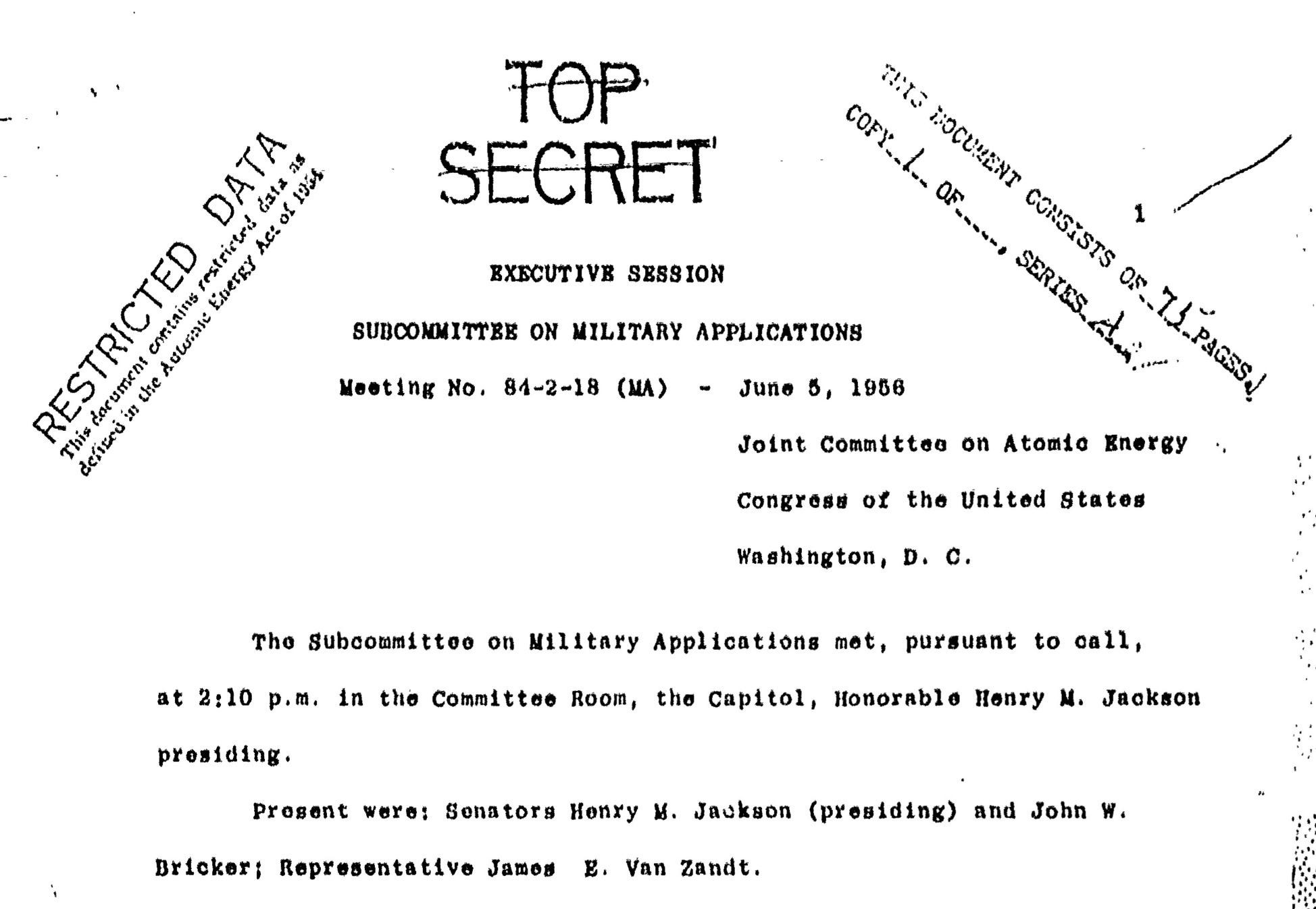
I recently stumbled across a fascinating discussion of the consequences of nuclear war in an Executive Session between the Congressional Joint Committee on Atomic Energy (JCAE) and representatives from the US Army from June 1956. The JCAE was the Congressional oversight committee for all matters relating to the US nuclear stockpile, and these Executive Sessions were highly-classified briefings that were never intended to see the light of day, but the transcripts of many of them have since been declassified, and are a historical treasure-trove.2
What makes the transcripts so valuable is that they are often far more blunt and direct than official reports and documents — one is seeing an actual conversation that took place, between people who thought that nobody outside of that room would ever get to hear the conversation. It doesn’t mean that people are necessarily more honest with one another, but it does mean that the show they are putting on is for a much more select audience.
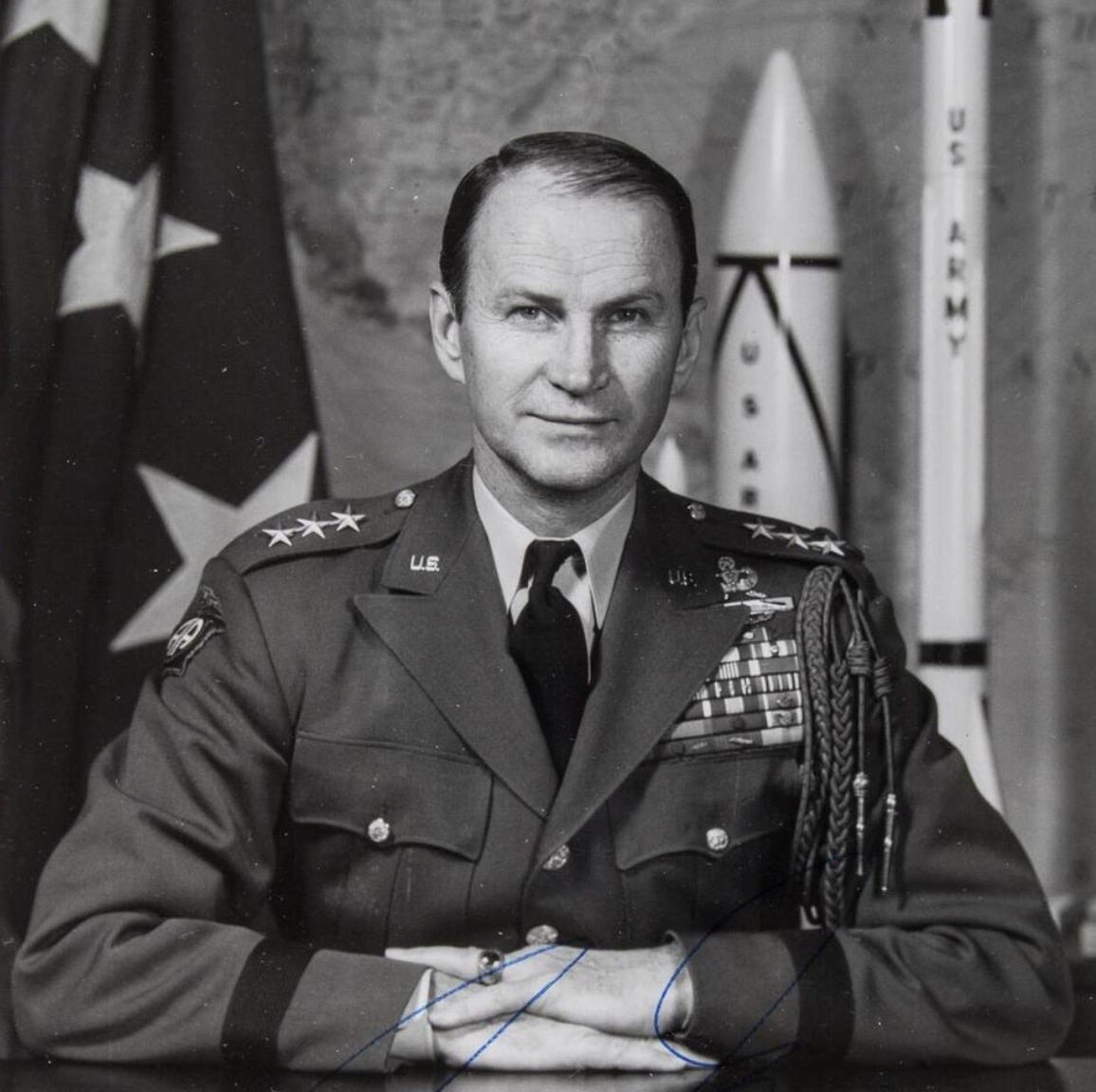
In this particular hearing, the JCAE was only its Subcommittee on Military Applications, with only three members: Senator Henry M. “Scoop” Jackson (D-WA), Senator John W. Bricker (R-OH), and Representative James E. Van Zandt (R-PA). The Army had sent some ten people to this hearing, but for the excerpts below the two who matter were Lt. General James M. Gavin, the chief of Research and Development and the ranking officer there, a Colonel Robert E. Coffin, and a Colonel George M. McHaney. I don’t know much about McHaney or Coffin — but what a name — but the point of the hearings, ostensibly, was to talk about the Army’s projected needs for nuclear weapons. And those needs were quite large, to hear them tell it: the Army alone was projecting a need for 151,000 tactical nuclear warheads, with yields ranging from “a tenth of a kiloton” up to a megaton, with the possibility of using over 420 per day of “intense combat.”
But it’s their presentation of a 1955 study of the consequences of a thermonuclear war in the bomber age that really grabbed me. What follows are selected excerpts from a much longer hearing.
GENERAL GAVIN. I would like to consider first the psychological and political aspects of thermonuclear war and in doing so I would like to present a chart that outlines the probable results from the use of a specific number of thermonuclear weapons against targets on the Eurasian land mass. This presentation has been made to the Chiefs of all services and the yardsticks used in developing the fall-out pattern are those accepted by all services.
This outline of fall-out shows the casualties that would occur if wind conditions were on this chart you are looking at now generally from to west to east and it is based upon the use of eight [11 characters redacted]3 weapons — surface bursts against airfields. This happens to be an arbitrary number and an arbitrary system of targets. It is not a precise plan. However, it is related to planning considerations.
SENATOR JACKSON, The primary first mission of our SAC [Strategic Air Command] would be to destroy their ability to hit us —
GENERAL GAVIN. That is right, sir.
SENATOR JACKSON. So that would be directed at their airfields.
GENERAL GAVIN. That is correct.
SENATOR JACKSON. This isn’t an inordinate number from that standpoint.
What is being described here is a “counterforce” attack on a massive scale, not unlike the one depicted in the contemporaneous USAF film, The Power of Decision. That it is largely “surface bursts” — weapons set to detonate on contact or very close to the Earth’s surface, in order to heavy damage to the airfields in question — is significant, because this means they would be heavily fallout generating. (Airbursts, of the sort used to destroy cities, produce considerably less “local fallout,” the intensely radioactive plumes that most people associate with nuclear fallout. Surface bursts produce lots.)
This is a massive attack — all the more so considering that the Soviet ability to attack the United States from those airfields was at that time still fairly limited.
When Senator Jackson notes, “This isn’t an inordinate number [of casualties] from that standpoint,” what I think he means is, “the casualties you are imagining inflicting upon the Soviets is not so high given that the goal is to keep them from being able to inflict huge casualties against us.“
Gavin continued to flesh out the numbers, helpfully painting the picture of the unseen map in our minds:
GENERAL GAVIN. Although numbers vary a great deal — this figure was projected into the future when this study was made a year ago — it is to be noted the casualties in the satellite countries were 324 million. The USSR — 142 million and allied 2 million.
Now I would like to show you the pattern of fall-out based upon a shift of winds that would put the winds generally east to west in mid-Europe with a little fishtailing into Japan and the Asiatic area, It is interesting that the gross casualties remain about the same — approach on the order of a half a billion, except if the wind blows one way someone else gets [more?] than if it blows the other way.
In this case it is to be noted that the casualties go up half way through the United Kingdom; the 80 percent line through the Scandinavian Peninsula; half of Spain, down into the Balkans, into Greece, into Turkey and of course a great deal of the fall-out pattern goes over Japan.
The capriciousness of the wind, and its ability to change which millions die, is a stunning concept. So is the planning of an attack that they believe would kill two million citizens of nations that are allied with them.
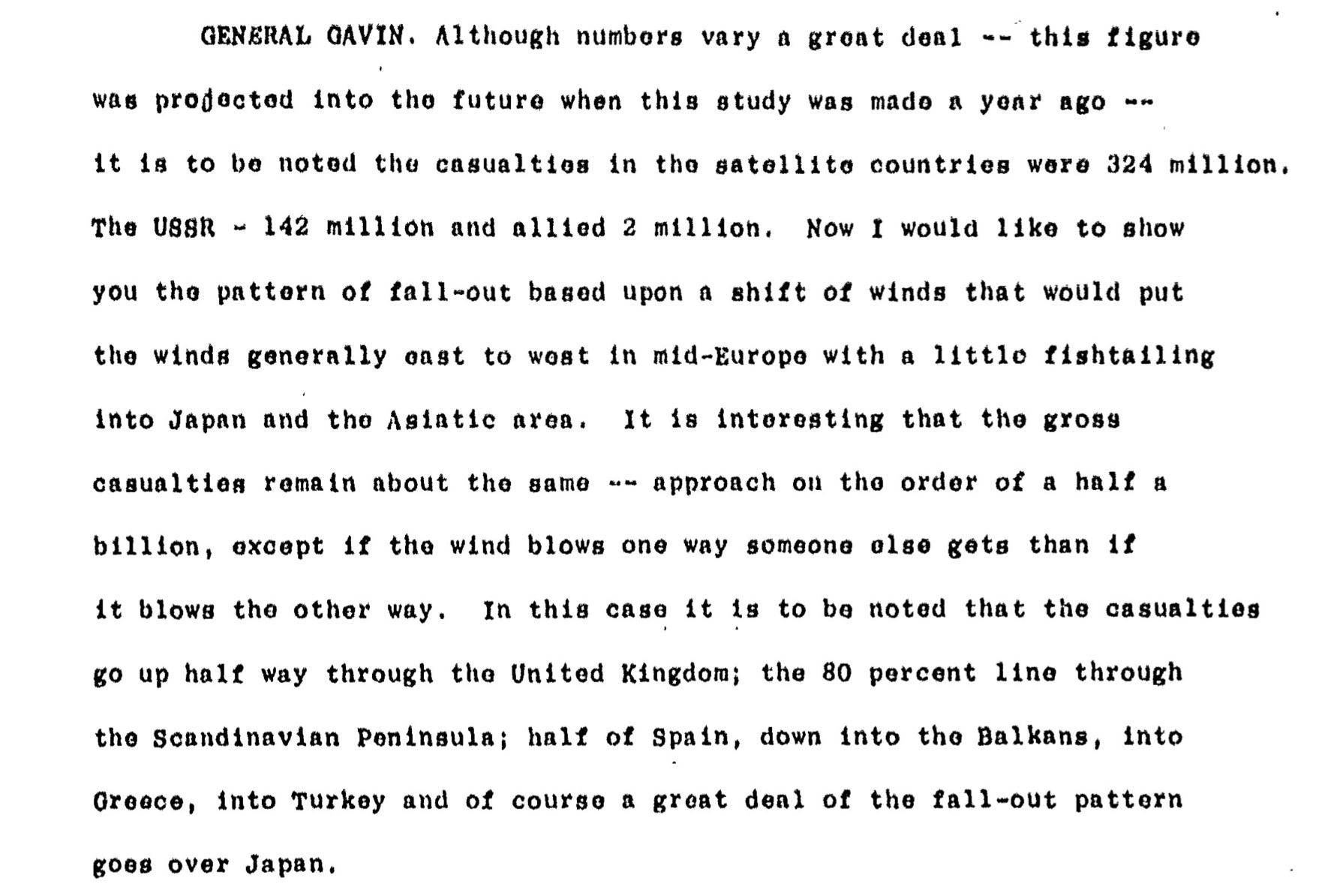
Another part of the discussion clarified that the “80 percent line” referenced was a line on the map depicting “80% civilian casualties.” They also clarified that they are talking about casualties — fatalities plus injuries — not just fatalities. Still, it is a massive number.
324 million casualties is still an incredible number. To put that into context, consider that the total number of deaths during World War II was on the order of 70-80 million people.
REPRESENTATIVE VAN ZANDT. These casualties are based on fall-out alone?
GENERAL GAVIN. Yes sir, fall-out alone.
REPRESENTATIVE VAN ZANDT. What about shock wave and so forth?
GENERAL GAVIN. No, I am incorrect, sir. These are total casualties. The heaviest losses would be from fall-out. Of course there would be complete destruction of people —
SENATOR JACKSON. And pre-supposes a lack of cover, of course.
REPRESENTATIVE VAN ZANDT. Those are all surface bursts?
GENERAL GAVIN. These are surface bursts, yes sir.
SENATOR JACKSON. Which they, of necessity, would be if they were directed at destroying their airfields.
The problem posed by fallout is, of course, immense here. And this study seems to presume that only counterforce (airfields) are being targeted, which it is clear was not the sum total of the US military’s nuclear war plans at the time. That is, they likely also were going to target cities directly, but that seems to be taking a back seat to the fallout problem in general.
All of the casualties discussed thus far are non-American casualties. Gavin did turn to the question of what might happen if the Soviets attacked in kind:
GENERAL GAVIN. There are various estimates of what casualties might occur under an attack on the United States. One figure that is pretty generally accepted is that, for example, a 60 megaton weapon over population centers of the United Stares would destroy about 50 percent of our population. One can take any number of weapons and come up with figures something of the order of these. I am not intending to be precise, but I would like to point out the problems one must face in making a decision to launch an attack like this. This is the psychological and political aspect of it.
REPRESENTATIVE VAN ZANDT. What is the world population — about 2 billion?
COLONEL COFFIN. Two billion.
SENATOR JACKSON. Two and one half. We have 7 percent of whatever it is.
The numbers here are a little imprecise. The current UN global population estimate for 1956 is that the world had 2.7 billion people at the time. The US Census estimate for the 1956 population was around 167 million. So the United States was more like 6% of the global population at the time.
The idea that the Soviets would use 60 megaton weapons on all US population centers not very realistic. Soviets never fielded weapons that large in reality. The US Strategic Air Command, was, however, quite interested in developing and fielding 60 Mt bombs. They had requested them in 1954, and twice again in 1956. SAC had first said that they wanted them to attack “hardened” targets, but they later suggested they would be more economical for destroying “target complexes” that were large-enough to require several smaller weapons, like greater Moscow. Ultimately Eisenhower vetoed the idea, after several years of pining.
There is a longer story to be told about this, at some later time, but I just want to emphasize this is an interesting example of “mirroring”: SAC wanted 60 megaton bombs in 1956, so they are imagining that the Soviets would be using that weapon against the US, even though the Soviets did not possess 60 megaton bombs at the time.
But just back to those numbers. If the US attack would create 342 million casualties, and the world population was 2.7 billion people, that means that the US attack alone would make military casualties out of about 12% of the entire global population. But if you go with the numbers the Congressmen were using, it’s more like 25% of the entire global population. World War II, by comparison, had a global casualty rate of around 3%, and was, well, rather remarkable for it.
The fallout discussion continued, with some discussion about “global fallout” — the general raising of background radioactivity that comes from the detonation of nuclear weapons, as opposed to the more direct “local fallout” previously discussed:
SENATOR BRICKER. Would the atmosphere in an atomic attack such as this pictured here become generally contaminated around the world?
GENERAL GAVIN. The strontium 90 content would go up significantly.
SENATOR BRICKER. How high do you figure?
GENERAL GAVIN: I am not sure I could any what the damage would be world-wide to people; that is through the United States, Canada and so on. I don’t know.
REPRESENTATIVE VAN ZANDT: Isn’t it true, General, that those who study fall-out now tell us that when you use high yield weapons, that is a megaton, you throw it up into the troposphere and about two pounds [of fallout] for every 20,000 [tons of yield] and it spends anywhere from five to ten years up there?
GENERAL GAVIN. I don’t know, sir. That is very interesting.
Van Zandt’s numbers (he later clarifies that he means two pounds of fallout for every 20 kilotons) likely derive from someone explaining to him that fallout is mostly made up of fission products, and the rule of thumb is that 1 kilogram (2.2 lbs) of material fissioning completely corresponds to around 18 kilotons of yield. So his numbers were a little off, but close-enough. It doesn’t really tell you that much, though, since the impact of one kilogram of fission products dispersed in the air (much less in the upper atmosphere) does not correspond in some obvious way to a given situation on the ground. Hence the difficulty of fallout modeling.
After some more discussion on fallout (and the desire, by the Congressmen, for developing “clean” nuclear bombs), and some questions about prevailing wind directions in Europe, the discussion of casualties continued:
REPRESENTATIVE VAN ZANDT. Do you suppose these nations concerned — these neutrals now are familiar with the results of fall-out in the event of an atomic war?
GENERAL GAVIN. I think a lot of them know more about it, sir, than we give them credit for knowing. This worries people very, very much in Europe in my opinion. Very much.
SENATOR BRICKER. What percentage of the 80 percent of civilian casualties there would come from fall-out?
COLONEL MCHANEY. I would say, well over 90 percent of them, sir.
GENERAL GAVIN. Again sir, the purpose of this chart was to make a point. This question was raised last year and in response I pointed out the psychological and political aspects would make the decision a very difficult one indeed.
SENATOR BRICKER. I have just one more question. That wouldn’t mean they would all be killed. It means incapacitated for warfare.
COLONEL, MCHANEY. That is right, sir.
SENATOR BRICKER. Some might survive.
COLONEL MCHANEY. Yes sir.
“Some might survive” is a grim way to put it. Later discussions appear to indicate that they are talking about around 250 rem and up, so “death and sickness” were combined into one blunt category.
Jackson asked about shelter assumptions, suggesting that if people took cover, those numbers would go down:
SENATOR JACKSON. You would reduce fall-out casualties very substantially if you could assume that the people in the fall-out area could obtain cover. This pre-supposes, I take it, a complete surprise.
COLONEL MCHANEY. No sir, if I might correct that impression. Those charts were drawn up under the assumption every man, woman and child in this area was taking advantage of any available cover. This was actually [based on] surveys made of normal building, housing structure in some of those regions. Most of the houses are stone. And in those regions the shielding effect of their homes was given appropriate credit. In other regions they are just frame houses and the shielding would be less.
SENATOR JACKSON. In other words you predicate [sic?] upon the home environment and made your decisions according to what the known environment is in each country.
COLONEL MCHANEY. That is correct, sir, so we have taken account of any natural shielding they could take today.
So that seems to indicate that these are the most “optimistic” numbers. If people didn’t take shelter, the numbers would presumably much higher.
At one point they go off the record when talking about American troops who would be exposed to fallout, but when they come back, they had this interesting exchange:
GENERAL GAVIN. I might say this is the first time we have ever brought these charts to any Congressional Committee. We have worked hard on them.
SENATOR JACKSON. We had one a couple years ago, as I recall, when General Ridgeway was up.
GENERAL GAVIN. It was a different one. It had a lot of bananas on it. I remember that one too.
Bananas, you say? I do seriously wonder if they are talking about the same map, and are making the same semi-serious association with those “Bravo” clouds and “bananas” that I did. The timing is not impossible!

There was one last discussion about global radiation increase from this much fallout, with Colonel Coffin (again, what a name):
COLONEL COFFIN. The exact effects of the massive fall-out on a world-wide basis are not known. We can arrive at such conclusions as 25,000 megatons will double the gamma radiation background in the world. The next question is what is the effect of that. Nobody knows.
SENATOR BRICKER. Genetically and otherwise. […]
COLONEL COFFIN. The effect on genetics is a tremendous increase in stillbirths. Nobody can give an exact figure, but a very definite increase. […]
SENATOR BRICKER. It isn’t a happy picture, is it?
COLONEL COFFIN. It is a very dismal picture at present.
To put this discussion of 25,000 megatons into context, in 1956 the United States nuclear arsenal was just shy of 9,200 megatons, and growing rapidly. By 1957, it had over 17,500 megatons. At its peak, in 1960, it was over 20,000 megatons. So 25,000 megatons is not an insane number to use for projecting what might be “expended” in a full-scale thermonuclear war with the Soviet Union (who would presumably add some of its own megatons to that total) in the near future, particularly given that the context of the entire discussion was about the ever-larger stockpile requirements requested by the US military.
After this discussion of worldwide fallout, Gavin tried to clarify why they were giving them this briefing on nuclear in the first place:
GENERAL GAVIN. Again, sir, the purpose of this chart was to respond to an inquiry of last year as to what is meant by psychological and political difficulties in making a decision to launch a strategic offensive. This is only mentioned in relationship to the overall purpose of this presentation to comment on the Army’s tactical atomic requirements.
SENATOR BRICKER. You have definitely arrived at this conclusion that if a strike is made, it will be an all-out strike?
GENERAL GAVIN. Yes sir. The great significance of this to the Army is that the Soviets are aware of this. We are aware of it. As they arrive at the point of being able to deliver a blow like this against us, then they will be in a position if they have other forces able to wage war on a lesser scale to be aggressive around the periphery while all the time blackmailing us and never giving us a black and white decision. It will always be grey. They will always be doing something less than this. This is the problem that worries us most. We are arriving at that point we feel now.
REPRESENTATIVE VAN ZANDT. In other words, a continuation of the cold war?
GENERAL GAVIN. Yes sir, in the atomic era.
And so the full logic of this grim presentation, by the same Army requesting over a hundred thousand nuclear warheads, is reached. The presentation is meant to be horrifying. It is meant to feel overwhelming and terrible. It is an Army presentation of an attack plan that was largely developed by the Air Force, one that would result in an unimaginable scale of death and destruction. And, as Gavin emphasized, the plan was all-or-nothing: there was no option for anyone to “limit” the destruction of the US nuclear war plan at this point.
And given all of that, Gavin says, what are the odds that the Soviets would set such a thing off? What are the odds that the US would ever initiate it? And couldn’t, then, the Soviets then wage a much lower-scale conflict, something that would not warrant this level of attack, and thus make such a massive threat seem impossible and impotent?
Hence the need for the Army to have tactical nuclear weapons — smaller-scale weapons that could lower the threshold for nuclear use in a credible way, and avoid nuclear war being rendered entirely all-or-nothing, genocide-or-capitulation.
At this point, there is one more amusing question from Representative Van Zandt:
REPRESENTATIVE VAN ZANDT. May I put one question at this point? I am thinking of the Russian propaganda machine putting something like this in print and distributing it to that part of the world affected and charging us with having capabilities of doing that job. From a propaganda standpoint, we would be behind the eight ball.
GENERAL GAVIN. If you handle it like that, we would.
REPRESENTATIVE VAN ZANDT. Yes sir. I imagine the Russians are thinking about the same as we are.
GENERAL GAVIN. I think they are too. They know about it.
Wouldn’t it be awful if the Soviets just told our allies that our plans would kill so many of them, and told the world that our war plans were so genocidal in nature? Wouldn’t that make us look like the baddies? It’s a good question — but nobody in this hearing really seems to think that the problem is that they are acting like the bad guys, here.
Which to me is an interestingly unspoken concern at this moment. Do the “good guys” actively spend their time planning for operations that would kill millions upon millions of non-combatants, including your own allies? If you assume they’ll never be carried out, that the act of planning for such mega-slaughter is enough to discourage it from ever occurring, one can certainly preserve some kind of moral position, although it’s still a pretty grim one.
But if you think that there’s a chance that position might slip, that deterrence might fail, and that you might actually then carry through a plan that would possibly kill or injure around 25% of the world’s population — as these people clearly thought was the case… that feels like a much worse moral position, to put it bluntly. And I think the fact that they were worried that the Soviets could use the reality of the American’s own nuclear war plans as moral propaganda against them shows, at some level, that these people understood that, in some way.
For an extensive treatment of this question, see, e.g., Lynn Eden, Whole World on Fire: Organizations, Knowledge, and Nuclear Weapons Devastation (Cornell University Press, 2006).
Executive Session, Joint Committee on Atomic Energy, Subcommittee on Military Applications (5 June 1956), from ProQuest Congressional.
The redacted portion is probably a yield estimate? With 11 characters, you could imagine something like “1-5 megaton” fitting in this slot, or “500 kiloton,” or “1.7 megaton” (the yield of the the workhorse Mk-15 thermonuclear bomb). But, say, “10 megaton” would not (10 characters), nor “megaton-range” (13 characters).
There are so many parts of the conversation where you expect someone to push back, along the lunes of "and that's why this is so stupid". For example, when talking about the effect of fallout on neutral parties ... There ARE no neutral parties unaffected by fallout.
The "mirroring" phenomenon evident in 1956 persisted for decades.
In the early years of the Reagan Administration, his defense secretary Cap Weinberger issued a book entitled "Soviet Military Power" in order to justify their huge arms buildup.
As Tom Gervasi pointed out in his "annotated and corrected edition" of SMP, many examples of the Pentagon attributing weapons capabilities to the Soviets were quite literally reflections of what the US had already done or planned to do. After 40+ years, I still have my copy of Gervasi on a bookshelf _somewhere,_ but it isn't easy for me to retrieve. Otherwise I would quote some specific examples.
Maybe Prof. Wellerstein is familiar with Gervasi and could comment on the reliability of his interpretations...?