
Hiroshima from below
Experiences of atomic bombing victims through the medium of photography

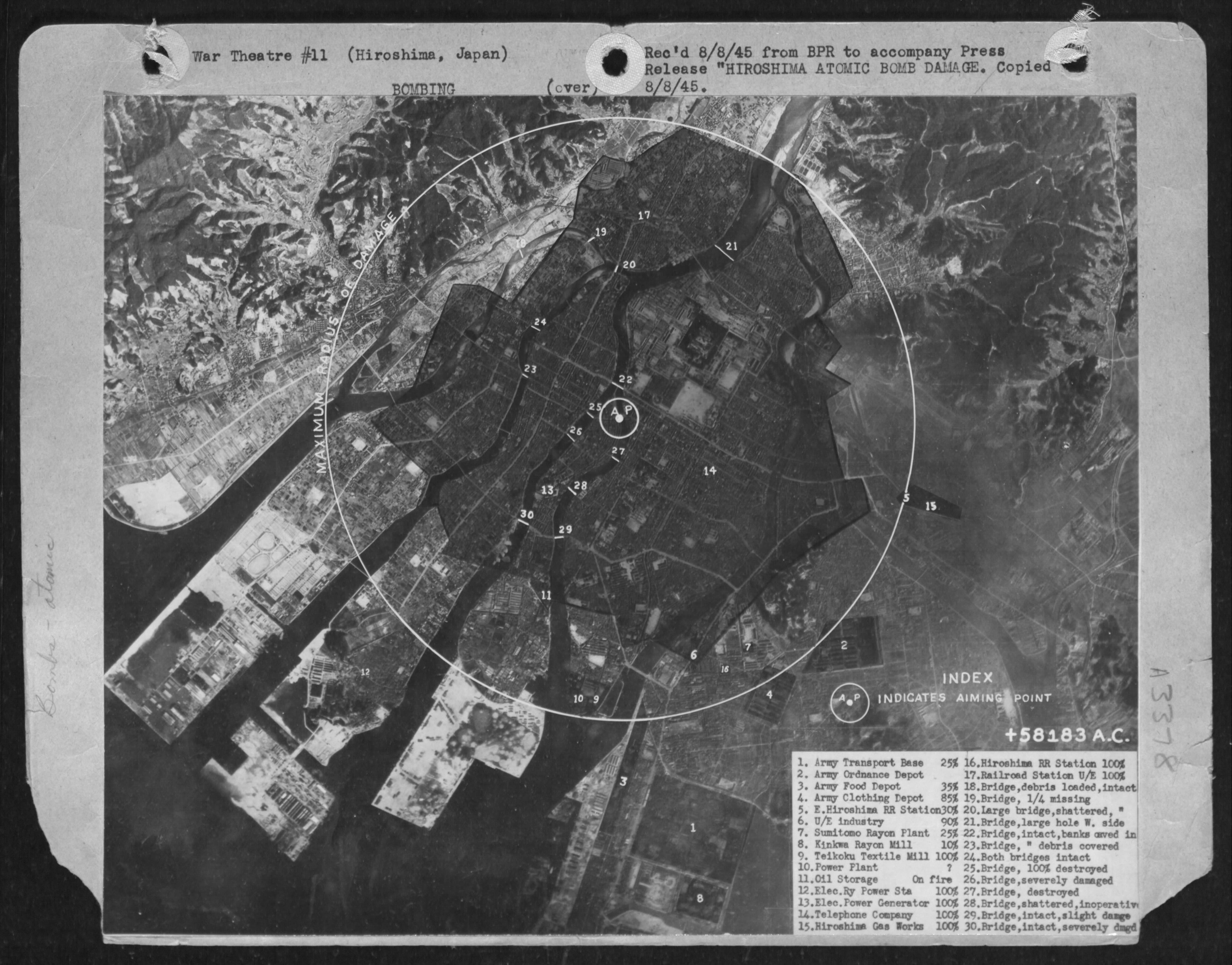
The first views of Hiroshima that were seen in the United States were from the air: the view from B-29 bombers of the mushroom cloud, and surveying the damage as a whole. This is the view of the person dropping the bomb, not the person being harmed by it.
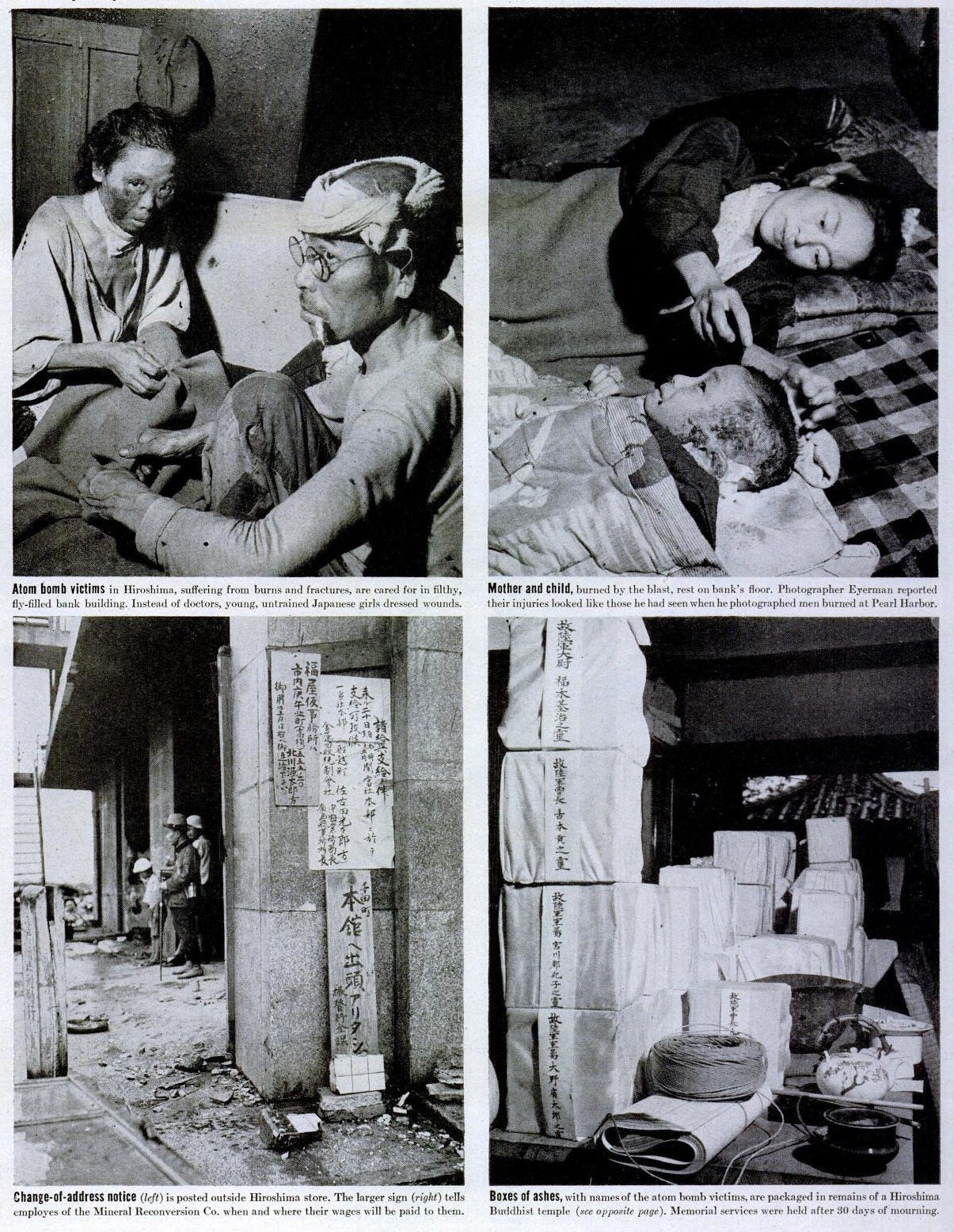
No photographs from the ground were available until after the surrender documents were signed, in September 1945, and American soldiers, scientists, and journalists, were permitted to enter Japan. By October 1945, some photographs of Hiroshima from the ground were beginning to show up in American publications, like LIFE magazine, although they are interesting in retrospect because they are all relatively close-in, giving very little sense of the scale of the destruction. But the LIFE photos did feature people, including women and children, some of whom were quite visibly injured.
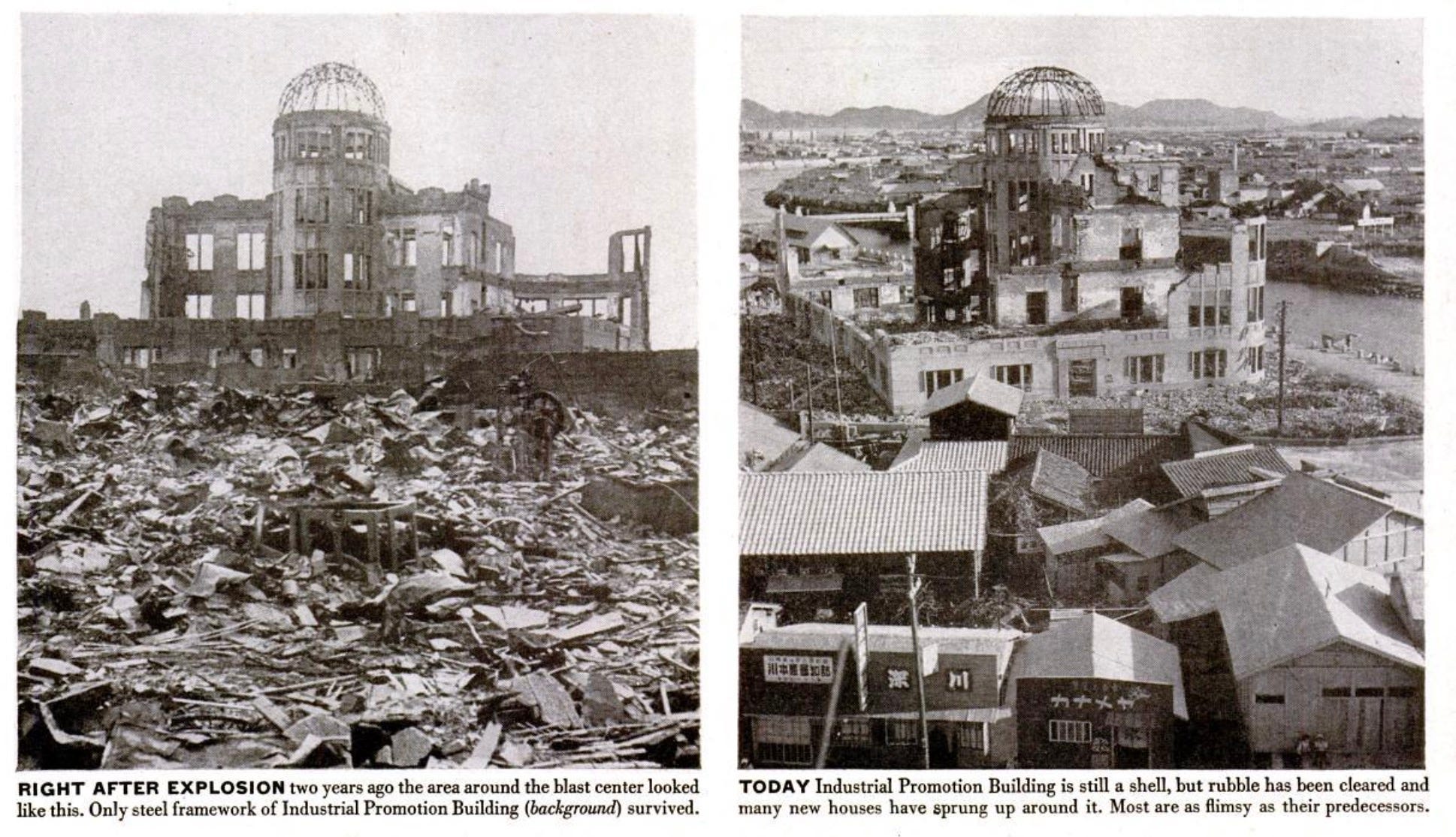
There appear to have been surprisingly few views of the damage at Hiroshima available to the American public until 1947, two years after the attack. At that point, one starts to see many versions of now-familiar photographs of the shell of the Hiroshima Industrial Promotion Building — now usually just called the “Atomic Bomb Dome” — in mainstream publications.
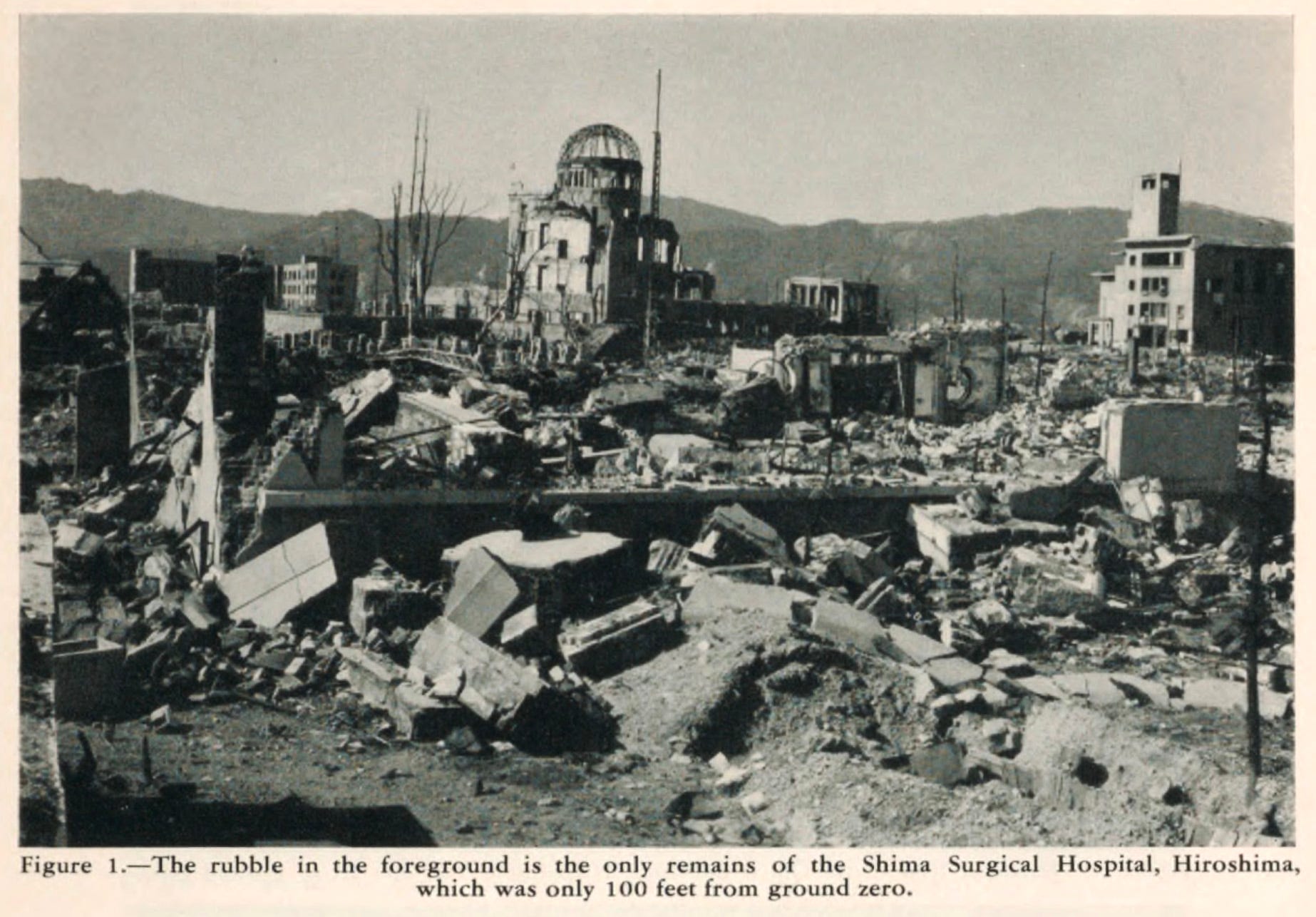
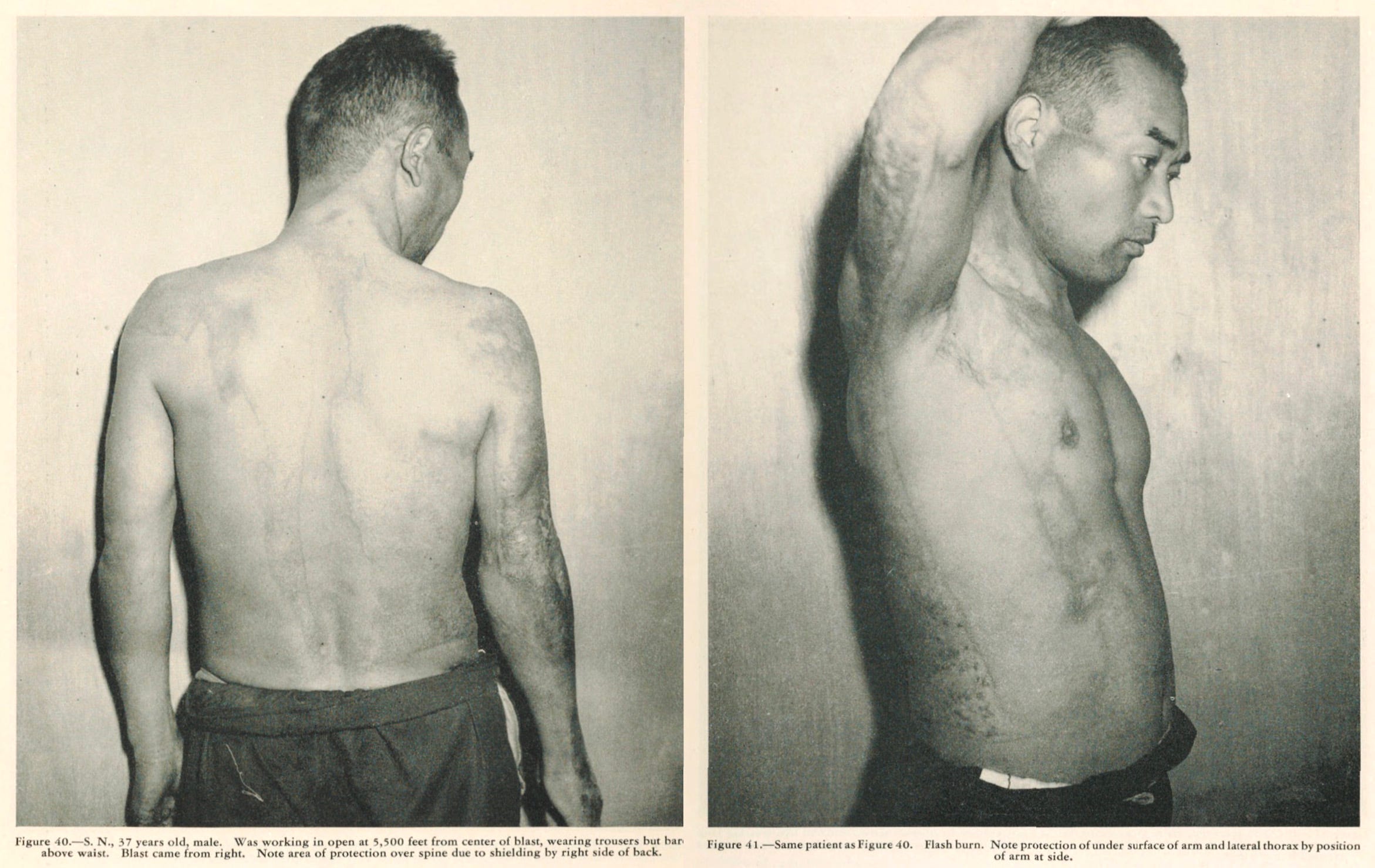
One also gets, in 1947, much more technical discussions of the damage at Hiroshima, and the declassification and release of official reports about the medical effects of the bomb. The United States Strategic Bombing Survey’s The Effects of the Atomic Bombs on Health and Medical Services in Hiroshima and Nagasaki, released in March 1947, contains both broad photographs of the damage, as well as photographs of victims that were taken as part of the general study that was made by the Occupation forces into the effects of the bombings.
As makes sense for a medical survey, the photographs of the victims are clinical and focused on identifying specific categories of injuries. The description of the injuries is clinical and usually concerned with the circumstances under which the injuries were attained, e.g.:
S.N., 37 years old, male. Was working in open at 5,500 feet from center of blast, wearing trousers but bare above waist. Blast came from right. Note area of protection over spine due to shielding by right side of back.
The photographs show wounds that had already healed and scarred. The text says that the Medical Division of the USSBS did not arrive to the cities until several months after the bombings, so the survivors are in much better shape than they would have been immediately after the attacks.
Most photographs of the damage at Hiroshima and Nagasaki were taken weeks, if not months, after the actual bombings. It gives them a particularly sterile look: the streets have already been cleared, the corpses have already been buried or cremated. It helps feed the misconception that the atomic bombings, while perhaps horrible in terms of the raw number of human beings killed by them, were fast and “clean” killers, vaporizing victims and ending their torment quickly. While there certainly were many who undoubtedly died very quickly, there were also many who died painfully, who were trapped under rubble that then caught fire, and survivors who suffered grievous injuries.
There are written accounts that give a potent sense of this. John Hersey’s Hiroshima, which debuted as an entire issue of The New Yorker in August 1946 before it was published as a stand-alone book, was potent then and is still potent now. It has no illustrations or photographs: the writing allows one’s imagination to do the violence for it.
After crossing Koi Bridge and Kannon Bridge, having run the whole way, Mr. Tanimoto saw, as he approached the center, that all the houses had been crushed and many were afire. Here the trees were bare and their trunks were charred. He tried at several points to penetrate the ruins, but the flames always stopped him. Under many houses, people screamed for help, but no one helped; in general, survivors that day assisted only their relatives or immediate neighbors, for they could not comprehend or tolerate a wider circle of misery. The wounded limped past the screams, and Mr. Tanimoto ran past them.
There were, however, photographs of Hiroshima on the ground taken on the day of the bombing. A Japanese photojournalist, Yoshito Matsushige, was employed by the Chugoku Shimbun newspaper, and worked as an official reporter for the Japanese Army. He lived 1.6 mi (2.7 km) from the hypocenter, and was at home, reading the newspaper, on the morning the attack happened.1
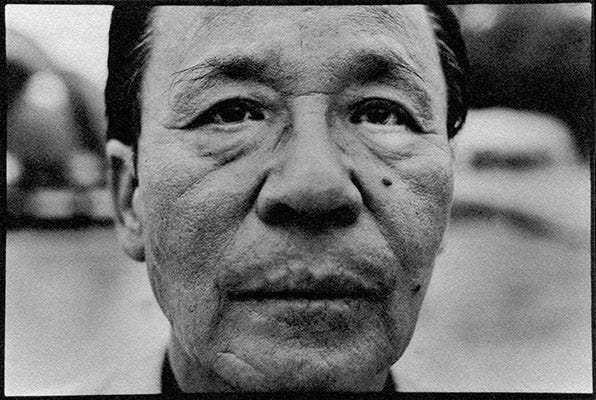
He later recalled the attack:2
At first I saw something shining and sparkling — it was a kind of twinkling light, like you see from a sparkling electric live wire. The next instant there was this huge white flash, like a giant magnesium flashbulb. I couldn’t see anything anymore after that. Then I heard a blast and when the blast hit, my body jumped in the air about one meter and I was thrown against the wall. My wife cried, ”Bombing!” and ran to me. I grabbed her hand and we both got out of the house. We crossed the streetcar racks and went out into the field across the street. I thought the bomb had landed right on my house. […] Everywhere there was dust; it made a grayish darkness over everything. But I could feel the warmth of my wife’s hand, and it was this that made me realize she was alive and also that I was still alive.
Matsushige recalled that in that moment of chaos and darkness, he thought, “I am a newspaper photographer and a reporter for the army, so I have an obligation to make sure where the bomb dropped.” He returned to his house and found his camera in the rubble. “It was time to go to work.”
Matsushige walked through Hiroshima. He took exactly five black-and-white photographs of the city that day with his small Mamiya viewfinder camera. They look dramatically different from the more sanitized photographs, and three of them feature people in them, giving a far more accurate depiction of what the victims looked like, at least in the areas that he was at.
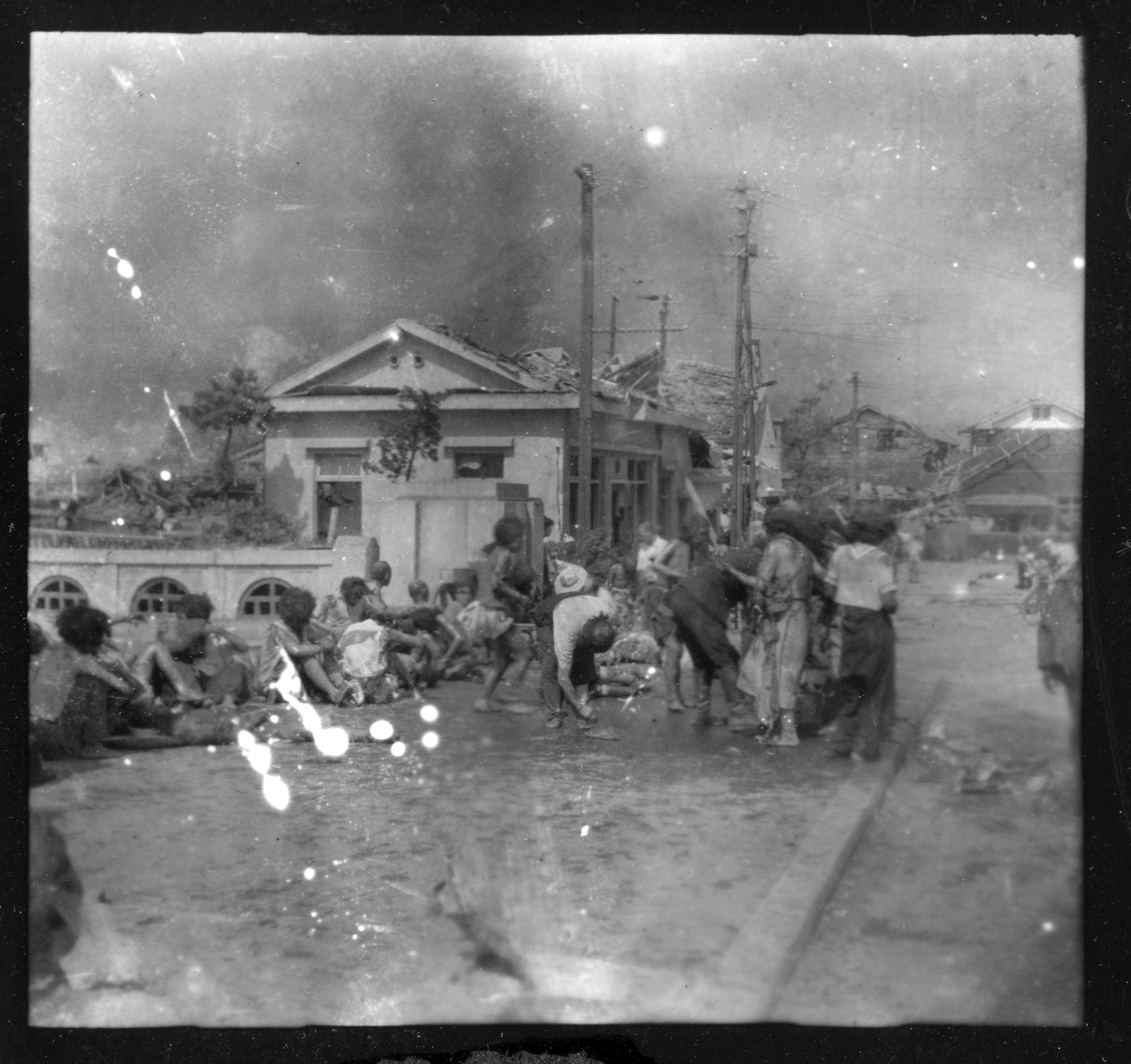
The first, reproduced above, was taken on the Miyuki bridge, and was have been taken about 2 hours after the bomb detonated. The building in the background is a police station, in front of which an ad hoc medical treatment center had been constructed. Officers were putting cooking oil on the burns of survivors. Most of the people were students from the Hiroshima Girl’s Commercial High School and a middle school, who had been mobilized to build firebreaks.
The students are more clearly visible in the second photograph, which moves us closer. It is hard, in black-and-white, to get a sense of their possible injuries. That they are dirty and distressed is, however, obvious. The scene is chaotic.
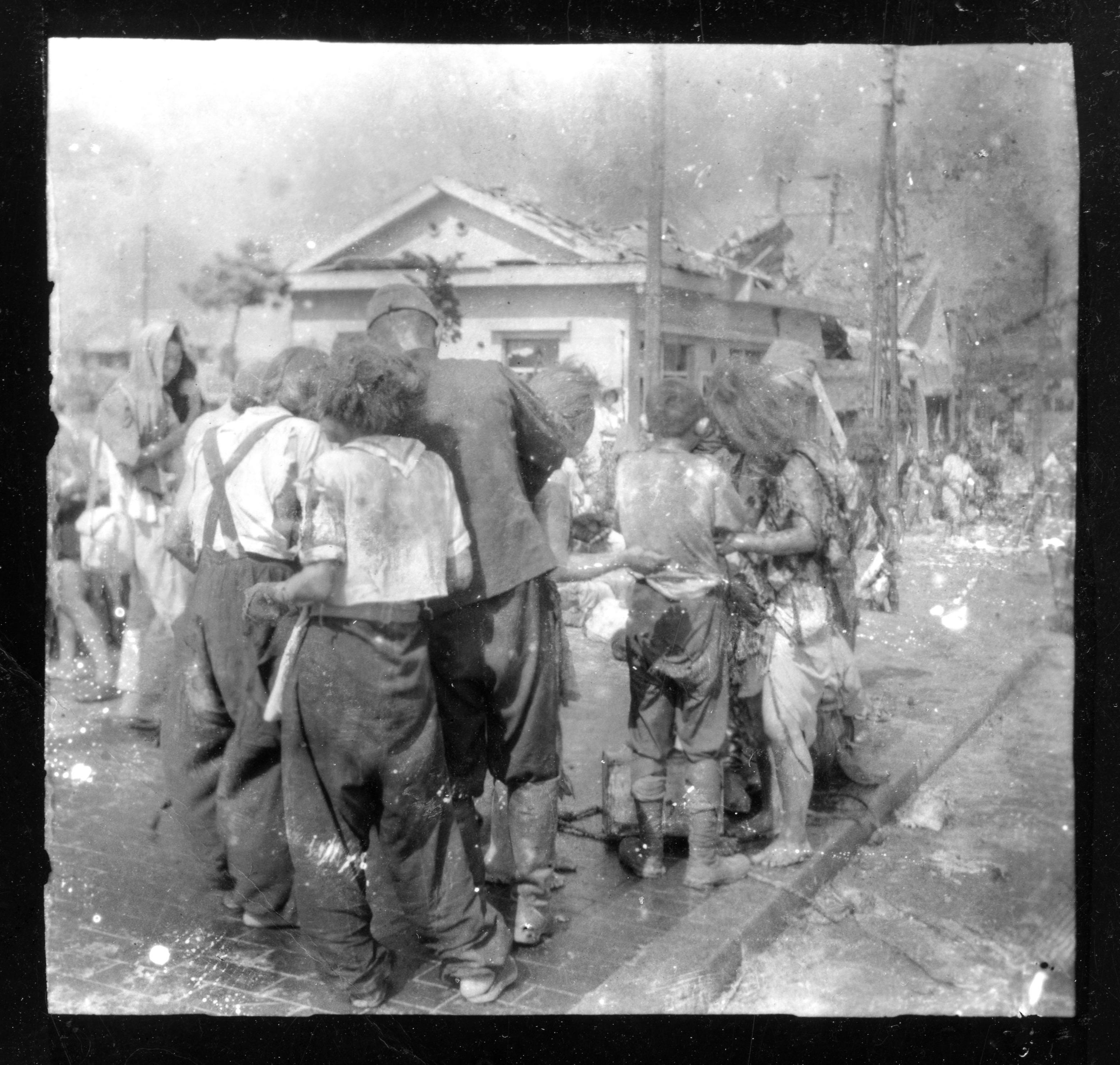
Matsushige later recalled that he hesitated before taking the photos:
Injured people were everywhere. Both sidewalks of the bridge were crowded with dead and suffering victims. When I saw them I realized I had to take a picture, and I tried to push the shutter, but I couldn’t. It was so terrible. These people were pathetic. I had to wait. Most of the people were students, children. […] I found it difficult to push the shutter. I was standing on the Miyuki-bashi Bridge for about twenty minutes before I could do it. Finally I thought, I am a professional cameraman so I have to take pictures. Then I managed to push the shutter.
Matsushige also recalled elsewhere that: “I felt that everyone was looking at me and thinking angrily, ‘He’s taking our picture and will bring us no help at all.’”
After the second photograph at the bridge, found he could take no more:
My viewfinder was fogged because of my tears. I understand why you ask me why I did not take more pictures, but in reality it was very difficult. When I set my camera at somebody who was asking for help I could not really push the shutter.
After this, Matsushige attempted to visit his office at the newspaper, with little success. Bodies were everywhere. Passing Hiroshima University, he saw the swimming pool was filled with the boiled corpses of people who had attempted to take refuge there while the city burned. Outside of his office, he saw a streetcar full of people posed almost as if they were on their morning commutes, but all burned, reddish-black corpses.
I put one foot up on the street car and looked into it. I put my finger on the shutter for one or two minutes, but I could not push it. I refrained from taking the picture. It was too terrible to take a picture of. This was the only scene I was going to take a picture of but did not.
Matsushige returned to his house. He photographed the barber shop attached to it, which was in shambles, and then snapped a photograph from inside of a destroyed fire station across the street. They feature no injured people, only his wife (in the background of the barbershop) and a passing man through the window.
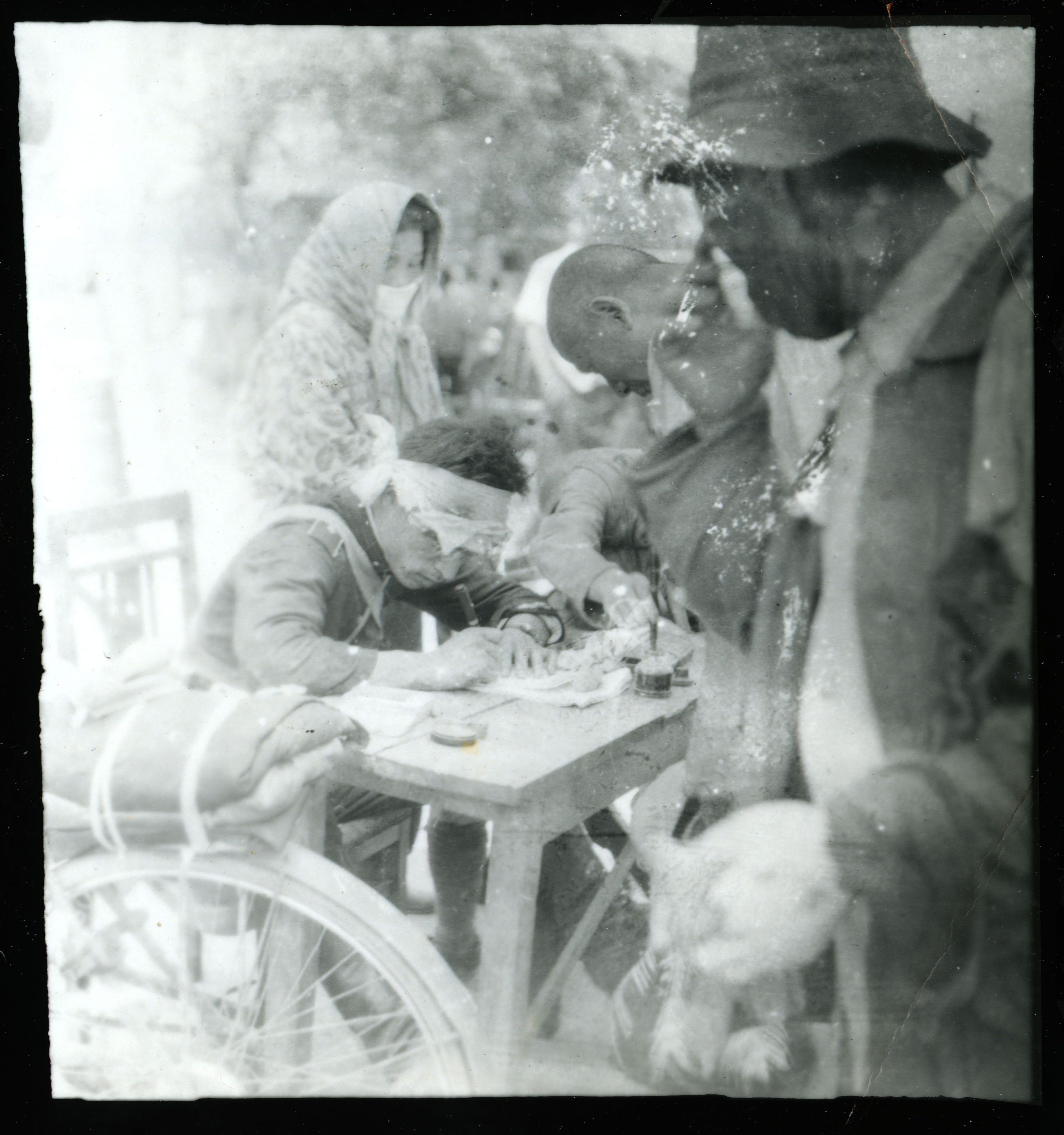
Hours later, Matsushige returned to the Miyuki bridge, and took one more photograph, this time of a bandaged soldier-policeman writing on a table. The man was writing certificates for people injured by the bombing, which would entitle them to some bread.
Matsushige says that he took a few more pictures that evening, but they did not come out, and so he threw the negatives away, not aware that his would be the only close-in documentation that day.
Matsushige’s photographs were confiscated by the US Occupation forces, who attempted to keep tight control on any Japanese discussions about the atomic bombings (part of a bid to avoid anti-American, pro-Communist sentiment). They were not published until after the Occupation ended in 1952. His photographs were first published by a magazine, Asahi Gurafu, in August 1952, in a sold-out and reprinted issue dedicated to damage photographs that ultimately had a circulation of 700,000.
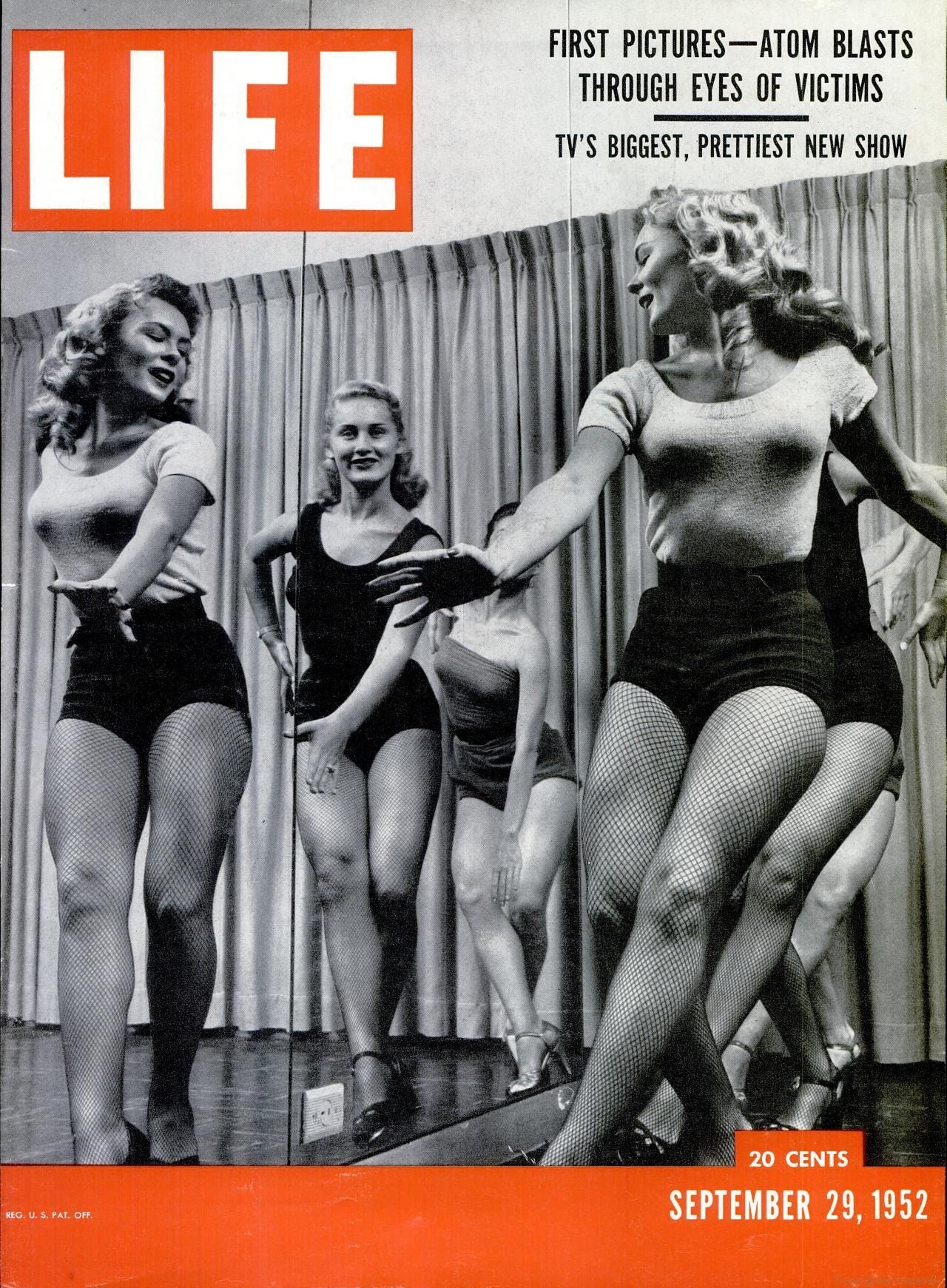
Two of Matsushige’s bridge photographs (the second and the third) were reproduced along with other post-attack photos of Hiroshima and Nagasaki in the September 29, 1952 issue of LIFE magazine, and referenced out on the cover as “FIRST PICTURES — ATOM BLASTS THROUGH EYES OF VICTIMS.” This was juxtaposed incongruously on the cover with “TV’S BIGGEST, PRETTIEST NEW SHOW,” and photographs of chorus girls auditioning for a Jackie Gleason production.
The article in LIFE was titled, “WHEN THE ATOM BOMB STRUCK — UNCENSORED,” blamed “jittery US military censors” for the fact that it had been over seven years before photographs of the bombings of Hiroshima (and Nagasaki) from “below” had been made available either inside or outside of Japan. It misleadingly claimed (based on a selective quotation) that the atomic bombs had given its victims a “quick death, with no suffering.” But it concluded by acknowledging that all of the Japanese speaking for the victims at Hiroshima and Nagasaki acknowledged that “the long suppressed photographs, terrible as they are, still fall far short of the depicting the horror which only those who lived under the blast can know.”
How can something on the scale of Hiroshima, as experienced by the victims, be captured? The photographic record is too meager to do the job, and even it represents a version of the event filtered through the experience of the photographer, who was himself a victim, “an ordinary person” (as he put it), and who found himself faced with his own decisions to make about what images he could, and could not, attempt to capture. But Matsushige’s photographs do give our imaginations a bit of additional material with which to understand the bombing, however incomplete.
For more on Matsushige and all five of his photographs on the day of the bombing (along with several he took in the later weeks), see Atomic Photographers’ page “Yoshito Matsushige.” For biographical information, see the Atomic Heritage Foundation’s profile on Matsushige. And see also David Wargowski’s excellent “Atomic testament: Yoshito Matsushige and the first photos of Hiroshima’s nuclear toll,” Bulletin of the Atomic Scientists (August 6, 1945).
All of the block-quotes from Matsushige are from an interview with Yoshito Matsushige (translated by Mieko Yamashita) included in Robert Del Tredici, At Work in the Fields of the Bomb (Harper & Row, 1987), 187-189.
Good post, thank you.
Hello Alex, This is awesome (in the original sense of inspiring awe (and/or horror)) - Mitsushige's accounts and photos are sobering and shocking.
Not sure if this is the right place to suggest a minor correction, and apologies if it isn't since this is an amazing piece. The footnote to Wargowski's article has the date as 1945 (i.e. the actual date of the event(s), so I think it should be 2025 (the article date)? It is also an amazing article, and like this Doomsday Machines piece does justice to the (uncensored) moment in time and Mitsushige's photographs.