
"It is obvious that the immediate destruction of the complete list of 66 cities would have an even more devastating effect on Russia"
The earliest postwar American planning for waging a full-scale nuclear war from 1945

Before the dust of World War II had really settled, analysts in the United States military were taking seriously what World War III might look like. From late August through mid-September 1945, the US Army Air Forces undertook a detailed study about what would be necessary if the United States were to have a serious nuclear strike capability.1
The “problem” tackled by the Top Secret–Limited study on “Atomic Bomb Production” was simple: “To determine the United States requirements for atomic bomb stocks in the interim post-war era.” The phrase “interim post-war era” is an interesting one — what, at that moment, are they in between?2
The study makes four assumptions for tackling the “problem”:
a. The United States must be prepared to conduct offensive operations against any other world power or combination of powers.
b. The United States will maintain sufficient bases and air forces capable of attacking the strategic heart of any potential enemy.
c. The immediate destruction of the enemy’s will and capacity to resist is the primary objective of the United States Army Strategic Air Forces.
d. Extensive research regarding the strategic vulnerability of all major powers will be conducted later and will permit a more complete analysis of bomb requirements.
These are both bland and interesting at the same time. Should it really be US policy, in the waning days of World War II, to assume that it needs to be able to wage war against “any other world power or combination of powers”? That is quite a requirement — to take on the entire world. The issue of bases is similarly grand in ambitions: at this time, the US does not really have “intercontinental” capabilities, so having sufficient bases to strike “any potential enemy” is quite a lot. And the goal of “the immediate destruction of the enemy’s will and capacity to resist” is also a serious assumption, particularly with the requirement of immediacy (US strategic capabilities in World War II were not “immediate” and took years to develop and deploy).
All of which is to say that this document, so far, makes perfect sense from the context of the strategic bombing of World War II, and perfect sense from the context of a later Cold War, but is actually quite audacious in its assumptions from the perspective of the immediate end of World War II and the beginning of the postwar period. It reflects no sensibility about war being over, or that the goal of US policy should be to prevent future world wars.
It then launches into its analysis of how the atomic bomb, which it acknowledges is not “just another bomb,” would be used in such a war in the future:
It is assumed that the United States may be required to conduct military operations against any other nation or combination of nations in the world, and that, finding herself at war with these powers, the United States would be desirous of immediately crippling the ability of the enemy to wage war. It is to be noted that the requirements established in this paper contemplate an M-Day force capable of being employed immediately upon initiation of hostilities and the estimated quantities of bombs required must be available at that time. There has been no attempt to estimate the quantity of atomic bombs which would be required to conduct a prolonged war of attrition. Therefore, the assumption was made that the initial mission of the air force units allocated for preparation, transportation, and delivery of these atomic bombs should be the immediate destruction of the enemy centers of industry, transportation, and population.
Again, this is certainly not the only way one could imagine that atomic bombs would be used in a future war, although it is unsurprising that the strategic bombing analysts would approach it in this way. This “M-Day” force would be tasked with an immediate destruction of a hypothetical enemy, a nearly overnight thing.
And who is the hypothetical enemy? The study claims agnosticism about what the future might be, but, for the sake of argument, settles into the obvious one:
During the period 1945 to 1955 it is probable that at the beginning of any war, bombs will still be delivered by the conventional airplane. It is also obvious that during this period Russia and the United States will be the outstanding military powers. For the purpose of this study the destruction of the Russian capability to wage war has therefore been used as a basis upon which to predicate the United States atomic bomb requirements. It is to be noted also from a geographical aspect alone, Russia is in the most favorable strategic position of any major power.
Perhaps I am cynical, but this feels like a bit of a fig leaf — “we’re only looking at Russia (the USSR) because it’s going to be very powerful and we have to pick someone.” One somewhat just wishes they came out with it: “we are assuming that in a future war, the Soviet Union would be the possible aggressor, and certainly the one worth planning for.”
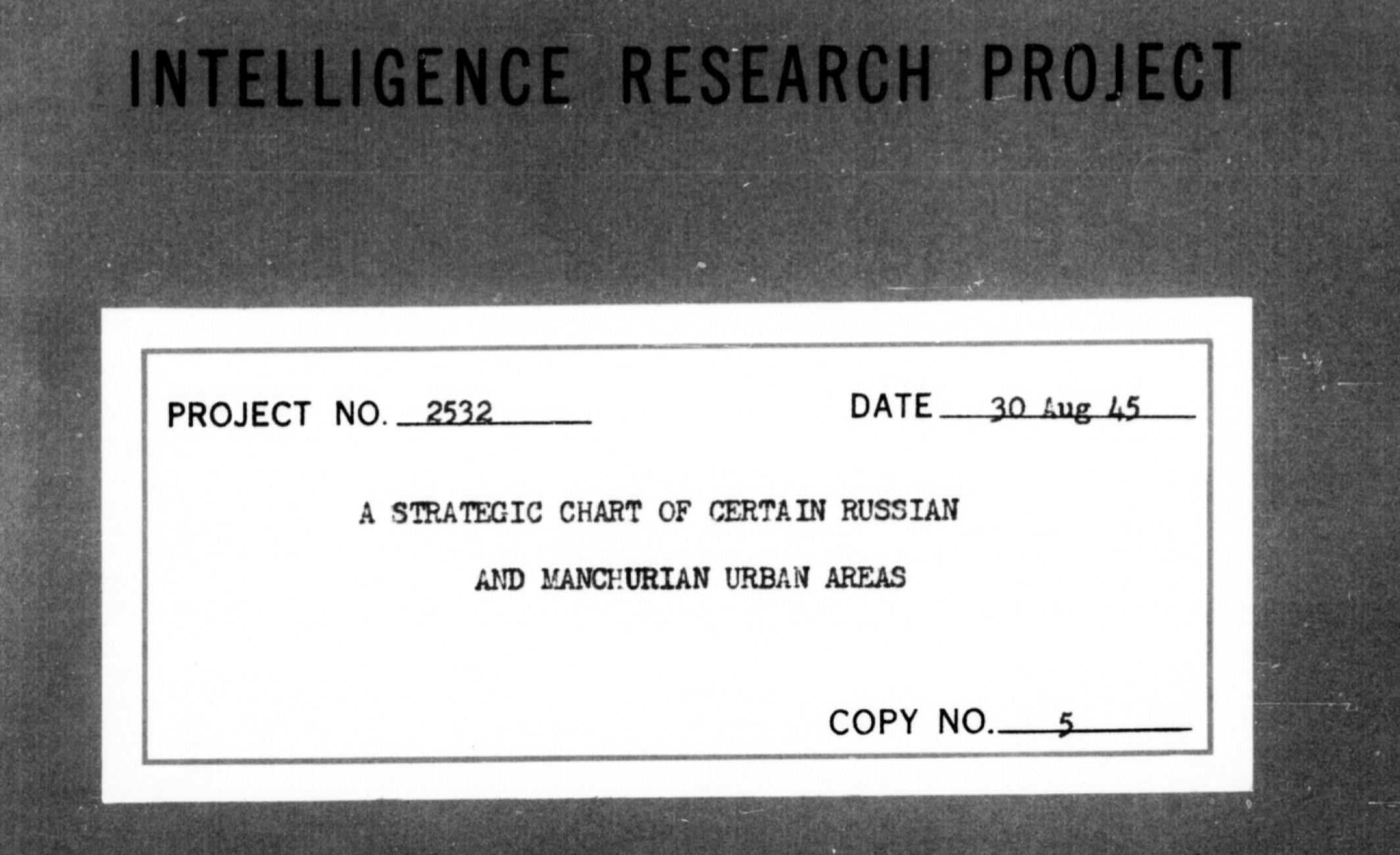
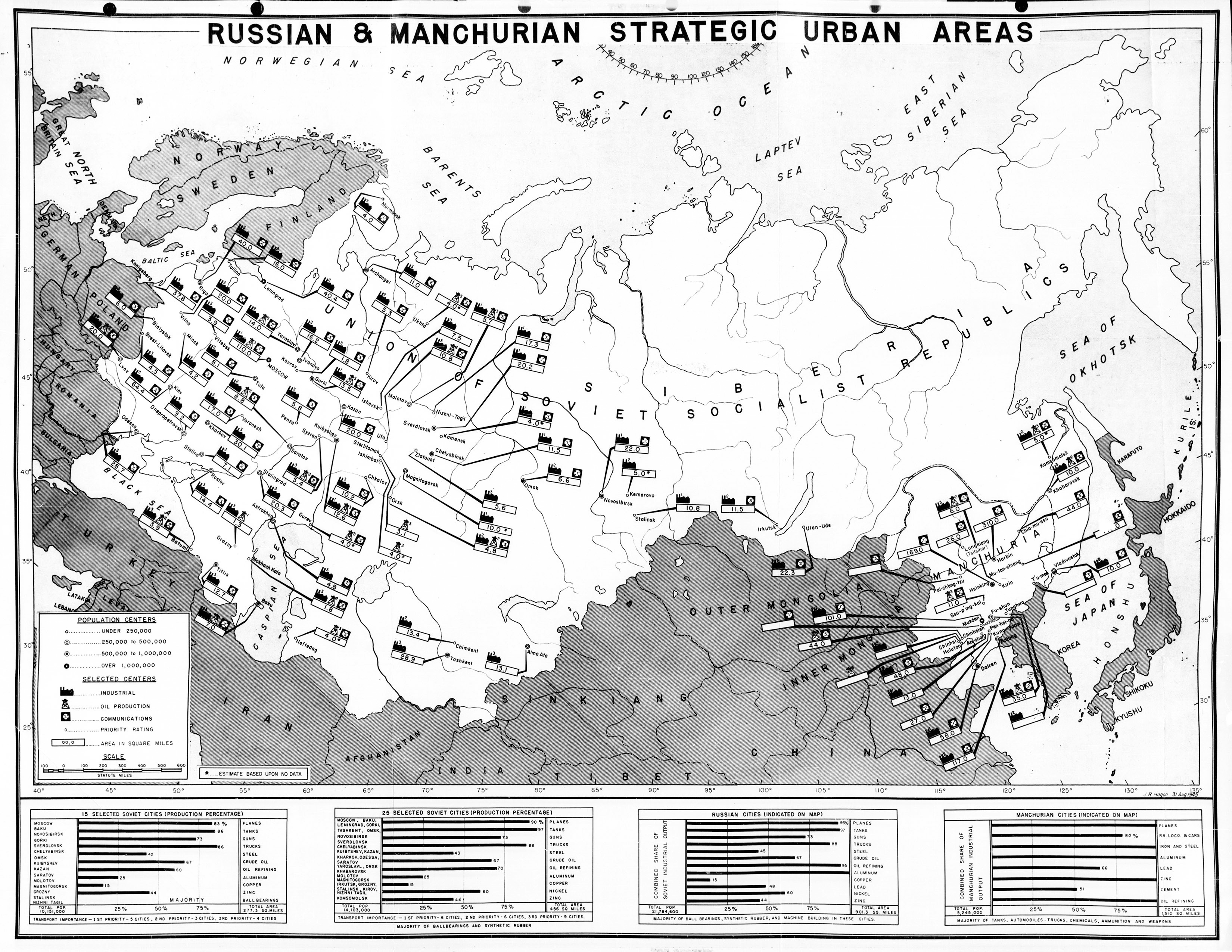
To tackle the issue, the stockpile estimate relies on the data of Intelligence Research Project No. 2532, “A Strategic Chart of Certain Russian and Manchurian Urban Areas,” dated August 30, 1945. This was produced by analysts in the Air Plans Section of Operations Division of the War Department, and consisted of tables of major cities in the Soviet Union and Soviet-controlled Manchuria. Each of these cities were listed by population, approximate area, and their “strategic importance” as measured by their industry, oil, and transportation infrastructure. A fantastic map of the target areas was produced:3
This intelligence study did not restrict itself purely to targets, though. What good is a target if you cannot reach it?
The atomic bombs of World War II were delivered by then state-of-the-art B-29 aircraft, but the range of the B-29 was still quite limited relative to the expanse of the Soviet Union and its distance from the United States. Indeed, the report contains a graphic showing what those limitations were, if one were assuming the continental United States as the launchpad:
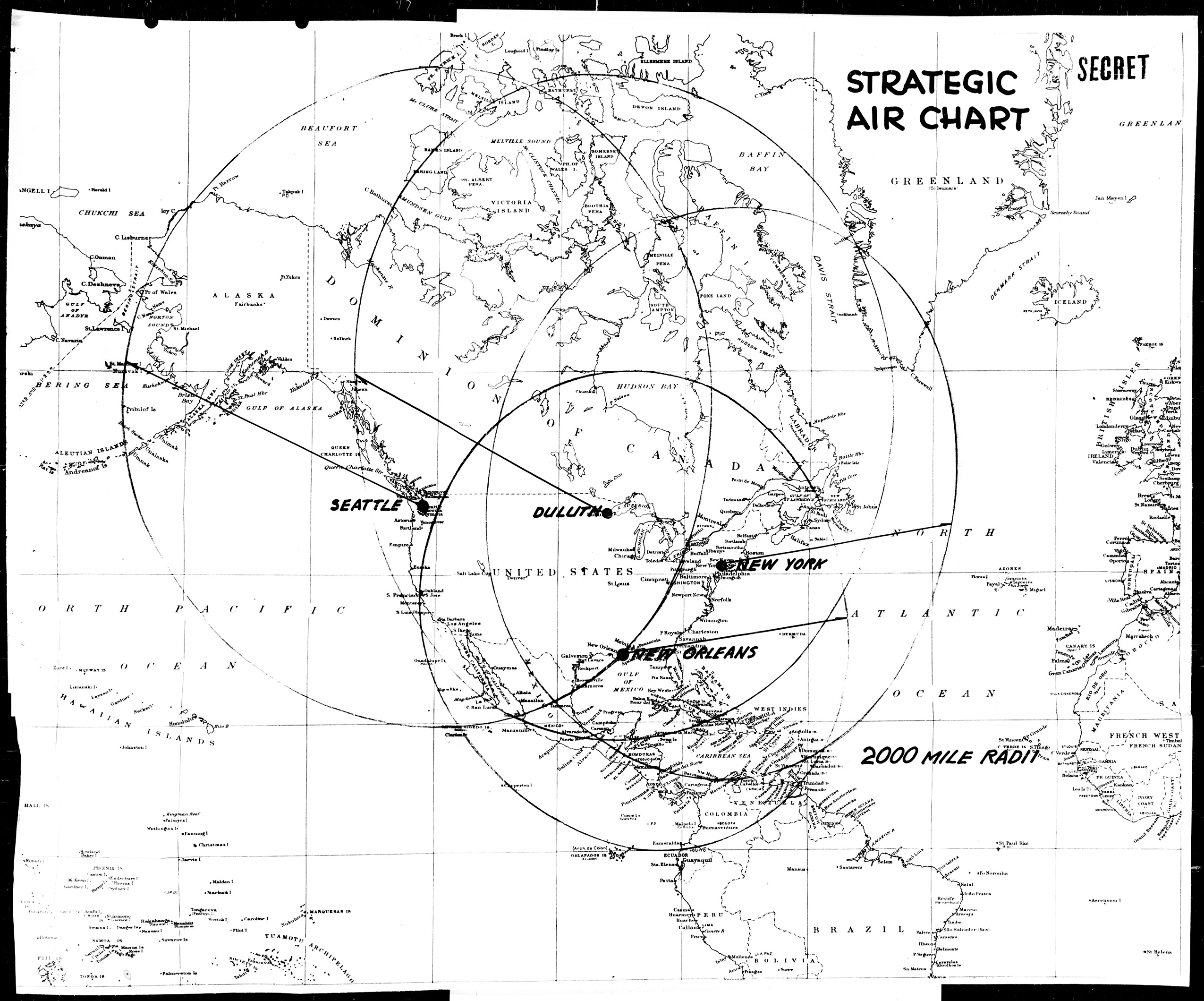

The same oceans that provided the United States with a great sense of security from foreign attack, in this case, worked against it: the range between the United States and the Soviet Union was just very far.
There are answers to this problem, of course. One is to create the means for longer-range delivery of bombs. Another is to station bombers closer to the potential target. The analysts embraced both ideas: the next generation of bomb, the B-36, was planned to have much greater range than the B-29, and certainly in the meantime you could put B-29s much closer to Soviet soil. This, again, they illustrated with a map:
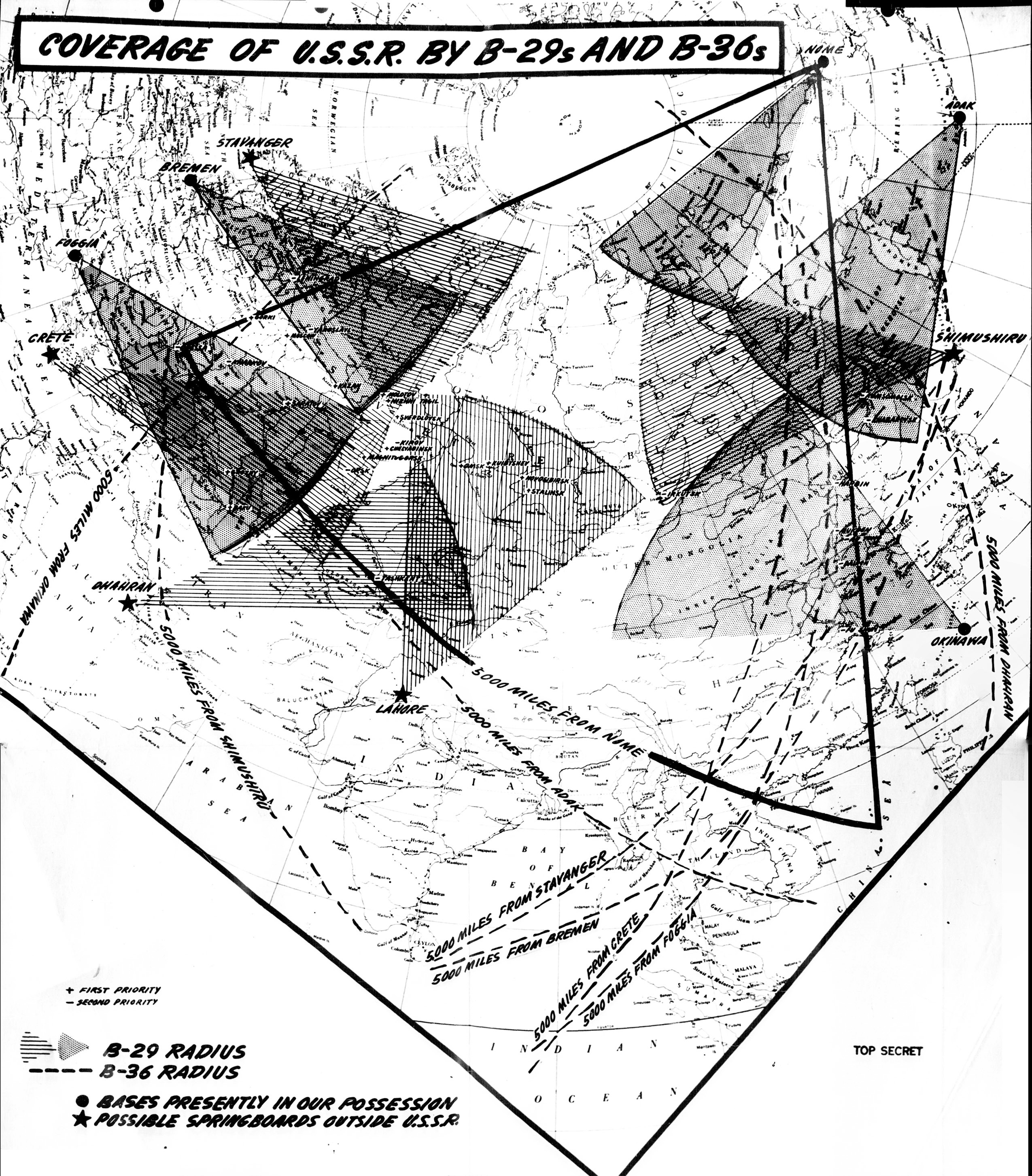
Of note is that this plan requires continual American access to bases in a number of countries, as well as expanding coverage to other possible bases that the US did not have a current hold in.
This is a bombers’ view of the problem; the planners were aware that there were “unlimited possible applications of the fundamental atomic energy in conjunction with future developments of rockets and guided missiles, both in their propulsion and in their explosive characteristics,” and limited themselves only to the next ten years as a way of reducing the analysis to something feasible.
So they had targets, and they had the means of hitting them (hypothetically). To figure out how many bombs they needed, they would need to make some assumptions about the damage-potential of the weapons, as well as the reliability and accuracy of the weapons. They had very little data on either of these fronts.
For the damage-potential, they had a preliminary survey by the Joint Target Survey, dated September 1, 1945, of the specific damage done at Hiroshima and Nagasaki, baed entirely on aerial photographs of city. (Only after the formal Japanese surrender, the next day, would US troops and scientists be allowed to actually visit the cities and conduct a more thorough survey.) They concluded that within about 6,000 feet (1.3 mi / 1.8 km) of ground zero, the number of buildings damaged was 100%. As you moved outward from ground zero, the percentage dropped off, until around 18,000 feet (3.4 mi / 5.5 km), at which it became negligible.
Based on this, and other analysis of the Japanese attacks, they came up with an estimate of how many bombs they would need to do devastating damage to each city in the Soviet Union and Manchuria, assuming the weapons available were the same as the ones used against Japan. They ended up with a table of “Estimated Bomb Requirements for Destruction of Russian Strategic Areas” for 66 Soviet cities, over 900 square miles of which to destroy, requiring 204 atomic bombs.
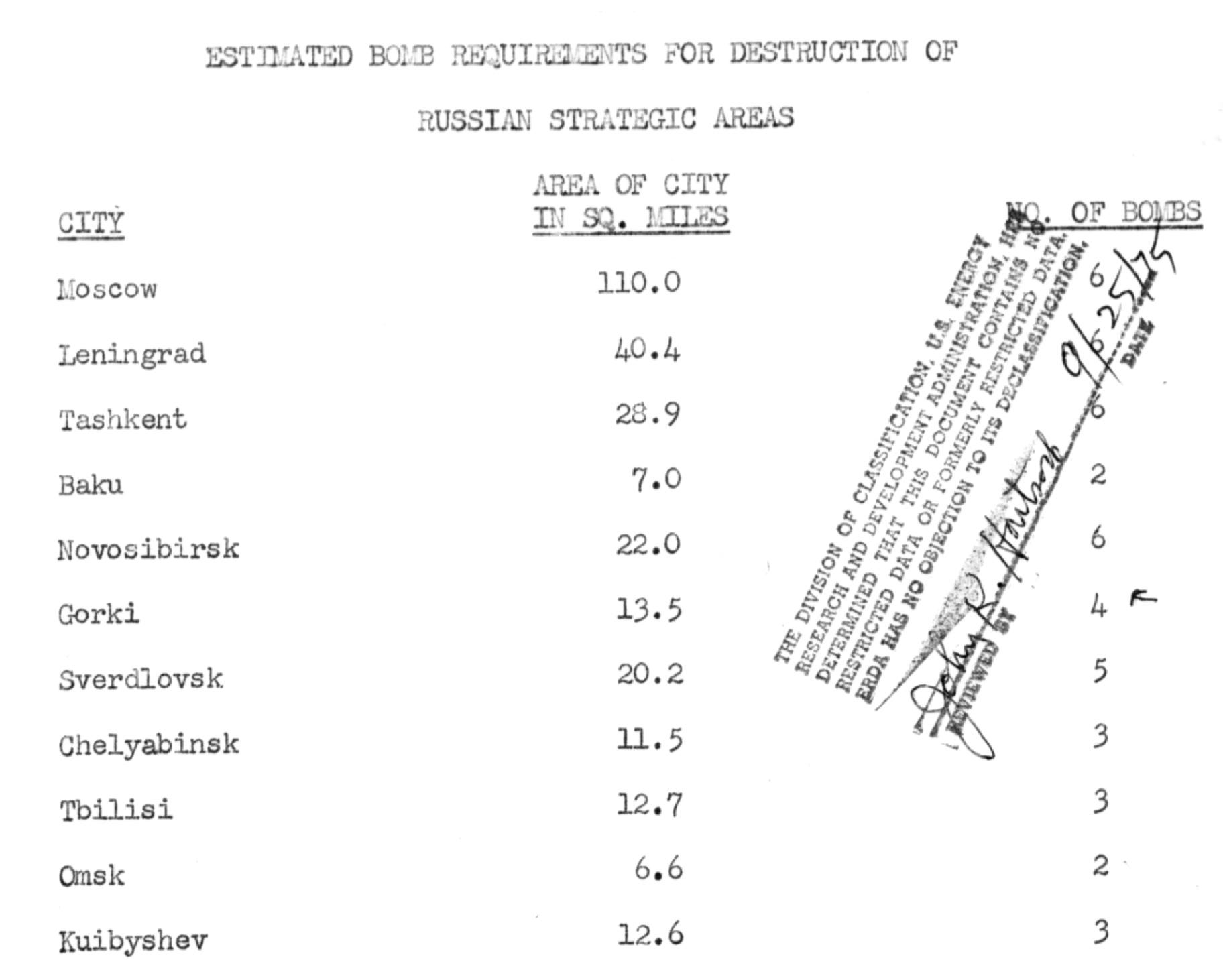
The biggest cities — Moscow, Leningrad (St. Petersburg), Tashkent, Novosibirsk, Kiev (Kyiv), Kharkov (Kharkiv), Riga, Kaliningrad, Odessa, and Ulan-Ude — required 6 atomic bombs. Seven more cities required 5 bombs, and another seven required 4 bombs. Twelve required 3 bombs, and fifteen required 2. The final fifteen took just 1 atomic bomb to destroy. None of the Manchurian cities were assigned bomb counts; the report reasoned that they weren’t as important as the Soviet ones. The number of bombs assigned appears to have been largely a function of size, although there seems to be some variance or judgment there.4
Even just attacking the top 15 priority cities would put the Soviet Union into a terrible position, as they contained “the bulk of all major industries” in the country. “It is obvious that the immediate destruction of the complete list of 66 cities would have an even more devastating effect on Russia,” the report notes. “Therefore, an optimum requirement for atomic bomb stocks would be the number necessary to obliterate all of these cities.”
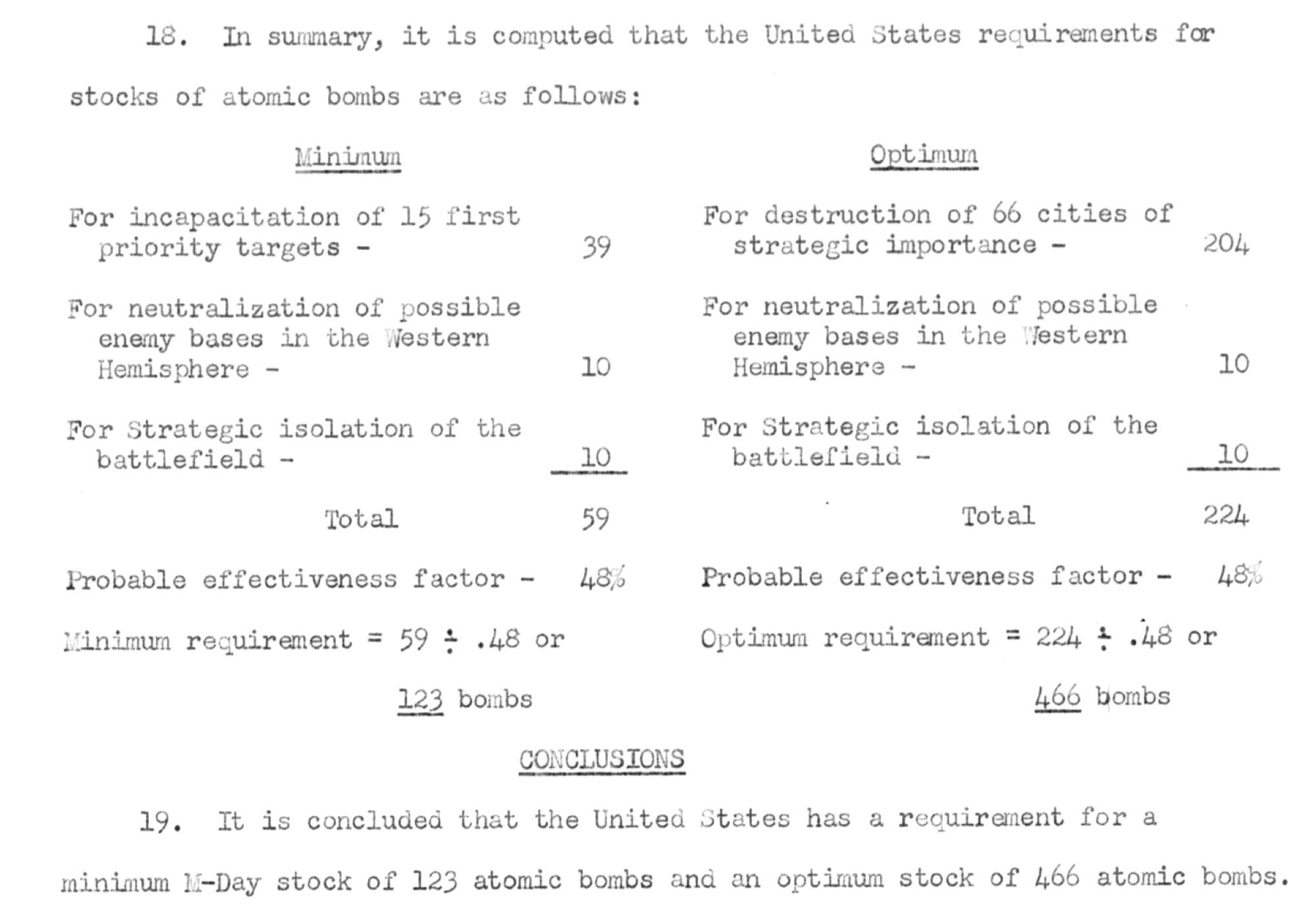
From this kind of reasoning, the report then moves on to set some idealized numbers. To destroy the first 15 high priority targets would require (by their logic) 39 atomic bombs. Add 10 more for “neutralization of possible enemy bases in the Western Hemisphere,” another 10 for “strategic isolation of the battlefield” (tactical use) and you end up with 59 desired bombs. But, they reasoned, the weapons will not be all accurately delivered. They assume that through enemy action and inaccuracy, only 48% of the bombs launched might reach their targets. So you divide 59 by 48% and end up with a minimum need for 123 atomic bombs in the American stockpile.
If you do the same math, but assume the full 66 city list, with its requirement for 204 bombs, plus the 20 “other” bombs and the 48% effectiveness factor, then the optimum number of weapons would be 466 atomic bombs.
466 atomic bombs is a small number by the later standards of the Cold War, when thousands of bombs were produced per year. It is an absolutely massive number for 1945, however, when the maximum output of the Manhattan Project infrastructure was planned around the idea of a few bombs per month. As it turned out, the US stockpile grew very slowly in the first years after World War II, for a variety of reasons, and the US did not reach these kinds of numbers until 1949 or so. Interestingly, the US likely had enough fissile material for the “minimum” requirement by around early 1947, but its weapons assembly system was so anemic that it had essentially zero bombs “ready to go” at that time, and the parts for maybe a dozen weapons.
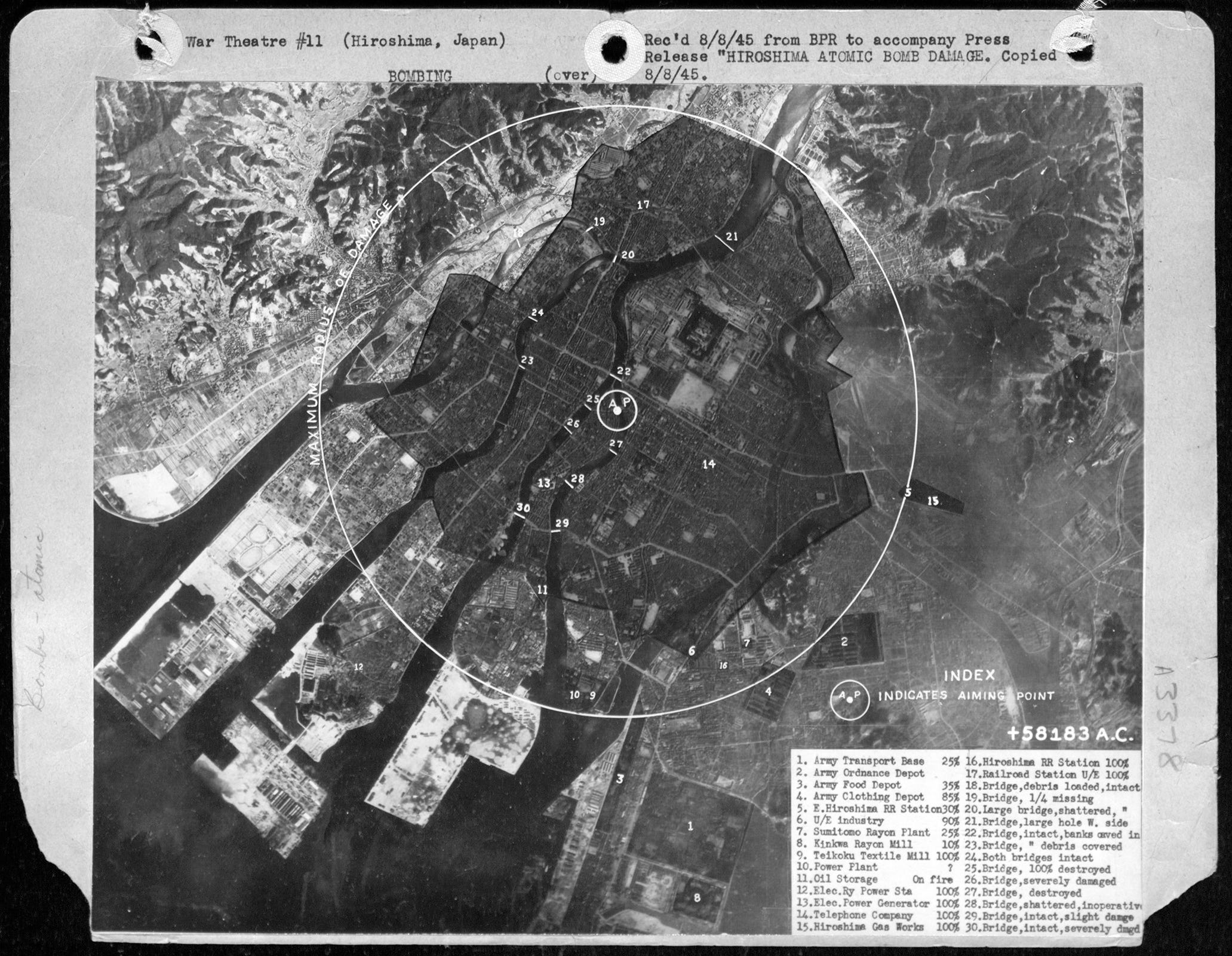
A copy of the overall report and recommendation was sent to General Leslie Groves, head of the Manhattan Project. He viewed it with not a small amount of professional offense — he felt the requirements were unrealistically high because the analysts had underestimated the power of the atomic bombs (he felt they were twice as effective as the report claimed) and overestimated how much destruction was actually required. “It is not essential to get total destruction of a city in order to destroy its effectiveness,” he wrote back. “Hiroshima no longer exists as a city even though the area of total destruction is considerably less than total.”
This wasn’t really a “war plan,” although it was a plan made in preparation for a war. The purpose of the document was to think through the questions that might come up for a future atomic war, without getting into the real details of it, and with very little knowledge about the weapons themselves. It would not be for several years until more realistic “war plans” were developed, and even these started more as “studies” than “plans”: exercises in thought that could guide policy decisions, not actual operations that could be put into practice, because they didn’t have the bombs, the bombers, or the bases yet. These are still works of fiction and fantasy, however rooted in analysis they attempt to be, and there is some difference between such fictional scenarios and, say, the reality of a ready-to-go war plan that could actually be executed.
Still, it seems telling that one of the first things the American strategic bombing staff did once their war with Japan was over was contemplate how best to kill an entire country with their new weapon. They make no attempt to estimate casualties, of course. Let us imagine that their population statistics were correct, and that their attacks were calibrated to kill an approximate equal percentage of those cities as the Hiroshima bomb did for Hiroshima. The “minimum” (15 city) list was estimated to contain 10.1 million people, and the “maximum” (66 city) list was estimated to contain 21.8 million people. At Hiroshima, around 28% of the city was killed within the first few weeks. Apply that number above, and we end up with a range between 2.8 million (minimum) and 6.1 million (maximum) dead.
By the standards of the later Cold War, where estimates in the hundreds of “megadeaths” were routine as a consequence of thermonuclear assaults and fallout plumes, 3-6 million doesn’t sound like that much. But it is sobering, and perhaps depressing — whatever one thinks of its necessity or appropriateness — to consider that the fires from World War II had hardly been extinguished before at least one of the armies of its victors, deep within the labyrinth of official secrecy, was contemplating another Holocaust’s worth of civilian dead.
The long-time reader will perhaps remember that I wrote about this work on Restricted Data some 14 years ago: “Targeting the USSR in August 1945” (27 April 2012) and “The First Atomic Stockpile Requirements” (9 May 2012). I figured that given the amount of time that has passed, and because I have new scans of the underlying report and images (courtesy of the National Archives), and because I am doing some different analysis/number crunching here, I can be forgiven to returning to something I have already once written about. This note is just to cop to the fact, and to alleviate any sense of déjà vu that you may or may not be feeling.
Lauris Norstad to Leslie R. Groves, “Atomic Bomb Production” (15 September 1945), Correspondence (“Top Secret”) of the Manhattan Engineer District, 1942-1946, microfilm publication M1109 (Washington, D.C.: National Archives and Records Administration, 1980), Roll 1, Target 4, Folder 3, “Stockpile, Storage, and Military Characteristics” (National Archives Identifier: 493470330).
For each of these maps, I have used the TIF files available at the National Archives link above, and used Photoshop to stitch the multiple images together. There may be some errors as a result of the stitching.
I have tried to transcribe the entire list of both Soviet and Manchurian targets, along with the other data included in the lists, and their modern-day names and locations. You can download my results here as a CSV file. No guarantees made. I ran out of will with some of the Manchurian cities, as they are transliterated extremely dubiously and finding the modern equivalent was more frustrating than I imagined it being worth to anybody.
I might be misreading the whole thing, but perhaps "the interim post-war era" means one of two periods:
(1) After the United States acquired a nuclear weapons stockpile large enough to fulfill these objectives, but before the Soviet Union acquired the capability to retaliate in anything approaching a proportional manner.
(2) After the US acquired such a stockpile, but before the development of new technologies (such as the H-bomb, ICBM and SLBM) that would inevitably call for new planning of a different sort.
The answer might actually depend on which of these reassessment-inducing situations (they thought) would happen first. Did they assume the USSR would get a second-strike capability before the US got new weapons and delivery means? The other way around? Did they think it was an open question?
I always found it weird that they included Manchuria in the Soviet sphere of economic influence but not the Soviet-occupied areas in East-Central Europe. One would think that, in World War III as in World War II, the US would be more focused on the European-Middle Eastern region than on the Asian-Pacific one - Europe First, Round Two. In which case Łódź or Ploiești would (in a few years) make for more relevant targets than Dairen or Fushun. And if Manchuria is included, why not include the Soviet occupation zone in northern Korea as well? It had been heavily industrialized under the Japanese and was actually adjacent to US forces (in southern Korea).
At the risk of sounding flippant, it feels as if one of the people involved in the study had learned a lot about Manchurian industry and wanted to show off (or feel relevant).
Anyway, the USSR would soon dismantle a lot of that industrial machinery and transfer it across the Sino-Soviet border as spoils of war, much to the annoyance of the Chinese. Does that qualify as irony?