

While working on my post about the clergy and Civil Defense, I stumbled across a collection of scanned issues of The Georgia Alert, a publication of the Civil Defense Division of the State of Georgia, USA, from the 1950s, hosted by the Digital Library of Georgia.
At first I was just amused by it, because it seemed to embody the paradox of American Civil Defense during the early Cold War: lots of rhetoric about how important it was that was absolutely detracted from by the relatively modest effort being made. The main headline from their first issue, in November 1951, is just… humorous: PAPER CUPS STOCKED FOR EMERGENCY USE.
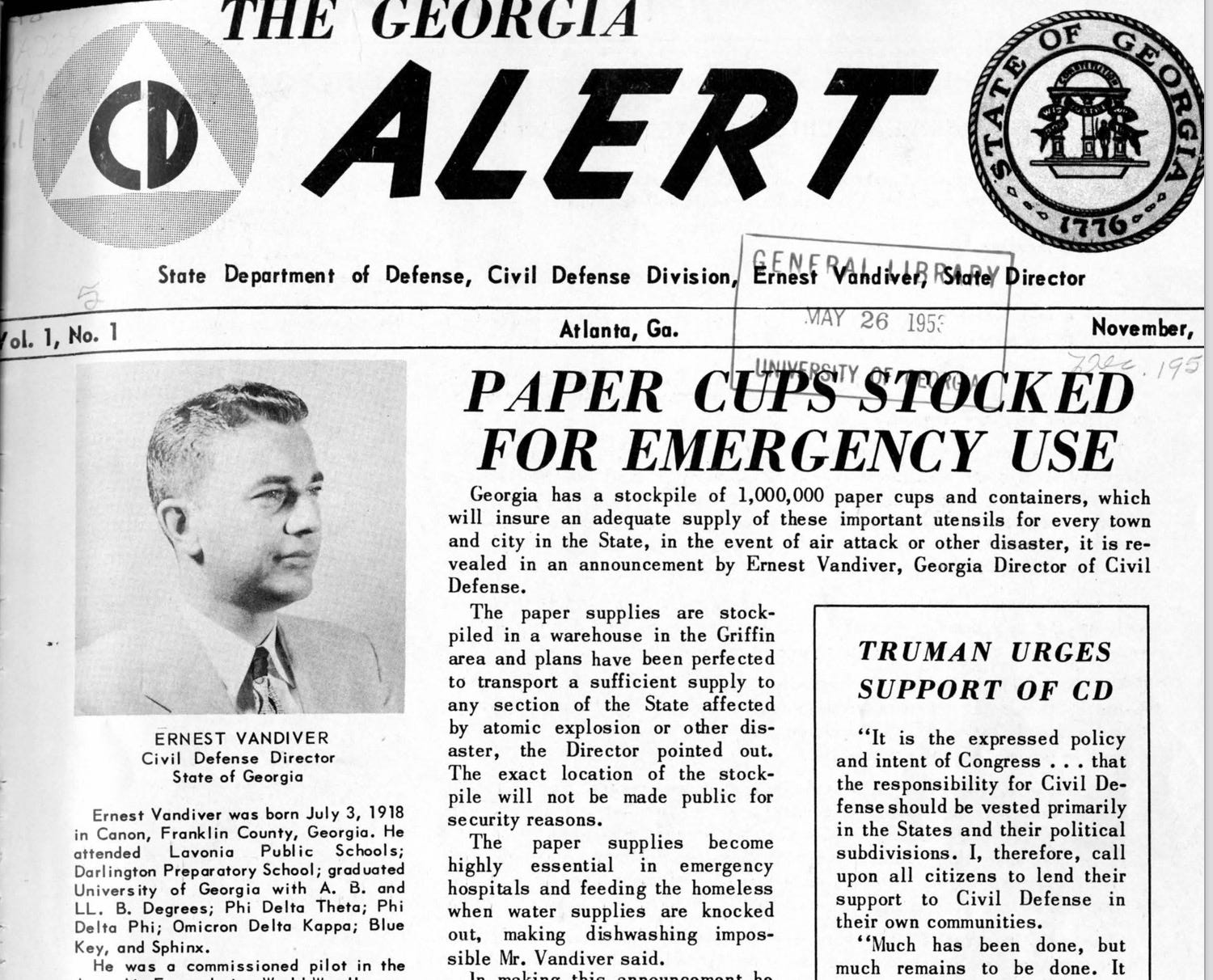
Georgia has a stockpile of 1,000,000 paper cups and containers, which will insure an adequate supply of these important utensils for every town and city in the State, in the event of air attack or other disaster, it is revealed in an announcement by Ernest Vandiver, Georgia Director of Civil Defense.
The paper supplies are stockpiled in a warehouse in the Griffin area and plans have been perfected to transport a sufficient supply to any section of the State affected by atomic explosion or other disaster, the Director pointed out. The exact location of the stockpile will not be made public for security reasons.
The paper supplies become highly essential in emergency hospitals and feeding the homeless when water supplies are knocked out, making dishwashing impossible, Mr. Vandiver said.
That this is the lead story of their premiere issue — paper cups, wow! — is funny enough. Yes, paper cups do seem like they would be useful in an emergency. And taking mundane problems like “how do we distribute water to people in a way efficiently and in a way that won’t spread disease?” is exactly what all emergency preparation efforts have to consider if they are serious at all, because disaster relief is really nothing but a series of mundane challenges. And perhaps the temptation to steal or otherwise use 1,000,000 paper cups would be enough to warrant their being kept at a secret location.
But the idea that paper cups are going to be the key to surviving a nuclear war is, well, inherently amusing. Pretty much any single response to an atomic explosion is going to look amusingly inadequate by comparison. Much less focusing on paper cups, of all things.
And it wasn’t just that they used it for the feature story — they kept going on about the paper cups in the interior pages, with a photo of the State Director of Civil Defense posting in front of boxes of the paper cups, labeled FOR DISASTER USE ONLY, demonstrating a “portable hot and cold drink dispenser” with a secretary:
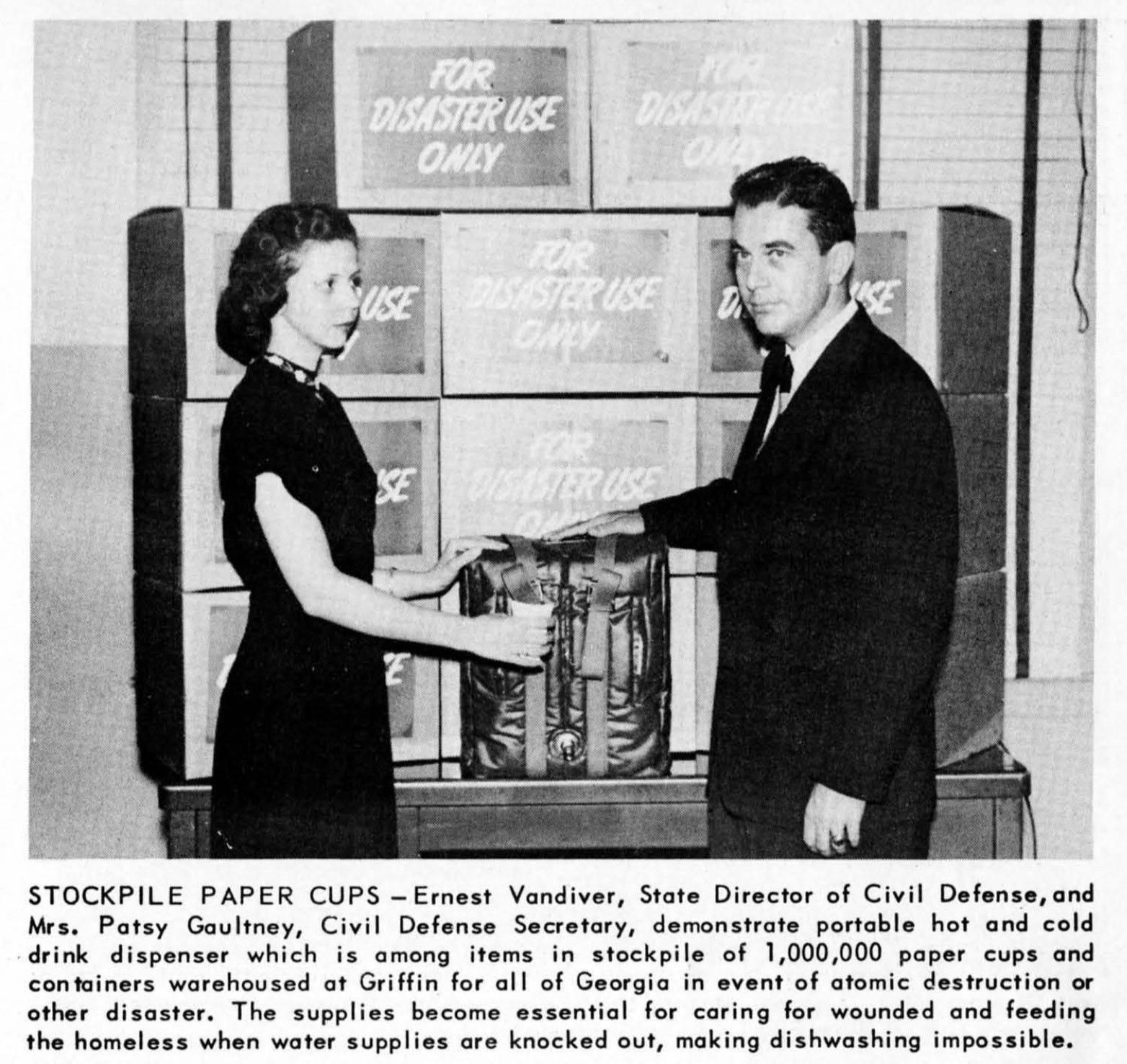
Again, I’m not saying these things are wrong… they just seem so woefully inadequate to the task at hand. And this is what they are choosing to publicize?
But it was really this photograph from the same issue, of the Civil Defense office’s staff, that suddenly put all of this in a different light for me:
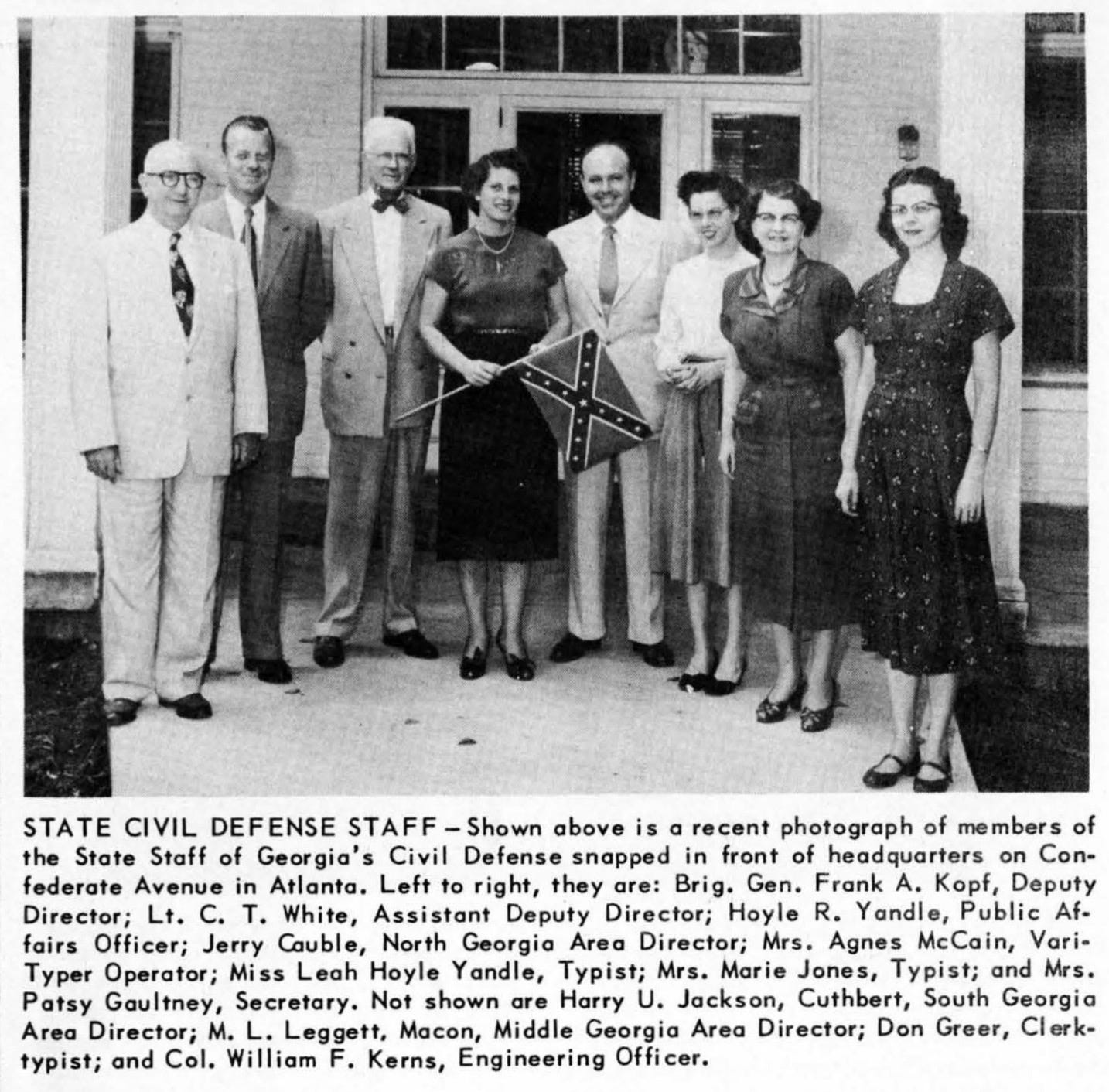
Oh, right. Georgia. That Georgia. The American South. The Deep South. Georgia, where the Civil Defense headquarters are located on Confederate Avenue (which was renamed United Avenue in… 2019). Georgia, the state that in 1956 adopted the Confederate Battle Flag as part of its state flag as part of its self-proclaimed “massive resistance” to forced integration after Brown v. Board of Education (1954). Which means that the woman posing with the Confederate battle flag in the above photograph from 1951 is not posing with the Georgia state flag — it’s “just” the Confederate flag, a symbol of “Southern heritage” — the war flag of a successionist government that fought the bloodiest war in American history in order to preserve the state’s “right” to enslave human beings. Ah. Yes.
I skimmed over the issues from 1951 through 1955, and found zero photographs of any African Americans, and exactly one reference to their existence at all: in a list highlighting “women’s activities in CD in Georgia,” from March 1953, one woman is listed as having been asked by the Superintendent of Schools for Richmond County “to assist in setting up a plan for the protection of children in the schools, white and colored.”
Looking at the newsletters from 1955-1958 turns up a story about Girl Scouts distributing a Civil Defense pamphlet in 1958 which also says that “a Colored Cub Scout Troop helped make deliveries to the Negro sections.” A news round-up story about a flood in Savannah in 1956 mentioned that 75 “negro children” were rescued. And a photo caption from July 1956 describes a mock “air raid alert” in Toccoa, Georgia, that was held in “both city schools,” and then mentions that one of them was “the white school” — suggesting, even only by omission, that the other school was for the non-white population, and that they too participated in the alert exercise.
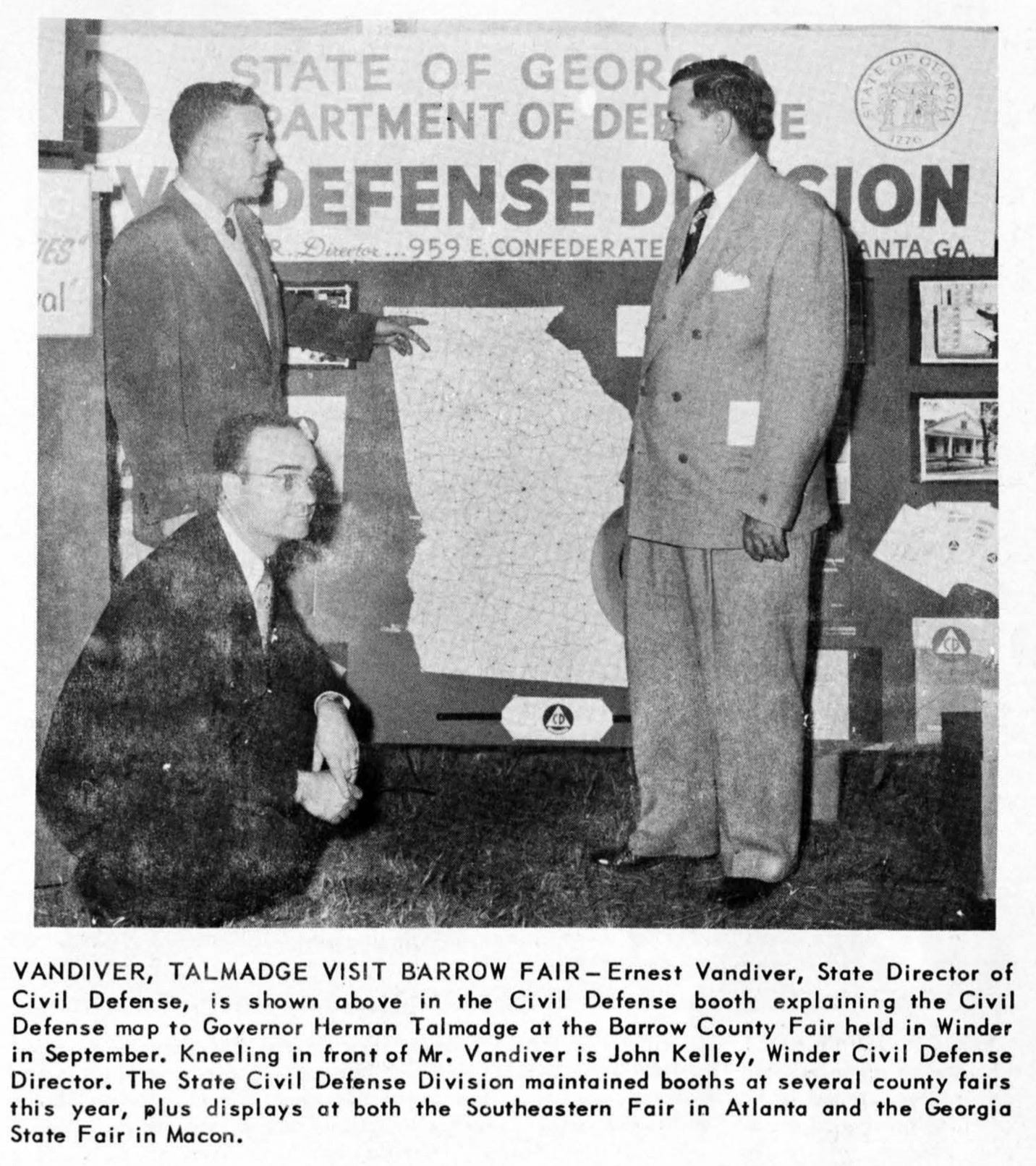
That the 30% or so African-Americans in Georgia are basically invisible in their Civil Defense publications from this time is hardly surprising. But it does stand out. It raises the question of how segregation was handled in Civil Defense planning. If one took these newsletters at face value, one would not be remiss in thinking that Civil Defense in Georgia was about preserving the white population exclusively. It puts the portable drink dispenser in a different light: in a state with segregated drinking fountains, were such supplies going to be made available to the entire Georgia public?
In a 2011 journal article about Civil Defense planning in Savannah, Georgia, by Jonathan Leib and Thomas Chapman suggests that this omission was characteristic of planning at the time.1 Looking at the 1955 “Hydrogen Bomb Evacuation Plan” for Savannah, that while there was no explicit discussion of Jim Crow segregation, a close reading of the plan suggests that the assumption was to maintain segregation even while trying to evacuate areas before or after an atomic attack. They conclude:
Facing the total destruction of Savannah and the surrounding region, it is both absurd and unremarkable that evacuation planners would be concerned enough to create an evacuation plan that sought to preserve Jim Crow racial segregation. It is absurd because a hydrogen bomb dropped on the city would likely result in a massive number of deaths that would not discriminate based upon one’s race. However, the tenets of the plan are also unremarkable in that it did not appear to have escaped the long fingers of the Jim Crow system of institutional segregation.
It is indeed “unremarkable,” in the sense that it is exactly what we would expect. But both the authors and I are, of course, remarking upon it, because it is a useful reminder that even in the face of existential risk, societies carry their “baggage” forward with them. For me, it also raises a question that I think about a lot in the context of the video game I am working on: if you were rebuilding society after a nuclear war, would you want to rebuild it to be the same society it was before the nuclear war? Or would you desire something radically different?
One would hope that the prospects of thermonuclear destruction would be enough to at least temporarily put aside base prejudices in the name of group survival. Would the survivors of such an attack be more open-minded and understanding than the people who were planning for it? One would hope… despite all evidence to the contrary.
Jonathan Leib and Thomas Chapman, “Jim Crow, Civil Defense, and the Hydrogen Bomb: Race, Evacuation Planning, and the Geopolitics of Fear in 1950s Savannah, Georgia,” Southern Geographer 51, no. 4 (Winter 2011), 578-595. I noted that a) they pinged on the same Georgia Alert photo that I did, and b) that they also concluded that the photos in the Georgia Alert did not include any African-Americans.
Also I'm interested in the video game you are working on
Around the same time there was this video that claimed a tidy yard and painted house helped against nuclear attack https://www.youtube.com/watch?v=-hh01SdN64Y