

Our present moment is one of promises and warnings — sometimes at the same time — about what artificial intelligence holds for our human future. The promises are about how a world of high productivity, high leisure, and incredible discovery is just around the corner. The warnings talk about disruption, joblessness, new threats from other states, and the fear that the creation of superintelligent machines will herald the end of man in one way or another. These ideas have been around for a long time, but the rise of large-language models and other kinds of highly-statistical “machine-learning” algorithms have made both extremes seem suddenly more plausible and urgent than they were just a decade ago.
“AI apocalypse” is a sub-genre of apocalypse, and is well-represented in late-20th century fiction. One version of it, probably the most common, which we could just call “Skynet” as a mnemonic reference to The Terminator (1984), involves a hostile AI that actively wages war against humanity. Another, which I suspect is actively feared less but is nonetheless known and resonant, could just be call “The Matrix,” after the film of the same name (1999), involves a hostile AI that enslaves humanity. These are only two of many, and they of course have sub-variations, like “WOPR,” from 1983’s WarGames (1983), where the AI unintentionally (almost) starts nuclear war.
These are all examples from the late-20th century, when digital computers had become ubiquitous in human society, when the idea of “digital minds” had become commonplace. But how far back to these ideas ago?
E.M. Forster’s short novella, “The Machine Stops,” is perhaps one of the earliest of this style of story, dating all the way back to 1909. It is an amazing thing to read at the present moment. Forster (1879-1970) is better known for other works on quite different subjects — like A Room with a View (1908), Howards End (1910), and A Passage to India (1924) — and “The Machine Stops” is one of his only works, I believe, that is concerned with the far future, or science fiction. But what a vision it is.
The novella is quite short, composed of just three chapters. They are all told more or less from the perspective of Vashanti, who is a “lecturer” living, like everyone she knows, in a “cell” inside a vast underground city which is managed by the Machine. Although Vashanti never leaves her room, she is connected through the Machine to thousands of friends and colleagues, part of innumerable conversations and discussions, and both attends and gives lectures on historical and artistic subjects regularly.
Her physical body is atrophied (“think of her as without teeth or hair… a swaddled lump of flesh… with a face as white as a fungus”), but her ever need is met by simply pushing a few buttons. If she needs anything, it comes to her, not the other way around. She cannot imagine any other way of life, at least without recoiling.
And of course she had studied the civilization that had immediately preceded her own — the civilization that had mistaken the functions of the system, and had used it for bringing people to things, instead of for bringing things to people. Those funny old days, when men went for change of air instead of changing the air in their rooms!
Everyone in the city lives the same fashion. Their rooms (the “cells”) are all assigned by the Machine, and all identical, and their physical location in the world is of no consequence, for what does physical location mean in an age where everyone is instantly connected to anyone and anything instantly? For in their age, they have conquered distance: “space in annihilated.”

She has but one physical book, The Book of the Machine, and it instructs what buttons to push to get any need met.
Then she generated the light, and the sight of her room, flooded with radiance and studded with electric buttons, revived her. There were buttons and switches everywhere – buttons to call for food for music, for clothing. There was the hot-bath button, by pressure of which a basin of (imitation) marble rose out of the floor, filled to the brim with a warm deodorized liquid. There was the cold-bath button. There was the button that produced literature. And there were of course the buttons by which she communicated with her friends. The room, though it contained nothing, was in touch with all that she cared for in the world. […]
By her side, on the little reading-desk, was a survival from the ages of litter – one book. This was the Book of the Machine. […] Sitting up in the bed, she took it reverently in her hands. She glanced round the glowing room as if some one might be watching her. Then, half ashamed, half joyful, she murmured “O Machine! O Machine!” and raised the volume to her lips. Thrice she kissed it, thrice inclined her head, thrice she felt the delirium of acquiescence.
Such is Vashanti’s life, until her son, Kuno, calls her on the videophone with an odd request: that she visit him in person. She cannot really understand the request. Surely a videophone connection is the same thing? She has not seen him in person since his infancy. He lives in an entirely different continent, hours away by airship. Surely she does not have time for this. But Kuno is insistent, even blasphemous:
“I want to see you not through the Machine,” said Kuno. “I want to speak to you not through the wearisome Machine. […] You talk as if a god had made the Machine. Men made it, do not forget that. Great men, but men. The Machine is much, but it is not everything. I see something like you in this plate, but I do not see you. I hear something like you through this telephone, but I do not hear you. That is why I want you to come. Pay me a visit, so that we can meet face to face, and talk about the hopes that are in my mind.”
Vashanti reluctantly agrees, and makes the arrangements (through the Machine) to take an airship to visit her son. This distresses her greatly, as she has not left her cell in years, and even though the transportation is as smooth as one would imagine it to be (because the Machine manages it), it involves disturbing things like being in the physical proximity of other people, exerting physical activity, and looking out the window, revealing horrors like dirt, mud, mountains, the sea, and stars. “I dislike seeing the horrible brown earth, and the sea, and the stars when it is dark,” Vashanti tells Kuno. “I get no ideas in an air-ship.”
The surface, we learn, is toxic. No one lives upon it. It is a relic of a past age, before the Machine. Vashanti suffers the trip as best she can, closing herself off to the outside world as much as possible.
She finally arrives to see Kuno, who tells her he is threatened with Homelessness — exile from the Machine — which of course means death. He explains to her that he had a radical idea, which was to explore the outside, outside of the confines of the Machine. She cannot believe it: “Don’t. Don’t talk of these terrible things. You make me miserable. You are throwing civilization away.”
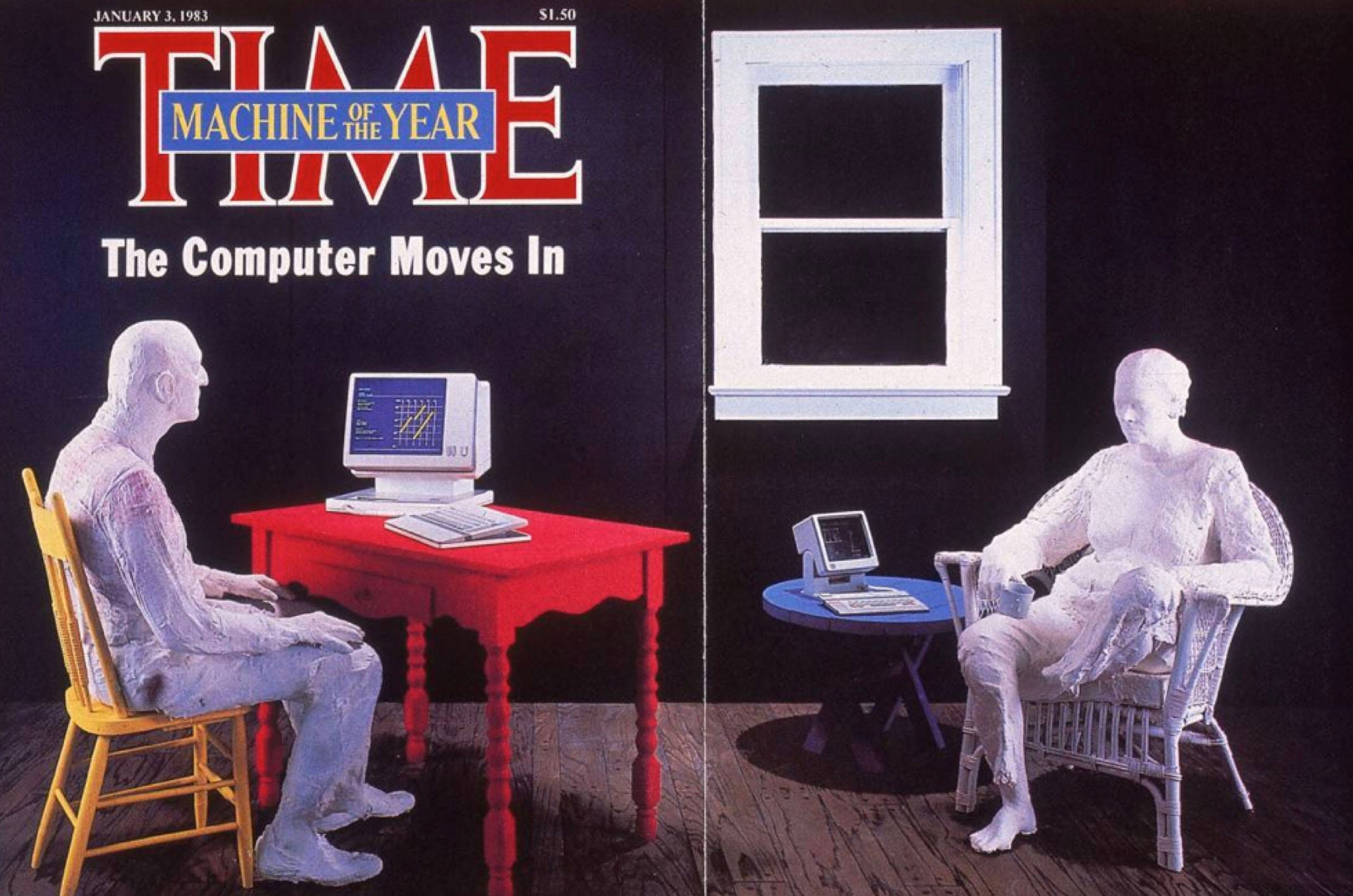
Nevertheless, Kuno explains how he found a way outside of the city, through old ventilation tunnels used in its construction. He prepared his body for the physical activity of it, and made it to the surface. The process changed his view of the human conditional in a profound way:
“But I had got back the sense of space and a man cannot rest then. I determined to get in at the hole and climb the shaft. And so I exercised my arms. Day after day I went through ridiculous movements, until my flesh ached, and I could hang by my hands and hold the pillow of my bed outstretched for many minutes. Then I summoned a respirator, and started. […]
“I felt that humanity existed, and that it existed without clothes. How can I possibly explain this? It was naked, humanity seemed naked, and all these tubes and buttons and machineries neither came into the world with us, nor will they follow us out, nor do they matter supremely while we are here. Had I been strong, I would have torn off every garment I had, and gone out into the outer air unswaddled.”
Kuno has been thoroughly radicalized by the experience. The surface is not as barren as understood. Nor necessarily as deadly. And he understands that their dependence on the Machine is dehumanizing at the core:
“Cannot you see, cannot all you lecturers see, that it is we that are dying, and that down here the only thing that really lives is the Machine? We created the Machine, to do our will, but we cannot make it do our will now. It has robbed us of the sense of space and of the sense of touch, it has blurred every human relation and narrowed down love to a carnal act, it has paralysed our bodies and our wills, and now it compels us to worship it. The Machine develops — but not on our lines. The Machine proceeds — but not to our goal. We only exist as the blood corpuscles that course through its arteries, and if it could work without us, it would let us die. Oh, I have no remedy — or, at least, only one — to tell men again and again that I have seen the hills of Wessex as Ælfrid saw them when he overthrew the Danes.”
Kuno further tells her that he saw evidence of humans living on the surface, before he was pulled back into the city by massive “worms” that had emerged from it and wrapped themselves around him.
Vashanti leaves, understanding that her son has gone mad.
Above: Accidental cyberpunk at a Whole Foods parking lot electric car recharging station in New Jersey, which I filmed in December 2024.
In the final chapter, we hear of changes with life in the Machine. First, the Machine bans the use of respirators, which means that none would be able to ever leave its perfect control. Airships travel was still permitted, but nothing on the surface. The inhabitants of the Machine are by and large friendly towards this change. Then, religion is reestablished: the worship of the Machine, which “is the friend of ideas and the enemy of superstition: the Machine is omnipotent, eternal; blessed is the Machine.“ Again, who would object to such an obvious thing?
Years pass. To Then atmospheric control and lighting. Finally all stops — silence surprise, she gets a call from Kuno, which is as mystifying and insane as anything:
He refused to visualize his face upon the blue plate, and speaking out of the darkness with solemnity said: “The Machine stops.”
“What do you say?”
“The Machine is stopping, I know it, I know the signs.” She burst into a peal of laughter. He heard her and was angry, and they spoke no more. “Can you imagine anything more absurd?” she cried to a friend. “A man who was my son believes that the Machine is stopping. It would be impious if it was not mad.”
But soon there are signs of problems. The Machine starts to glitch. Vashanti notices them while listening to music. She reports them to the Central Committee, but they persist nonetheless. Soon other glitches emerge — strange noises. The sleep system malfunctions. Then atmospheric control and lighting.
It becomes clear that the Machine’s own Mending Apparatus is failing, and that the people who manage the Machine no longer possess an understanding of how the Machine works that is sufficient to repair it.
Eventually, as Kuno predicted, the Machine stops. There is nothing but silence and darkness. Vashanti is forced to do the unthinkable: she opens her door and wanders into the corridor. It is full of other people, equally panicked, trying to summon help and trains and fighting over buttons.
People at any time repelled her, and these were nightmares from her worst dreams. People were crawling about, people were screaming, whimpering, gasping for breath, touching each other, vanishing in the dark, and ever and anon being pushed off the platform on to the live rail. Some were fighting round the electric bells, trying to summon trains which could not be summoned.
Others were yelling for Euthanasia or for respirators, or blaspheming the Machine. Others stood at the doors of their cells fearing, like herself, either to stop in them or to leave them. And behind all the uproar was silence – the silence which is the voice of the earth and of the generations who have gone.
She retreats back to her cell. Eventually she ventures out one last time. The fighting has stopped, the dead and injured lie around. She somehow finds Kuno, who lays dying in the dark. He tells her that men outside the Machine exist. She suggests they will restart the Machine, then. He tells her, “Never. Humanity has learnt its lesson.” And at that moment, an airship crashes into the city — destroying it. The end.
I think the easy, superficial way to appreciate Forster’s “The Machine Stops” is to marvel at how much he managed to get “right” in predicting what a world might look like in the far future. The ubiquitous communication and connectivity, which produces highly physically isolated people who are nonetheless constantly engaged with hundreds or thousands of others (a state of Sherry Turkle calls “Alone Together”), and shrinks the world by making it possible to rapidly move anything you want to you (rather than you to it) — this is all a fairly impressive extrapolation of late Industrial Revolution advances in communications, transportation, and automation technology. Similarly, the lament that humanity might become passively addicted to technological convenience feels ahead of its time. If this book was written in the 1960s or 1970s, it would be commonplace in this respect; by the fact that it was written in 1909, it is remarkable.
What I think is the deeper point of appreciation, though, is Forster’s humanistic concerns. It is not just the dependence that is the problem, although by the end of the book, when the Machine stops, it is clear how dangerous that can be. It is that people have gradually allowed the Machine to dominate their dreams of what it means to live and thrive. As Forster puts it at one point:
Humanity, in its desire for comfort, had over-reached itself. It had exploited the riches of nature too far. Quietly and complacently, it was sinking into decadence, and progress had come to mean the progress of the Machine.
Again, one can find other 20th century voices saying similar things, with different degrees of emphasis. The idea that modern “decadence,” particularly technological decadence, had produced a separation between modern humanity and the eons of generations before it, becomes very common starting in the 1920s and 1930s, and the technological horrors of the two World Wars spurred much of that sentiment. But 1909 still feels rather early for this.
If H.G. Wells gets credit for the trope of the atomic bomb (1914), should E.M. Forster get credit for… whatever this is? The idea of an artificial intelligence — for what other way can we understand the Machine in our present time? — that has been built for the convenience of humanity, whose workings become too impossible for humanity to understand and maintain, and on whose survival humanity becomes utterly dependent?
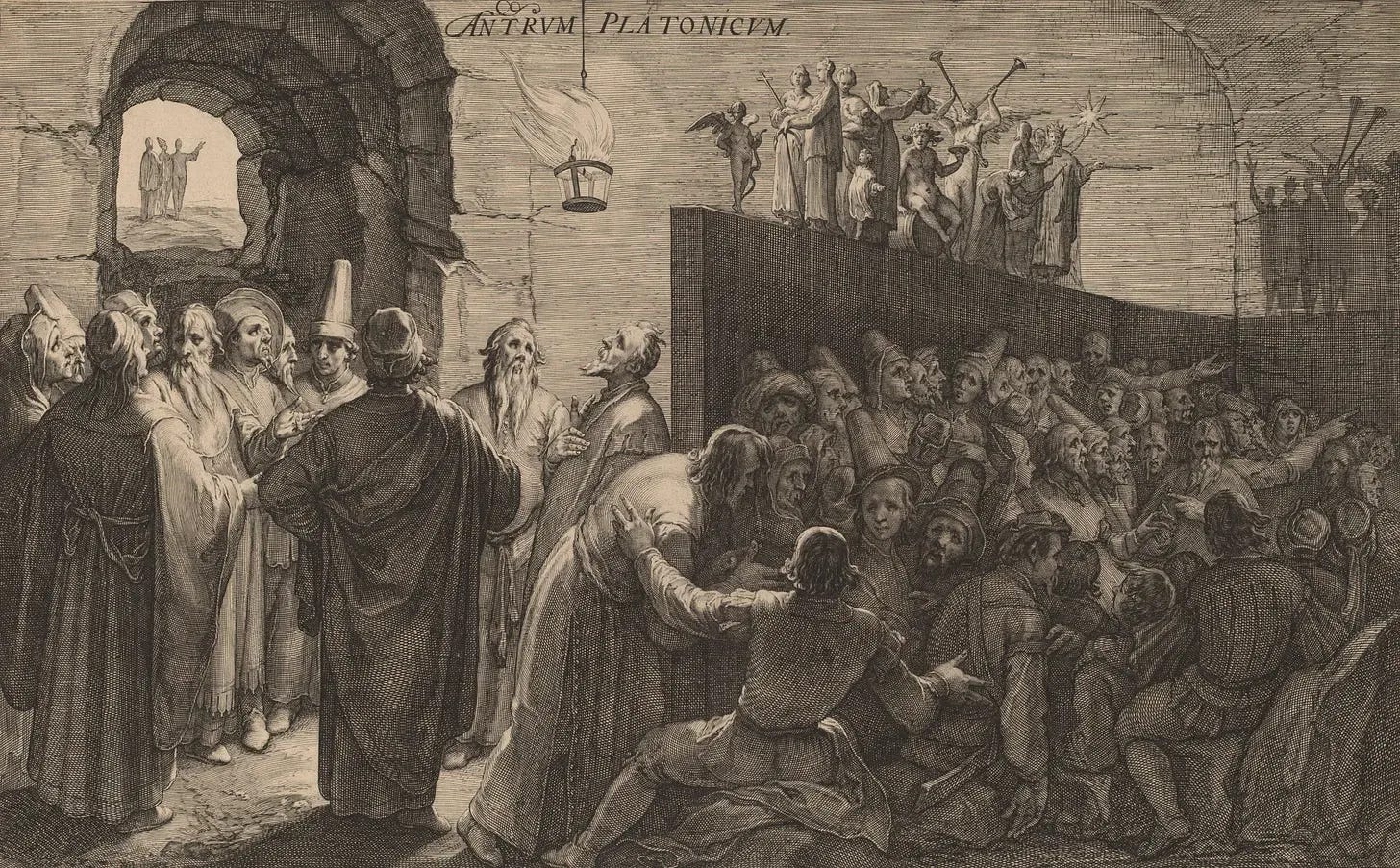

This is not “The Matrix,” I do not think. The people in Forster’s story are aware they live in the Machine, and while it is hinted that the Machine is involved in some degree of enslavement (the “worms” pulling Kuno back into the city and the banning of respirators that follows are all implied to be efforts the Machine to avoid humanity possibly leaving its embraces), it does not have the same degree of externally-imposed coercion that is implied by “The Matrix.” The situation with the Machine is even more of a reference to Plato’s allegory of the cave than “The Matrix,” as very few people who learn about the nature of “The Matrix” actually want to go back into it afterwards.
Is “The Machine Stops” an end of the world story? I think so, somewhat. Certainly it is the end for most of those people who live in the Machine. The implication that there are people living amongst the ruins of the world, and that they will be new inheritors of the mantle of humanity, is meant to be a little hopeful. But it is still quite grim, as it is hardly implied that those people living outside are doing very well up until that point, and even if there were significant numbers of Machine survivors, it is hard to see how much help they would be: not only are they useless at anything practical, including physical activity, but despite Kuno’s pronouncement that humanity must have learned its lesson, it is hard to believe.
As a humanist at a moment when the most profound disrespect to humanistic endeavor, art, thought, and ideals are being broadcast constantly from the engines of capital, the halls of governance, the administrators of higher education, and the centers of science and technology, I will admit that “The Machine Stops” sings to me and my concerns. Not so much in the sense that I think its specific future of people living underground is one that I am particularly worried about. But Plato’s cave was never a warning about literal caves, either — it is about the cave of men’s minds. We live at a moment in which great excavators are at work, boring metaphorical holes in to the metaphorical earth, and their monied and powerful operators are telling us pleasant lies about how happy we’ll all be, once we embrace living in our little cells.
Does anyone remember a sci-fi short story in , maybe, mid to late 1970s in which a group of wild humans breaks into a facility that train humans to be like machines? There are only rules and processes to follow, no activity outside the building.