
"To build a shelter was to admit to the kind of age we lived in..."
The moral dilemmas explored by The Twilight Zone's "The Shelter" (1961)

The end of the world is a recurrent themes in several episodes of Rod Serling’s The Twilight Zone (1959–1964), but none perhaps are quite as direct about it as “The Shelter,” which aired on September 29, 1961. Its focal point was a family bomb shelter, and it came at one of the real peaks of popular interest in the idea, not long after President Kennedy announced a massive public fallout shelter program.
“The Shelter” opens with a birthday celebration of a physician, Dr. William Stockton, thrown by his family and neighborhood friends. Along with singing the praises of the good doctor’s generosity, the celebrants also give him some gentle ribbing about how much time and effort he has put into building a bomb shelter:
Well, I'm afraid we'll have to forgive him for all that despite the fact that what the doctor thinks of as farsightedness on his part has been a real pain in the neck to the rest of us, what with all the concrete trucks and the nocturnal hammering and all the rest of it.
But the party quickly turns sour when Dr. Stockton’s son, Paulie, runs him to tell him that the radio program he had been listening to had abruptly shut off after announcing that people should turn to the CONELRAD station. Today this would require a bit more explanation, but in 1961 I suspect the audience could be expected to know that the CONELRAD station, which was even marked on many American radios from the time with a triangle, was for emergency information, particularly related to Civil Defense and nuclear war.
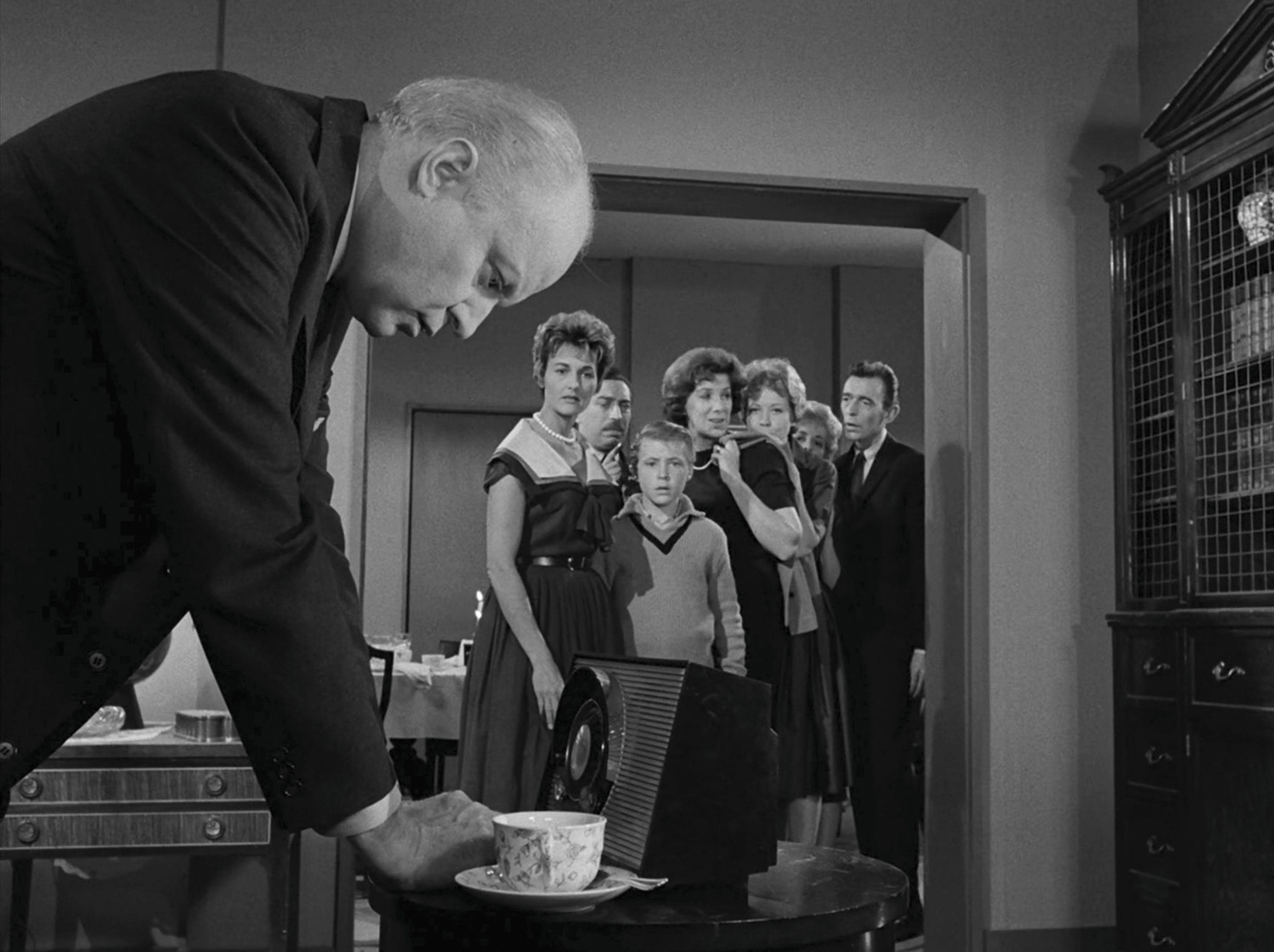
Dr. Stockton takes this seriously, as befits a man with a bomb shelter. The station announces that “unidentified flying objects” had been detected by America’s ballistic missile warning systems, and that people were advised to go into their shelters if they have them. If they did not have them, they were advised to move supplies of food, water, and medicine to a “central place.” The guests hastily run home.
At this point, Serling’s introductory monologue cuts in:
What you’re about to watch is a nightmare. It is not meant to be prophetic, it need not happen. It’s the fervent and urgent prayer of all men of goodwill that it never shall happen. But in this place, in this moment, it does happen. This is the twilight zone.
The partygoers have left. Stockton and his wife, Grace, are preparing their supplies. Grace is filling up jars full of water at the sink, although the water pressure is waning and finally ends. Grace and Bill move their supplies to the basement and send Paulie out to grab some more.
While he is gone, Grace kneels in desperation or prayer. Bill tries to comfort her:
– Grace. Now, if it is a bomb, there's no assurance it'll land near us, and if it doesn't...
– But if it does, Bill, New York is only 40 miles away. And New York’s gonna get it, we know that. So we'll get it, too, all of it. The poison, the radiation, the whole mess. We'll get it.
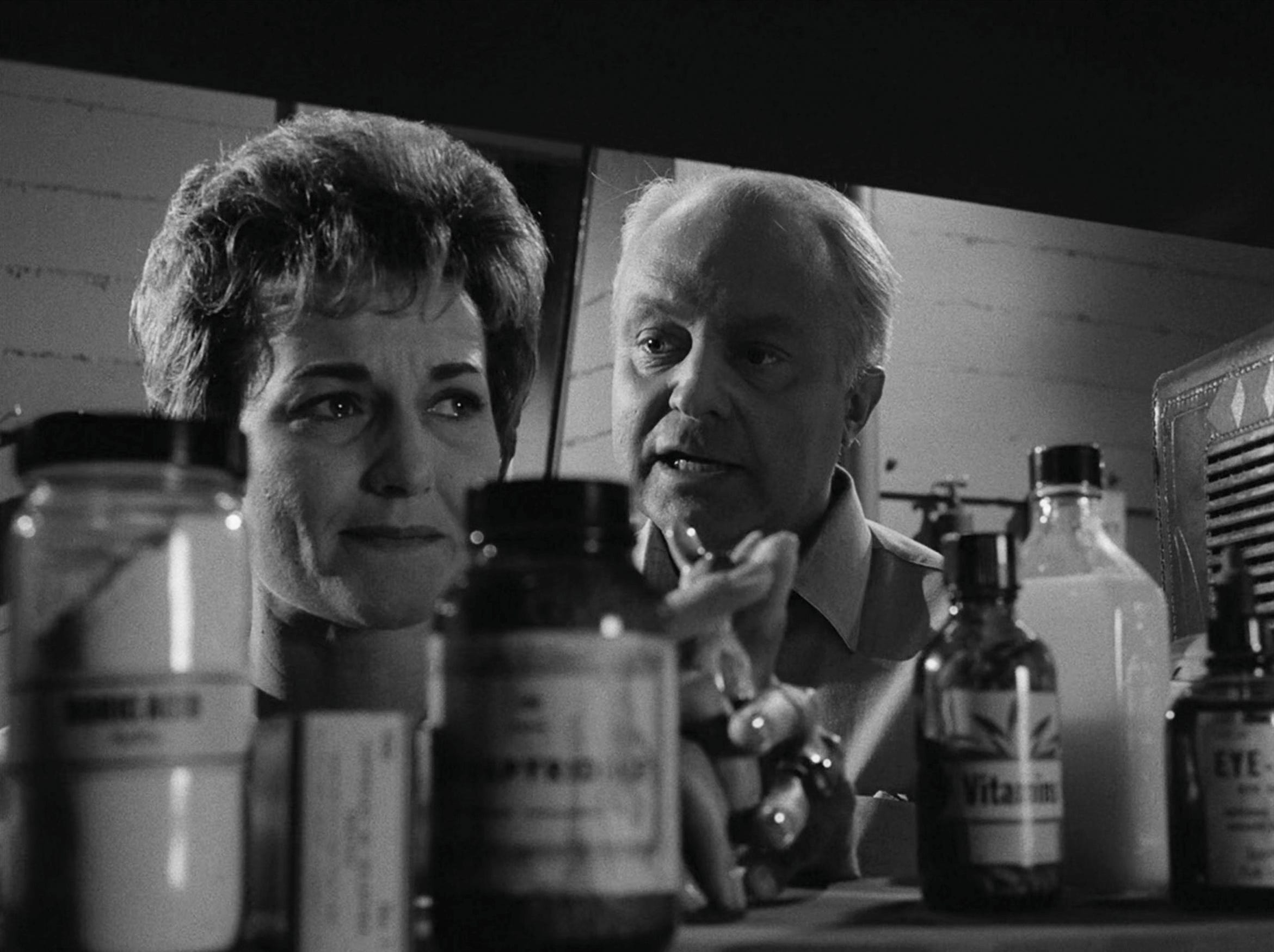
– We'll be in a shelter, Grace, and with any luck at all, we'll survive. We've got food and water enough to last us for two weeks. Maybe even longer if we use it wisely.
– Then what, Bill? Then what? We crawl out of here like gophers to tiptoe through all that rubble up above? The rubble and the ruin and the bodies of our friends? Oh, Bill, why is it so necessary to survive? What's the good of it? Wouldn’t it just be better and easier, just quicker if we just...
Before she can finish the sentence, Paulie is heard up the stairs. Bill gestures upwards:
Grace, that’s why we have to survive. That’s the reason. He may only inherit rubble now, but he’s 12 years old. He’s only 12 years old, Grace.
Grace seems somewhat reassured, and collects herself.
We cut to Bill upstairs, in the kitchen, grabbing some final jugs of water. A knock comes at his window — it is one of his neighbors, asking that Bill might allow him and his family share the Stocktons’ shelter. Bill tells him there is no room and tells him that he should instead go into his own basement. But his friend notes that his own house doesn’t have a basement; it is modern construction, with all the electric conveniences of the time, but no basement, no protection. Bill gives him a lecture:
I kept telling you, Jerry... all of you... Get ready, build a shelter. Forget the card parties and the barbecues for maybe a few hours a week, forget them, and make the admission to yourself that the worst was possible. But you didn’t want to listen. None of you wanted to listen.
To build a shelter was to admit to the kind of age we lived in, and none of you had the guts to face that. So now you've got to face something far worse! So, God, please, God protect you. It’s out of my hands. It’s simply out of my hands.
And so emerges the central tension of the episode. One by one, the neighbors who had been at Dr. Stockton’s birthday party show up at the house, begging for shelter. Bill, by now barricaded inside his bomb shelter, is adamant that this is impossible: they do not have enough space, supplies, or even air to spare. Bill has been the one who prepared, and the others mocked it, and now they were on their own.
The friends become increasingly agitated. They turn on one another. They argue about which of them is more deserving to live; one of them declares that another is a “foreigner,” a “pushy, grabby, semi-American” who does not deserve anything.
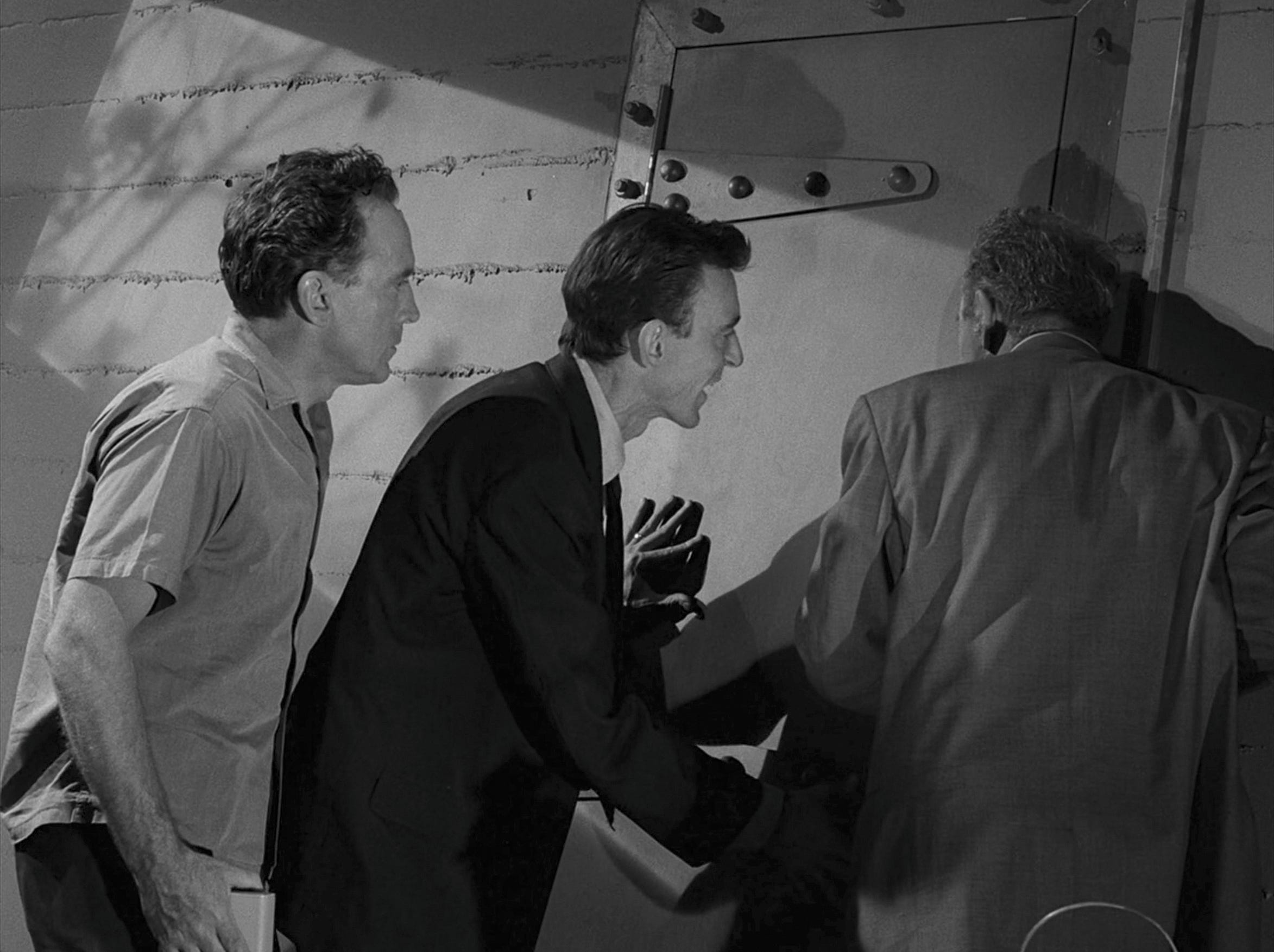
At the shelter door, they plead for the lives of their children. They threaten. Bill tells them that they are wasting their time, that he will not let them in, that they should be seeking shelter or preparations elsewhere.
Finally, the neighbors move to acquire the tools necessary to break down the door to the Stocktons’ shelter, to claim it for themselves. Hearing all of this, inside the shelter, the Stockton family process it:
– Bill… Who are those people?
– Those people... those people are our neighbors, our friends, the people we've lived with and alongside for 20 years.
The neighbors return with a battering ram. They force the door down, but the Stocktons have piled up furniture to slow them down.
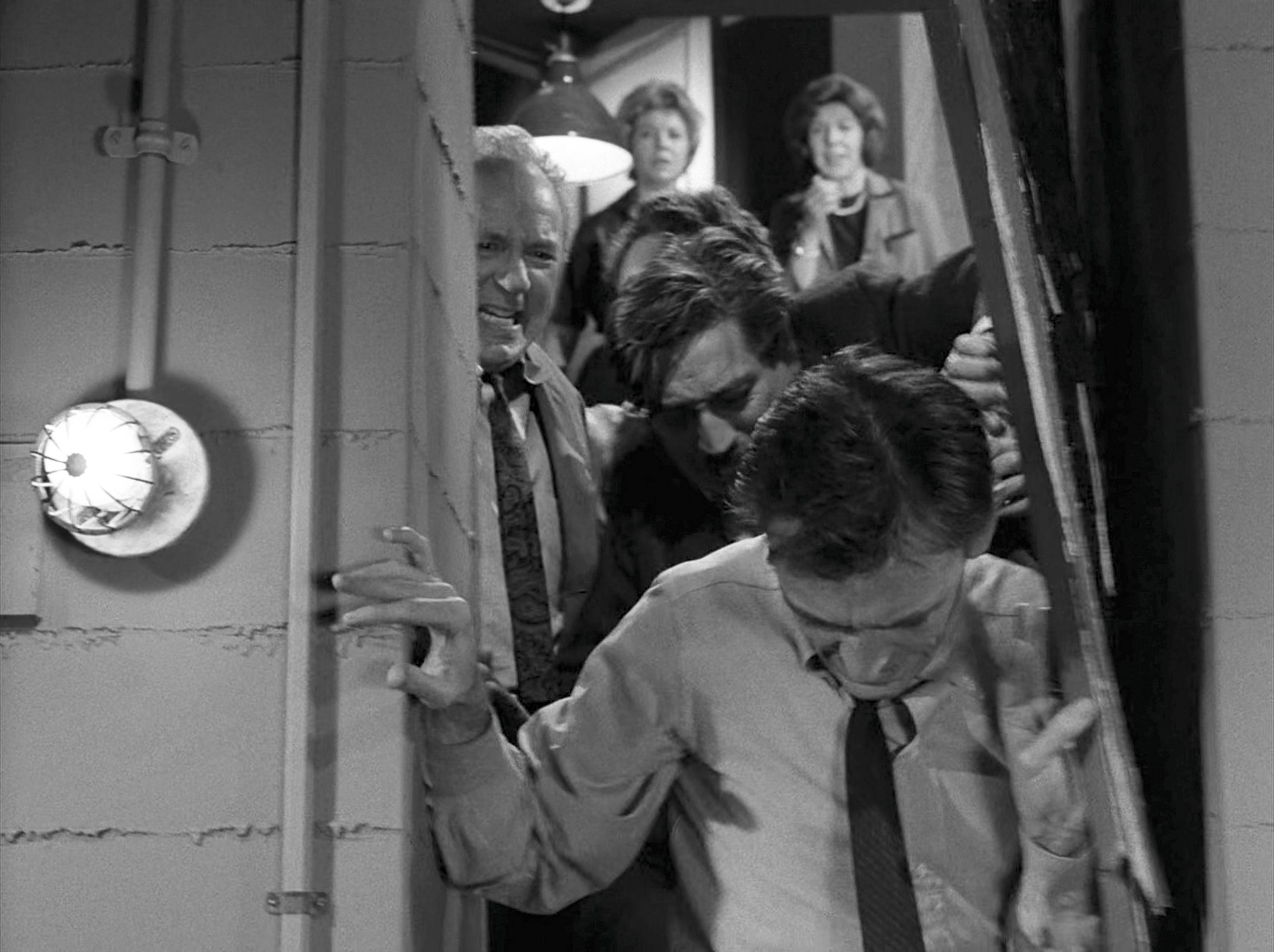
Just as they make it through the door, the CONELRAD station pipes up:
This is CONELRAD. Remain tuned for an important message. The President of the United States has just announced that the previously unidentified objects have now been definitely ascertained as being satellites. Repeat. There are no enemy missiles approaching. Repeat: There are no enemy missiles approaching. The objects have been identified as satellites. They are harmless and we are in no danger. The state of emergency has officially been called off. We are in no danger.
The neighbors embrace their loved ones, crying with relief. The most aggressive neighbor attempts to apologize to his immigrant friend — “I went off my rocker… well, you can understand that, can’t you?” — who is clearly not reassured. They apologize to Dr. Stockton and offer to pay for the damage they have caused to his home.
Dr. Stockton emerges from the shelter, looking spent and haggard. One of the other neighbors suggests they have a big block party to celebrate their survival. While another nervous neighbor embraces the idea: “anything to get back to normal, huh?”
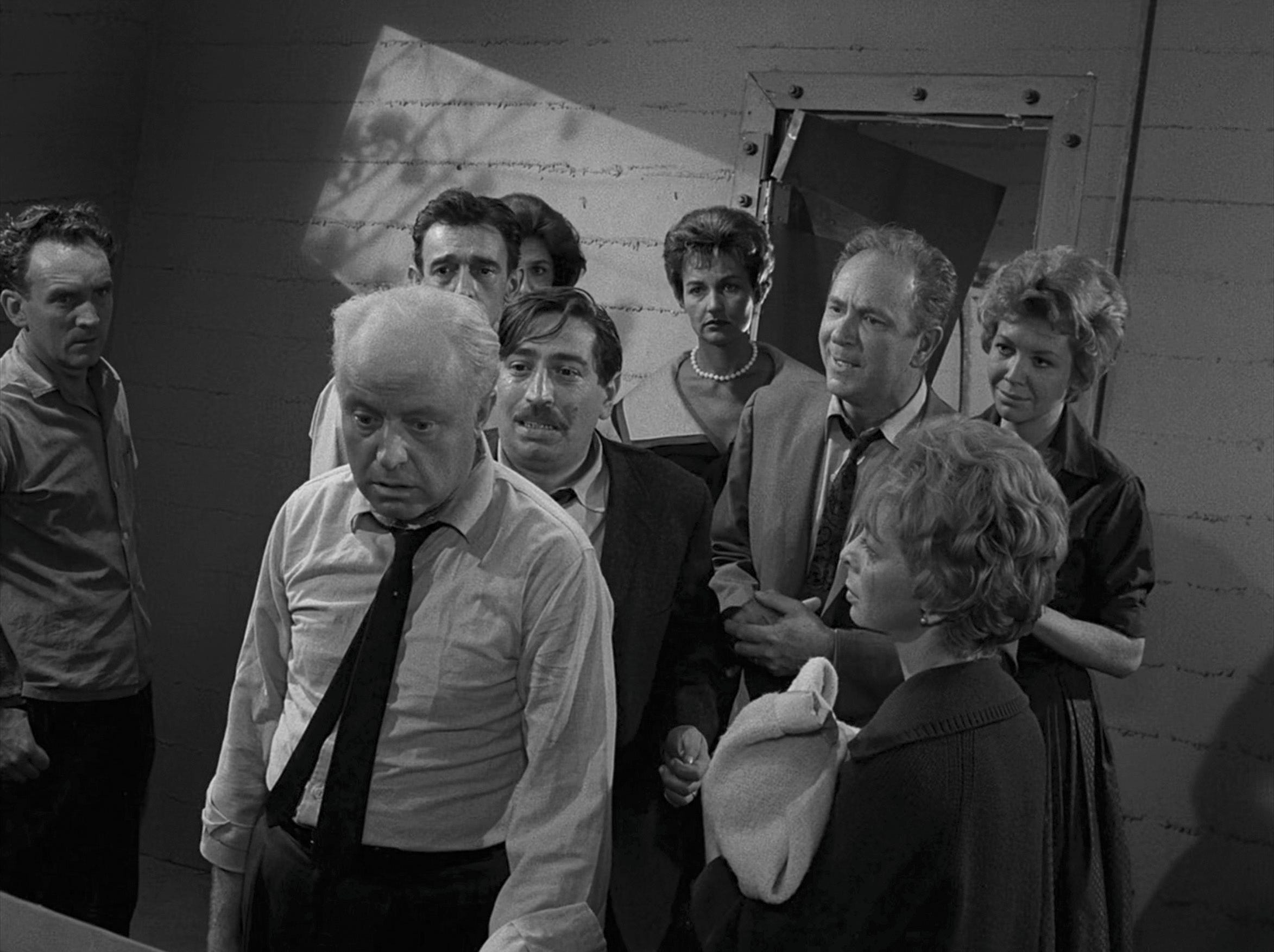
The doctor walks through them, shell-shocked. He turns, looking at them like they are madmen:
– Normal? I don’t know. I don’t know what normal is. I thought I did once. I don’t anymore.
– I told you we'd pay for the damages, Bill.
– Damages? I wonder. I wonder if any one of us has any idea what those damages really are. Maybe one of them is finding out what we're really like when we're normal... The kind of people we are just underneath the skin. I mean all of us. A lot of naked, wild animals who put such a price on staying alive that they'll claw their neighbors to death just for the privilege. We were spared a bomb tonight, but I wonder. I wonder if we weren’t destroyed even without it.
And so the episode ends. Serling gives his outro monologue:
No moral, no message, no prophetic tract. Just a simple statement of fact: For civilization to survive, the human race has to remain civilized. Tonight’s very small exercise in logic from the twilight zone.
Like many episodes of The Twilight Zone, the themes are not subtle, nor obscure. The question of “fallout shelter morality” was a commonly-discussed one at the time. If you prepare for nuclear war, and your neighbor does not, are you obligated to help them, even if it comes at the expense of yourself or your own family? Conversely, is the neighbor under the obligation to simply suffer under those circumstances, or are they justified in trying to protect themselves and their loved ones?
And the idea that friends could become instant enemies when the world was at the door, and that civilization and civility are only thin veneers that wash away at the first sign of threat, is a common threat in literature, sociological musings, and post-apocalyptic fiction. (And many other episodes of The Twilight Zone.)
But “The Shelter” does a very good job of putting these things together in a way that befits the context of a call for national shelter building. Unlike some of Serling’s other episodes that invoke nuclear disaster, nuclear war isn’t just a metaphor here, it is part of a very real concern at the moment, referring to very real questions at the time. There is no indication that this episode is taking place on an Earth-like planet (like some other episodes), or any place other than the here and now. It’s not even fanciful: there had already been several major “false alarms” of nuclear warning systems that reached the public, and many other secret alarms that had not resulted in any public warning. The episode aired only a month after the Berlin Wall had been erected, and about a year before the Cuban Missile Crisis — pretty much the most dangerous period of the Cold War.
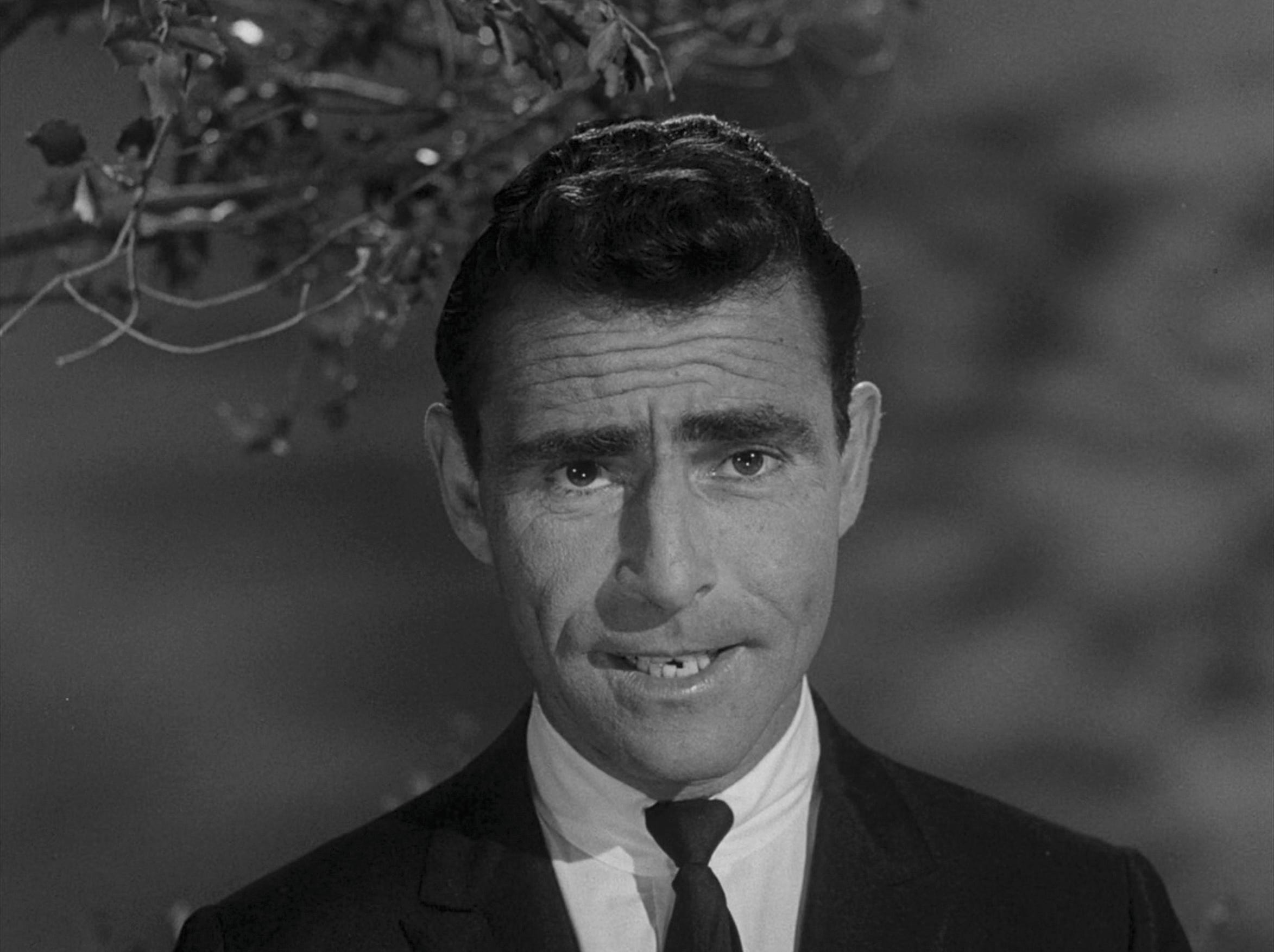
Serling was interviewed on the radio about the episode on a radio station apparently about a month later, asked about the reaction to the episode. He told the interviewer, Bob Crane that:
We had about 13,000 letters and cards inside of two days. I think we hit some kind of nerve. […] I wrote it because I felt that it had great immediacy. We’d be talking at home, my wife and me, about the possibility of building a shelter, and we were struck with the moral and ethical problem of what would happen if there were an alert sounding, and we got into our shelter happily, because we’d built one, and neighbors with children came to the door and said, “please let us in.” Well, that was the problem. I can’t answer it. I don’t know what is the ethical rightness and justice of this. I haven’t figured it out yet.
The interviewer noted that he had heard several “knowledgable men” on a panel debating exactly these kinds of ethical questions, and asked Serling about the ending, and whether he wanted “to leave it a little bit stronger than that,” in terms of providing answers to the moral question posed. Serling was emphatic:
No, because I’m not one of those quote “knowledgable men,” Bob, I don’t know. I was up in the air about it, morally and ethically. I didn’t know how to end that thing. I didn’t know what position, philosophically, I could take.
The interviewer then asked Serling about his own shelter plans. Serling said they weren’t building one now, but for awhile “they had thought very seriously about it.” But they decided they weren’t going to build one. “Why?”
Well, for very realistic, you know, stringently realistic reasons. It’s my feeling now that if we survive, what’ll we survive for? What kind of world are we going to go into? You know, if it’s rubble and poisoned water, and inedible food, and my kids have to live like wild beasts, I’m not particularly sure I want to survive in that kind of world.
The only character who voices this specific point of view in “The Shelter” is that of Grace, Dr. Stockton’s wife. Both Dr. Stockton, and the neighbors, took the imperative for survival as a given. But Grace had to be convinced, and only supported the effort after her husband reminded her that it was really about the survival of their child.
Serling also invoked the lives of his children his children’s lives, but to support the opposite conclusion of Dr. Stockton, from the episode: that he could not bear to put them through such a “survival.”
"The idea that friends could become instant enemies when the world was at the door, and that civilization and civility are only thin veneers that wash away at the first sign of threat, is a common threat in literature, sociological musings, and post-apocalyptic fiction."
It absolutely is -- which is why Rebecca Solnit's "A Paradise Built in Hell" is so important as a corrective. Her research shows that it's also entirely possible to have community increase after a disaster, not decrease -- and cites examples that we never hear of, drowned out by the drumbeat of "disasters = barbarism" stories. I had never even heard of the 9/11 boatlift, for example.
But Solnit acknowledges it doesn't always work -- and points to Hurricane Katrina as a case in point. In that case, however, it was more disaster + racism = barbarism. To tie this back to your previous post, Alex: one can safely assume that the white disaster preppers of 1960s Georgia would not have opened their shelters to their Black neighbors.
One of my favorites episodes. Definitely made a big impression on me about having the guts to face harsh reality now and prepare, or have it forced on you later.
I think this is applicable to plenty of modern day issues people would rather not look into or think too much about, like climate change, peak oil, or even the still everpresent threat and maybe even increasing likelihood of nuclear war.
Also interesting how societal attitudes change, if you compare this episode to the one which came later that had the same topic with a radically different message.