

This last week was a bit of a blur, as I traveled to Southern California very briefly for a family event. The event itself was in Joshua Tree, which is 3 hours by car east of Los Angeles, so with the CDG–LAX flights (11 hours each way) and the drive (3 hours each way) over four days, that ends up being quite a lot of time spent in transit.1
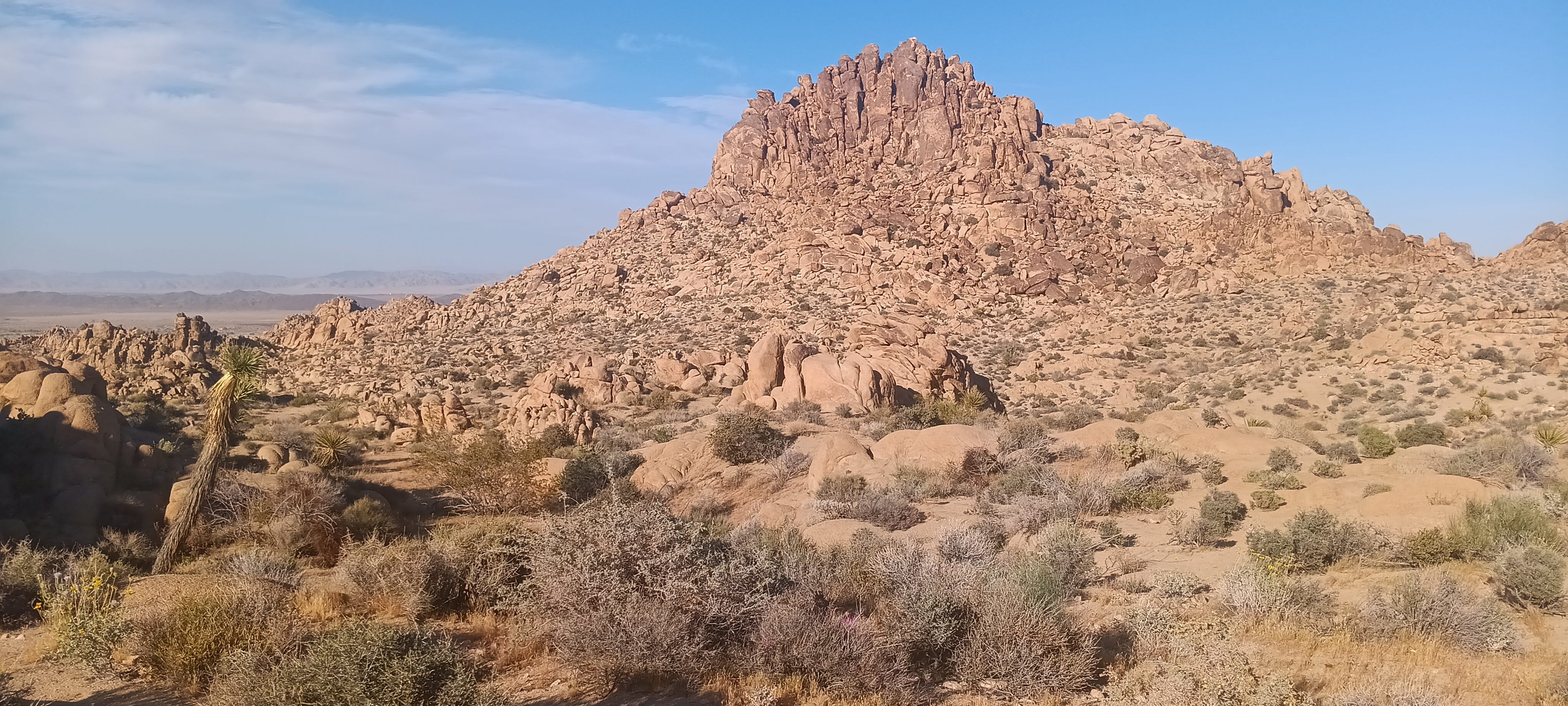
But I’m not complaining. I am glad I could make the trip. Joshua Tree was quite beautiful, and (believe it or not) I had never been there before. (I am from Central California, and while I have spent some time visiting Southern California over the years, there is much I haven’t seen there.) The vistas reminded me of photos of the Nevada Test Site — scrubby desert broken up by rocky mountains. Quite beautiful in its own, austere way.
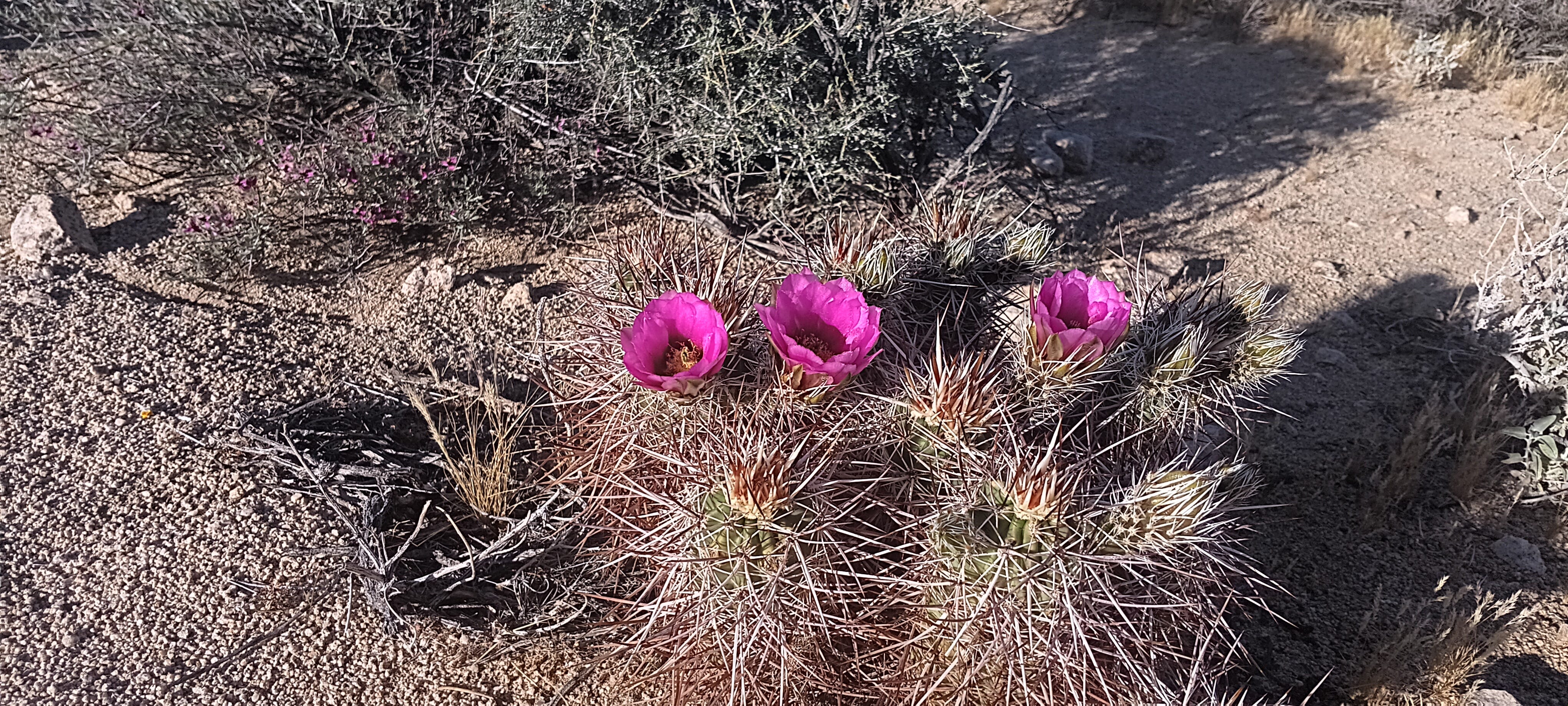
I saw a coyote, and several chubby rodents (which may be White-tailed Antelope Squirrels), and many birds (but no roadrunners). And there were flowering cacti in abundance. I found myself wondering how this landscape would look to people crossing it in ye olden days — would it be as beautiful if one didn’t have easy roads in and out of it, or would it simply look intimidating?
The family event was lovely (I will not be going into detail on my blog, thank you very much!), and despite the wear-and-tear imposed by this kind of travel I am glad I could make it work out. I have not driven a car since coming to France, and I believe I more than made up for it on this trip, spending some 7 or 8 hours behind the wheel total on Los Angeles freeways.
I have to admit that I felt that the vision of Los Angeles I saw on this trip did not compare very favorably to Paris — roads, roads, and more roads, moderately (for LA) busy, with most people driving monstrously large vehicles, and an endless stream of garish LED billboards advertising primarily the services of accident lawyers and online gambling. These things do not exist in Paris (billboards, for example, seem to be very heavily regulated there, in both size and content). I found myself thinking about how a born-and-bred Parisian would think they’d landed in some kind of cyberpunk wasteland dystopia. But I am aware that Los Angeles is more than just this, and that staying in a motel near LAX for two nights did not really allow the city to put its best foot forward.
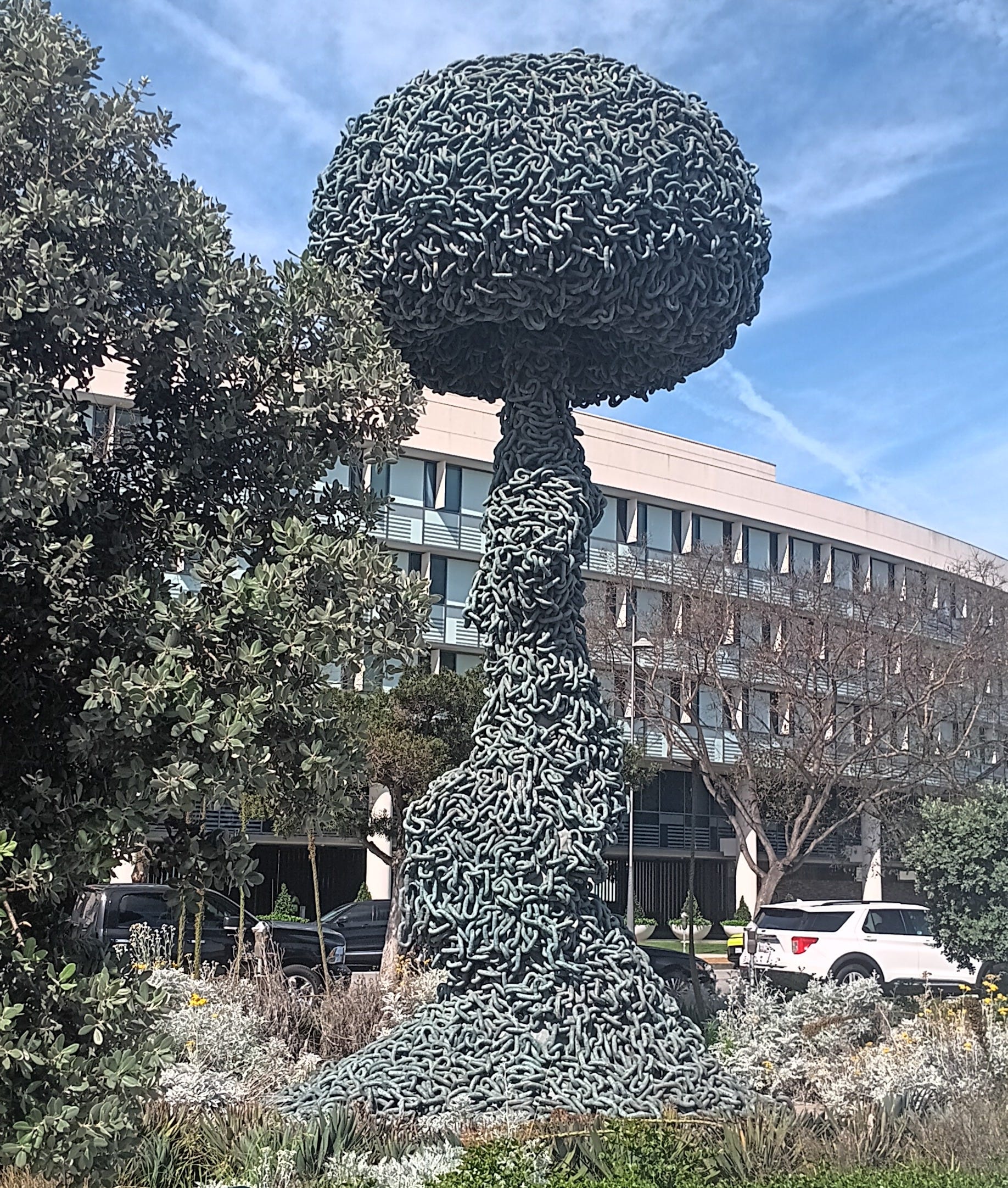
And while this was not a work trip, I did squeeze in one bit of “work” while I was out here — I gave a talk at the RAND Corporation in Santa Monica, where my longtime friend and fellow nuclear historian Edward Geist works. I had never been to visit RAND before, and so the experience alone was an valuable one just for the taste of it. I was highly amused, for example, to see that the city of Santa Monica had erected a statue of a mushroom cloud, made out of chains, across the street from RAND’s campus (above).
RAND was quite interesting. The people I met were about what I expected: earnest and smart, perhaps a slight overrepresentation of people on the spectrum, with good questions about the material. And they were also quite interested in talking about NUKEMAP, which is always fun for me, particularly because so much of the work I do on that is relatively “invisible” to the everyday user (“behind the scenes” stuff). I was also able to take a look at at their library, which included a lot of interesting early works by RAND luminaries.
The talk I gave on the Castle Bravo accident, essentially similar to the one that I mentioned some weeks ago. I’ve been writing it up as a formal academic paper, and have found some new documents that further my argument a bit more. The most amusing of which is that I believe I have traced the erroneous, pre-Bravo theory of “stratospheric trapping” — the idea that megaton-range detonations would not have any significant local fallout because their mushroom clouds would rise to such a high altitude, which was one of the two erroneous approaches to thinking about fallout that led to Bravo accident — to a possible initial author. And, dear reader, you will be as shcoked as I was to find it may have originated as early as 1950 from none other than your friend and mine, Edward Teller.
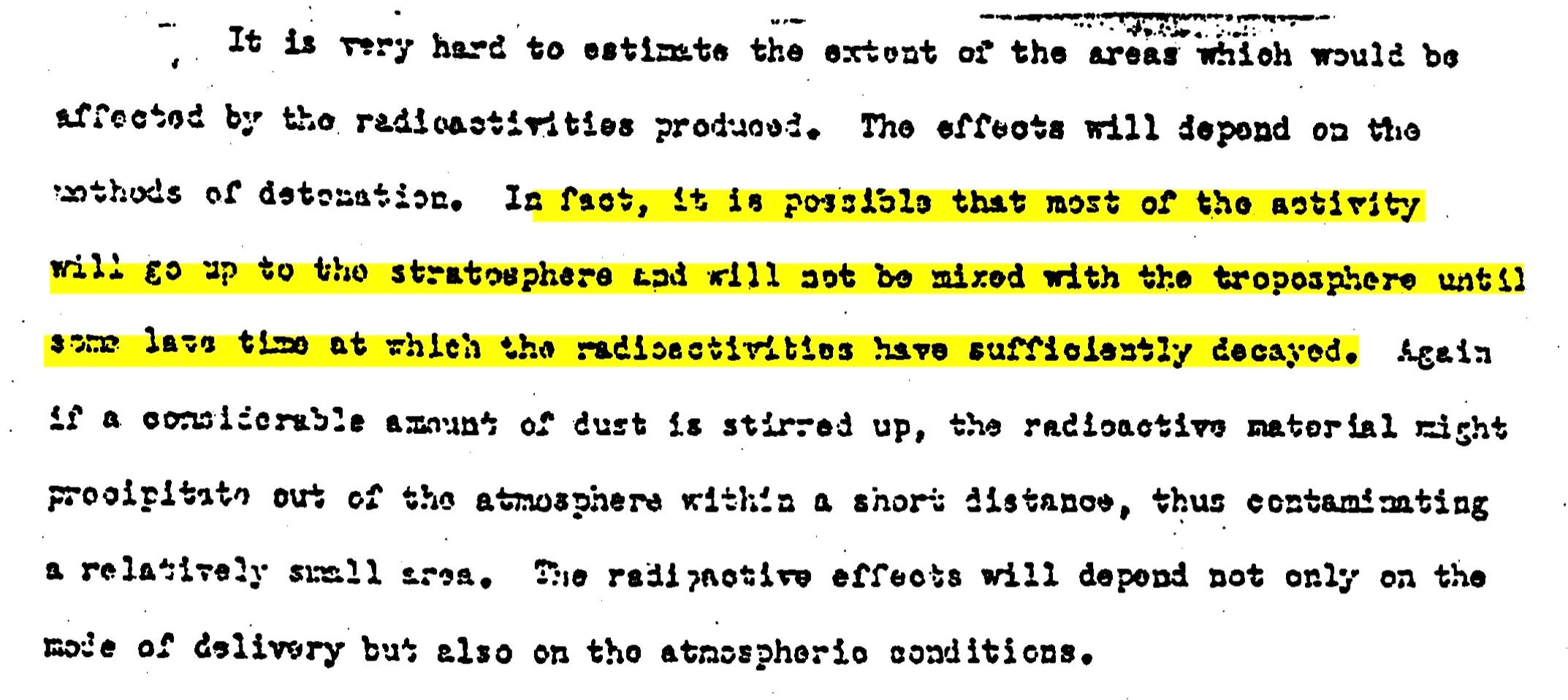
I was asked: how did I find such a thing? The answer is just that I have many, many, many reports and documents on my computer, and occasionally I do things like search all of them for the word “stratosphere” and go over the results (in this case, I have about 1,600 PDFs with that word in them, but by glancing at the file names I can rule out a lot of them). That might sound laborious but it’s a lot easier than wading through archival boxes, let me tell you. And I have enough success with this method that it feels a bit like a game, like I’m mining for treasure. And the worst-case scenario is that I find something unrelated-but-also-interesting!
I love the serendipity of this kind of research. Once one has found something to focus on, sure, it is good to dig into it, but wading through lots of different things can turn up so many unexpected results. Which is what happened with this week’s Doomsday Machines (posted on Saturday, because my jet-lagged brain just didn’t have the bandwidth on Friday to wrap it up), which is on the role of organized religion in US Civil Defense planning:

That this is coming out on Eastern weekend is, I assure you, a total coincidence (I am pretty unaware of religious holidays, and would not have even known it was Easter if someone hadn’t mentioned it). I stumbled across the two pamphlets discussed, “The Clergy in Civil Defense” and “The Church and Civil Defense,” while looking for information about something else (the “something else” will be a future post). Then I started digging into the personages involved, particularly this Fred W. Kern, and was quite delighted to find that he had made Civil Defense into a holy ideological struggle (what fun) and also that he was FCDA Administrator Val Peterson’s brother-in-law (which was not obvious). The latter I was tipped to by the fact that in Val Peterson’s post-gubernatorial papers, Kern’s correspondence (which I haven’t seen) is included in the “Peterson family” collection, and with some digging I was able to find that Kern had been married to his sister. Not a major research accomplishment, but satisfying nonetheless.