
Wasteland wrap-up #77
Parisian spring, summer game priorities, Dixie cups, dungeon crawling, a Tiger Electronics-style game from the creator of Papers, Please...

We are well into spring here, which sometimes means overcast and even rainy days. But it also means that the length of the day is getting dramatic, and because France is in the wrong time zone, it also means that the day keeps being light well into the night.
Here is a photo from 9:30pm the other evening, when the sun was only starting to set and had hit that “Golden Hour”:
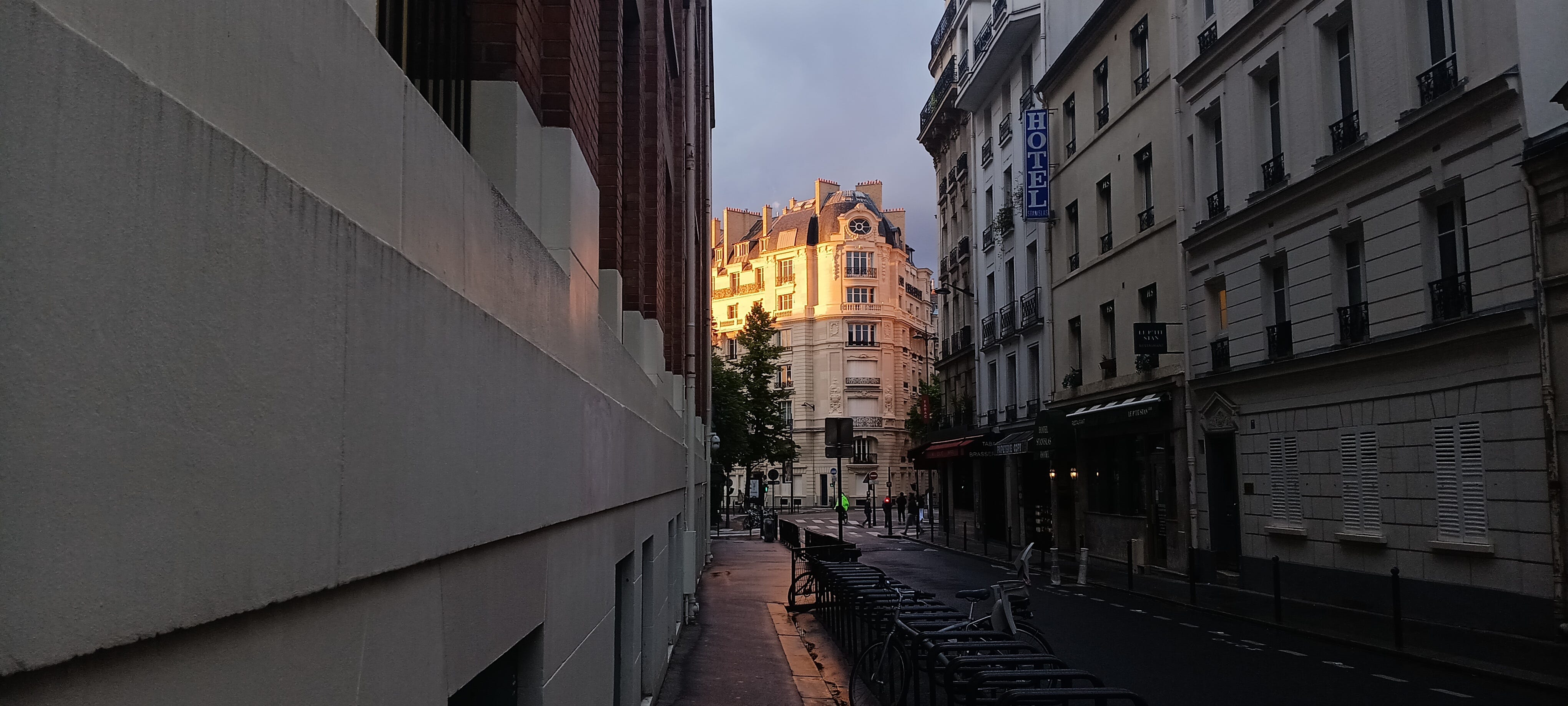
It was even lighter than it is there, because the camera on my phone (which is not good) is trying to balance out how bright the sun was against the building in front of me.
I can see, now, why the French famously end up eating and staying up so late. It doesn’t feel like nighttime until it is truly late, now, and getting dinner at 6pm feels like eating it at noon. I’m not complaining, though, except for the fact that it’s easy to get thrown off.
Last week I got all of my grades in and closed out my semester at Sciences Po. I always feel a bit liberated after doing that, and excited to start planning out the summer. Among the several things I will be doing this summer, I have once again got a group of students together to work on the Oregon Road ‘83 project, as I mentioned last time.
We had our first “pre-summer meeting” (we will start in earnest in a few weeks) last week, and I did some of the setup work that is necessary each year, like setting up a Discord server for the team, setting up a shared folder for the game, making sure everyone had been added to the private Github repo, and so on.
I also drew up my list of summer 2026 priorities for the game. The major one is to push it to public beta. That happens to have been the major priority for summer 2025 as well, but I think if we stay focused — and I am not in the middle of an international move again! — it should be possible to achieve, as we are quite a lot of the way there.
The “to do” list is more or less:
Debugging and fixing a lot of things — as always!
Fully fleshing out the city exploration system that lets the player move through cities — this is pretty well developed but is not quite “done” yet, either in terms of the programming, the integration into other systems, or in terms of final UI design.
Finalizing the “introduction” sequence — this has been plotted out in some detail, with some art, but it just hasn’t been fully finalized/developed.
Endings — two of the endings are well-described and partially coded, but they need to get fully fleshed out/finished. There are also two other endings I would like developed. Ultimately I am hoping the beta will have at least 3 possible endings (other than player death).
Two of the recruitable NPCs are pretty fleshed out, one of the most important ones is almost totally programmed (he is being used as the “demo” for all NPCs, and is very complex). We have lots of potential other recruitable NPCs, and the goal is to narrow down to maybe eight or so for the public beta, and to get them fully integrated into the game. Some of the NPCs are necessary for some of the endings, as well.
Finalizing aspects of the “nuclear war scenario,” including targets, weather/climate, and the final fallout parameters.
I will be posting more on these things over the summer on here. The main goal is to really avoid any further scope creep for the moment, and to just focus on finalizing and fleshing out the existing systems.
For Doomsday Machines this week, I had been working on an entirely different topic (which I might finish for next week; I just felt like it could use some more work), when I serendipitously stumbled across a PDF I had downloaded of issues of The Georgia Alert from the 1950s. As my post explains, I had initially downloaded this researching a different blog post, but this time my eye was drawn to their headlines about paper cups, for whatever reason. And then, as the post explains, I noticed something else, which took me in a very different direction:

I am quite curious about how segregation was handled in other aspects of Civil Defense in the American South in the 1950s and 1960s. It feels like a topic for a very deep historical study. Has anyone done such a study? I found the one article that I cited about it, but honestly it didn’t have all that much more information in it than I had been able to dig up from just looking at those PDFs of The Georgia Alert in the first place. There must be more to this story, particularly in the period in which Civil Defense in the USA shifted towards public fallout shelters. It is hard to see how segregation and Civil Defense could be truly compatible, and that has got to have had some interesting-if-terrible consequences to how the planning was done.
The post I was working on related to Soviet nuclear targeting priorities in the 1970s and 1980s, and what little we do and don’t know about them, and perhaps I will post that next week… we shall see! But I had intended to do something less heavy this week, like write about a zombie film or something like that, so perhaps that is still on the table…
Incidentally, while looking for something else (how often is that the case? always?) I stumbled across this rather amusing paragraph in a document from the early 1970s about revisions that were made to the American nuclear war plan, the SIOP (Single Integrated Operations Plan):
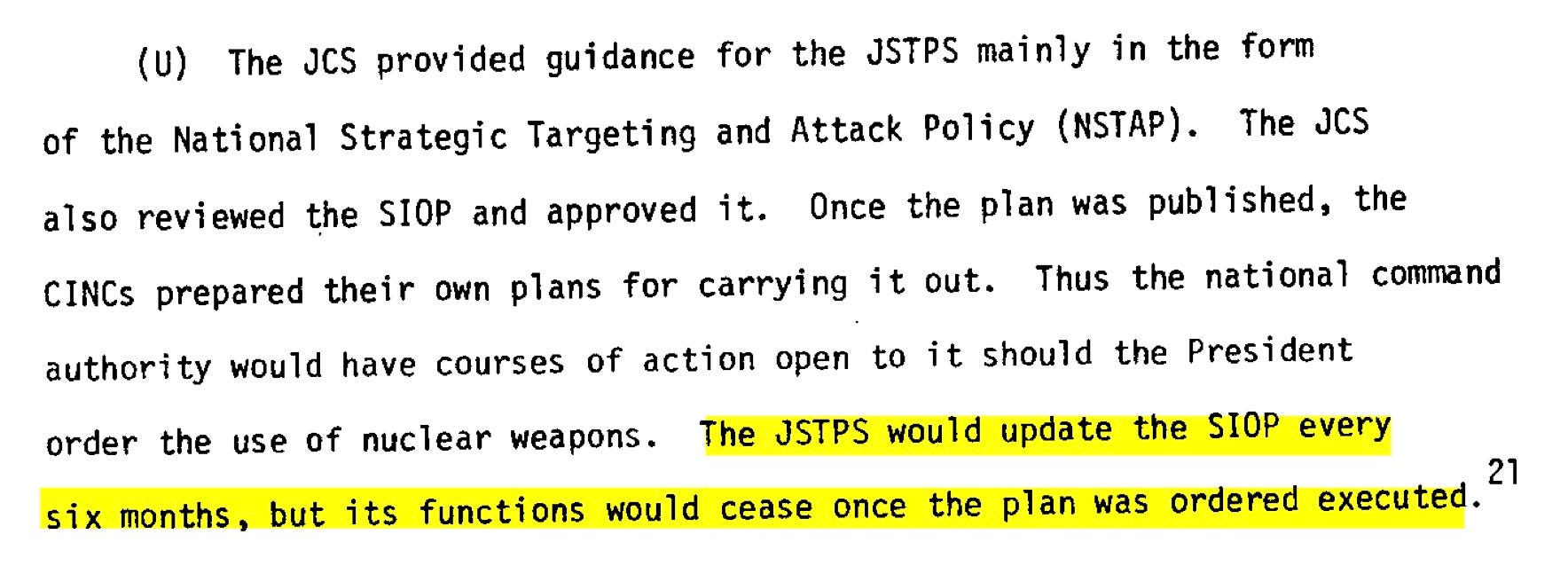
The acronyms require a little decoding: the JSTPS is an organization within the Joint Chiefs of Staff (top military brass) tasked with creating the SIOP (the war plan). The above is explaining that once the JCS approve the SIOP — which was a list of targets and forces allocated to them — it would then given to the commanders of the different military branches that would actually be tasked with making it happen in the event that the president ordered for it to be “executed” — nuclear war.
The last, highlighted line, is what amused me. If I am reading it right, it is saying that the group who designed the SIOP would update it every 6 months, but the group’s “functions would cease once the plan was ordered executed.” Which is to say, that they would not have to keep updating it once nuclear war began. Which seems fair, I guess? But what a funny thing to put into writing. I wonder how many other contracts or lists of obligations could have a similar clause in them: “all of the above is to continue until the point that nuclear war breaks out.”
Keep reading with a 7-day free trial
Subscribe to Doomsday Machines to keep reading this post and get 7 days of free access to the full post archives.