
Wasteland wrap-up #80
Some travel plans, MISSILEMAP progress, Philip K. Dick's post-nuclear apocalypse book, the third Dungeon Crawler Carl audiobook...

The weather has cooled off dramatically from the heat wave of the last few weeks, to the point where I’ve had to put my shorts aside and go back to slacks. Quite a contrast! It also has been raining on and off, which has its ups and downs.
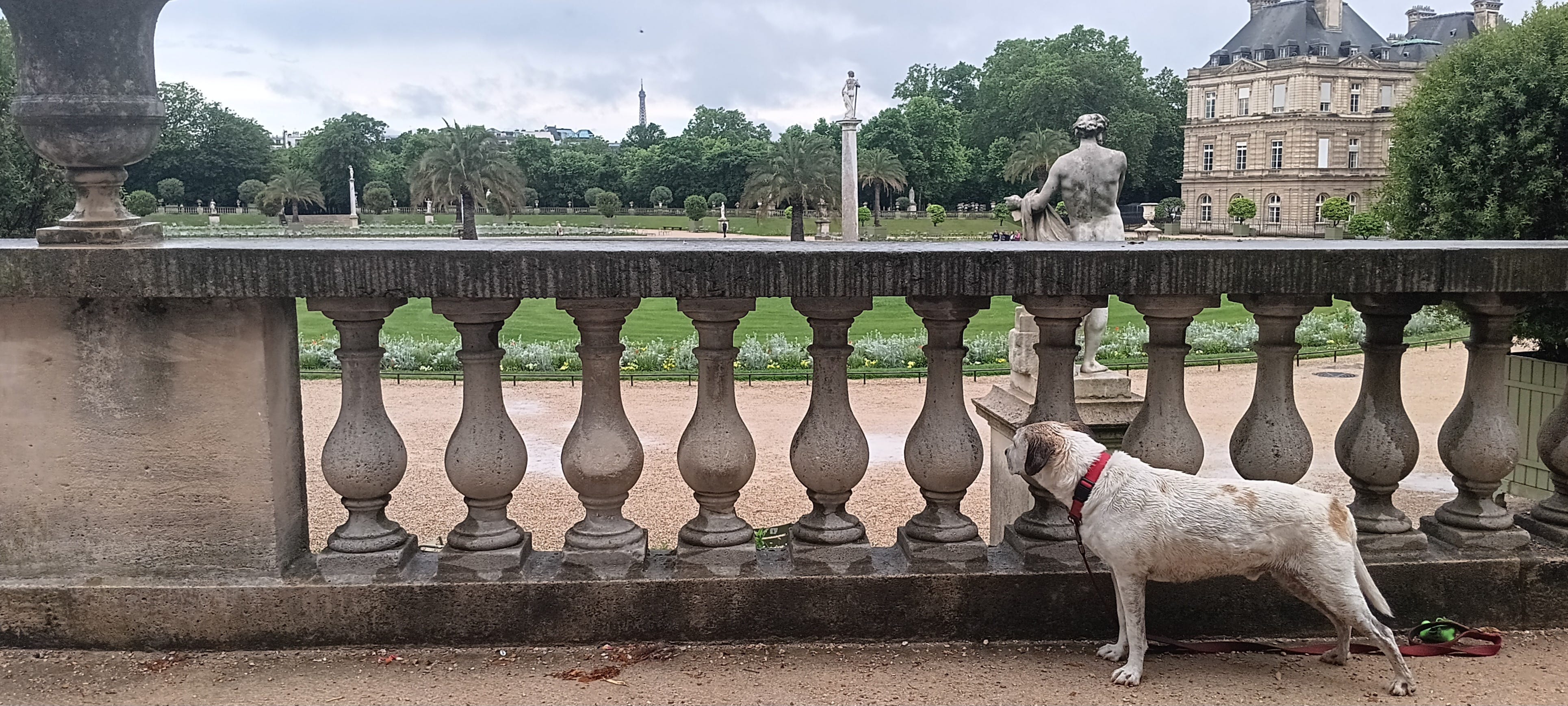
This upcoming week I will be making a trip to Potsdam, Germany, for the Science and Democracy Network annual meeting. I have only been to Germany once, years ago, and only to Munich (which was lovely, but I gather from Germans that saying “I have been to Germany but only Munich” is a bit like saying “I have been to the United States but only Columbus, Ohio” — they consider it to be a very strange choice as the only place one has been in their country, despite it being a rather significant city historically). So that should be interesting.
I have also finalized my plans to go to Edinburgh in July for the 2026 annual meeting of the History of Science Society, where I will be presenting a paper (on the “architecture of secrecy”) and participating in a round-table (on global nuclear history). I have never been to Scotland, so I am also looking forward to that.
I’ve been working on a few articles for The Bulletin of the Atomic Scientists, one of which will involve dipping my toe very delicately into the discussion about “AI” (specifically LLMs) and nuclear security. It is a big topic, and one that many very capable and able people have thought about a lot, and not one that I have particularly strong feelings about at the moment (in the sense that I do not really feel confident about predicting the future).
My article will focus on an aspect of the nuclear side of things that I know particularly well, a place where I feel I might be able to offer some non-obvious (and hopefully somewhat well-grounded) observations. Well, we’ll see…
One of the things I’ve been working on for the last few weeks have been improvements to MISSILEMAP, which has needed some updates for awhile now. The major push for making the changes is that MISSILEMAP is still running on Mapbox, which means that if traffic spikes (as it occasionally does) I get hit with a bill from them, and I am rather resentful of paying them for that. So I’ve been converting it over to the Protomaps setup that I developed for NUKEMAP a few years ago, which is much cheaper.
The problem is that the setup I developed is (like every piece of code I go back to) squirrelly and spaghettified and certainly does not explain itself. Additionally, the framework I developed for NUKEMAP, while pretty flexible, doesn’t have built-in capability for some of the things MISSILEMAP needs, like geodesic paths. So I’ve been adapting the code over (and remembering how it works, because of course it is not documented), and I’ve also made the obviously-wrong choice of re-coding the map framework along more sensible lines. It is coming along.
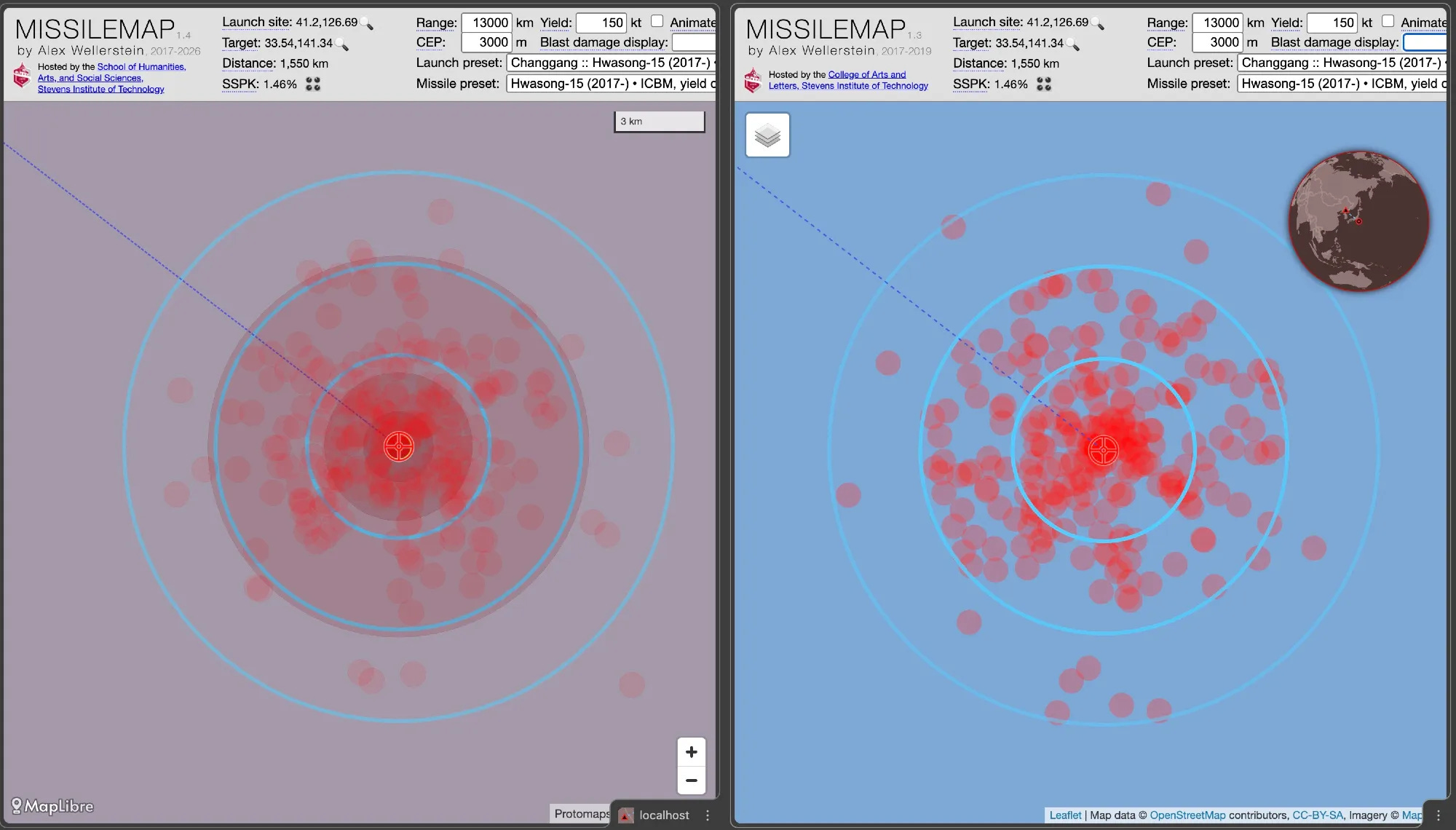
While I was in the MISSILEMAP code anyway, I re-did a few of the functions that I was somewhat unhappy with. One of them is the way it calculated accuracy (circular error probable), particularly when it “simulated” launches. The original function mathematically satisfied the definition of it, but was clearly not very “natural” in that the distribution did not look very Gaussian (smooth).
The new function is based on a better statistical function, and will even (in the future) allow one to tweak the parameters a bit. Above is a quick screenshot showing the new function (left) and the only function (right) — you can see how much more “realistic” the one on the left looks. You can also see that there are occasionally “hits” that go outside of the CEPX3 range (the largest of the light blue circles), which is possible in a better function.
For Doomsday Machines this week, I wrote about one of the stranger post-apocalypse novels I have ever read: Philip K. Dick’s Dr. Bloodmoney, or How We Got Along After the Bomb (1965).

I don’t remember when I first read Dr. Bloodmoney, but it was a few years back. I re-read most of it prior to writing the blog post, as a refresher, and it was interesting to come back to it. I had remembered the psychic phocomelus and the titular Dr. Bluthgeld, but I had forgotten exactly how Dick characterized Bluthgeld in particular, and the dark paranoia that suffused the work. I had not, prior to writing the post, thought about the contrasts between it and Dr. Strangelove, whose title the editor blatantly emulated, and I thought that was a productive way to engage with it as a cultural artifact, as it shed light on both of the works.
Keep reading with a 7-day free trial
Subscribe to Doomsday Machines to keep reading this post and get 7 days of free access to the full post archives.