

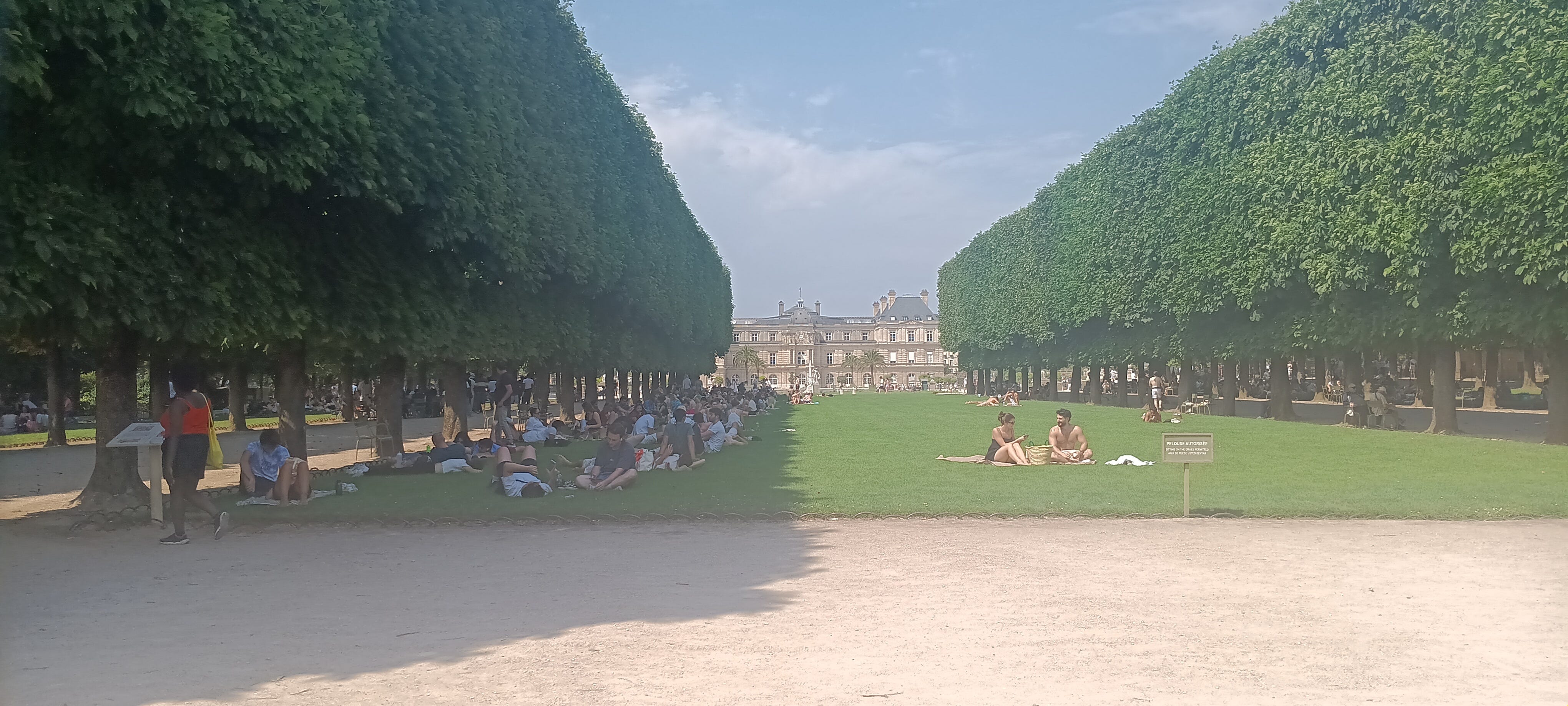
The Paris heat wave is back! It’s almost funny, because these are temperatures that Americans in much of the country would not find that impressive (from 90ºF to 98ºF or so), especially given that the humidity is generally low. I grew up in the California Central Valley, where the summers are very hot but very dry, and lived for many years in Boston, New York, and especially Washington, DC, where the humidity makes everything feel like the inside of an oven.

But, boy howdy, is it different to not have air conditioning, to have the heat be so omnipresent, to have no relief other than perhaps watching a movie or loitering around one of the few stores that has air conditioning. And even places that are air conditioned here are not that cold, because the French believe that you really shouldn’t have that much in temperature contrast.
Many of them (truly) believe that the body will undergo a “shock” (choque) under those conditions, to which I say: a) we are mammals, so we are pretty good at that kind of thing, and b) however uncomfortable it may or may not be to move between temperatures is nothing like the discomfort of just being hot all the time.
When they find that argument is not hitting the mark, they switch to one about energy resources, climate, and — in a last gasp — somehow else up talking about the artificiality of a place like Las Vegas, to which I say: nobody is talking about erecting an unsustainable temple to avarice in the desert, we’re talking about adapting to a warming world. As for resources and costs, sure, everything has a cost. But excessive heat claimed over 175,000 deaths in Europe in 2024, per the UN. That is nearly four times as many people as who died of gun deaths in the United States the same year.
Such are my frustrations with the “air conditioning conversation” here. I have met some French who are more amenable to admitting that sweating while your elderly die is not, in fact, a moral virtue. But they seem, as of now, still rare. Far more common is the “air conditioning is bad, for a variety of reasons, but ultimately, we are just better people because we forego it.” I think the Europeans actually do have the moral high ground on the United States on many issues… but this isn’t one of them.

I would be far more sympathetic if they just gave what I suspect is the “real” answer: they didn’t require it in the near past and did not feel they could afford it, they are as such not used to it, it will be very expensive to upgrade their infrastructure for it at this point, and like most people they are still a bit in denial about how climate change is actively making the world, even Europe, less livable in their lifetimes. That I can empathize with. Pseudoscience, pseudo-morality, and appeals to Las Vegas — no.
In more pro-European news, this week the historian Marc Bloch (1886-1944) is being inducted into the Panthéon. I find that extremely satisfying. When I was an undergraduate, we talked a lot about Bloch in one of my “methods” classes, in reverent tones. He is sort of a secular saint within the field of history.
Bloch was a medieval historian, part of the famous Annales school, which made real strides towards shifting the frame of historical analysis towards long-scale social and economic history and away from just political themes and the lives of individuals. He was a soldier for France in World War I. When the Germans invaded France in World War II, he wrote a famous monograph, Strange Defeat (1940), about what he saw as the cause of that disaster (the mismanagement of the French military). It is a classic example of a historian attempting to understand his own times as they happened. (Like all historians’ works, the scholarship has moved in different directions over time from what Bloch was doing. If academic work doesn’t eventually move somewhere else, it means a field has stagnated or died!)

During the Nazi Occupation, he aided the French Resistance in writing propaganda. He was eventually picked up by the Gestapo and executed. So you can see the whole secular saint thing going its full circle, to martyrdom. He’s a perfect example of someone who ought to be in the Panthéon — I was surprised, honestly, that he was not already in it. One of the things I like about French culture is that they do really seem to value these kinds of intellectuals, to a degree that is hard to imagine in American culture.
In other news, I filmed a “reaction video” for a Canadian online magazine that I’ve worked with in the past (they are mostly Francophone but have been branching into Anglophone content, and they film here in Paris). I had fun doing it, and it has been getting a lot of views (over 1.2 million at the moment, which is a lot for a channel that only has about 3k subscribers), but I do somewhat detest the thumbnail! Well, c’est la vie.
I had fun making it, as I think one can tell. Before anyone suggests that I could have said more about anything, this is cut down from a much longer session, as is necessary for such videos. This kind of thing always takes 2-3 hours to film, and even having it be 30 minutes long is pretty lengthy…!
For Doomsday Machines this week, I wrote about one of my favorite passages in the Old Testament, where Abraham is negotiating with God over the sparing of Sodom:

As I discuss in the post, I find it really interesting for a lot of reasons. The idea of haggling with God has always struck me as hilarious — Abraham gets God to agree to spare the city if there are 50 righteous men in it, and then haggles him all the way down to 10! Epic work. Ultimately it does not work, of course, but the principle is interesting. I also talked about a short story by Karel Čapek that imagines Lot’s side of the moral question, and creates an entirely different ending to the story, again based around the moral question, but now around the question about whether even the wicked have a right to exist.
As I mentioned in a footnote, there was another aspect of the story that jumped out to me as I re-read it again: God talks to himself at one point (“Shall I hide from Abraham what I am about to do?”). That strikes me as pretty rare in the Bible? I have not done a systemic study of it, but I went over Genesis a bit, and found a few other instances. In the very beginning (Genesis 1), before there is anyone to talk to, God makes some proclamations (“And God said, ‘let there be light’”). But there is one “talking to one’s self” part: “Then God said, ‘Let us make mankind in our image, in our likeness…’” And in the second creation sequence (Genesis 2), God appears to talk to himself one other time: “The Lord God said, ‘It is not good for the man to be alone. I will make a helper suitable for him.’”

Who cares? (I do not believe any of this literally happened.) As I mentioned in the footnotes, it relates to arguments that the psychologist Julian Jaynes makes about the “consciousness” (“interiority”) of ancient peoples, about whether they considered themselves to have an “inside” space separate from their speech and so on (or something like that — Jaynes is really vague about this), and he specifically talks about the differences between the representations of God in the Old and New Testaments as illustrative of his point. I don’t think these examples disprove Jaynes’ argument (whatever it really even is), because in all of them God is still talking, making little verbal declarations (as opposed to having a truly internal dialogue of some sort), but it’s still an interesting question. Does God think? Is God “conscious” in a meaningful way? What does that even mean? If I were a religious person this is the kind of thing I would spend all of my time wondering about, so perhaps it is for the better that I am not.