
Wasteland wrap-up #84
America at 250, Lyndon meets some cats, some light science fiction, thoughts on the architecture of secrecy...

I’ve never been much of a 4th of July celebrator; I have always regarded patriotism with only a slightly less dim view than I have nationalism.
So I probably would have regarded the celebration of the 250th anniversary of the Declaration of Independence with some skepticism anyway. Certainly at the moment it feels like a bitter thing: 250 years and we have this monstrosity, this perversion of ideals, this blatant evidence that the system does not work if it is meant to be a bastion of “democracy,” “rationality,” “freedom,” and so on.
I am aware that there are those who say that one should not let the worst of us define how we think about the country, but it feels like quite the indictment to me that not only is the country under the control of “the worst of us,” but that “the worst of us” is such a sizable fraction of the US population. It goes beyond mere differences of opinion about how to run a country — MAGA is not just un-American, it is quite literally anti-American, as it is Americans and the United States who will suffer the most from their policies at every turn.
They are dismantling and defrauding the country with impunity. If a foreign entity were deliberately breaking our institutions like this it would be rightly considered an act of war. And it is hard to imagine any president in modern times who would be simply allowed to sell presidential pardons for a fixed rate, who would proudly set up anonymous personal donation procedures, who would so pathetically and desperately affix his name to everything in reach, etc. If this is what 250 years has led the US to, it is a pretty sorry state of things. We’re in the middle of a long national nightmare, one decades in the making, one that I suspect will take decades to unmake — assuming it gets unmade at all. I’m not trying to be defeatist. But I do get tired of being encouraged by (well-meaning) Americans online that I should pretend I see it differently. As always with these things, I’d be quite happy if my read of things turns out to be wrong. I don’t claim to have any special insights into these things.
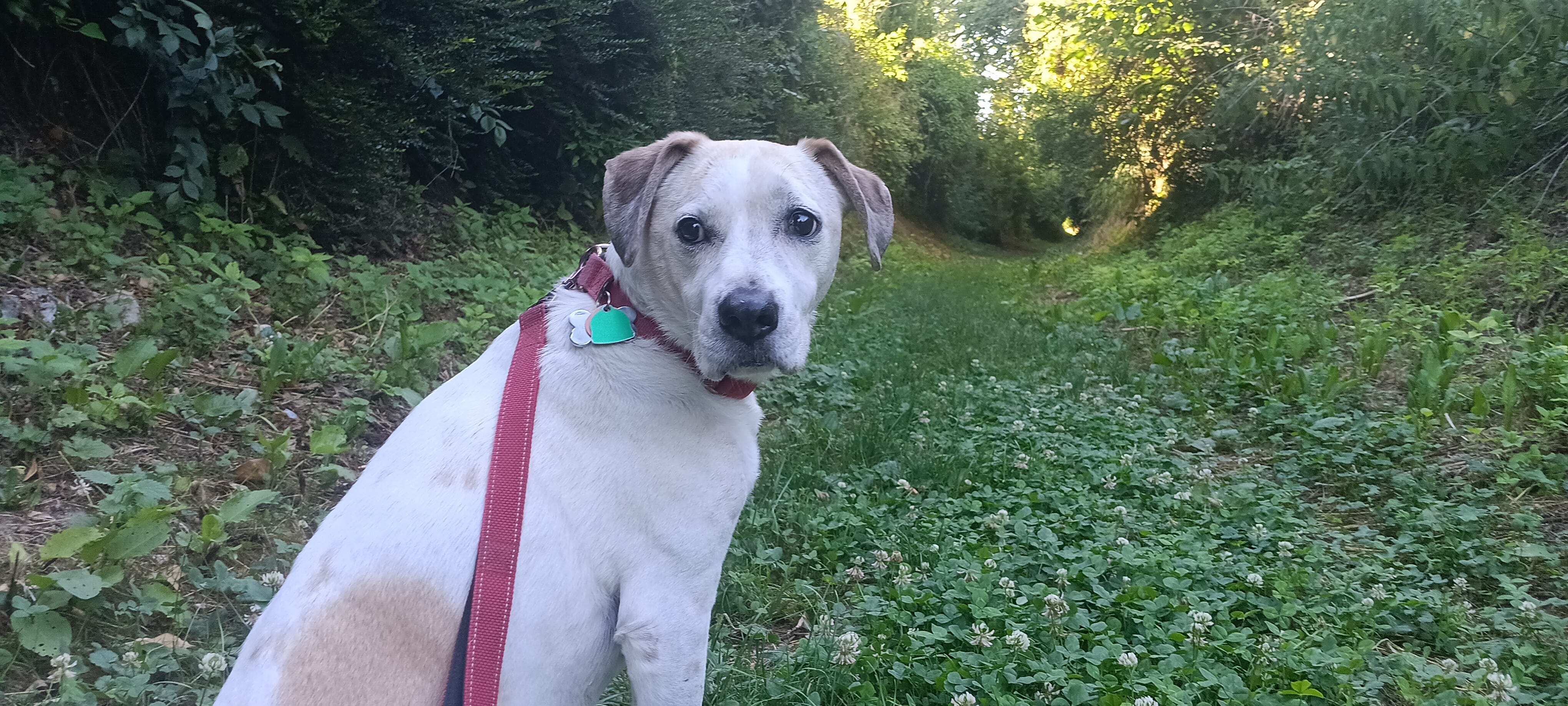
For the 4th, we ended up going to see some of my wife’s colleagues (also American expats) who live about 30 minutes by train outside of Paris. We took Lyndon along, which he enjoyed quite a lot. He was a perfect angel on the train (he had his own ticket, of the class “BIG_PET,” and was allowed to just sit between us on the floor), and was positively delighted to discover that the people we were visiting had many cats.
Lyndon has never really gotten a handle on cats. There were stray cats in Jersey City, but he was never allowed close inspection of them. He got a little bit more “cat time” this weekend, inasmuch as he stalked them, and was in turn stalked by them. Lyndon’s situational awareness is not what it used to be (he is 13 and a half!), and so humorously he would be searching for them while they watched him from perches he didn’t think to look at. At one point, shown in the sequence below, he did not realize that two cats were watching him intently as he searched their “cattery” (he did not look up). He walked around their cat trees, oblivious, to search inside of a cat carrier, and while he did so (not photographed, alas) one of them snuck down and whacked him in the tail.

Ultimately although some blood was drawn (all his, and all superficial — no cats were harmed), he seemed quite satisfied with the interactions. There were also some dogs there who were protective of the cats, but Lyndon basically ignored them. I still am not sure what he thinks of cats but perhaps he has understood a little better that they are quite capable of whacking him and that they are also quite lithe.
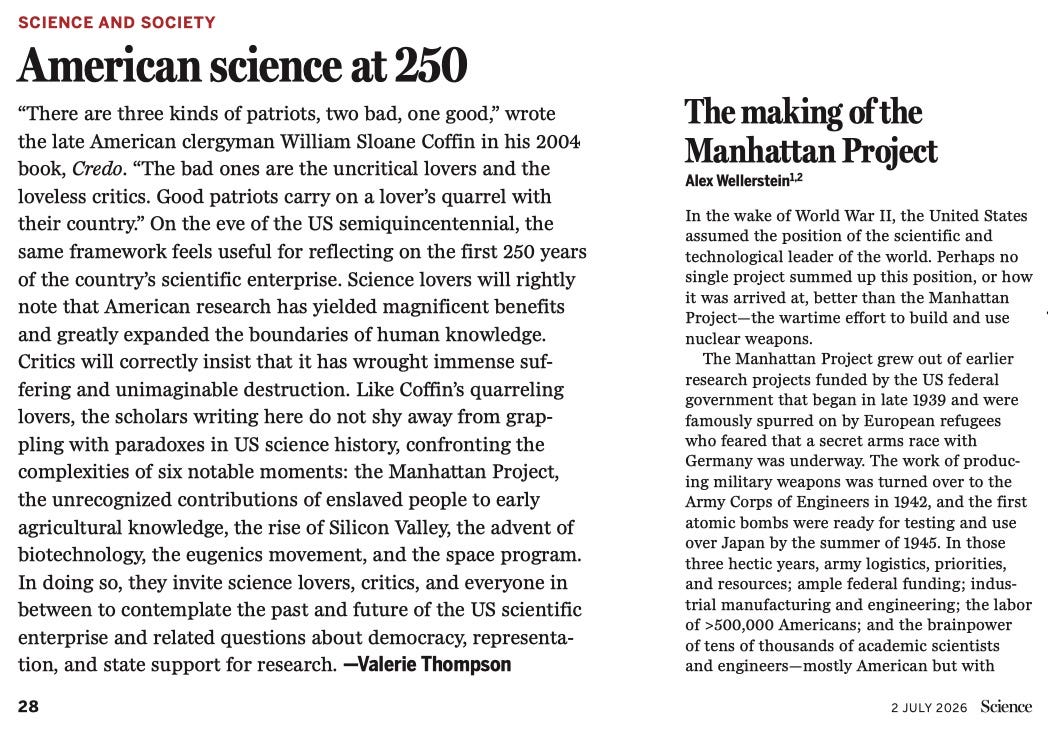
I was asked by Science to write a very short piece on the Manhattan Project for a feature they ran on American science at 250. It came out last week, and you should be able to read it here if you are interested. It is not profound, but I tried to frame the project’s role in the arc of American science, and highlight aspects of it that I think are overlooked when it is invoked as some kind of “model” for science, technology, and governmental application of funds.
I passed my French A2.1 class final exams last week, and received a “CERTIFICAT DE COMPETENCES” from the city of Paris, entitling me to enroll in A2.2 in the fall, which I was happy about and also thought was amusing. I am official competent! At basic French, anyway.
Perhaps it has given me some more confidence, as I have been told by a few random people I’ve talked with in the world over the last week that my French is pretty good for someone who has “only” been living in France for about 10 months. It’s not that good — I still mostly speak in little phrases rather than complete sentences that flow correctly — but I can usually get my point across and understand the response. And I can talk about more complex things now than I could before (I’ve gotten pretty good at using que and qui to string together phrases a bit, and feel I finally have a handle on lui/leur), so that’s definitely progress. I got my second Parisian haircut this week (I don’t get haircuts all that often, and had gotten one in Cambridge when I gave a talk there a few months ago), and it was a much easier experience than the one I got when I had only been here a month.
For Doomsday Machines this week, I wrote a post I’ve been thinking about for awhile, which was focused on the “on the ground” photos of the bombing of Hiroshima by Yoshito Matsushige:

Much has been written on these photos before, of course, although I think they are still relatively obscure outside of people steeped in bomb things. I think about Matsushige’s account of his difficulty in taking the photos a lot — that blurred line between being a professional and being a participant, photographer and victim. I also used it as an excuse to think about some of the other “visions” of Hiroshima that were available in the United States in this period, and how Matsushige’s photographs contrast with not only the “view from the above” (the “bomber’s eye view”) photos of the destruction, but even the more clinical “on the ground” photos that were taken of the injured in the weeks and months after the attacks.
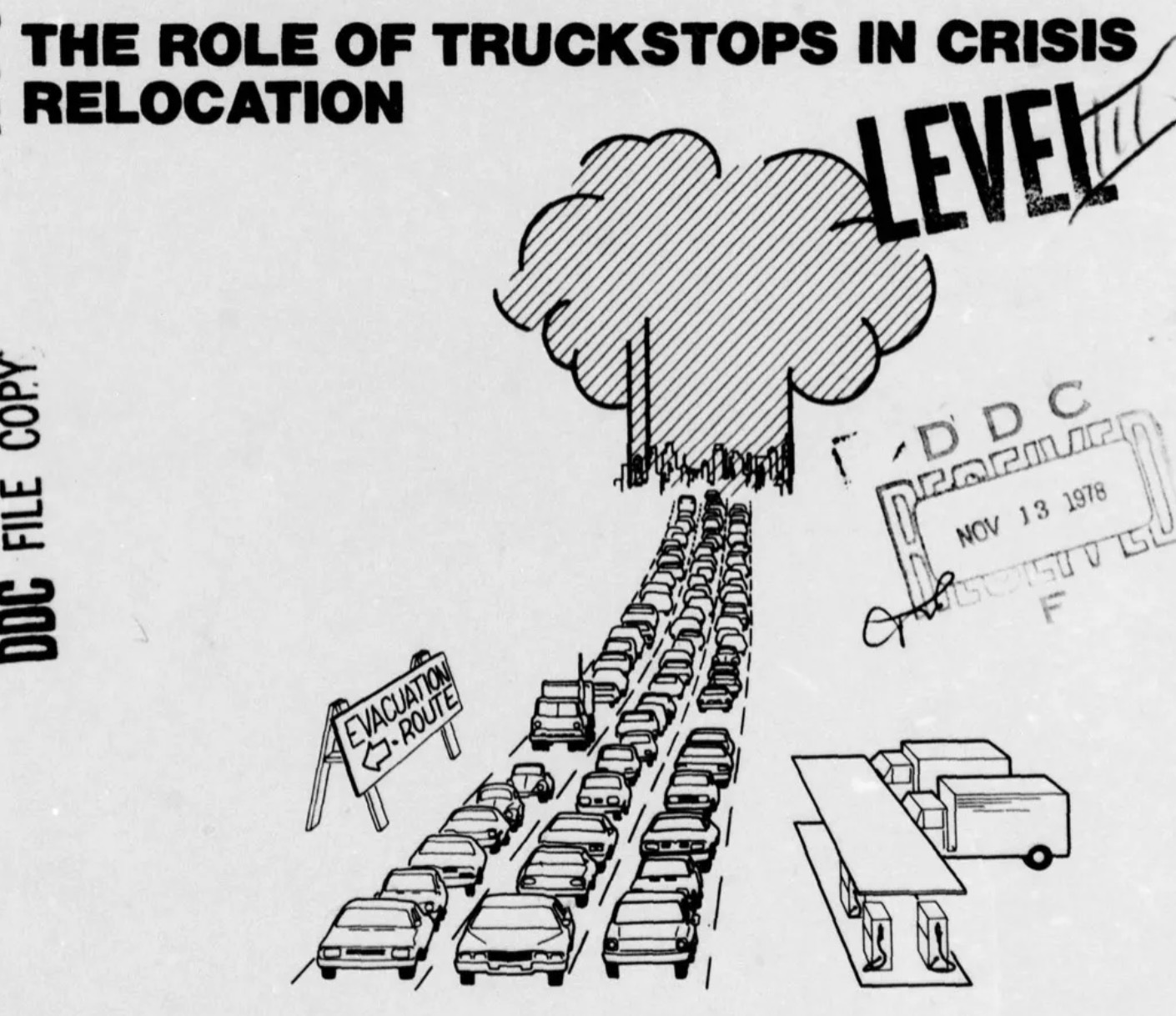
I suspect that next week I will write (as I mentioned last time) about one of the more obscure (?) nuclear weapons films I’ve been watching, but this last week I ended up dealing with a variety of deadlines (including pulling together my paper for the History of Science Society meeting in Edinburgh, in 2 weeks) and didn’t quite get to that. But we will see! I have also been doing work on Oregon Road ‘83 that has gotten me into some interesting rabbit holes (like the study from 1978 above about the role of truck stops in nuclear war evacuations), and I might write about one of those…
Keep reading with a 7-day free trial
Subscribe to Doomsday Machines to keep reading this post and get 7 days of free access to the full post archives.