

This last week, after a late afternoon thunderstorm — which gifted us with a fantastic double rainbow — the weather suddenly turned, and we have (apparently) made it out of the heat of summer and into the cool breeze of fall. Lyndon and I celebrated by going on a long walk to the Seine, and digging out my longer pants. We’ve also been so happy that they finally finished the construction work on the outside of our apartment building, which has been going on for 9 months or so.
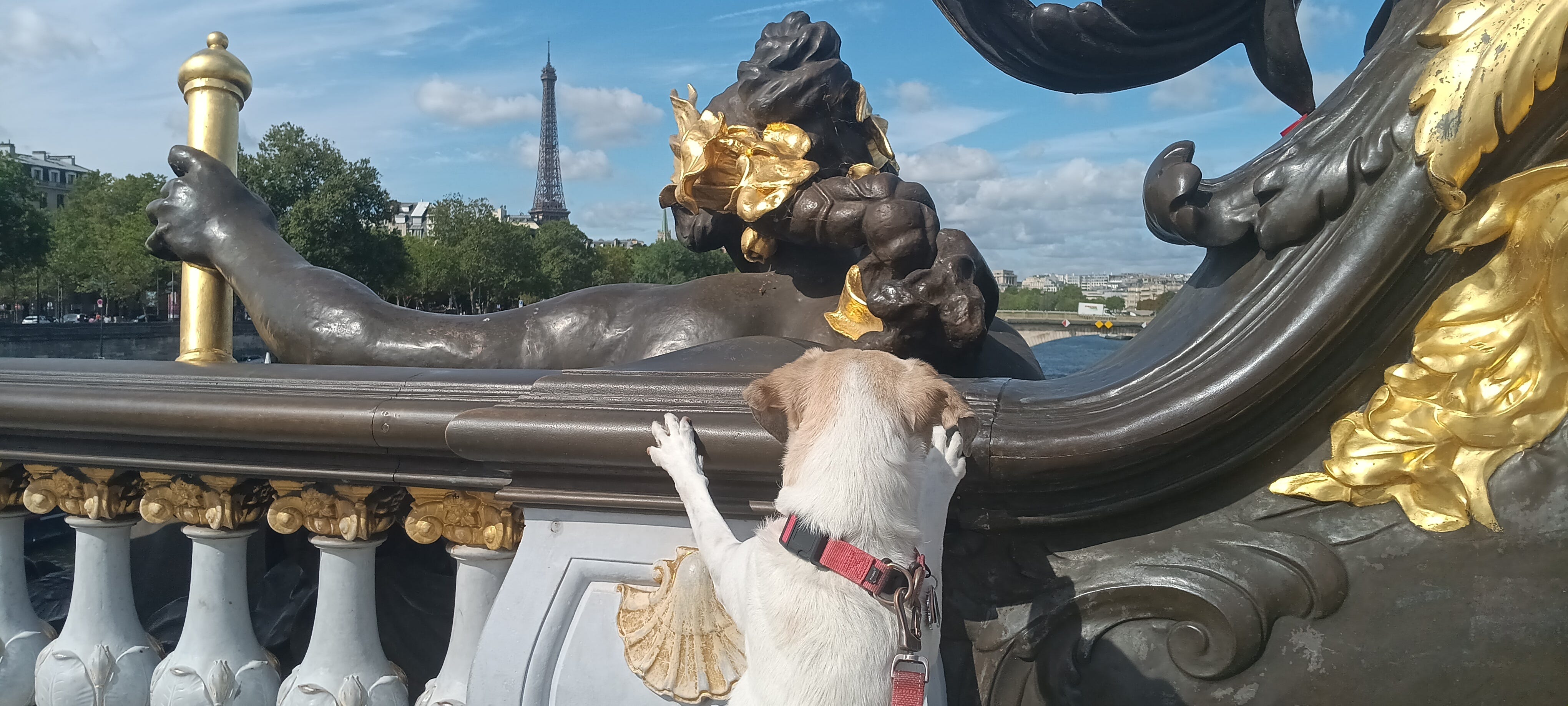
It has now been exactly one year since we arrived in Paris. That of course has given rise to some reflection. We like it here very much, as I think is evident. It is a very comfortable place to live, much more so than, say, the New York area. I am as busy with work as ever (endlessly so, it seems), but there’s something about the environment here which encourages one not to feel harassed and stressed by it all. I admit that part of that is the fact that I am so displaced, in terms of time zones, from people in the United States, where my work is still centered — I love the fact that there is a very narrow window in which anyone can expect to communicate with me in real time. It allows me to claim more of the day for myself.
The news from abroad continues to be as shameful and insane as always, but it doesn’t bleed into my own mental health nearly as much as I know it would if I were in the middle of it. I still can see signs of decline and decay from here, particularly when I talk to people from back home about “how it’s going” — so many little signs and indications leak through even innocuous reports, much less the more depressing ones — but they’re not part of my lived physical experience here. This was a large part of my motivation for wanting to get out: I felt like living in the United States for the last ten years were basically a form of almost unrelenting psychological warfare against the mental health of its citizens perpetuated by politicians, big tech, and the media, and I was just not willing to keep playing along.
I saw a former student of mine a few weeks ago, someone I saw graduate before I left. He was doing a sort of modern version of the Grand Tour, which is to say, bouncing around European cities, staying in hostels or crashing with people he met, checking out the scene and the vibe as a young musician who was trying to find out what kind of world there is out there as he looks for his place in it. I wonder what my own life might have looked like if I had done something like that at his age — it never occurred to me that it was something one could do.
We had a lovely conversation while walking around a bit, and one of the things we talked about is the way in which this kind of exposure to the world, which is “travel” but not exclusively “tourism,” expands one’s sense of this Earth we live on, this civilization we are part of.
The way I tend to phrase it in my mind, which is admittedly imprecise, is that it paradoxically makes the world seem much larger and much smaller at the same time. Smaller in the sense that one truly begins to see that, yes, you could get on an airplane, or a train, or a bus, or a boat, and simply be somewhere else. It has never been easier, in some respects, at least if one is coming from a place like the United States (whose passport, despite all of its insults, is still a powerful one, and means that no country really cares if you just show up for a bit), and have some modest (by American standards) expendable financial resources. When one is inside the United States, I feel like there is this sense that the world is quite far away, that other countries are places that can only be visited at specific times and interacted with in specific ways (tourism) and the idea of moving to one is seen as a tremendous, nearly impossible journey. But once you bounce around a few of them in a more casual way, one sees that people live all over the place, and that every major city is full of immigrants (and Americans), and that people do this kind of thing every day.
The world seems bigger in the same way: you could pick out any city in any country and find it teeming with human life. There is more to France than Paris and more to the United Kingdom than London and more to Germany than Berlin and so on. When I was in the US I frequently felt (and once we announced our move we had people actually say) that surely there are not many other places to go in the world, and this is just wrong. The world is large. And while “wherever you go, there you are” (a favorite quote of mine from The Great American Sage), in every sense possible, other places are different. Each city is different from the next, and certainly each country is different from the next, even ones that by American standards are small and have been living next to one another for vast amounts of time.
The large and the small don’t quite capture it all, but it’s where my mind gets stuck. Perhaps I will find better ways to articulate it over time. A world that is full of variation and possibility, but not in an overwhelming way. Perhaps it is a combination of my American upbringing (in which one is really quite ingrained with the idea that nobody else really “matters” except the United States, that anyone who is not an American should be somewhat pitied for it) and the social distortions produced by being in the world of American higher education (in which the jobs are few and far between and one must quickly accept that one’s ability to choose where one lives is extremely constrained), but all of this has felt like a real change of mindset for me. Intellectually I think all of this is rather obvious, but actually experiencing it, that’s been something different.
Prior to moving here, I enjoyed travel, but also tired of it quite easily. I knew some people in my life who had gone on to live in many different countries, often but not always as part of careers whose “lifestyles” demanded it (e.g. foreign service), and I always thought, well, that’s quite interesting, although I wasn’t sure it was for me, and doubted the circumstances would ever come up that I would find out. And yet, here we are. I still don’t think I’m quite cut out for a life of too much moving — I like having a sense of a “home base” — but I do enjoy the opening up of horizons that has come up with simply picking everything up and going somewhere else. I don’t think I could have even thought to have done it had I not been required to move quite around the United States for school and work, or if I hadn’t known other people (through academia) who had done similar things. It is not a mindset I was born into, is I guess what I am saying — I didn’t take a trip to Europe until I had finished my PhD!

The year has been a good one. Like all years it has had its ups and downs. There were times in which I felt somewhat alienated, and despaired of ever learning the language or finding a way to make things work over here. There were of course interactions that left a bad taste in one’s mouth for a day or two, and occasionally one is just struck by the “strangeness” of another system (French academia is just very different from American academia, in ways both bewildering and frustrating from an American perspective, and one just has to come to accept that, because it isn’t going to change on your account!). There are still a few things that I have not quite gotten figured out — like how to integrate a more regular exercise schedule into my week, something with a bit more cardio than just walking around.
But by and large, I think the adaptation has been good, and things feel like they are moving in the right direction, bit by bit. I have signed up for my next level of French class, which will start in a few weeks. I have made my peace with how French (and European) academia appears to work, and am no longer struck with the urge to tell them how they ought to be doing it differently. Even the issue of air conditioning became less acute over the course of the summer, as one adapts and accepts that, well, they’re going to figure this out, eventually. And while I have up days and down days as always, I do feel that on the whole I have felt less tossed around by the world than I used to feel in the US. I still don’t have enough time in a day to do everything I want or need to do, but what else is new? I have little grounds for complaint in that area.
This week we will — with any luck — pick up our newly renewed residence permits (we were supposed to get them last week, but the department that issues them had some kind of “extraordinary circumstance” and moved it to this next week), which allow us to be here another year. What happens after that? Who can say — the world is large and small, and not entirely predictable!
For Doomsday Machines this week, I wrote about E.M. Forster’s “The Machine Stops,” a short novella (you can read it in an hour) from 1909. It is not exactly obscure, but I had not heard of it before, and stumbled across it quite by chance a week ago (I am writing something up about another film that features a fallout shelter, and somehow came upon a reference to it, even though it is not about that at all), and was mesmerized by its prescience, its relevance, and its rhetorical power.

I have not written about “AI apocalypses” on Doomsday Machines before, because it is really not my area of primary interest or knowledge, but I am hoping to have some more on them in the near future. I have become increasingly cranky about the incessant push of AI slop into every aspect of our culture, to the point where even serious applications that I use for my work are constantly asking if I would like to produce slop instead. I am utterly dismayed by how many educators and academic administrators have revealed themselves as people who do not understand the point of education or educational institutions, and as people who cannot distinguish sloppy bullshit from actual communication and ideas. So this is what I am thinking about when I read Forster’s jeremiads:
“Cannot you see, cannot all you lecturers see, that it is we that are dying, and that down here the only thing that really lives is the Machine? We created the Machine, to do our will, but we cannot make it do our will now. It has robbed us of the sense of space and of the sense of touch, it has blurred every human relation and narrowed down love to a carnal act, it has paralysed our bodies and our wills, and now it compels us to worship it. The Machine develops — but not on our lines. The Machine proceeds — but not to our goal. We only exist as the blood corpuscles that course through its arteries, and if it could work without us, it would let us die. Oh, I have no remedy — or, at least, only one — to tell men again and again that I have seen the hills of Wessex as Ælfrid saw them when he overthrew the Danes.”
I am not a Luddite in the sense that most people usually mean by it — someone who is reflexively against technological change — but I suppose I am a Luddite in the sense that I believe that people should have the ability to resist changes imposed upon them by faceless profiteers who care not one bit for what they destroy in the process. What I resent most about this current hype is not so much that it exists, but that we are all expected, sometimes required, to be enrolled in it, despite the fact that 90% of what it has done so far is blight and enshittification. The Machine slops. (Yes, I just came up with that. Yes, I’m proud of myself. Yes, you’re welcome to use it without crediting me — it seems only right.)
But again, I admit I am quite cranky about this stuff. Your Mileage May Vary. Don’t look for me in the bowels of the Machine, though — I’ll be looking for that shaft to the surface, every time…