

Panic in Year Zero! (1962) was an early and today fairly obscure entry into the genre of post-apocalyptic films. Directed by and starring the Welsh actor Ray Milland, it was a low-budget the post-apocalyptic road trip following the activities of a family in the aftermath of a thermonuclear attack on Los Angeles. While its message and aesthetic are often a bit dissonant, it makes for an interesting representation of what an American imagination surviving nuclear war looked like in the early 1960s, all set to an overly-jazzy soundtrack that doesn’t quite match the tone of the plot.
The setup: Harry Baldwin (Milland), his wife Ann (Jean Hagen), son Rick (Frankie Avalon), and daughter Karen (Mary Mitchel) have left their Los Angeles home early one morning, camper in tow, to go on fishing trip into the wilderness. While on the road and some ways out of the city, they see a fantastic flash of light in the distance. They tune in to an emergency broadcasting station, and learn that it may have been a nuclear detonation.1 They then see a mushroom cloud rising over Los Angeles. Later, a radio report makes it clear that it wasn’t the only victim: New York, Chicago, Philadelphia, San Francisco, London, Paris, and Rome are all destroyed as well, and retaliation against an unnamed enemy was also occurring.
For the rest of the film, the (nuclear) family, dominated by the patriarchal Harry, go about the business of “survival.” Harry is essentially convinced, from the first moment, that the world is about to fall apart, and that this will pit all against all. He approaches this in a hard and often condescending fashion, lecturing all who will listen about what the new facts of life are going to be. And he of course sees confirmation in this everywhere he looks, as panic, disorder, and violence start to bubble up almost immediately. Harry’s ethos for most of the film is quite simple: if it’s all against all, then he wants his family to survive, and he’s willing to do anything make that happen. Trust is a luxury he can’t afford.
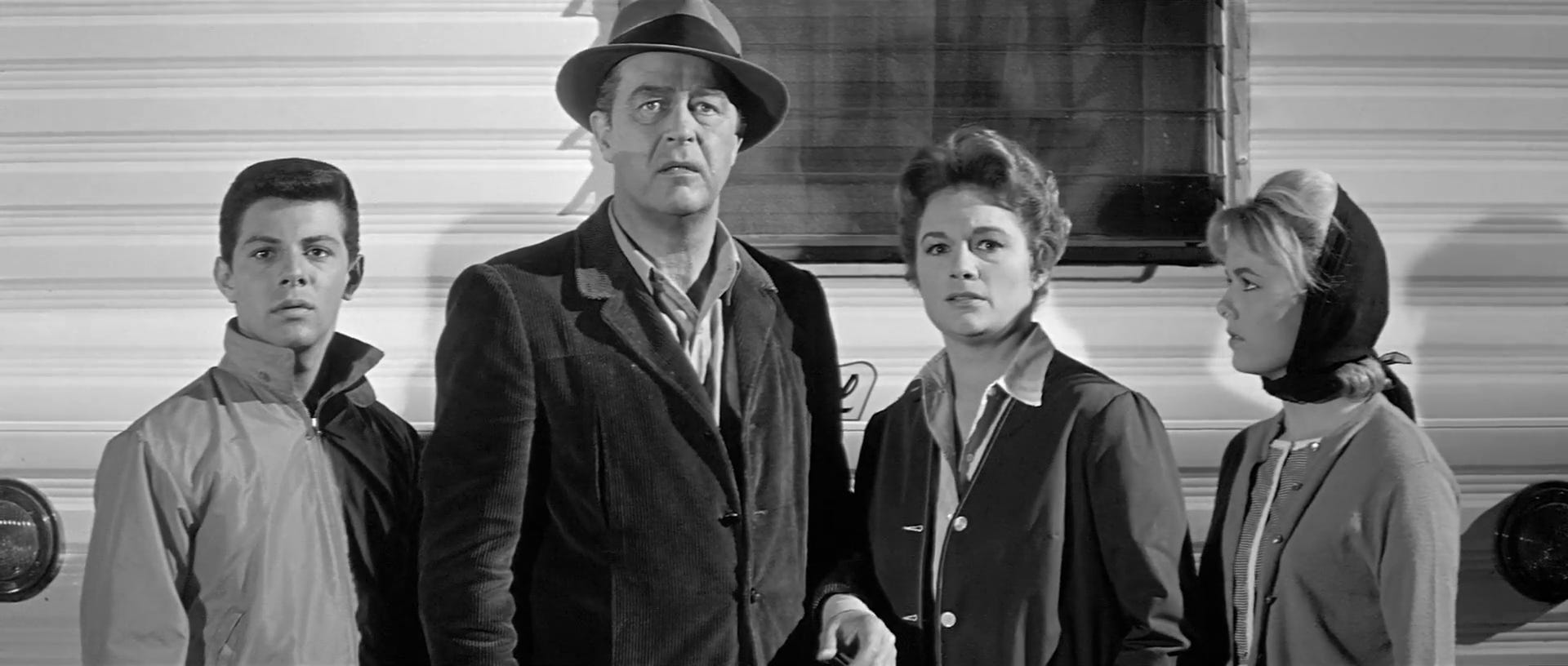
Ann, by comparison, is the voice of compassion and hope. She’s the one who frets about how her mother, in Los Angeles, is doing. She’s the one who desperately wants to avoid causing more harm in the world. She’s the one who worries that her teenage son, Rick, is all-to-eagerly embracing Harry’s dog-eat-dog mindset, and is likely to become a murderer before all of this is over. Harry has no time for this, and gives her numerous lectures about the new ethos, in a frustrated, smug, and condescending tone of voice:
Ann: Are you trying to scare me? You’re wasting your time, I’m already scared.
Harry: Look, sweetheart: two-and-two doesn’t make four anymore. At the moment it adds up to exactly nothing. For the next few weeks, survival is going to have to be on an individual basis.
A: What do you want to do, write off the rest of the world?
H: When civilization gets civilized again, I’ll re-join.
A: It’s still here.
Harry is portrayed as wanting the best for his family, but he also frequently crosses lines towards that end. Early on, he turns what was intended as an honest transaction (buying supplies from a hardware store) into a robbery when the store owner wants to do the state-mandated background check before selling Harry guns. Harry sees this as madness and, of course, inconvenient, and he even fools himself into thinking that he’s not robbing the man:
Proprietor: This isn’t enough.
Harry: Is this? [gestures with a handgun that he has just swiped and loaded]
P: Well, just about.
H: Give me a receipt for the cash.
P: This isn’t a hold up?
H: No.
P: Then what about the balance?
H: I’ll owe it to you. Write the receipt.
The proprietor and Harry get into a fist fight, which sends the gun flying. Harry cries out for help, and Rick rushes in, grabs the handgun, and jabs it into the ribs of the proprietor. Harry grabs even more guns as he leaves.
H: I owe you $200. I’ll pay you when I can.
P: In my book, you’re just a thug.
H: [to Rick] If he makes one stupid move, shoot him. Come on. [to Ann, outside, harshly] Get in the car!
This is a world on the precipice: people are still paying for things with cash and checks, both of which require a functioning society to have any value. Politeness and social norms are being followed… until they suddenly aren’t. And although Harry seems to be in denial about the fact that he is robbing the man (“I’ll pay you when I can” is a hollow promise if you believe you are about to go into hiding from a coming civilizational collapse), Ann is not.
Back in the car, Ann looks at her husband in horror while they drive.
A: I can’t get over it. All these years, I thought I knew you, but you turn out to be a stranger. Robbing and mauling people like some kind of a cheap hoodlum.
H: We’re fighting for our lives, Ann. Every footpath will be crawling with men saying, ‘no matter what, I’m going to live,’ and that’s what I’m saying, too.
A: Intelligent people don’t just turn their backs on the rest of the world.
H: Under these conditions, intelligent people will be the first to try.
Ann points out that he just enlisted his teenage son in armed robbery, eliciting nothing but any angry snap from Harry, and then Rick chimes in: “We’re on our own, Ma, no rules, no regulations, and no laws.” Harry bristles at this, too: “Don’t write off the law; the law will come back. I just want us to be around when it does.”
The depiction of Harry is quite interesting and complex. He’s clearly coded as a villain in most of these scenes. He’s nasty to everyone, including the family who are meant to be the object of all of his sacrifices and actions. He looks increasingly wild as the film continues. But, the film implies as well, he’s not completely wrong: the society is rapidly falling apart, there are plenty of evil-doers and opportunists around, and his concerns about food, weapons, fallout, and insecurity are borne out again and again. That the actor playing Harry (Milland) is also the director is quite interesting, and one wonders what he thought about it (unfortunately, Milland does not mention the film at all in his autobiography).
The Baldwin family continue on their way, committing other various crimes (in the name of survival) as they go. They run into three men who menace them with threats of violence and hep-cat lingo (“We’re the new highway patrol… someone dropped a bomb, dad, crazy kick…”), but Rick gets the jump on them with a shotgun and they are run off.
Later, the family get into a classic post-apocalyptic traffic jam of others joining the exodus (in amazing period cars). When they find it difficult to rejoin the traffic after having left it for a while, Harry creates a sociopathic “stop sign” by spraying gasoline across the road and lighting up a wall of flame. It stops the traffic, all right, but not before setting at least one car completely ablaze — which doesn’t seem to bother Harry much.
Ultimately they end up deep in the woods, living in a literal cave (to avoid fallout). If this film were made today, one would imagine that this would be seen as pretty bleak living, an outward manifestation of Harry’s internal psychological state. Instead, it is portrayed as superficially idyllic living (and, in general, none of the family’s actors ever look like they are “roughing it” — they’re all pretty clean and kept, and one must imagine that Rick brought a generous supply of pomade to keep his hair looking as well-coifed as it is).
They have access to a radio, so they have some information about the outside world. General war has broken out between the United States and the unnamed enemy, and the United Nations has declared that it is now “Year Zero.” Harry wants to eschew all contact with other people until order has reasserted itself, to Ann’s frustration. “I love you, Harry,” she tells him at one point, “but not more than a future without hope.”
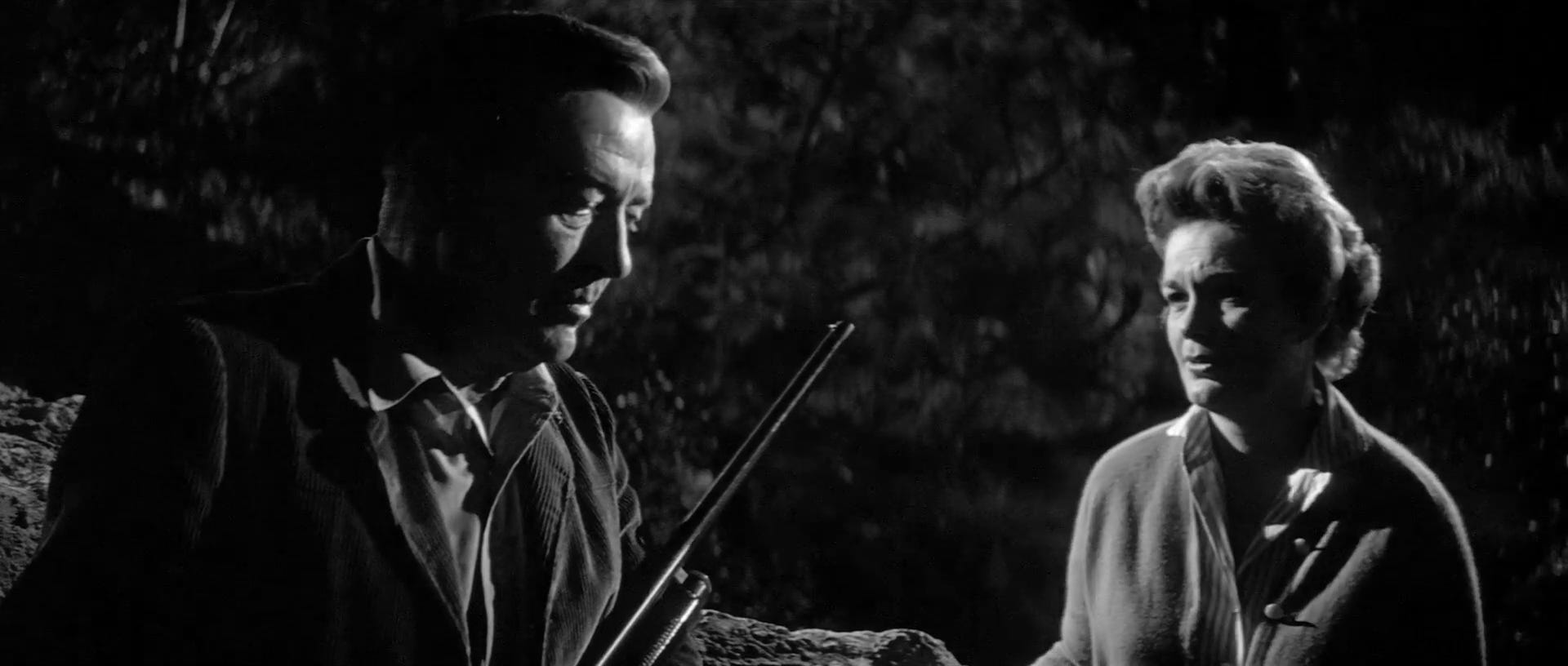
Eventually, the three hoodlums from before resurface. Two of them come across Karen, the daughter, and rape her before Ann can chase them off with a rifle. Harry and Rick track two of them back to a farmhouse and execute them in cold blood. They also discover that the trio had been keeping a teenage girl, Marilyn, as a sex slave in the house, having murdered her parents. Marilyn agrees to come back with the Baldwins after some hesitation.
That night, Harry talks with Ann, sharing self-doubts that he has hitherto kept to himself:
A: Harry, you can’t go on torturing yourself.
H: I killed two men.
A: I tried to kill them, too, but I missed, I just wasn’t a good-enough shot.
H: I looked for the worst in others and I found it in myself.
A: But you brought Marilyn here. That was kind, and good!
H: Even that was Rick’s idea.
Eventually, the radio announcer tells them that “relocation centers” have been established around the state for survivors, with the nearest one being 135 miles away. Ann and Rick are thrilled, but Karen’s experience has made her a newly hardened recruit to the Harry school of distrust:
Rick: People!
Ann: Civilization!
Karen: Some civilization.
A: What’s the matter, dear?
K: All our friends are probably dead. Our house… my school… everything’s… gone. Everything’s changed. Including me!
And she’s right — but of course, that kind of cynicism doesn’t get you anywhere. It doesn’t tell you what you ought to do next.
Harry decides against leaving; he feels they’re better off where they are, for now, and he fears the trip. He worries about “the wrong people.” Ann asks him how safe they are in their cave-forest setup, and Harry explains: “I have some measure of control here. Out there, none. Now leave me alone, please.” That night, after everyone else turns in, Harry sits outside in the dark, with his rifle. He looks stricken, and wordlessly puts his face in his hands.
The final act involves the third hoodlum coming across Marilyn and Rick chopping firewood. In the ensuing confrontation, Marilyn shoots the hoodlum, but not before he shoots Rick in the thigh. The family pile into the car and head to the closest town seeking a doctor for the unconscious Rick. While on the road, the radio tells them that the war is close to over: “Year Zero is drawing to a close.” Ann asks: “Does this mean that the war is over?” Harry replies: “For some people, yes. For us, not yet.”
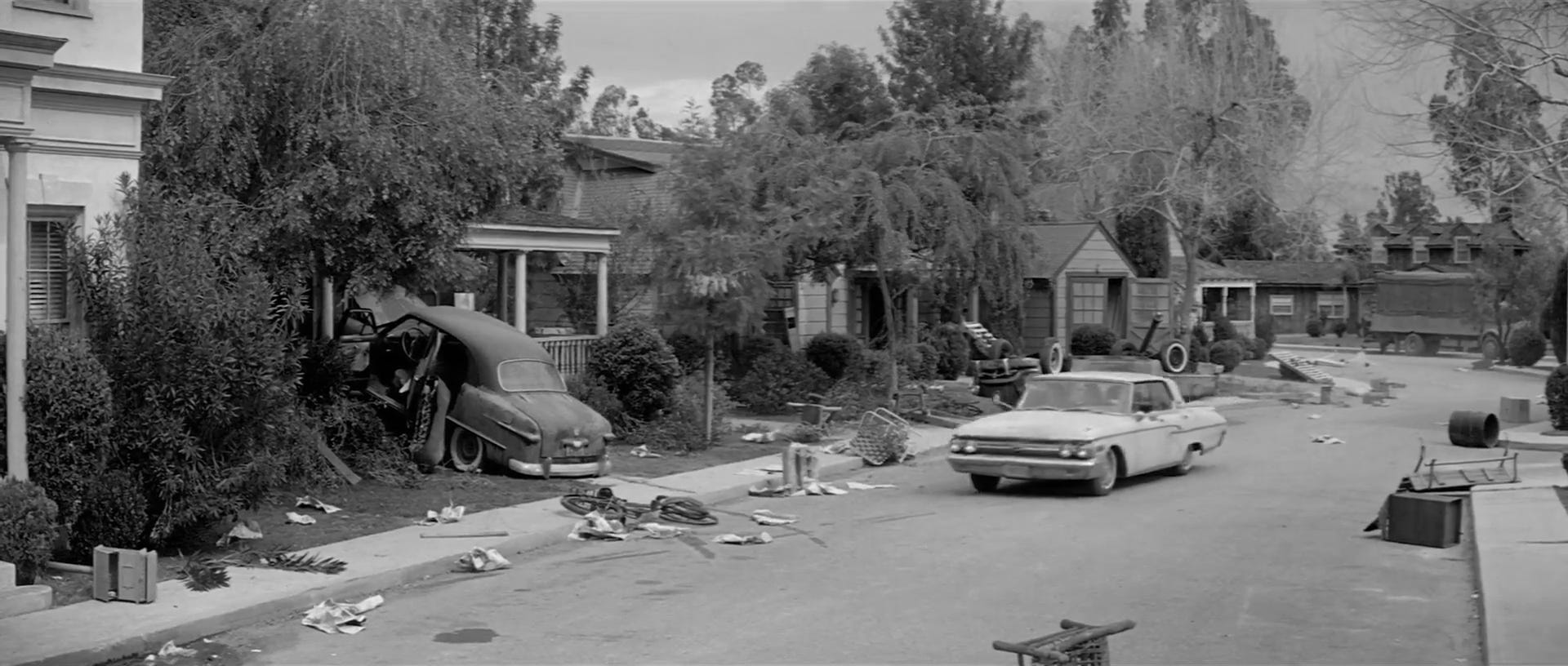
They make their way through the ruins of a ransacked town (the only specifically post-apocalyptic set in the entire film), and use a phonebook to find a doctor’s house. We get some world-building lore from the doctor, who tells them to be on the lookout for “dope addicts” and notes that he has been without electricity for two weeks. He lacks the necessary supplies to save Rick’s life, and so sends them to the relocation facility, telling them that the Army has set up aide stations there.
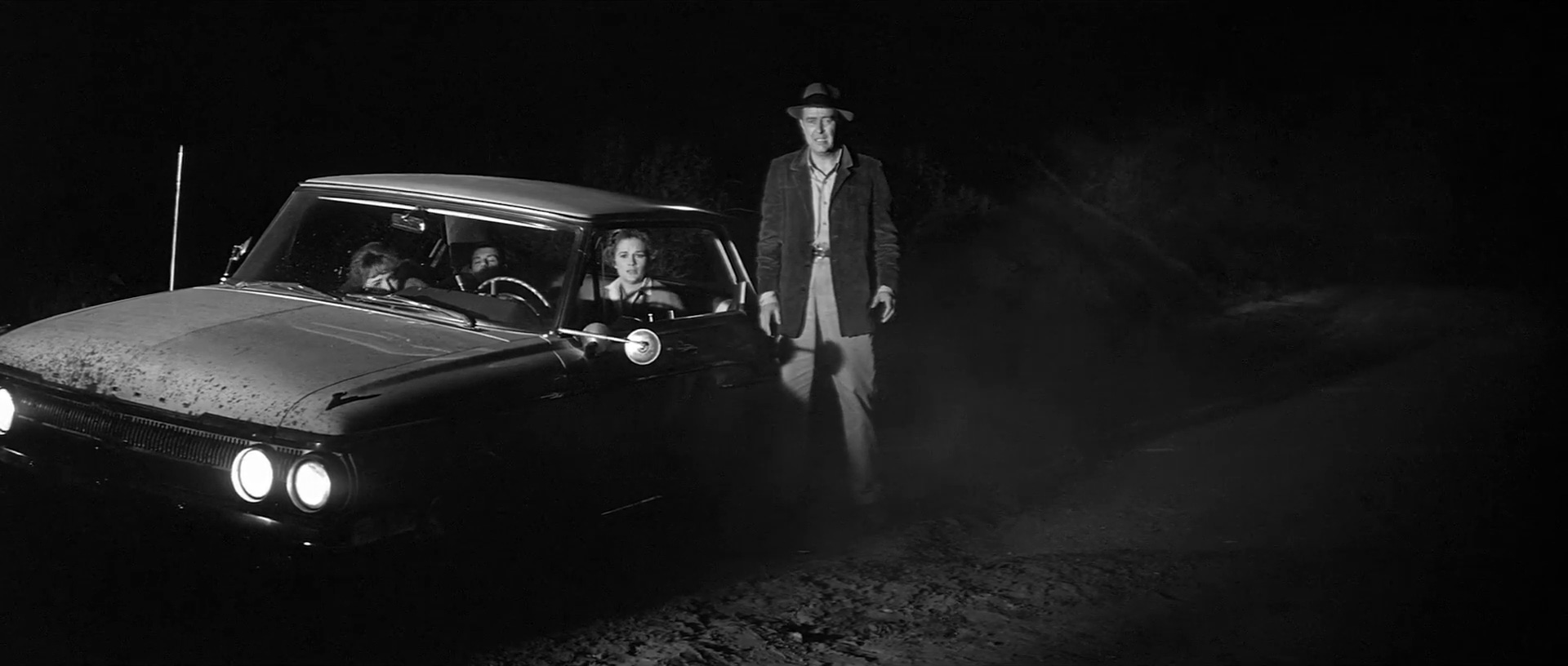
The family pile back into the car, driving into the night. They are run off the road by a vehicle, whose occupants demand Harry exits and disarms or they will fire upon them. Harry does so, fearful for his life, but it turns out to be an Army patrol, who tell them they are close to their salvation. “Thank god!,” Ann cries. As the family drives off to save risk, the two Army men look on and chat: “That’s five more.” “Five more what?” “Five more that are OK. They come from the hills. No radiation sickness.” “Yep. Five good ones.” The end.
Panic in Year Zero! is not a terrible film. It is definitely low-budget. The whole thing would have been easy to film on generic sets (some of them have a definitely “Western” look to them), with the sole exception of the single street in the looted town, and the cast is kept improbably small (I didn’t mention it, but along with the hoodlums being repeated characters, the hardware store owner turns out, completely coincidentally, to be the Baldwins’ neighbor while they are living in the forest). But the performances are decent-enough (with perhaps the exception of the hoodlums, who are ridiculous). It is actually a better film than its marketing posters from the time — which billed it as “AN ORGY OF LOOTING AND LUST” and really tried to capitalize on the rape aspect — make it out to be.
The actual post-nuclear world-building is pretty spare. There is only the slimmest discussion of things like fallout, and no context for the war is ever hinted at. This is less a film about nuclear war than it is about the appropriate lengths one can take for survival, a common theme in early 1960s fallout shelter-inspired morality tales. I appreciate, though, that their take on nuclear war is spread out over the first few weeks — that is an interval of time that is often skipped in nuclear war films, who usually focus on “the run up to war” (or near-war), “the day after” (the attack and its immediate aftermath), or “the far post-apocalyptic future.”
It is not a Survivalist/Prepper film, however. Even Harry’s individualism has its limits. He is only trying to get through a few weeks of uncertainty, and is iron-clad in his belief that eventually “the law” will return to power. He also hasn’t prepared for this outcome; he’s playing it by ear as it comes, but he doesn’t know any more about surviving nuclear war than anyone else. He is not truly a hyper-individualist; this is not a libertarian fantasy. None of this is surprising — that genre of “survival” would not become really a thing until the mid-1970s — but it is again a very different film than would have been probably made even a decade later, much less today.
It makes for an interesting comparison with John Christopher’s novel The Death of Grass (1956), which features a very similar sort of post-apocalyptic family road trip. In The Death of Grass, the protagonist becomes a harder man as a result of the world going to hell, but the novel externalizes the most extreme individualism onto another character, an antagonist (Pirrie) who is ultimately punished for his sins.
In Panic in Year Zero!, Harry has some self-doubts, but he’s largely let off the hook. His kids are the only ones who are really abused by the conditions of war. Even with them, it is implied that Rick’s injury will be healed, and while Karen’s rape is treated as an appropriately horrible event when it happens, it is also said quite explicitly that “she’ll get over it.” Even Marilyn, whose situation was much worse than Karen’s, transitions from traumatized, orphaned sex slave into a cleaned-up love interest for Rick in what appears to be a matter of a few days’ time and a shower.
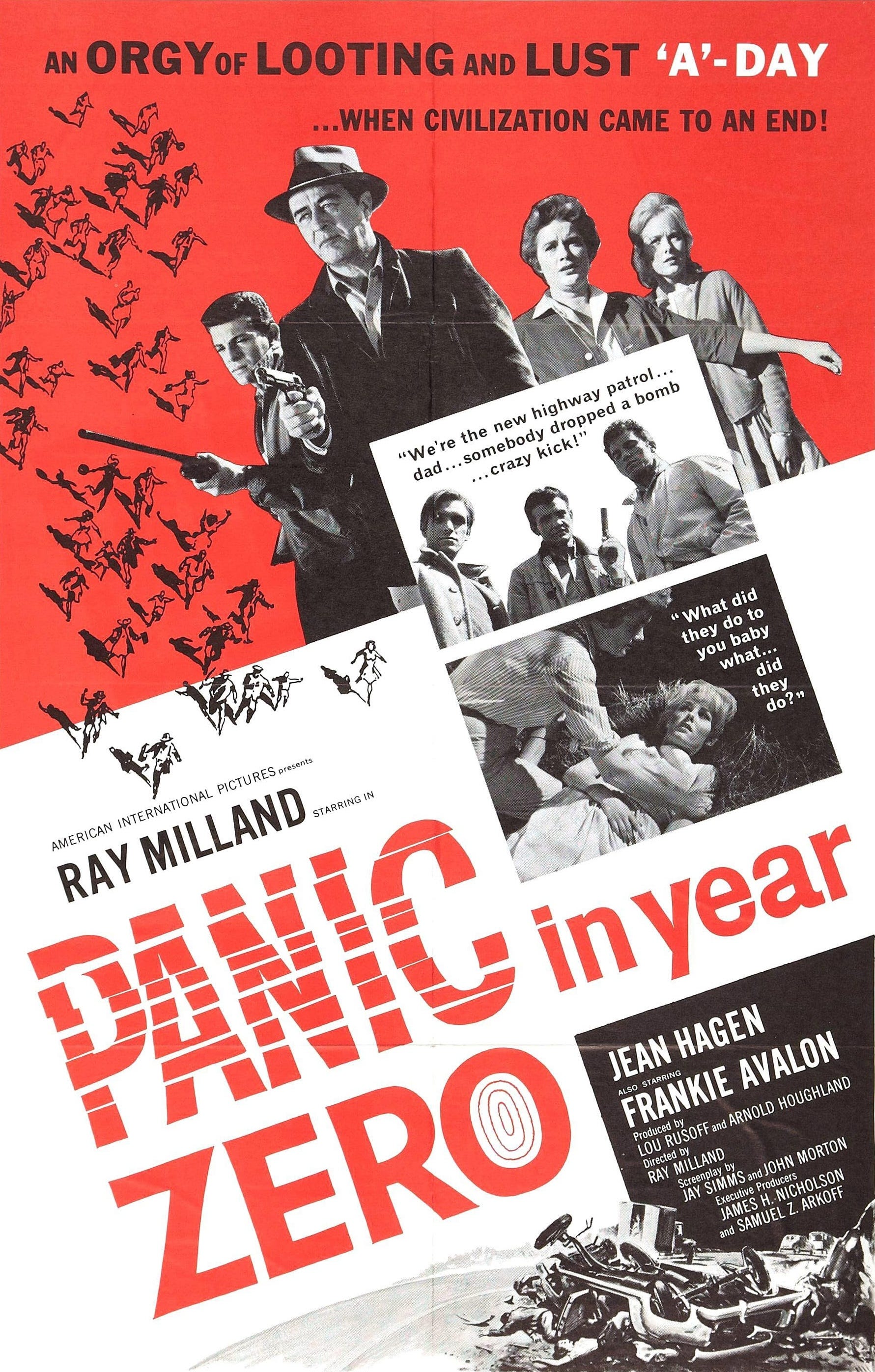
Which is just to say that the film doesn’t appear to want us to think that the Baldwins have been too traumatized by their nuclear war experience. They’ve “changed,” as Karen put its, in more ways than one, but they ultimately find salvation and a happy ending. Which makes the film’s message about Harry a little tricky to parse. Was he right in his cynical, self-interested, and often even predatory approach to survival? Harry himself only expresses a sense of guilt after he shoots the hoodlums in cold blood; he expresses no regrets about his violent thievery or his “stop sign” of fire.
The message of the film, then, is an interesting one. It’s not the everyone-dies fatalism of On the Beach (1959), and it’s not the “welcome to hell” post-nuclear vision of later films like The Day After (1983) or Threads (1984). But it’s also not a Survivalist/Prepper film. It seems to exist in a liminal space that is still largely based in a Civil Defense-approach to nuclear war, but with nascent Survivalist influences. The view it gives of nuclear war is something along the lines of: it’ll be bad, but recovery is completely possible if everyone keeps their cool and allows the authorities to reestablish themselves, but the odds are that until that happens you’re on your own, so get ready to temporarily “bug out.”
I find it an interesting question to ask how Hollywood would likely do this film differently if it was made today. It is hard to imagine that “hurray, we are saved by the Army” would be the happy ending. I suspect the “costs” to Harry would be higher — one of the kids would be killed, for example, and Marilyn would find assimilating into the family more difficult. At the same time, I also suspect that modern audiences would want a somewhat more sympathetic protagonist than Harry. If Harry had expressed more reluctance to do the things he did, and more regret over some of the things he did (I still can’t get over the “stop sign” incident), he’d be a lot more relatable. Instead, he comes off as sociopathic.
I enjoyed the film more than I thought I would. It has a sort of “what if nuclear war happened to the Cleaver family?” quality to it, Millard’s Harry is both terrible and complex in just the right ways, and even its “happy” ending is tinged with some foreboding. It somehow manages to be neither anti-nuclear nor pro-nuclear. Even if its nuclear aftermath is relatively tame compared to the vision put out in Civil Defense literature from the time, it is still no walk in the park, and as Karen points out, “everything’s changed,” and nothing for the better.
I find the intro sequence, with its lingering on the car radio with its two CONELRAD emergency broadcast stations indicated (the two circles), sort of wonderful. I continue to think it is amazing that most car radios from this period had the CONELRAD stations indicated. What a way to emphasize the threat of nuclear war, by building it into every vehicle…
Hey Where'd you get a machine gun?
I’d like to read your thoughts on ‘A Boy and His Dog’ - one of my favorite films, and one I seldom see mentioned.