
How to fight a nuclear war in 1950
OFFTACKLE, the first US war plan after the loss of the nuclear monopoly

When most people imagine “nuclear war,” they imagine the push-button “wargasm” that only became possible for the United States to do by the mid-to-late 1950s, and some time later than that by the Soviet Union. From the mid-1940s through the early 1950s, however, the US arsenal was relatively small in terms of quantity, and relatively limited in terms of capability. Consequently, “nuclear war” in this period was a different sort of beast.
The spring of 1950 is an interesting moment for thinking about US capabilities just at the end of the American nuclear monopoly. The Soviets had tested their first atomic bomb the previous fall. The Korean War had not yet started — that would happen in late June. As I write about in my most recent book (obligatory plug), the Korean War was an important turning point for American nuclear policy, and the start of the serious arms build-up that we tend to associate with the Cold War. While the Joint Chiefs of Staff had begun to take the possibility of war with the Soviets more seriously after the Berlin Crisis of 1948, President Truman himself was still opposed to re-militarizing and hesitant regarding anything like that looked like either conventional or atomic expansion. So this is before the US was actually on a true “Cold War” footing, even though the US Air Force was already beating that drum very loudly, at least internally.
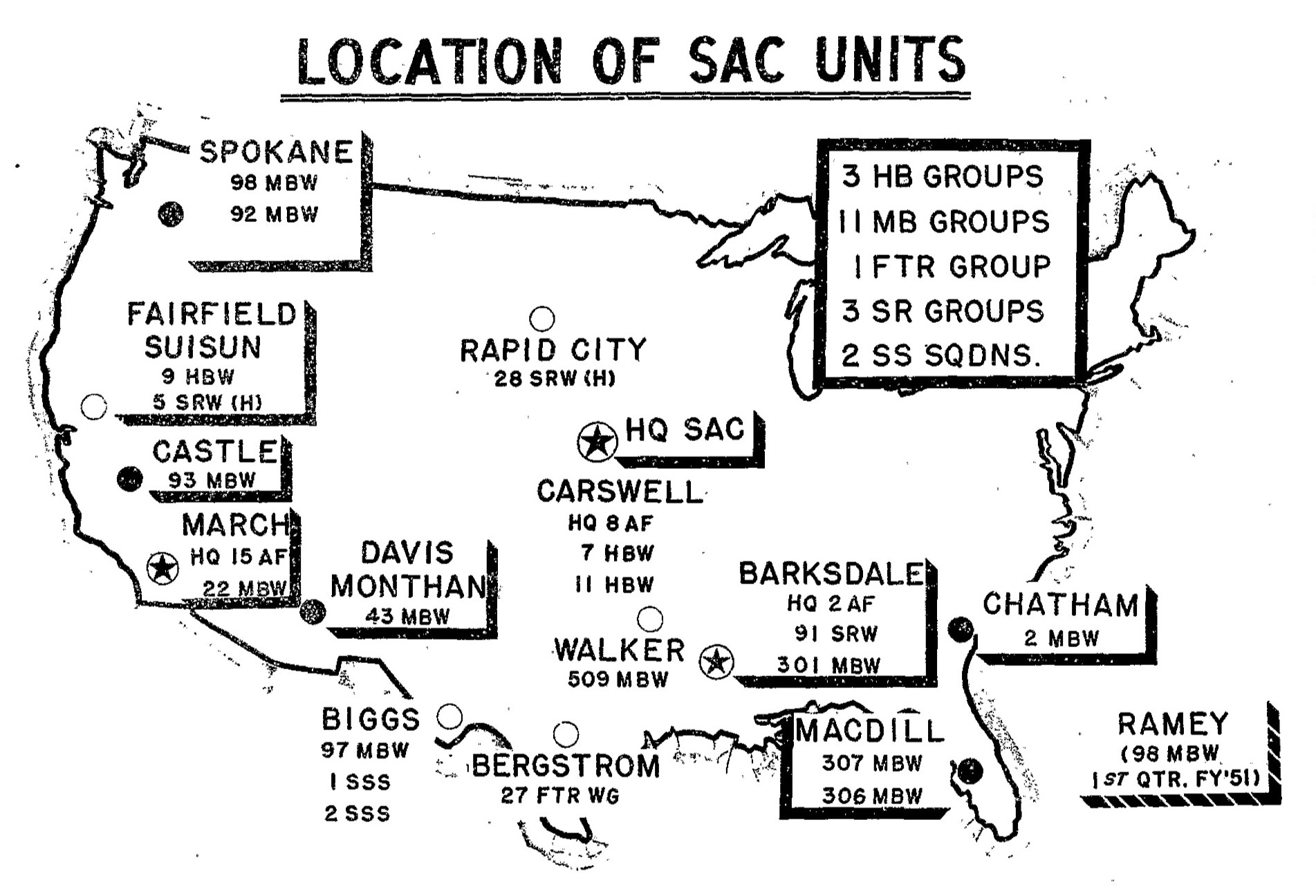
We can get an unusually good glimpse of how the Strategic Air Command (SAC) viewed OFFTACKLE, because many of the presentations for a Commanders’ Conference at Ramey Air Force Base in Aguadilla, Puerto Rico, from late April 1950 have been declassified. They make for interesting reading in and of themselves, particularly for their ideological content — the head of SAC intelligence, Maj. Geneal Charles Cabell, for example, was adamant that the Soviet Union was planning world conquest via direct military hostilities against the United States, a position he realized was deeply at-odds with how the CIA’s view that the Soviets would use subtle and sneakier tactics (subversion, playing allies against each other, etc.). Cabell urged the other SAC commanders to accept that they were not truly in peacetime: “we are at war right now and … an all-out national effort designed to maintain permanent military and political superiority over the Soviet Union is required.”1
The war plan at this time was known as “OFFTACKLE” (sometimes rendered with a space in the middle). It was a “Joint Outline Emergency War Plan” commissioned by the Joint Chiefs of Staff in November 1949, and meant to replace their existing war plan, known formally as JCS 1844/32. There were a succession of “plans” from 1946 through the 1950s with “colorful” codenames of this sort: PINCHER, BROILER, BUSHWACKER, GRABBER, SIZZLE, and so on.2 Unlike some of these, OFFTACKLE was a realistic “war plan,” as opposed to, say, early studies of what nuclear war might look like that were used for planning arsenal sizes, and were thus unrealistic when it came to actual US capabilities. (OFFTACKLE would itself, a few months later, be renamed SHAKEDOWN.)
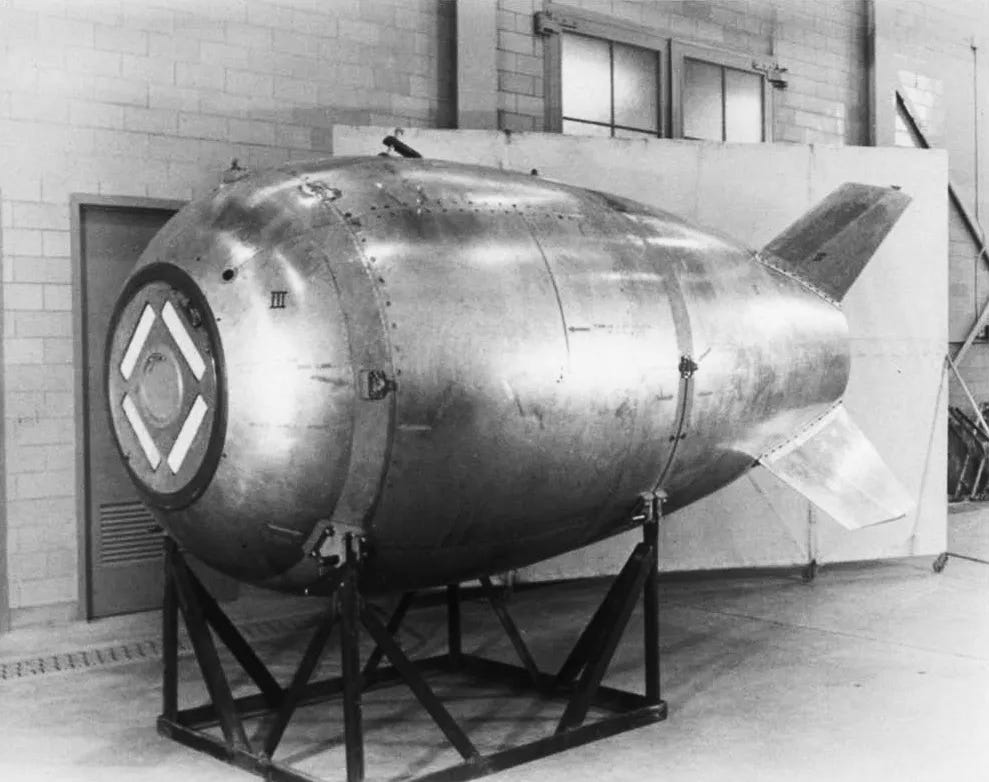
As Maj. General S.E. Anderson emphasized in his presentation of it at the conference, OFFTACKLE was the first war plan developed with the fact that the Soviets also had atomic bombs in mind. It planned for a two year war, based on the imagined capabilities of the US and the USSR starting in December 1949. It would proceed in several phases. The first would start with “D-day,” the beginning of the war, and continue for the first three months. This would be based around securing major US launching points for Soviet attacks: above-all, the preservation of the United Kingdom, but also Japan (particularly Okinawa), and the oil-producing states of the Middle East.
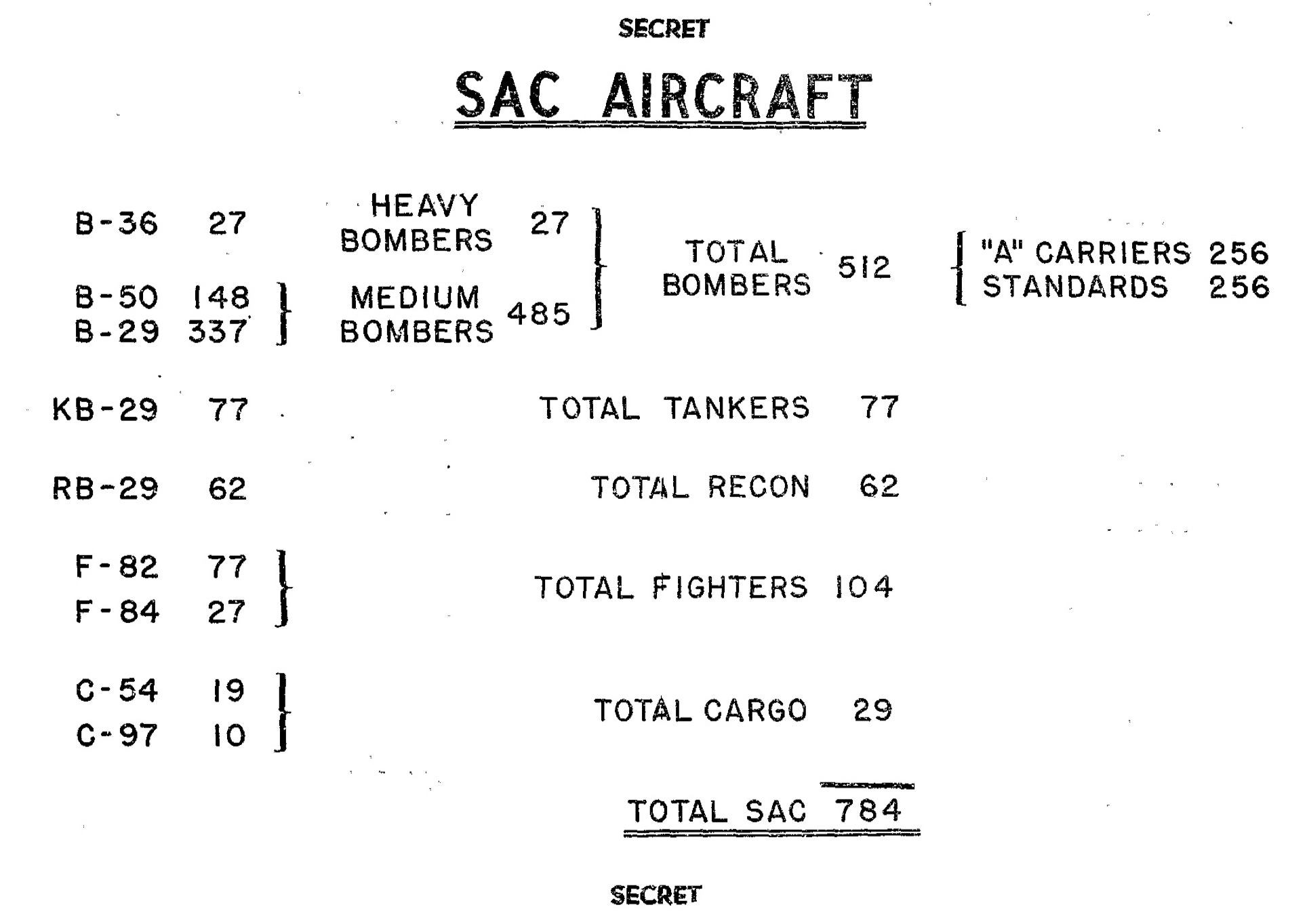
To do this would require a fast and massive movement of US forces, because the deployed forces in places like the UK were considered inadequate to the task. By the third day of the war, the SAC forces, a bit over 500 bombers largely based in the continental United States, would be shuffled around to the UK and Eielson base in Alaska. Only 256 of these were “A-carriers” — nuclear capable.3
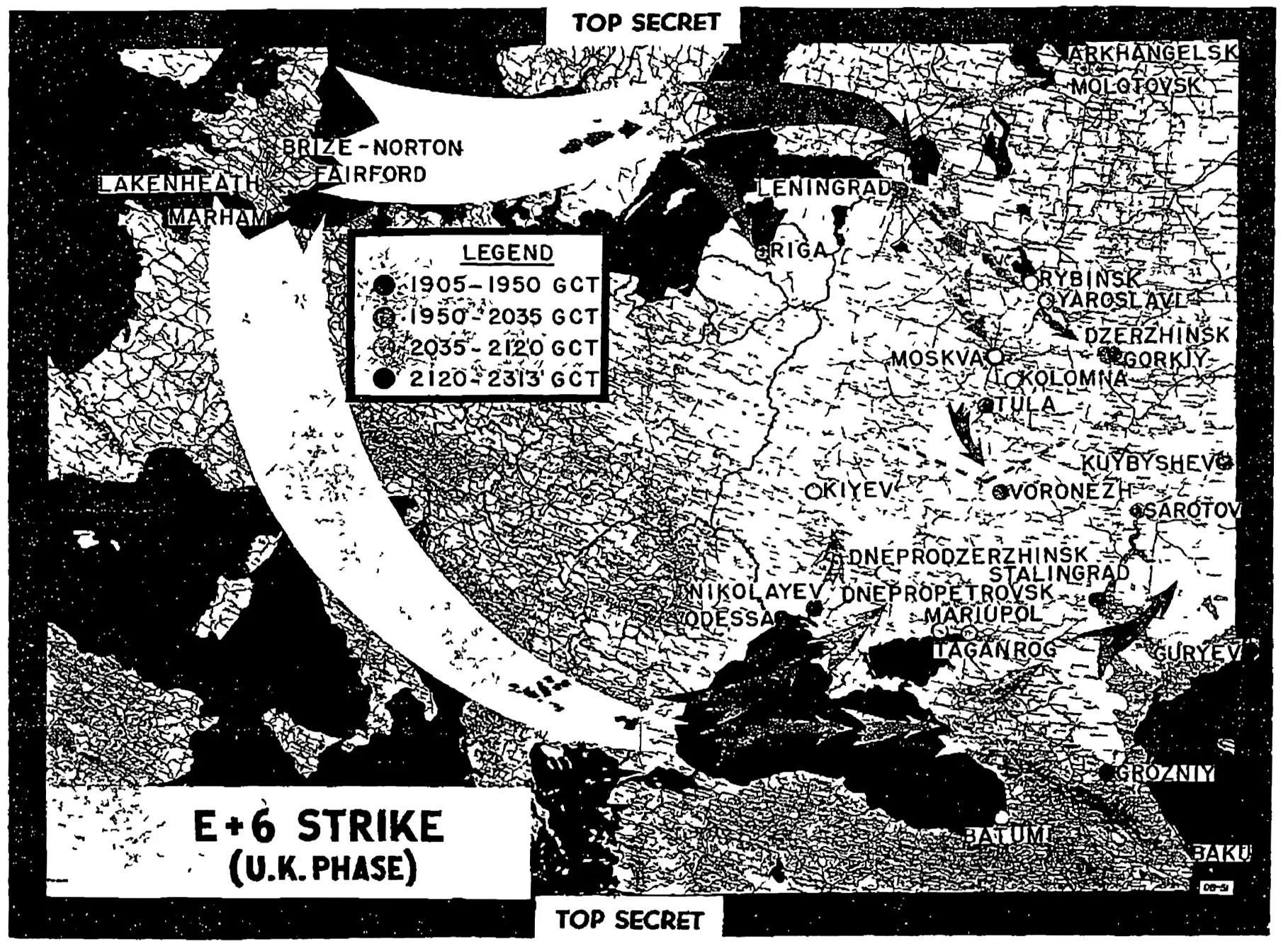
The first atomic strikes would not take place until the sixth day of the war, when medium bombers (B-29s and B-50s) would attack targets in the Soviet Union from bases in the United Kingdom, and heavy bombers (B-36) would attack from either Alaska, Canada (Goose Bay), or the Middle East (via South Dakota).4
Over the course of four hours, 26 “target areas” would be bombed by the UK bombers, who would then withdraw to bases in the UK and the Middle East. Six targets would also be hit by B-36s from the North American bases. A second strike was tentatively imagined to take place no more than three days later. If the UK bases “remain tenable,” then over the next 30 days, a total of 123 “industrial centers” would be bombed. By comparison, a previous plan, TROJAN targeted 70. Note that the US stockpile at this point was about 300 atomic bombs, with an average yield of about 30 kilotons.5 One report from February 1950 that I have says that the full plan at that moment was to drop 17,610 tons of high explosives on Soviet targets as well as 292 atomic bombs, 72 of which were set aside for “re-attack” of targets presumably not destroyed by the first wave.6
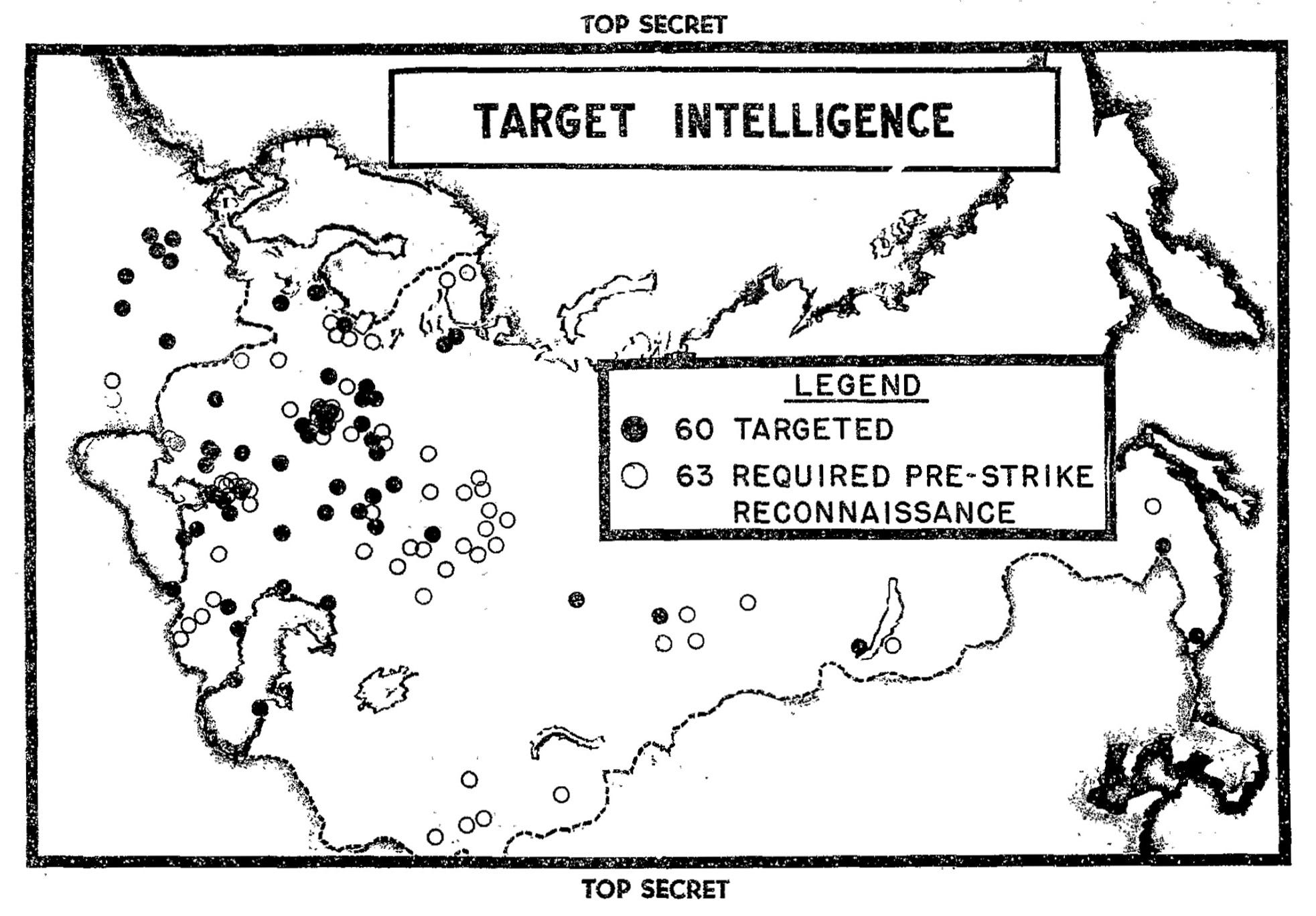
A later presentation at the same conference by Brig. General John B. Montgomery, SAC director of operations, displayed the above map of the 123 targets. It noted that adequate intelligence only existed for 60 of the targets, and that the other 63 would require pre-strike reconnaissance before they could be successfully attacked. The targets ranged across the whole of the Soviet Union, although most were concentrated in its western parts, and some where in Warsaw Pact nations.7
The second phase of OFFTACKLE would take place between the 3rd and 18th months of the war. During the period, the US and Europe would be recovering from whatever the initial Soviet atomic attack against them was, to continue efforts at defending against further Soviet attacks, to continue a “very greatly reduced” strategic air campaign against the USSR, and to maintain control of key assets like the UK and the Middle East. Very interestingly, securing Spain against invasion was also listed — it is clear that they believed that the Soviets would effectively occupy all of the rest of Western Europe up until the point. If the UK fell, SAC would move their forces to North Africa.
The third phase, from the 18th through the 36 months of the war, would involve the Allied forces pushing the Soviet forces out of Western Europe. After 24 months, they would have also created a “build up” of strategic air units for another major attack phase. The SAC presenters have very little to say about this and the previous phase, because this wasn’t their part of the war — they were the bombers. But this was clearly envisioned as a major effort that would require a significant conventional effort as well.
During a “fourth and final phase,” from 36 months until the end of the war, would involve “re-entry in force into Europe, defeat of the USSR, and the establishing of control over the defeated enemy.” There is an understandable vagueness to this stage of planning, given the unknowns and how much is dependent on how things worked out in the previous phases. And, as noted, this part plainly this would not be SAC’s job. There were, as another presentation emphasized, also many “soft spots,” places where there were need for improvements if an optimistic outcome was to be assured.
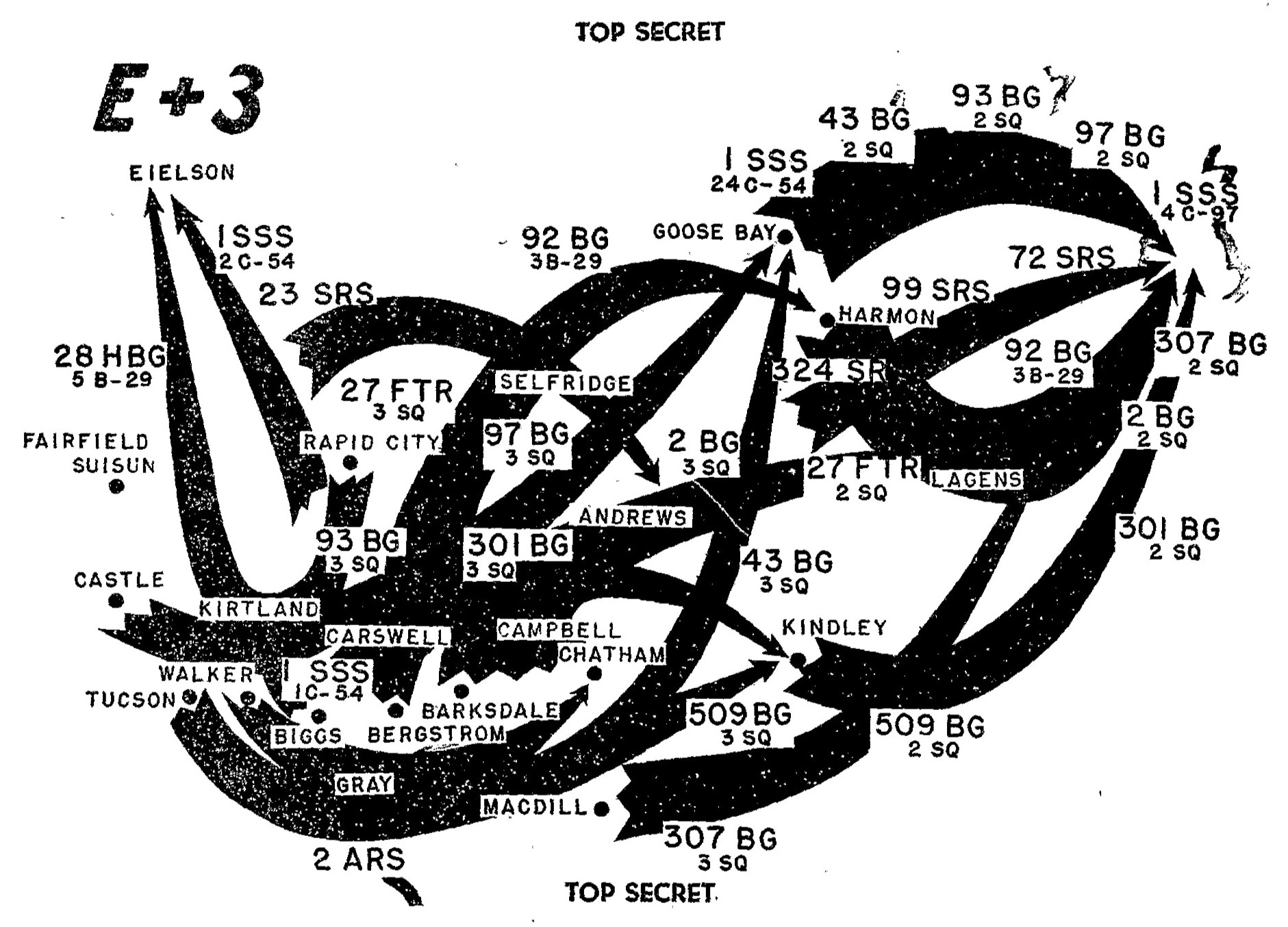
What we have here is a war still measured in months and years, not hours and days. It is World War II on nuclear steroids: an initial period of heavy bombing, but one assumed to be taking place while a massive Soviet army is invading Western Europe. Like World War II, logistics was key: you can’t fight if you’re not close-enough to do so. Holding territory, rebuilding infrastructure in real-time, continuing to put pressure on the enemy — these kinds of issues, ones which seem relatively quaint compared to the imagination of nuclear war that would dominate in a decade, still hold sway in an era where most of the weapons are being delivered by relatively short-ranged bombers, where the number of atomic bombs available is still relatively limited (to the thousands and thousands it would soon become), and where a Soviet attack on the USA is assumed to be something the US could recover from in a few months.
There was no discussion of casualties from what I can see. This is hardly surprising, but seems worth noting. This is a vision for how SAC saw its job in the event of a nuclear war at the time. It was not something that would be easily to implement. At this time, the US military had access to exactly zero fully-assembled nuclear weapons — their nuclear cores were still being kept by the US Atomic Energy Commission. Assembling the weapons had gotten a bit easier since the early days of the atomic arsenal, but there were still a limited number of trained teams who were capable of doing it, and a limited number of both weapons and atomic-capable aircraft. SAC was planning to use only six “assembly teams” available to put the weapons together for OFFTACKLE.
The atomic bomb was definitely a central part of this war plan, as can be seen, but it’s an ugly, gritty-looking war. There is no sense that the atomic bomb would be decisive in and of itself. There is no delusion that the Soviets would be totally destroyed by the initial atomic assault, nor that they would immediately sue for peace. In this period both Soviet and American planners agreed that atomic bomb alone “would not win the war,” as David Holloway puts it.8
One can readily see why even the SAC commanders had little enthusiasm for this kind of war, little belief that this was something one would want to voluntarily get into. I mention this because a frequent question online is: why did the USA not use its atomic bombs to preemptively destroy the Soviet Union? Aside from the political and moral aspects to the question (nothing could be further from Truman’s intentions at that time), a strategic answer is that doing so would hardly be a walk in the park, and an ultimate victory, defined as a total elimination of the Soviet Union, was hardly assured. OFFTACKLE was one of the more optimistic plans they had considered at the time, and it’s not all that optimistic, as the commanders themselves recognized.
How did the Air Force commanders receive this information? We have limited sources to answer this, but one is interesting. Immediately after the conference on OFFTACKLE, General George C. Kenney, who had until 1948 been the head of SAC, wrote a letter to General Hoyt Vandenberg about it. He was blunt in his assessment:
It was quite evident to all the conferees that Plan “Offtackle” was decidedly unrealistic. The one conclusion that almost everyone seemed to reach was that if we waited until Russia hit us, Europe, very probably includ[ing] the United Kingdom, would be lost to us. To repeat the Normandy Beach operation is something that is almost inconceivable. The problem of gaining air superiority over the beachhead two or three years after the shooting war started and after Russia had organized her defenses against such an invasion, the overcoming of the submarine menace in order to embark the huge number of troops and supplies for such a landing, and all the other complications in the face of atomic weapons or even conventional air operations, would seem to rule this type of warfare into the realm of impracticability.
He then went on to criticize nearly every aspect of the plan. He did not think that the US would be able to hold an inch of Western Europe, and that it would take “years” to gain adequate bases in the Middle East. He continued:
I believe that any plan looking toward July 1, 1952 as the probable D-day of a third World War should visualize that we will have no holdings on the other side of the Atlantic. Our primary move will be made by the Strategic Air Command against targets in Russia itself. If our air defense is good enough to prevent the Russian A-bomb attacks from knocking us out of the war and the attacks of our Strategic Air Command are powerful enough to bring Russia to terms, we will win. If not, we will either lose the war or get into a long-drawn-out contest that we certainly will not win and which will probably result in a stalemate with both sides exhausted and civilization as we now know it a thing of the past.
Which is both depressingly realistic as much as it is dire: World War III, Kenney is saying, needs to be predicated on the “wargasm,” on the total and utter destruction of the Soviet Union with nuclear weapons, and no nonsense about holding territory and playing at a World War II redux. More than that, he felt that the assumption that the US would not initiate a nuclear war would have to be banished: “We have got to do something about the conception that we must wait until Russia hits us before we can start shooting. … By all previous definitions, we are now in a state of war with Russia. Whether we call it a cold war or apply any other term, we are not winning. … It would not be a preventative war, because we are already at war.”9
Transcript of Strategic Air Command Commanders’ Conference (25 April 1950, Ramey Air Force Base, Puerto Rico), pages 2-8. Copy in the Gale U.S. Declassified Documents Online collection, document CK2349592568, but is ultimately attributed to the National Archives and Records Administration.
A biography of General Hoyt S. Vandenberg has an amusing bit about the codenames in it: “Sorting out war plan codenames is nearly as big a chore as keeping straight all the World War II codenames. For example: HALFMOON begat FLEETWOOD which became TROJAN, then DOUBLESTAR, father of OFFTACKLE, sire of SHAKEDOWN, whose son was CRASSPIECE, etc. Said a leading authority on the subject, David Maclsaac [in 1979]: ‘Both the air staff and joint planners continued work on a whole series of so-called war plans whose only long-range significance would be to provide historians the problem of trying to sort them out.’” Phillip S. Meilinger, Hoyt S. Vandenberg: The Life of a General (Indiana University Press, 1989), 237 fn. 12.
A chart in the presentation at the conference by SAC Director of Operations Brig. General John B. Montgomery indicates that at the time, OFFTACKLE was imagined to use 27 B-36 (“Heavy bombers”), and 148 B-50 and 337 B-29 (“Medium bombers”), for a total of 512 bombers. There were also 272 support planes, of which 104 were fighters. Brig. Gen. J. B. Montgomery, “Resources and Status of the Strategic Air Command,” presentation for the SAC Commanders’ Conference (25 April 1950). This copy comes from Brill Primary Sources’ Weapons of Mass Destruction collection, but is ultimately attributed to the National Archives and Records Administration.
For OFFTACKLE, it was contemplated that there would be eight UK bases used, and two “staging bases” in the Middle East (Dhahran, Saudi Arabia, and Cairo, Egypt). The briefing makes it clear that all of this was still just being planned out — all of the bases had deficiencies and were not ready to implement the full OFFTACKLE plan.
The US DOD/DOE numbers say that in 1950 (probably around fiscal year) there were 299 atomic weapons in the US arsenal, with a total yield of 9.53 megatons combined. So that comes out to 32 kilotons per bomb on average. By the same time in 1951, the US had 438 bombs with a total yield of 35.25 megatons — an average of 80.5 kilotons per weapon, a very impressive increase for the fission era. In the next few years, the average yield would go down (59.4 kt for 1952, 62.3 kt for 1953) as lower-yield tactical weapons were developed. US Department of Defense and US Department of Energy, “Declassified Stockpile Data 1945 to 1994,” DOE OpenNet (1995).
“Report on the Evaluation of Effectiveness of Strategic Air Operations,” JCS 1952/11 (8 February 1950), which includes a copy of WSEG Report no. 1. Copy in the Gale U.S. Declassified Documents Online collection, document CK2349359741. The WSEG report cites these attack numbers as an example of how “unrealistic” OFFTACKLE was in some of its particulars, as to do this would require some 6,000 sorties, and the “current strategic reserves of petroleum produces are inadequate to support an effort of this magnitude.”
The western border of the USSR in both of these maps is quite curious — it appears to use the pre-WWII borders of Poland. I would not read too much into this, in the sense that I am sure their actual war planning maps used accurate borders and that it is only for these “digestible” maps that they were relying on by then nearly 10 years out of date borders, but it is still interesting that they would make such an error.
David Holloway, Stalin and the Bomb: The Soviet Union and Atomic Energy, 1939-1956 (Yale University Press, 1994), 240.
George C. Kenney to Hoyt S. Vandenberg (29 April 1950). Copy in the Gale U.S. Declassified Documents Online collection, document CK2349592714.
On the question of Poland’s borders, this probably reflects the US’ rejection of Soviet territorial claims from both before and after WWII. For a long time, for example, the US did not accept the absorption of the Baltic states into the SU. Official US maps showed them as independent states. I think it was the Helsinki Accords that ended this practice.
I'd be interested to see what the other side (USSR) was saying. I've been told the USSR's plans were quite good, detailed, and not very offensive in nature (most particularly in the 1960s, when they couldn't have attacked if they'd wanted to... oh, well).