

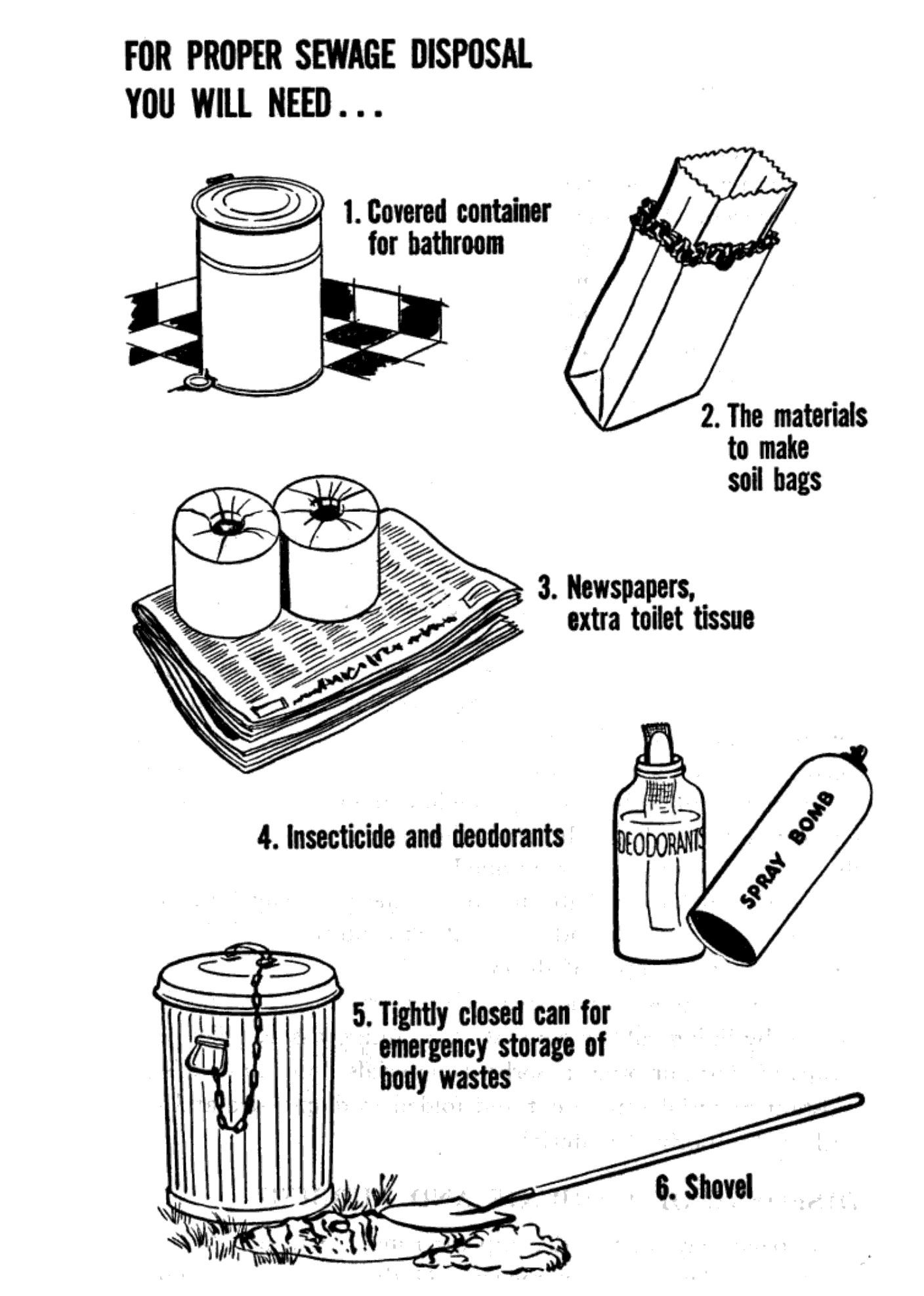
Most US government-produced imagery about fallout shelters was clean, calm, and collected. Illustrators showed happy, white, suburban families in neat little spaces, doing “normal” activities like reading books, telling stories, and playing with toys. You’d hardly know that there was a nuclear war on, based on these images. It is the rare image, like the one below from Survival in a Nuclear Attack (New York State, 1960) that even acknowledges that trash and waste might be something you’d have keep in mind.
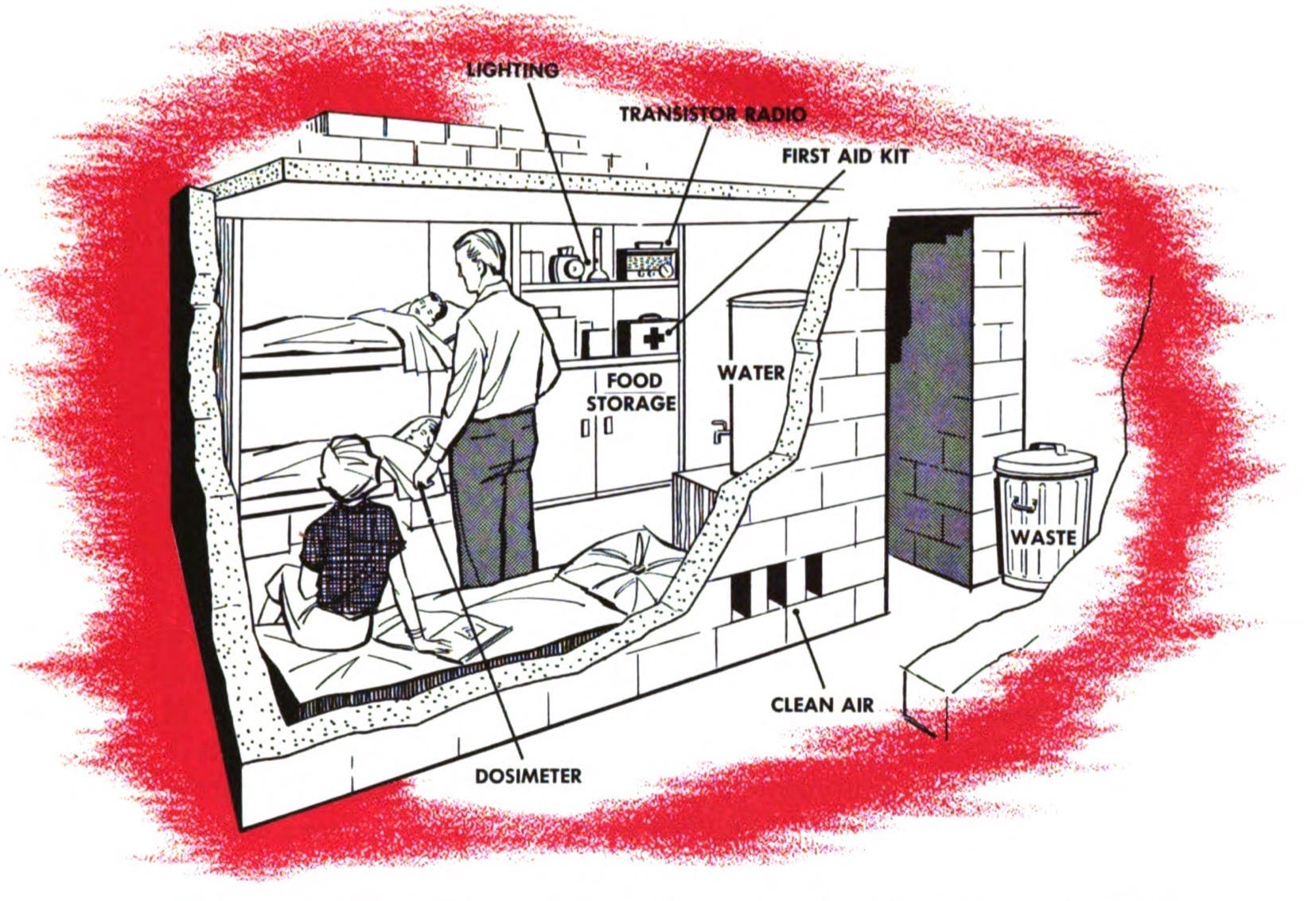
These shelters were imagined to be used for at most a couple of weeks. By that point, it was hoped that the worst of the external fallout would have decayed to relatively safe levels that would allow for evacuation. These were not meant for long-term habitation. Which is a good thing, because even these idealized images look claustrophobic. Two adults and two children in an area the size of a prison cell, with nothing to do but survive for one week, much less two, sounds like a form of torture.
Some months ago I wrote about Dean Ing’s Pulling Through (1983), which is quite a wonder of a Survivalist novel. As I discussed then, Ing put himself into a strange bind when writing it, in that he both wanted the main character to be a relatable everyman, demonstrating that anyone could survive nuclear war if they just prepared for it, but on the other hand, he also wanted him to be really cool and special, and so he gave him a flying car, a pet cheetah, and made it really, really clear that no, not everyone is going to be able to do all of this stuff, because surviving nuclear war is hard. Because if it was easy, it wouldn’t be much of a plot, would it?
I did (and still do) mock many of Ing’s choices (he makes having a flying car a major element of Harv’s survival! what is relatable about that!?), but I did appreciate aspects of his book. For example, I thought he did a good job of (accidentally) illustrating why literally nobody was ever going to make and use a Kearny Survival Meter correctly — they seem quite hard to build correctly and seem like they need constant maintenance and are difficult to read and those are not the properties you want to have in a DYI “save you in a nuclear war” radiation meter. I say this is “accidental” because it is clear (in no small part because he includes the plans to build them in an appendix to his novel) that Ing actually thinks that people could and should use these things, but he struggles to have his own plot-armored/flying car protagonists pull that off.
But to my real point here, I also appreciated that Ing made the time in the shelter seem, well, awful. It’s dirty. People are sick and even dying. There’s fallout creeping in from all over the place, because the ventilation is bad. They’re in the dark a bunch of the time. It just sounds hellish. And, importantly, it’s dirty. He’s in there with a family of four, a couple other folks who come by (one of whom is dying of radiation sickness), his criminal-turned-love interest, and live cheetah, and, yeah, that’s going to get pretty nasty pretty quickly. And, importantly, they have to go to the bathroom.
I don’t know (or care) if Ing’s detailed description of the quirks of cheetah defecation is accurate, but he gets human needs about right. People need to use the bathroom. It’s one of those things that most media we produce tactfully ignores, but if you’re serious about surviving in a fallout shelter, you’ve got to think about it. So… what’s the plan?
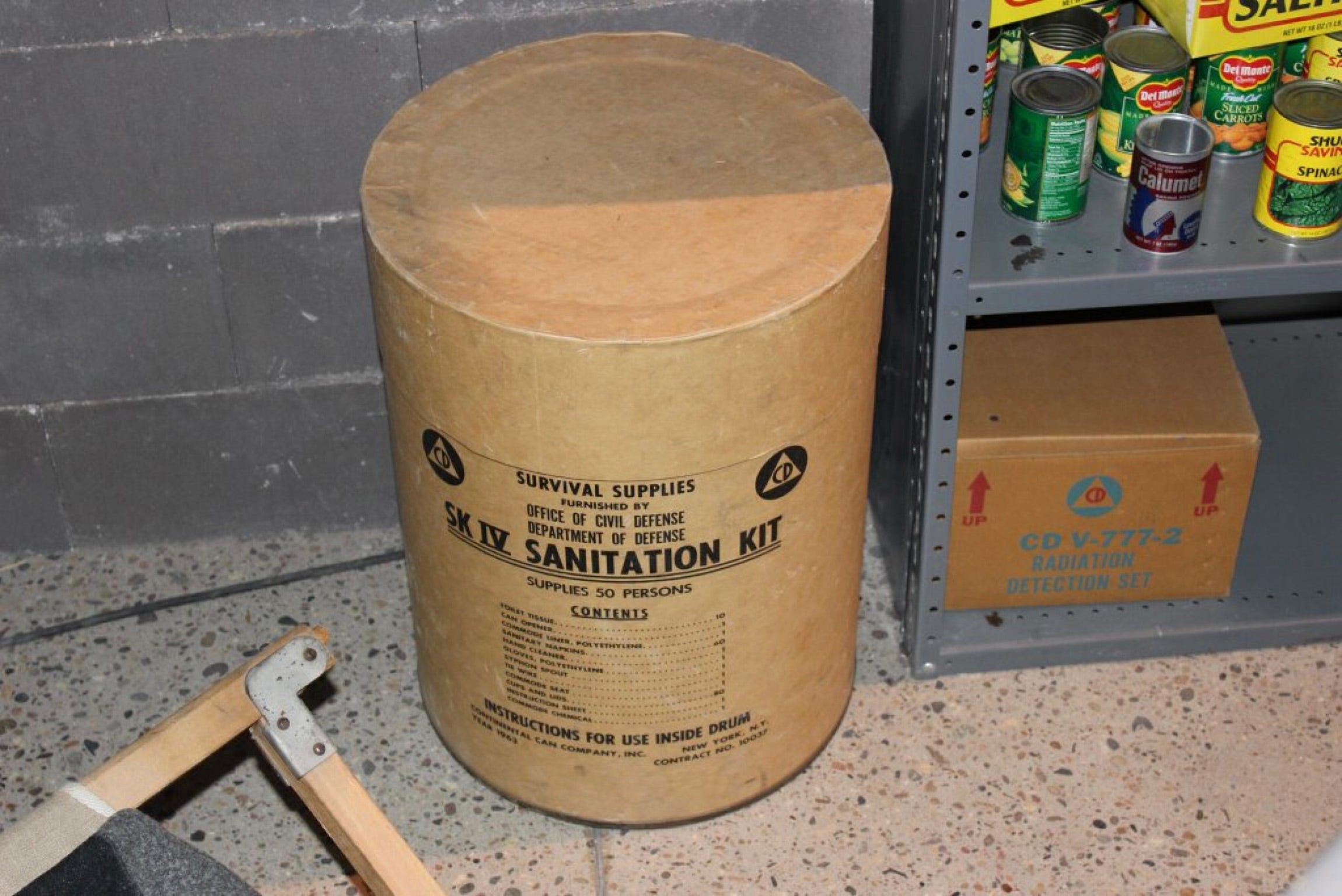
One plan would be to have a dedicated, government-issued “Sanitation Kit.” All the ones I have seen look like the one in the photograph above, which I snapped at the National Museum of Nuclear History in Albuquerque, New Mexico, in their exhibit on Civil Defense some years back. Some years before that, I was interviewed for a television special about fallout shelters, and as part of the segment they actually had bought one of these things and had me open it up with them. The contents were:
10 x toilet tissue (rolls)
1 x can opener
1 x commode liner, polyethylene
60 x sanitary napkins
1 x hand cleaner
1 x gloves, polyethylene
1 x syphon spout
1 x tie wire
1 x commode seat
80 x cups and lids
1 x instruction sheet
1 x commode chemical
You were supposed to take everything out of the barrel, and then put the plastic liner inside of it, and then the “commode seat” — a plastic toilet seat the same size as the barrel — and put it on top of the barrel. And that is your commode, your true “nuclear throne.” The “commode chemical” could be added to reduce the smell. When the bag is full and ready to be disposed of, you use the wire to tie it shut. Lovely.
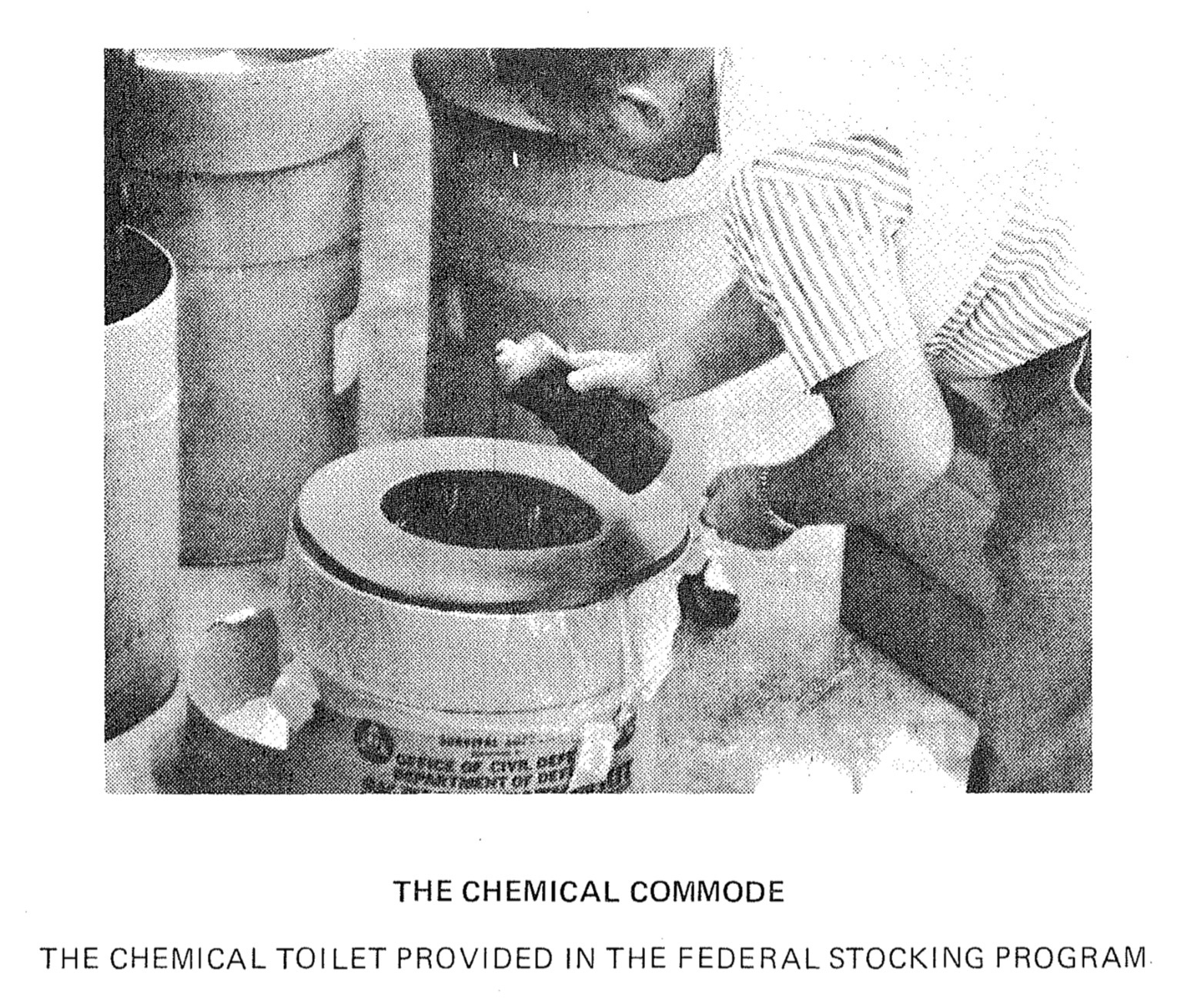
So that is a pretty grim thing to contemplate in and of itself, to imagine spending a week or two sitting on top of a squat cardboard “commode” that comes with one lousy liner. But look closer at the barrel in the photo, right about the “CONTENTS,” for the true horror to manifest: SUPPLIES 50 PERSONS. Perhaps the survivors will envy the dead.
The “Sanitation Kits” were mostly, I believe, aimed at large, group shelters in urban areas, the kinds you’d see those yellow-and-black “fallout shelter” signs for, not suburban, home shelters. (The different “models,” like the above SK IV, appear to refer to how many people each kit could supply. The SK III had the same contents, in slightly different numbers, and could supply 25 people, for example.)
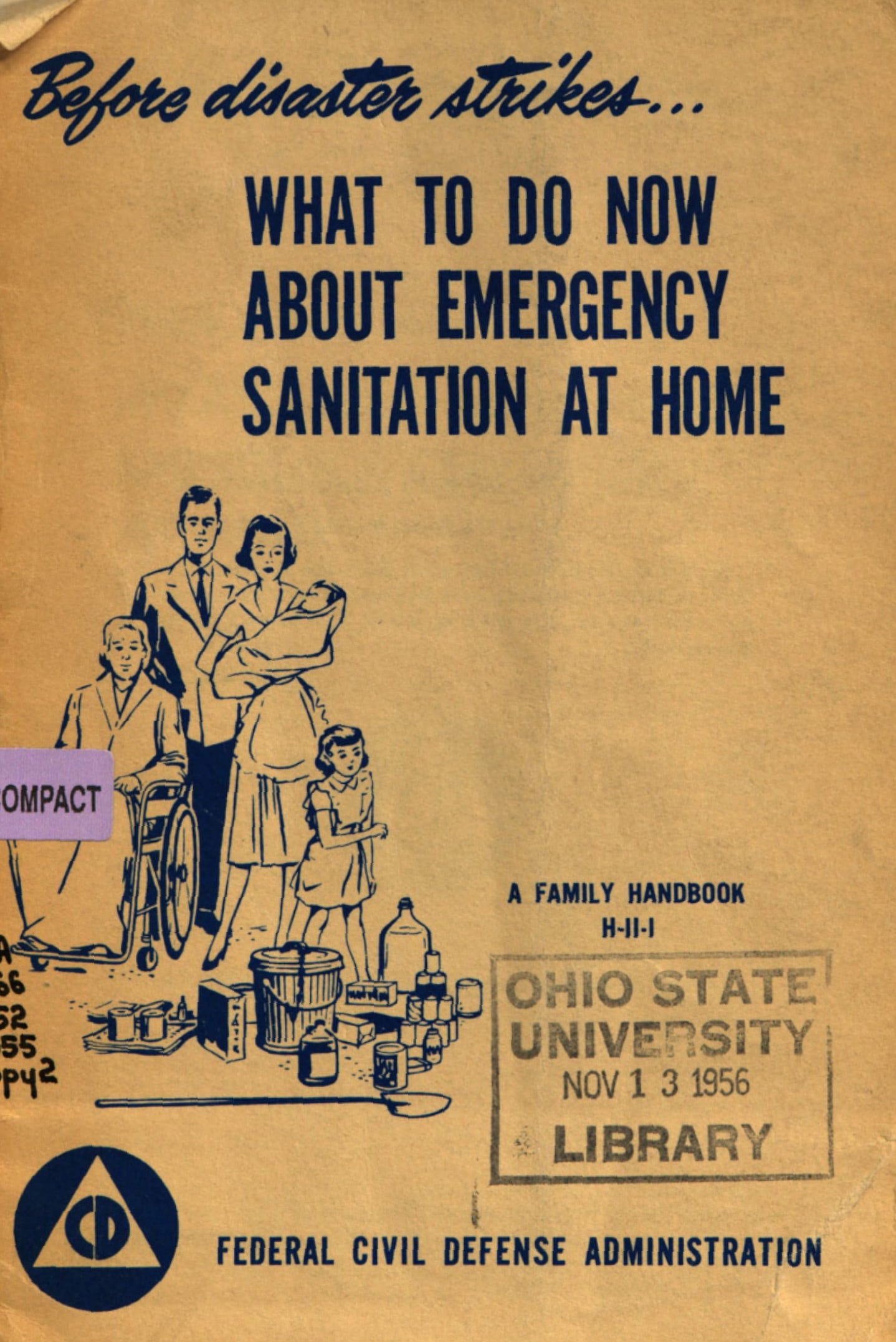
Those planning a home shelter were required to figure out their own preparation. As always, the US government provided pamphlets. Of these, Before Disaster Strikes… What to do About Emergency Sanitation in the Home (1955), from the Federal Civil Defense Administration, has the most amusing title. (“Before Disaster Strikes” is now going to be the phrase running in my head when I am off to the store to buy toilet paper.)
“Emergency sewage disposal” is only part of the overall “emergency sanitation” question (in case you were wondering why paper cups were included in the kit), but it’s a big part of it. The handbook explains that even if you did have access to regular flush toilets, it might be wise not to use or flush them, to conserve water, and the sewer system may not be working anyway. If the nuclear war continues for “some time,” or sewer systems are disabled for “several days,” then “you may find that disposal is a big problem,” the pamphlet informs us.1 Ultimately the pamphlet recommends you assemble basically in the emergency kits (including a bucket, and a trash can to empty it into), plus a shovel, to bury the waste, if need be.
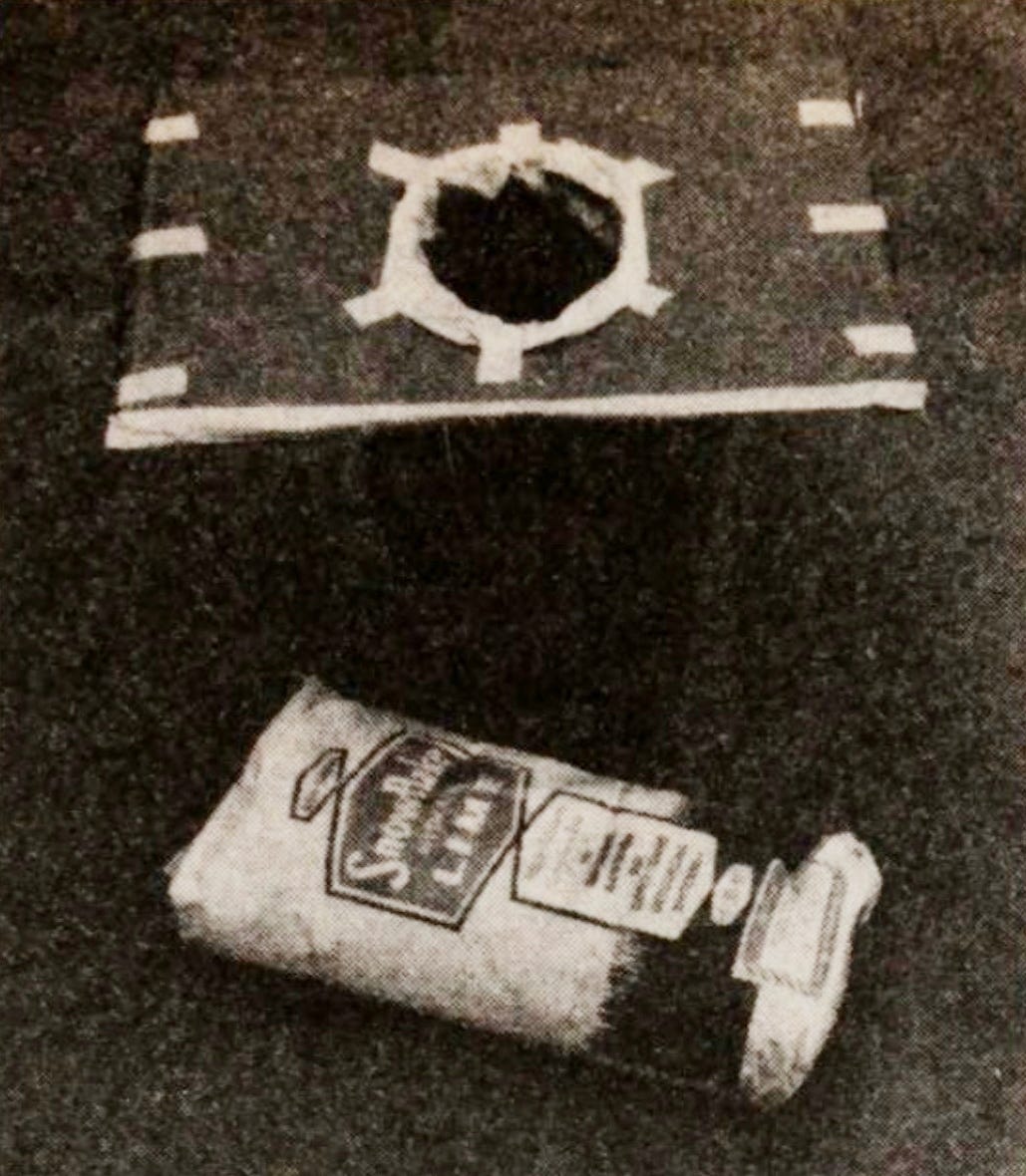
Dean Ing, for his part, includes a section on “potties for the people” as one of his appendices in Pulling Through, and while he tries to put a good face on it, it’s as abject as everything else discussed here. There’s no dressing up that having to use “an emergency john made from a wastepaper basket, several layers of cardboard taped together with a hole cut through them, and a plastic bag taped into the hole.”
Even Ing is aware of this on some level, as he feels compelled to add: “Okay, so it ain’t the Waldorf; it only took ten minutes to build and it’s fast, fast, fast relief.” Great.
Cresson Kearny, of the aforementioned Kearny fallout meter, features a photograph in his 1986 Nuclear War Survival Skills of an “expedient toilet” that was used by a Utah family for an experiment of sheltering for three days. The family, it appears, took the whole in thing a good spirit (as they were aware, presumably, that they would only be spending a few days in the shelter, and nuclear war had not occurred), and decorated their little fallout shelter bathroom whimsically with a (disconnected) telephone and a sign that reads “boutiful sanitation department” and “Hole Sweet Hole.”
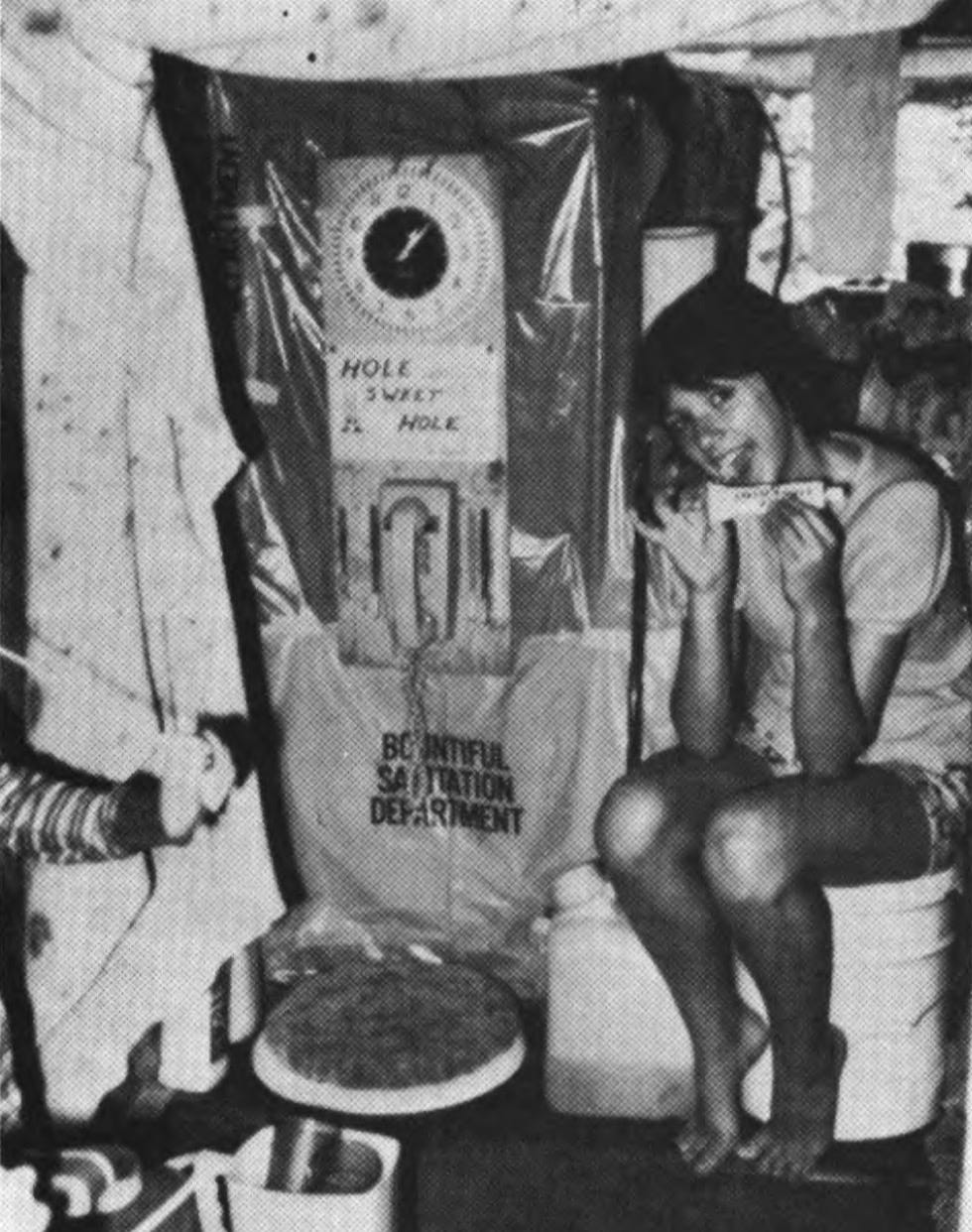
That’s at least better than Ing’s 10-minute toilet, I’ll say. Preparation matters after all, I suppose.
Why should we care about this? What I find fascinating and compelling about the problem of human waste during nuclear war is that it is so abject, so mundane, so easy to overlook, and yet the minute you start thinking about it, your nose rankles. It makes the reality of shelter survival much more tangible. And that’s assuming the best case scenario about what has happened in that nuclear war.
It’s such a minor thing, as opposed to hundreds of millions of dead corpses, but somehow it’s such a human thing, such an awful thing. I’m not saying it is an insurmountable thing. But the real value of this kind of Civil Defense, for me, is not so much fantasizing how one would feel superior “surviving” by pooping into a bucket for two weeks, but making us think really and truly seriously about what the lived experience of being even a very fortunate survivor in a nuclear war would be. And it’s pretty unpleasant.
I’m thoroughly on team “it’s probably better to survive than not,” but jeez, wouldn’t it be just infinitely better to just, you know, not get into this situation in the first place.
Both the 1955 and the 1957 (“revised”) versions of Before Disaster Strikes assume one will be sheltering for no more than 7 days. Which is, well, optimistic even for its time. The 1961 edition doesn’t change the human waste guidelines much that I can see, but it does increase the recommendations for sheltering time to two weeks.